RNSG 1115 Chapter 26 Vital Signs
 Call Kai
 Learn
Learn Practice Test
 Spaced Repetition
 Match
Match Flashcards
 Knowt Play
1/85

There's no tags or description
Looks like no tags are added yet.
Name | Mastery | Learn | Test | Matching | Spaced | Call with Kai | Chat |
|---|
No analytics yet
Send a link to your students to track their progress
86 Terms
Vital Signs
indicators of physiologic functioning and reflect the overall health status of the patient
Change in a patient’s vital signs=
change in patient’s overall health
Four vial signs:
temperature
pulse
respirations
blood pressure
Pain can be considered a patient’s 5th vital sign
Pulse oximetry is often used as well
When to Assess Vital Signs
on admission
based on facility or institutional policies/procedures
any time there’s a change in the patient’s condition
any time there’s a loss of consciousness
before and after activity that may increase risk, such as ambulation afrer surgery
before administering medications that affect cardiovascular and respiratory function
Frequency in which to obtain vital signs depends on many different factors:
patient’s medical diagnosis
co-morbidities
types of treatments received
patient’s level of acuity
Normal Vital Sign Ranges (Adults): Oral temperature
35.8–37.5°C (96.4 - 99.5°F)
Normal Vital Sign Ranges (Adults): Pulse rate
60-100 beats/min
Normal Vital Sign Ranges (Adults): Respirations
12-20 breaths/min
Normal Vital Sign Ranges (Adults): Blood pressure
<120/80
Heat Production:
primary source is metabolism
hormones, muscle movements, and exercise increase metabolism
epinephrine and norepinephrine are released when additional heat is required, and alter metabolism
thyroid hormone and shivering also increase heat production
energy production decreases and heat production increases
Heat Loss:
skin (primary source)
evaporation of sweat
warming and humidifying inspired air
eliminating urine and feces
Transfer of Heat
radiation
convection
evaporation
conduction
Factors Affecting Body Temperature
circadian rhythms
age and gender
physical activity
state of health
environmental temperature
Thermometer Types
oral
rectal
axillary
tympanic
forehead
Oral Thermometer Range
35.9 - 37.5°C; 96.6 - 99.5°F
Rectal Thermometer Range
36.3 - 38.1°C; 97.4 - 100.5°F
Axillary Thermometer Range
35.4 - 36.9°C; 95.6 - 98.5°F
Tympanic Thermometer Range
36.8 - 38.3º C; 98.2 - 100.9°F
Forehead (temporal artery) Thermometer Range
36.3 - 38.1°C; 98.7 - 100.5°F
Fever (Pyrexia):
an increase above normal body temperature
signals an increased immune function and inflammation and is a reliable indicator of health status
generally not normal unless very elevated (>104 F)
Types of Fever:
intermittent
remittent
sustained or continuous
relapsing or recurrent
Types of Fever: Intermittent
the body temperature returns to normal at least once every 24 hours
Types of Fever: Remittent
the body temperature does not return to normal and fluctuates a few degrees up or down
Types of Fever: Sustained or Continuous
the body temperature remains above normal with minimal variations
Types of Fever: Relapsing or Recurrent
the body temperature returns to normal for one or more days with one or more episodes of fever, each as long as several days
Effects of Fever:
decreased appetite
headache
hot/dry skin
muscle aches
fatigue
increased pulse rate
fluid and electrolyte imblances
Fever Treatment: Pharmacologic: antipyretic (fever reducing)
drug
aspirin (not given to pt’s <19)
ibuprofen
acetaminophen
Fever Treatment: Nonpharmacologic
hypothermia blankets
cool sponge baths
cool packs
oral hydration
Hypothermia:
body temperature below the lower limit of normal
Physical effects of hypothermia:
poor coordination
slurred speech
poor judgement
weak and irregular pulse
hypotension
stupor
Treatment of hypothermia:
rewarm the patient
additional blankets
heating blankets
radiant warmers
heating pads
warm fluids
increasing ambient temperature in the room
Physiology:
regulated by the automatic nervous system through sinoatrial (SA) node (the pacemaker) of the heart
Parasympathetic stimulation:
stimulated via the vagus nerve; decreases the heart rate
Sympathetic stimulation:
increases heart rate and force of contraction
Pulse rate:
number of contractions over a peripheral artery in 1 minute; usually corresponds to the same rate at which the heart is beating
Factors affecting the pulse:
age
gender
physical activity
fever
strees
medications
disease
Pulse Rates:
normal: 60-100 beats/min
tachycardia: 100-180 beats/min
bradycardia: below 60 beats/min
Pulse Amplitude:
grade 0: absent, unable to palpate
grade +1: diminished, weaker than expected
grade +2: brisk, expected (normal)
grade +3: bounding
Assessing the Peripheral Pulse
assessed by palpating peripheral arteries, by auscultating the aplical pulse with a stethoscope, or by ultrasound
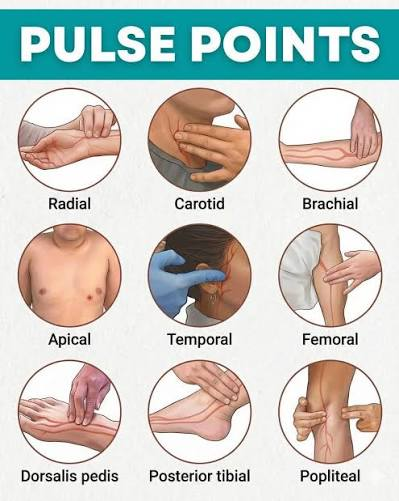
Palpation:
most common; use two fingers to palpate (feel) the artery
Ausculation:
the apical pulse is auscultated with a stethoscope
Doppler Ultrasound:
may be used to assess pulses that are difficult to palpate or ausculate, such as the pedal pulse
Respirations:
a component of vital signs that is the measurement of ventilation; allows for a baseline assessment of respiratory function
involves ventilation, diffusion, and perfusion
Ventilation (breathing):
movement of gases in and out of the lungs
Inspiration (inhalation):
the act of breathing in
Expiration (exhalation):
the act of breathing out
Diffusion:
the exchange of oxygen and carbon dioxide between the alveoli of the lungs and circulating blood
Perfusion:
the exchange of oxygen and carbon dioxide between the circulating blood and tissue
Factors affecting respiration:
age
exercise
acid-base balance
brain lesions
increase in altitude
respiratory disease
anemia
anxiety
medications
pain
Assessing Respiratory Rate:
respiratory rate: breaths/min
Assessing Respiratory Rate Eupnea:
normal, unlabored respiration; one breath to 4 heartbeats
Assessing Respiratory Rate Tachypnea:
an increased respiratory rate
Assessing Respiratory Rate Bradypnea:
decreased respiratory rate
Assessing Respiratory Rate Hyperventilation:
any condition that causes an increase in carbon dioxide and a decrease in oxygen in the blood; results in increasing the rate and depth of respirations
Assessing Respiratory Rate Apnea:
periods where there is no breathing
Assessing Respiratory Rate Dyspnea:
difficult or labored breathing
Assessing Respiratory Rate Orthopnea:
changes in breathing when sitting or standing
Assessing Respiratory Rate Depth:
deep
shallow
Assessing Respiratory Rate Rhythm:
regular
irregular
Assessing Respiratory Rate Assessment
visual inspection
auscultation
Blood pressure:
the force of moving force against arterial walls
measured in millimeters of mercury (mmHg) and recorded as a fraction
Blood pressure fraction:
systolic pressure/diastolic pressure (ex: 120/80 mmHg)
Systolic pressure:
the highest pressure; created during ventricular contraction
Diastolic pressure:
the lowest pressure; present on arterial walls when the heart rests between beats
Pulse pressure:
the difference between systolic and diastolic pressures
How is blood pressure regulated short-term?
either neural (nerve) or humoral (pertaining to body fluids)
______ will affect blood pressure
cardiac output (strength of heart contractions)
What slows the heart rate?
stimulation of the vagus nerve (parasympathetic impulses)
What increase the heart rate?
Sympathetic stimulation
What are baroreceptors and what do they do?
they’re pressure sensors in the heart and arterial walls that detect blood pressure changes and signal the cardiovascular center of the brain
_______ raises pressure
renin-angiotensin-aldosterone
Factors affecting blood pressure:
age; race
circadian rhythm
biologic sex
food intake
exercise
weight
emotional state
body position
drugs/ medications
Assessing blood pressure:
B/P reading can be measured on two or more occasions before determining if the B/P is outside acceptable parameters
measurements should be taken after the patient is at rest for at least 5 minutes and hasn’t consumed coffee or smoked for 30 minutes before the assessment
a rise of fall of 20-30 mmHg is significant, even if it’s within the accepted normal range
Assessing blood pressure equipment needed
stethoscope and sphygmomanometer
doppler ultrasound
electronic or automated devices
Korotkoff sounds:
series of sounds to listen for when assessing the BP with a stethoscope
sounds are only heard when using a stethoscope to assess BP
First sound heard through the stethoscope represent the _______
systolic pressure
The level at which the sound disappear completely represents the ______
diastolic pressure
Blood pressure shouldn’t be assessed in an arm that has an:
IV
PICC line
AV fistula
on side where a patient had a mastectomy