ProteinMPNN Flashcards (IPD reading)
 Call Kai
 Learn
Learn Practice Test
 Spaced Repetition
 Match
Match Flashcards
 Knowt Play
1/28

Earn XP
Description and Tags
Dauparas et al. Science 2022, inverse folding. fact checked against the PMC manuscript. TRAP cards = where the obvious summary is wrong. last 4 cards are figures to explain.
Name | Mastery | Learn | Test | Matching | Spaced | Call with Kai | Chat |
|---|
No analytics yet
Send a link to your students to track their progress
29 Terms
what problem does ProteinMPNN solve?
fixed backbone sequence design, aka inverse folding: you are handed the 3D path the chain should trace and must pick the amino acid at each position so it actually folds that way. before this it was Rosetta, a physics energy function, slow and hand tuned
who wrote ProteinMPNN and where was it published?
Dauparas et al., Baker lab / IPD at UW, Science 378:49-56, September 2022. Neil King is a listed co-author, so Sebastian sent a paper his own PI is on
what kind of model is ProteinMPNN architecturally?
a message passing graph neural network, encoder-decoder, 3 layers each, 128 hidden dims, ~1.68M parameters. residues are nodes, nearest neighbors by C-alpha distance are edges (48 neighbors in the released model)
what does ProteinMPNN actually see as input?
backbone only: distances between N, C-alpha, C, O and a virtual C-beta, plus backbone dihedrals and relative frame orientations. no side chains at all
the two headline ProteinMPNN numbers
52.4% native sequence recovery vs 32.9% for Rosetta, and 1.2 seconds vs 4.3 minutes per 100 residues. the ~200x framing is your own arithmetic, the paper never states a fold change
what is native sequence recovery and why is it only a proxy?
throw away a real protein's sequence, keep the backbone, redesign, count how often you get nature's residue back. recovering the native residue is not the same as designing a functional protein, and a different sequence may fold better. that is why the paper leans on experiments
how does ProteinMPNN sequence recovery change with burial?
90-95% in the deep core, about 35% on the surface. the core is nearly determined by the backbone, the surface is genuinely degenerate. for a nanoparticle immunogen the surface is where solubility and aggregation live
does ProteinMPNN handle multi chain problems worse than single chains?
no, about the same: roughly 52% median recovery on monomers (690 test), 55% on homomers (732), 51% on heteromers (98)
what is order agnostic decoding and why does it matter?
the decoder generates residues one at a time, but training randomizes the decoding order over all permutations. so at inference you can freeze any subset (an epitope, a binding motif) and have the model fill in the rest. this is the mechanism behind partial redesign and interface only design
what are tied positions in ProteinMPNN?
forcing symmetry equivalent positions to output the same residue. for the tetrahedral cages they tied identities across the 12 copies of each subunit. this is what symmetric nanoparticle design requires
what is the training noise trick in ProteinMPNN?
gaussian noise added to backbone coordinates during training so the model does not over trust exact geometry. noise levels used are 0.00, 0.02 and 0.3 A
what does backbone noise cost and buy?
costs recovery on pristine crystal structures (50.5% without noise to 47.3% at 0.02 A) and buys robustness on computer generated backbones (47.9% on AlphaFold models). at 0.3 A noise the model produced 2-3x more sequences whose AlphaFold predictions hit lDDT-Ca 90 or 95
what was ProteinMPNN trained on?
PDB as of Aug 2 2021, X-ray or cryo-EM, better than 3.5 A, under 10,000 residues, clustered at 30% sequence identity with mmseqs2 into 25,361 clusters, split by cluster so similar proteins do not straddle train and test
the monomer rescue result
starting from ~150 AlphaFold hallucinated designs that expressed terribly (median ~9 mg/L), 96 ProteinMPNN redesigns were expressed in E. coli: 73 soluble with median yield 247 mg/L, 50 with the target oligomeric state by SEC, and one crystal structure matching the design at 2.35 A RMSD over 130 residues
the cyclic homo-oligomer result (the cleanest comparison in the paper)
same backbones, both methods. rosetta: 40% soluble, 0% correct oligomeric state by SEC-MALS. ProteinMPNN: 88% soluble, 27.7% correct. denominators are not given in the text
the tetrahedral nanoparticle result, stated correctly
76 sequences across 27 two component backbones, tied across 12 subunit copies, ordered with no further intervention. 13 formed ~1 MDa assemblies, one crystal structure at 1.2 A C-alpha RMSD over two subunits
TRAP: did ProteinMPNN beat Rosetta on the nanoparticles?
no. verbatim: "a similar overall success rate was obtained using Rosetta in the original study." the win is automation, ~1 second per backbone versus more than a week of manual intervention, plus several new assemblies rosetta had failed on
the binder result
helical bundle scaffolds presenting a proline rich peptide to the Grb2 SH3 domain. rosetta sequences for those backbones did not fold to binding structures in E. coli, ProteinMPNN sequences gave strong binding by BLI
TRAP: the NTF2 result
in silico only. redesigning 3,000 rosetta designed NTF2 backbones gave considerably better AlphaFold single sequence prediction accuracy. that is a prediction metric, not a wet lab rescue
what does ProteinMPNN NOT do?
it does not generate or refine backbones (that is hallucination / RFdiffusion), it has no side chains, ligands, metals or nucleic acids in its inputs, and it does not model function. functional constraints have to be imposed by fixing residues
the authors' own caveat
"in most protein design applications it is desirable to test multiple designed sequences experimentally." it raises your hit rate, it does not hand you one guaranteed sequence. 13 of 76 cages assembled, 27.7% of cyclic oligomers were correct
why would a King lab person assign ProteinMPNN?
it is the sequence design step of the whole nanoparticle pipeline: generate or scaffold a backbone, ProteinMPNN writes the sequence, AlphaFold filters, order genes. tied positions and fixed positions are exactly what symmetric cages and epitope preserving immunogens need
what is SEC-MALS and why does it appear in this paper?
size exclusion chromatography separates by size, multi angle light scattering gives the actual mass of what elutes, so you learn whether you got the intended oligomer or a soup. it is the reality check most designs fail, and it is how the 0% vs 27.7% number was measured
what is hallucination in protein design?
running a structure prediction network backwards, optimizing a sequence until the network confidently predicts a well formed structure, to invent new backbones. these slightly imperfect backbones are exactly what noise trained ProteinMPNN is for
what is pLDDT used for here?
AlphaFold's per residue confidence, 0-100. used as a cheap in silico filter: design a sequence, predict its structure, check the prediction is confident (>80) and matches the target

explain this figure: ProteinMPNN fig 1 (architecture)
a shows the whole model: backbone coordinates become N, C-alpha, C, O, C-beta distances, a 3x backbone encoder builds node and edge features, then a sequence decoder generates residues in random order and samples from the output probabilities. b contrasts fixed left to right decoding (yellow, sequence context unusable for preceding positions) with random order decoding (blue, context usable), which is why you can decode fixed residues first. c shows tying across chains: the same position in chains A, B and C shares one predicted logit, giving symmetric design
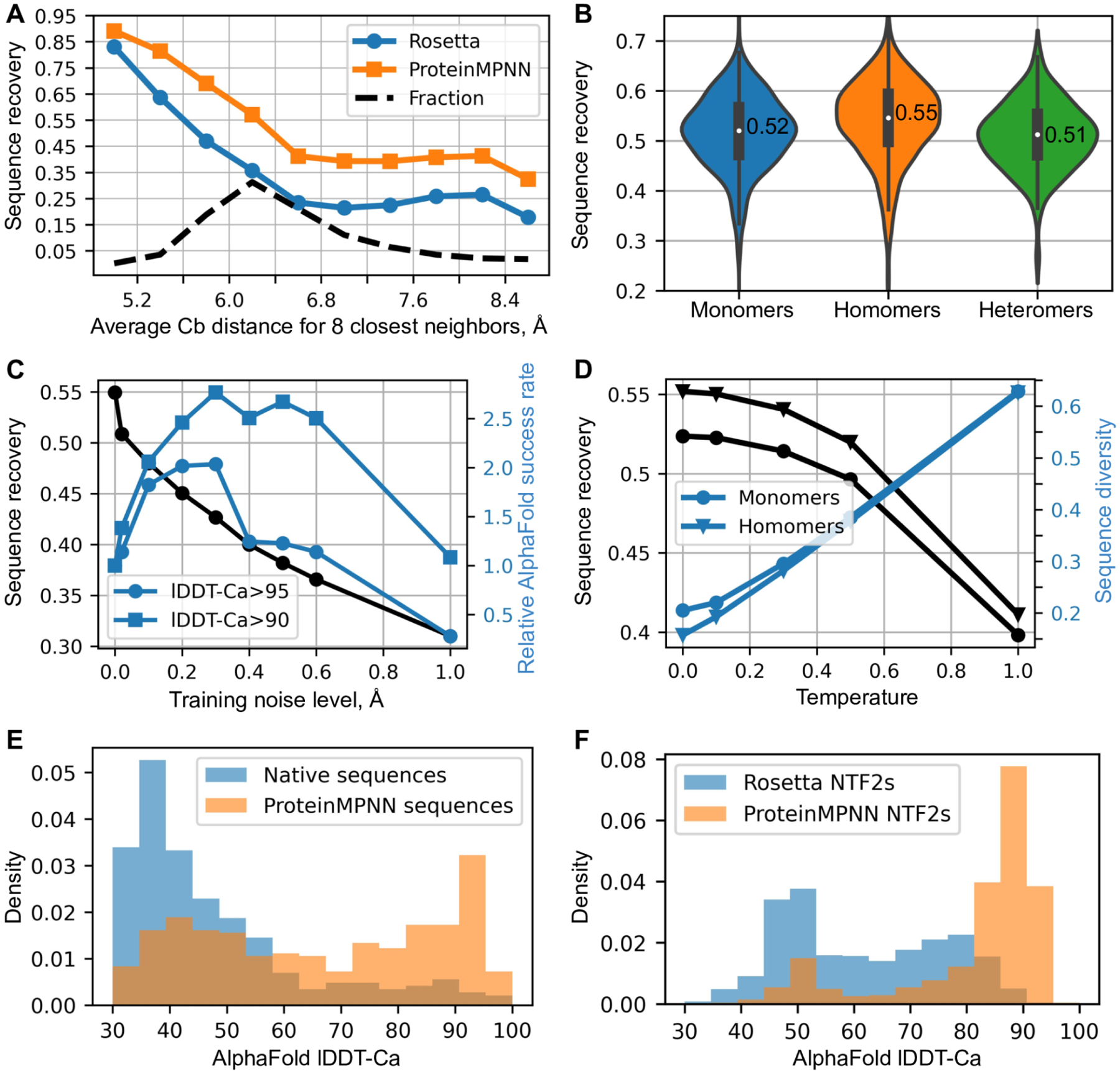
explain this figure: ProteinMPNN fig 2 (in silico evaluation)
a plots sequence recovery against burial (average C-beta distance to the 8 closest neighbors), ProteinMPNN above Rosetta at every level, from ~0.85 buried down to ~0.35 exposed. b is violin plots showing 0.52 monomers, 0.55 homomers, 0.51 heteromers. c is the noise tradeoff: recovery falls with training noise (black) while AlphaFold success rate peaks around 0.2-0.3 A. d shows sampling temperature trading recovery for diversity. e and f show AlphaFold lDDT distributions shifting right for ProteinMPNN sequences vs native and vs rosetta NTF2s

explain this figure: ProteinMPNN fig 3 (structural characterization)
a is the rescue histogram: soluble yield for 129 AlphaFold hallucinated designs (blue, median 9 mg/L) versus the same backbones redesigned by ProteinMPNN (orange, median 247 mg/L). the rest is deep characterization of one monomer rescue, including a crystal structure matching the design model
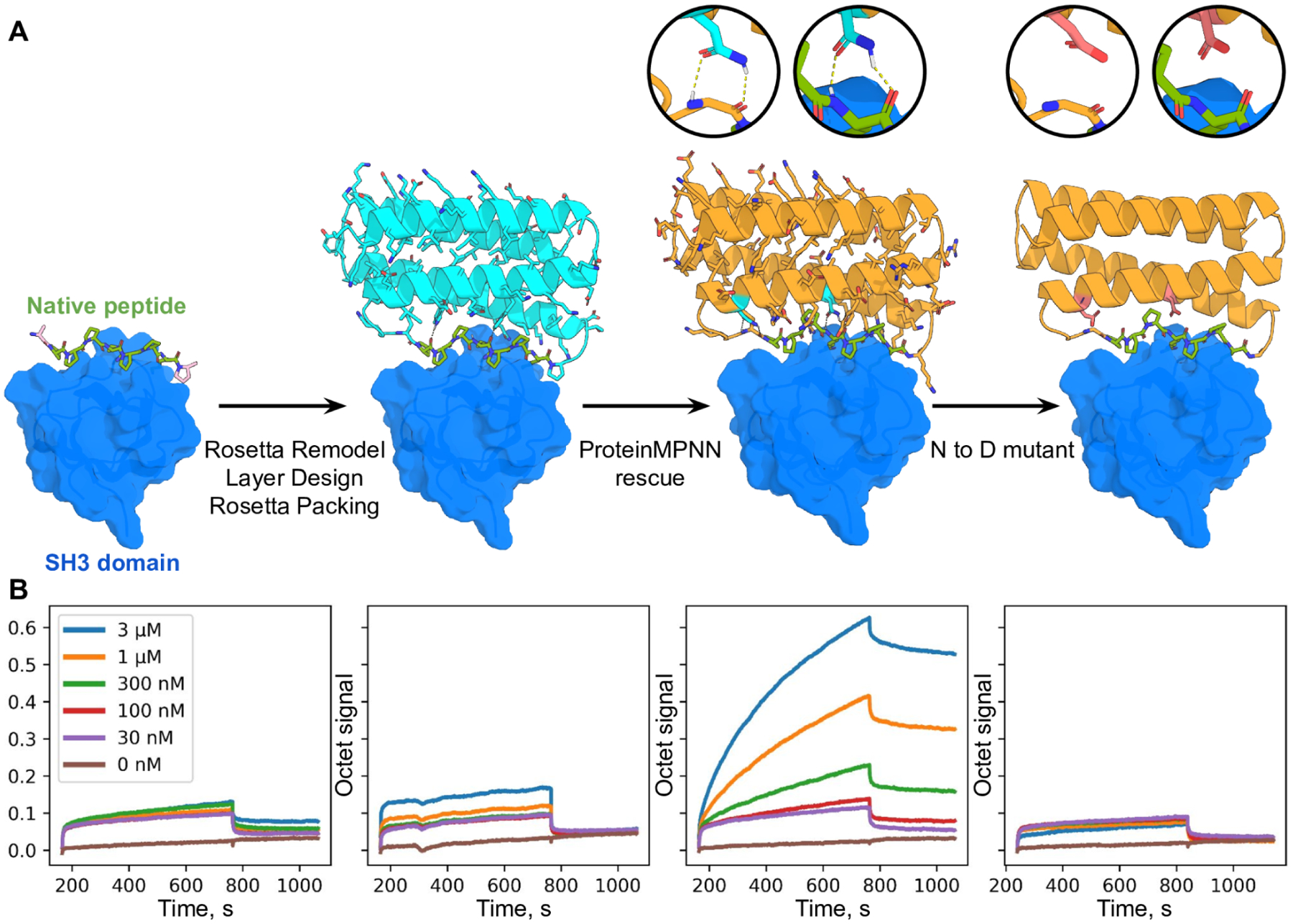
explain this figure: ProteinMPNN fig 4 (design of function)
the binder pipeline: the Grb2 SH3 domain bound to a proline rich peptide, helical bundles docked onto the exposed peptide face with RIFDOCK, loops built with Rosetta remodel, then ProteinMPNN redesign of the fusion sequence, with hydrogen bonds from asparagines shown. the point is that function came from fixing the motif and redesigning everything else