EngMaths 245 - Week 1 to Week 2 - 11.1 to 11.2
 Call Kai
 Learn
Learn Practice Test
 Spaced Repetition
 Match
Match Flashcards
 Knowt Play
1/21

There's no tags or description
Looks like no tags are added yet.
Name | Mastery | Learn | Test | Matching | Spaced | Call with Kai | Chat |
|---|
No analytics yet
Send a link to your students to track their progress
22 Terms
Define a sequence and give an example
A sequence is a list of numbers
e.g a1,a2,a3,…,an,…
Describe the two ways you can denote a sequence
(an),(an)n=1∞
e.g (n+3)n=1∞ would give:
1, 4, 7, 10, ….
superscript is the final n
subscript is the initial n
e.g an=an−1+an−2
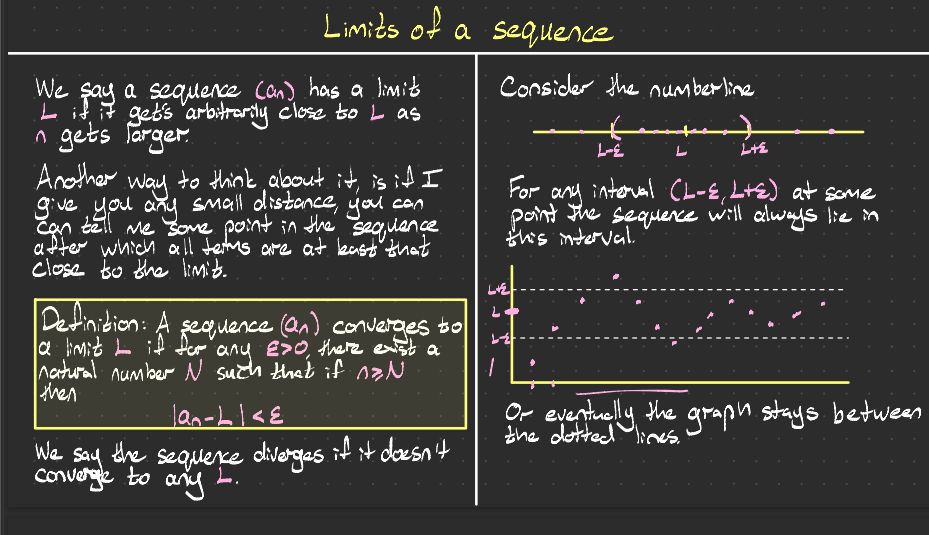
Describe what is meant by the limit of a sequence
A sequence with a limit L will get arbitrarily closer to that limit as n increases
Describe the condition for the convergence of a sequence
A sequence (an)
For any ϵ > 0:
if a natural number N exists with the following property:
n ≥ N
then | an - L | < ϵ
otherwise it diverges
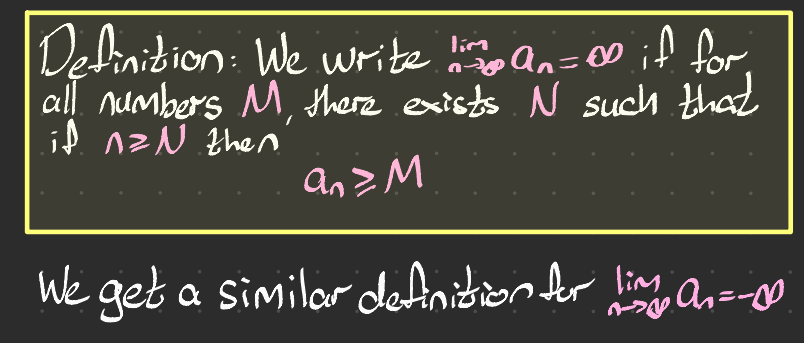
Describe the condition for the divergence of a sequence of a sequence
A sequence (an)
For all numbers M:
if a natural number N exists with the following property:
n ≥ N
then an ≥ M
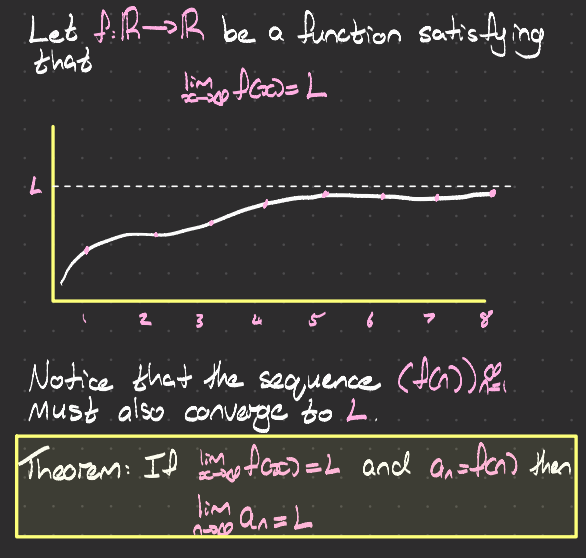
Derive the proof relating the limit of a function to the limit of a sequence
if limx→∞f(x)=L and
an=f(n) then
n→∞liman=L
State the limit laws referring to the limit of two sequences that have the following operations applied to each other:
summed
subtracted
divided
multiplied
% 1) Sum Law
lim(an+bn)=lim(an)+lim(bn)
% 2) Difference Law
lim(an−bn)=lim(an)−lim(bn)
% 4) Product Law
lim(anbn)=lim(an)lim(bn)
% 5) Division (Quotient) Law
lim(an/bn)=lim(bn)lim(an),lim(bn)=0
State the limit law regarding the limit of the product of a sequence and a constant
lim(c⋅an)=c⋅lim(an)
State the limit law regarding the limit of the power of a sequence and a variable p > 0, a_n > 0
lim(anp)=(lim(an))p
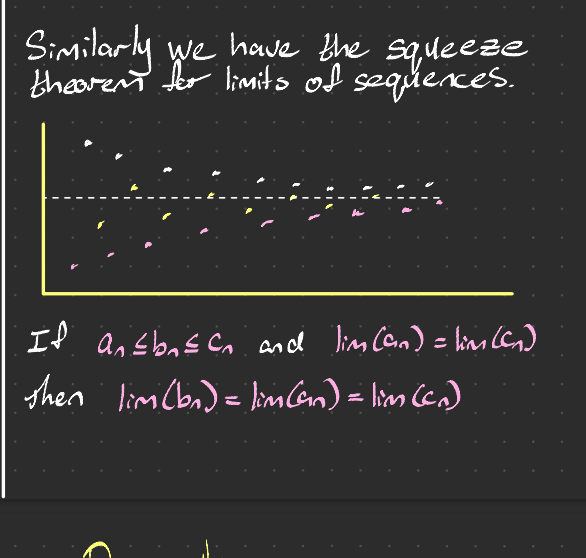
Describe the squeeze theorem regarding sequences
if an≤bn≤cn and lim(an)=lim(cn)</p><ul><li><p>lim(b_n) = lim(a_n) = lim(c_n)$$
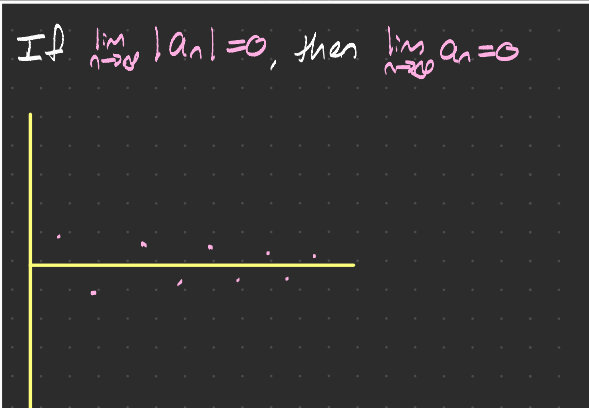
State the limit law regarding limn→∞∣an∣=0
if limn→∞∣an∣=0 then limn→∞an=0
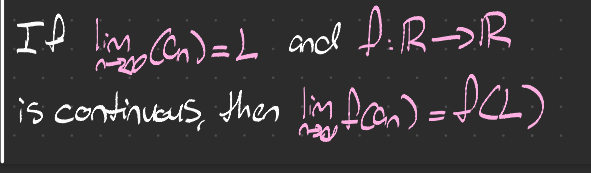
State the limit law of sequences relating the limit of a sequence and a function of that sequence as an input
Define a monotone sequence

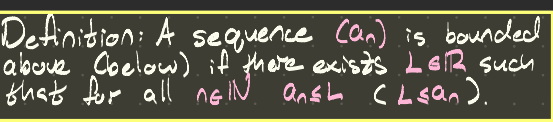
Define a bounded sequence
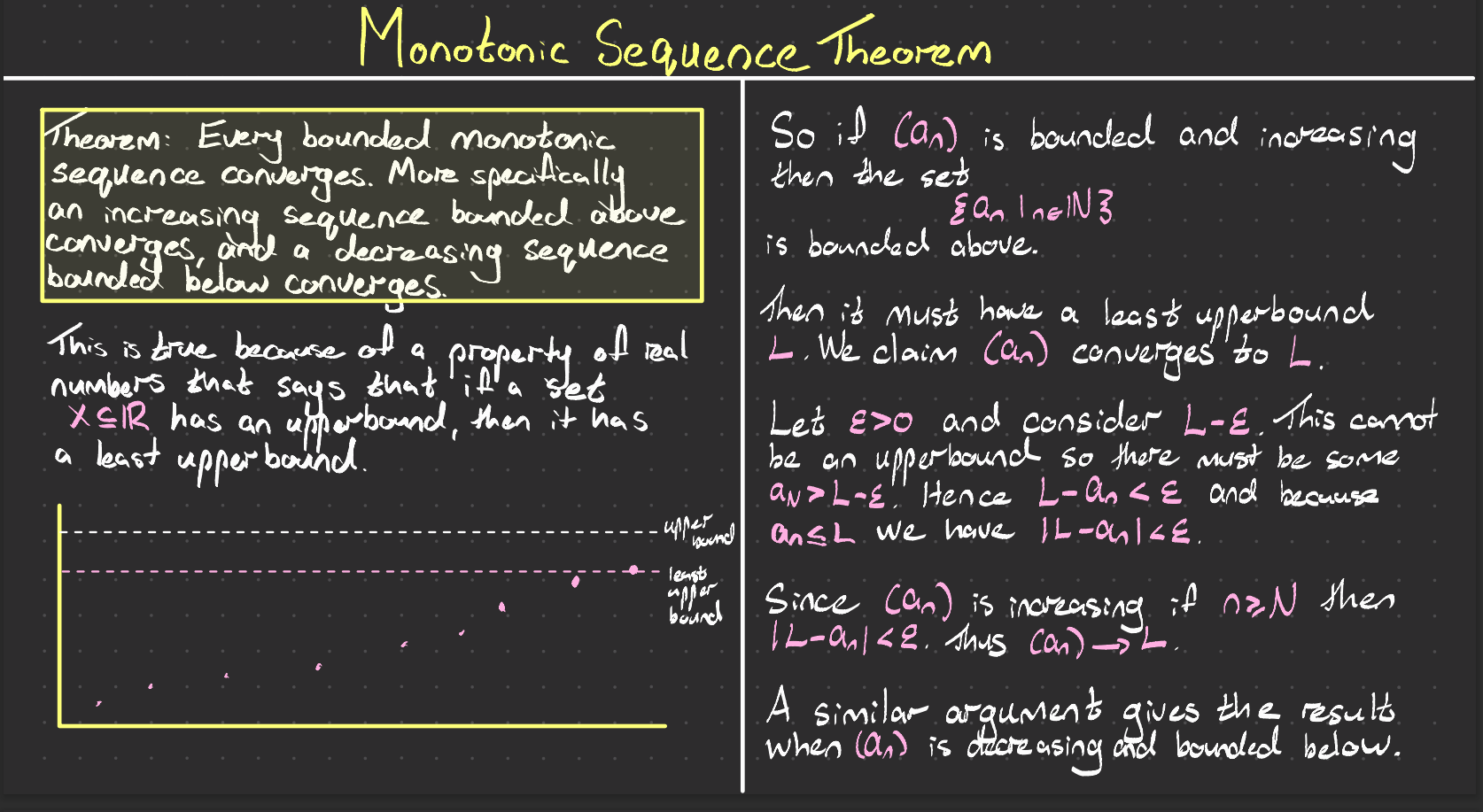
Relate the monotone and bounded properties of a sequence to it convergence
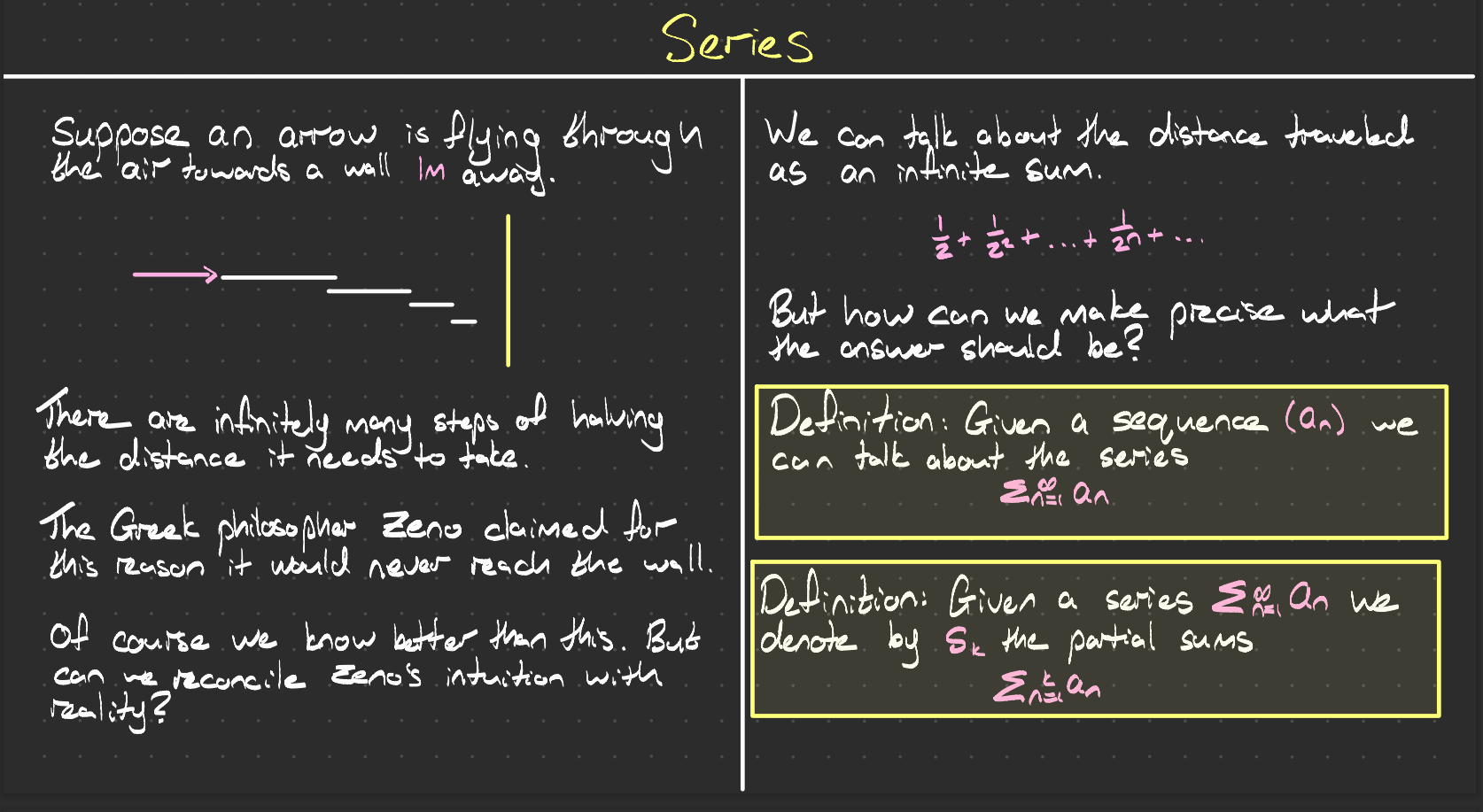
Describe and define what is meant by the series and partial sums of a sequence
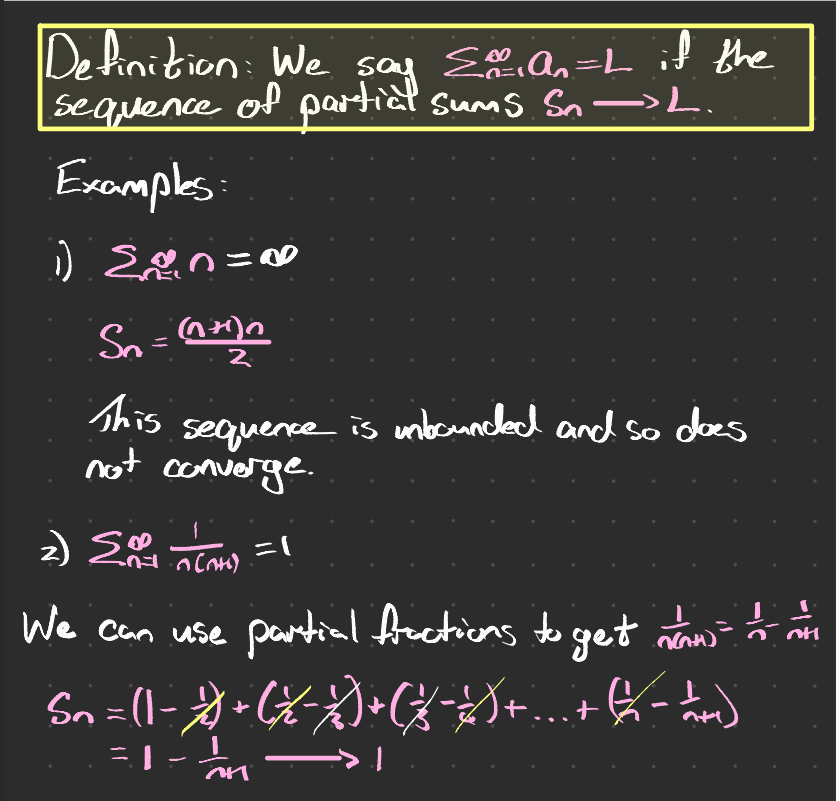
Relate the convergence of a series to its partial series
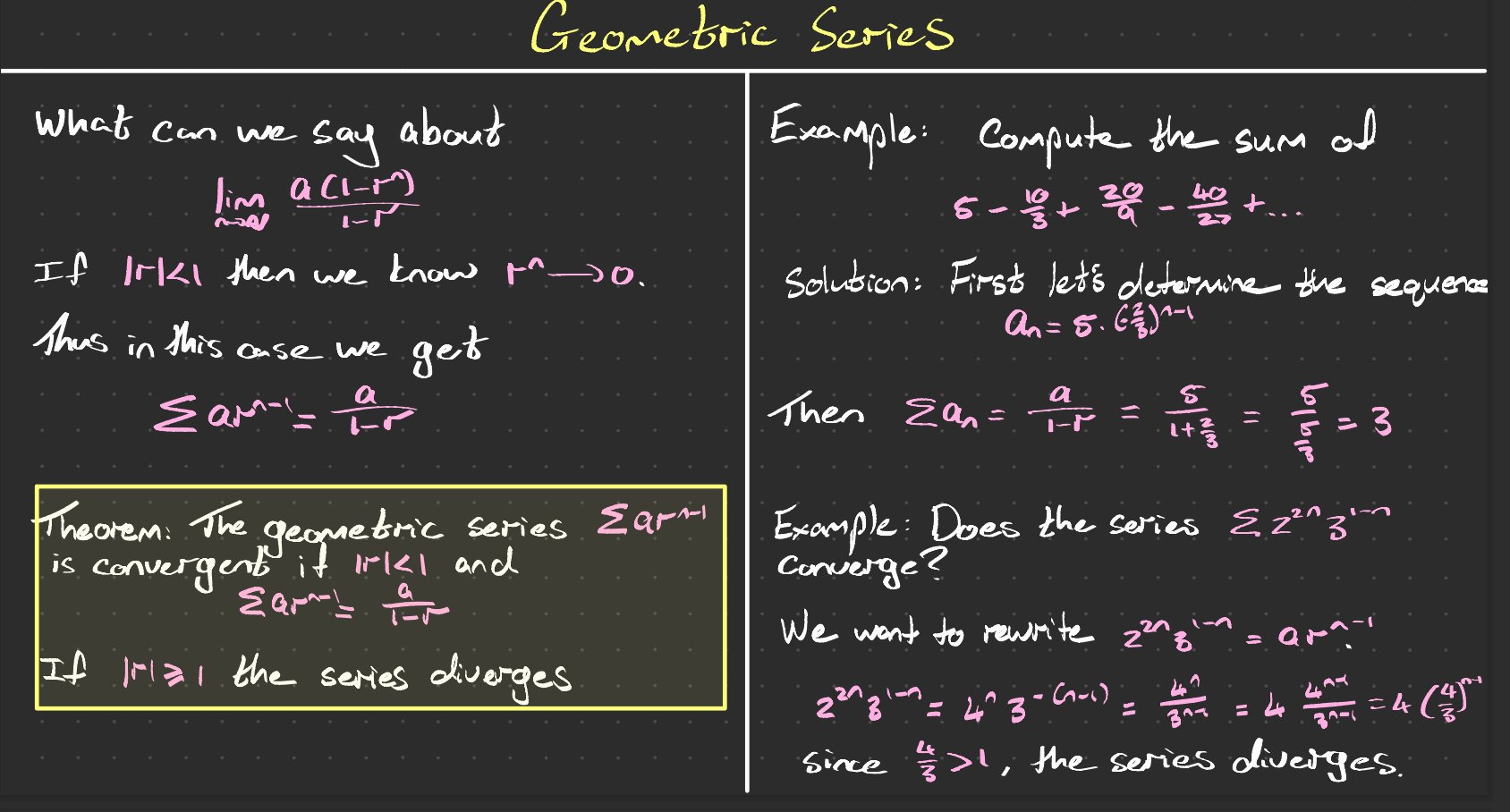
Define what is meant by a geometric series
sum of numbers in a sequence where
each term is found by multiplying the previous term by a fixed, non-zero number
that number is called the common ratio r
State the formula for the series of a geometric sequence
Σn=1∞a⋅rn−1
a = first term
r = common ratio
Derive the equation for the sequence of partial sums of a geometric series
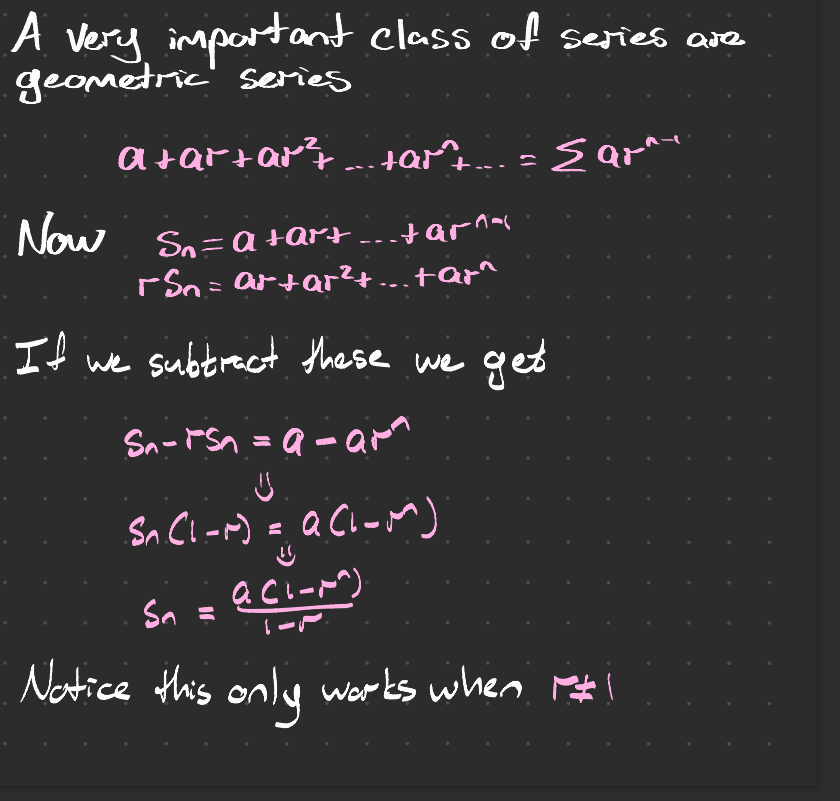
Derive the condition for the convergence of a geometric series
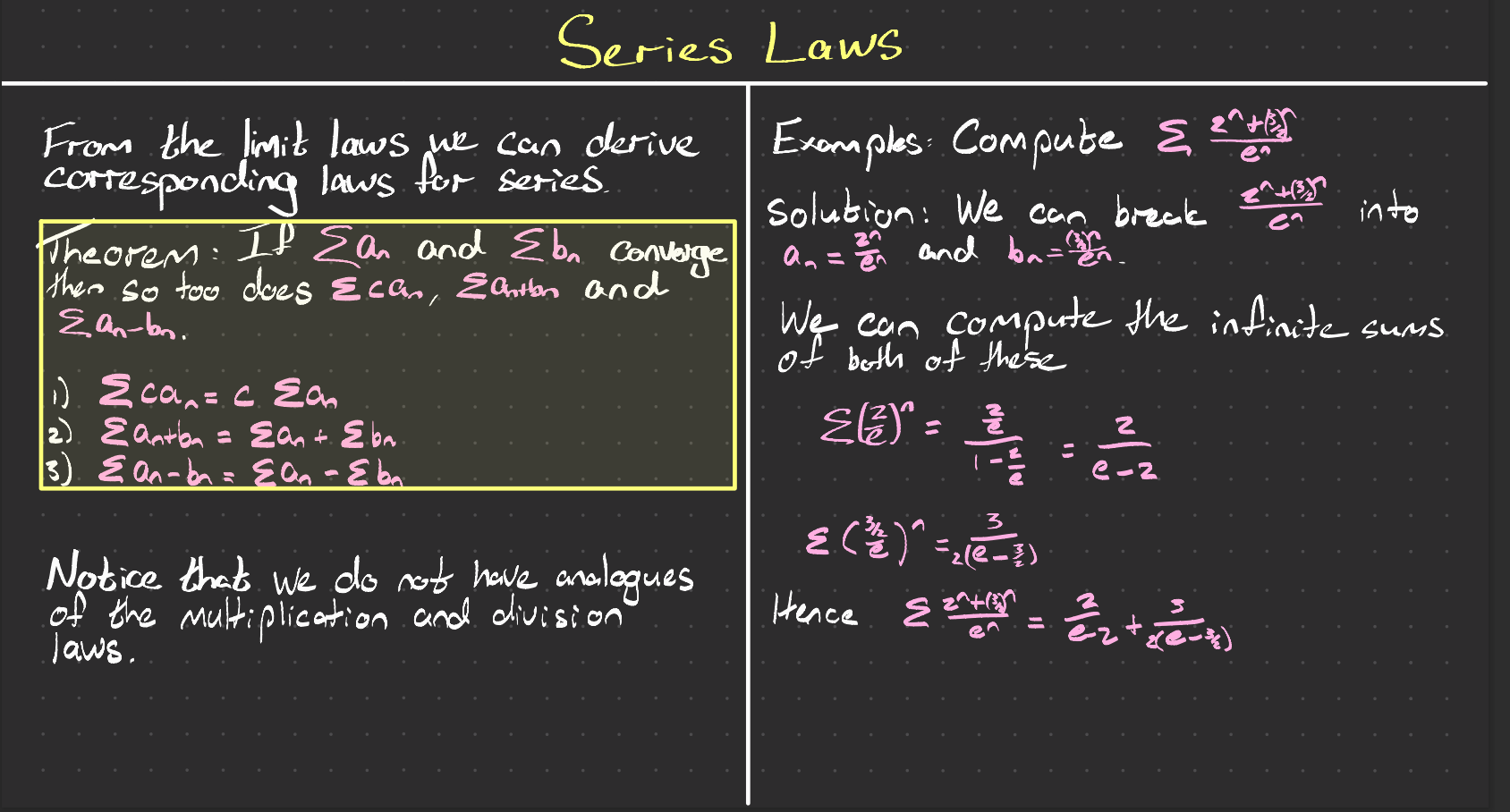
Derive and state the series laws related to different series:
addition
subtraction
constant