Summer Geometry 2026
 Call Kai
 Learn
Learn Practice Test
 Spaced Repetition
 Match
Match Flashcards
 Knowt Play
1/160

There's no tags or description
Looks like no tags are added yet.
Name | Mastery | Learn | Test | Matching | Spaced | Call with Kai | Chat |
|---|
No analytics yet
Send a link to your students to track their progress
161 Terms
Point
0 dimensions
Represented by a dot
Line
1 dimension
Represented by ↔
Extends infinitely
Plane
2 dimensions
Represented by 3 points on it
Extends infinitely
Segment
2 endpoints
Ray
1 endpoint
Collinear Points
Lie on the same line
Coplanar Points
Lie on the same plane
Postulate or Axiom
A rule that is accepted without proof
Coordinate of a Point
Real number that corresponds to a point
Example: (5, 3)
Segment Addition Postulate
If B is between A and C, AB + BC = AC
Congruent Segments
Same length
Midpoint
Point that divides a segment into two congruent segments
Segment Bisector
A point, ray, line, line segment, or plane that intersects a segment at its midpoint
Midpoint Formula
Distance Formula
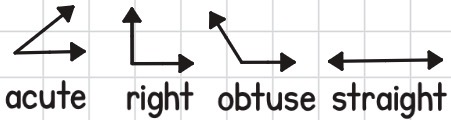
Angles
Consist of two different rays with the same endpoint that are the sides of the angle
Angle Addition Postulate
If P is the interior of angle RST, then mRST = mRSP + mPST
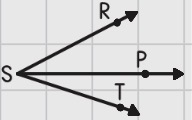
Angle Bisector
A ray that divides an angle into 2 congruent angles
Complementary Angles
2 angles whose measures sum to 90 degrees
Supplementary Angles
2 angles whose measures sum to 180 degrees
Adjacent Angles
2 angles that share a common vertex and side but no common interior points
IMPORTANT: vertical angles CANNOT be adjacent angles
Linear Pair
2 angles’ uncommon sides are opposite rays and they are supplementary
Vertical Angles
Angles whose sides are opposite rays and they are congruent
Polygon
Closed plane figure formed by 3+ line segments and each side intersects exactly 2 sides
Vertex of a Polygon
Endpoint of a side
Convex Polygon
No line that contains the sides of a polygon contains a point inside the polygon
Concave Polygon
A line that contains the sides of a polygon also contains a point inside
Equilateral Polygon
All congruent sides
Equiangular Polygon
All congruent angles
Regular Polygon
Convex, equilateral, and equiangular
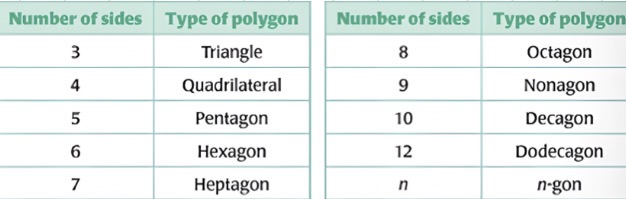
Polygon Number of Sides Names Chart
Conjecture
Unproven statement based on observations
Inductive Reasoning
Find a pattern in specific cases then use a conjecture to apply for the general case
Prove a Conjecture True
Prove for every single case
Disprove a Conjecture
Find 1 counterexample
Counterexample
Used to disprove a conjecture
A special case where the conjecture is false
Conditional Statement
A logical statement with 2 parts (eg. If the weather is nice, then I will play outside)
Hypothesis (eg. If the weather is nice)
Conclusion (eg. then I will play outside)
If p, then q.
Converse
Switch the hypothesis and conclusion
If q, then p
Inverse
Negate the hypothesis and conclusion
If not p, then not q
Contrapositive
Write the converse then inverse
If not q, then not p
Equivalent Statements
When two statements are both true or both false
Examples:
The conditional and contrapositive are either both true or both false
The inverse and converse are either both true or both false
Biconditional Statement
When a conditional statement and its converse are both true and can rewrite as one statement
Us if and only if
Deductive Reasoning
Uses facts, definitions, accepted properties, and laws of logic to form a logical argument (NO PATTERNS)
Postulates So Far
Ruler Postulates (not needed)
Segment Addition Postulate
Protractor Postulate (not needed)
Angle Addition Postulate
Through any 2 points there exists exactly 1 line
A line contains at least 2 points
If 2 lines intersect, then their intersection is exactly 1 point
Through any 3 noncollinear points, there exists exactly 1 plane
A plane contains at least 3 noncollinear points
If 2 points lie in a plane, then the line containing them lies in the plane
If two planes intersect, then their intersection is a line
Proof
Logical argument using deductive reasoning that shows a statement is true and is created by making 1 fact-based statement at a time
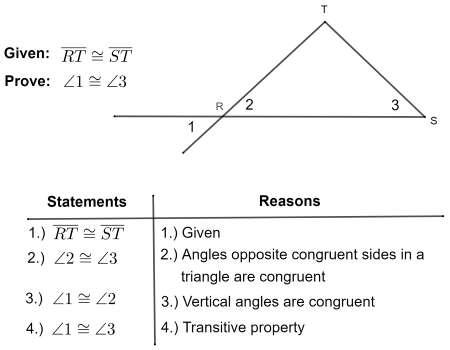
2 Column Proof
Contains numbers statements and reasons
2 Column Proof
Contains numbers statements and reasons
Segment Congruence Theorem
Segment congruence is reflexive
For any segment AB, AB = AB
Segment congruence is symmetric
If AB = CD, then CD = AB
Segment congruence is transitive
If AB = CD and CD = EF, then AB = EF
Angle Congruence Theorem
Angle congruence is reflexive
For any angle A, A = A
Angle congruence is symmetric
If A = B, then B = A
Angle congruence is transitive
If A = B and B = C, then A = C
Angle Theorems
All right angles are congruent
If 2 angles are supplementary to the same angle, then they are congruent
If two angles are complementary to the same angle, then they are congruent
Angle Postulates
If two angles form a linear pair, then they are supplementary
Vertical angles are congruent
Parallel Lines
Lines that are coplanar and never intersect
IMPORTANT: Lines that do not intersect are SOMETIMES parallel
Skew Lines
Lines that do not intersect but are not coplanar
Parallel Planes
Planes that do not intersect
Angles Formed by Transversals
Corresponding angles if they have corresponding positions
Alternate interior angles if they lie between the two lines on opposite sides
Alternate exterior angles if they lie outside the two lines on opposite sides
Consecutive interior angles if they lie between the two lines on the same side
Parallel Postulate
If there is a line and a point not on the lines, then there is exactly one line through the point parallel to the line
Perpendicular Postulate
If there is a line and a point not on the lines, then there is exactly one line through the point perpendicular to the line
Corresponding Angles Postulate
If two parallel lines are cut by a transversal, then the pairs of corresponding angles are congruent
Alternate Interior Angles Converse
If two lines are cut by a transversal so the alternate interior angles are congruent, then the lines are parallel
Corresponding Angles Converse
If two lines are cut by a transversal so the corresponding angles are congruent, then the lines are parallel
Alternate Interior Angles Theorem
If two lines are cut by a transversal so the corresponding angles are congruent, then the lines are parallel
Alternate Exterior Angles Theorem
If two parallel lines are cut by a transversal, then the pairs of alternate exterior angles are congruent
Consecutive Interior Angles Theorem
If two parallel lines are cut by a transversal, the the pairs of consecutive interior angles are supplementary
Alternate Exterior Angles Converse
If two lines are cut by a transversal so the alternate exterior angles are congruent, then the lines are parallel
Consecutive Interior Angles Converse
If two lines are cut by a transversal so the consecutive interior angles are supplementary, then the lines are parallel
Transitive Property of Parallel Lines
If two lines are parallel to the same line, then they are parallel to each other
Slope
Ration of the vertical change to the horizontal change of a nonvertical lines
Negative slope: falls left to right
Positive slope: rises left to right
Zero slope: horizontal
Undefined: vertical
Slopes of Parallel Lines Postulate
In a coordinate plane, two nonvertical lines are parallel if and only if they have the same slope
Two vertical lines are always parallel
Slopes of Perpendicular Lines Postulate
In a coordinate plane, two nonvertical lines are perpendicular if and only if the product of their slopes is -1
Horizontal lines are perpendicular to vertical lines
Slopes with Different Lines (Parallel and Perpendicular)
Parallel lines have the same slope
Perpendicular lines have opposite reciprocal slops
Slope Intercept Form
y = mx + b
m = slope
b = y intercept
Point Slope Form
y - y_1 = m(x - x_1)
m = slope
Standard Form
Ax + By = C
If two lines intersect to form a linear pair of congruent angles…
then the lines are perpendicular
If two lines are perpendicular…
then they intersect to form 4 right angles
If two sides of two adjacent acute angles are perpendicular…
then the angles are complementary
If a transversal is perpendicular to one of two parallel lines…
then it is perpendicular to the other
In a plane, if two lines are perpendicular to the same line…
then they are parallel to each other
The distance from a point to a lines is…
the length of the perpendicular segment from the point to the lines
Scalene Triangles
No congruent sides
Isosceles Triangle
At least 2 congruent sides
Equilateral Triangles
3 congruent sides
Acute Triangles
3 acute angles
Right Triangle
1 right angle
Obtuse Triangles
1 obtuse angle
Equiangular Triangles
3 congruent angles
Triangle Sum Theorem
The sum of the measures of the interior angles of a triangle is 180 degrees
Corollary to the Triangle Sum Theorem
The acute angles of a right triangle are complementary
Exterior Angle Theorem
The measure of an exterior angle of a triangle is equal to the sum of the measures of the two nonadjacent interior angles
Congruent Figures
Exactly the same size and shape and all parts of one figure are exactly the same to the corresponding parts of the other
Third Angles Theorem
If two angles of one triangle are congruent to two angles of another triangle, then the third angles are also congruent
Properties of Congruent Triangles
Reflexive property of congruent triangles:
For any triangle ABC, ABC is congruent to ABC
Symmetric property of congruent triangles:
If ABC is congruent to DEF, then DEF is congruent to ABC
Transitive property of congruent triangles:
If ABC is congruent to DEF and DEF is congruent to JKL, then ABC is congruent to JKL
Side-Side-Side (SSS) Congruence Postulate
If three sides of one triangle are congruent to three sides of a second triangle, then the two triangles are congruent
Side-Angle-Side (SAS) Congruence Postulate
If two sides and the included angle of one triangle are congruent to two sides and the included angle of a second triangle, then the two triangles are congruent
Hypotenuse-Leg Congruence Theorem
If the hypotenuse and a leg of a right triangle are congruent to the hypotenuse and a leg of a second right triangle, then the two triangles are congruent
Angle-Side-Angle (ASA) Congruence Postulate
If two angles and the included side of one triangle are congruent to two angles and the included side of a second triangle, then the two triangles are congruent
Angle-Angle-Side (AAS) Congruence Theorem
If two angles and a non-included side of one triangle are congruent to two angles and the corresponding non-included side of a second triangle, then the two triangles are congruent
CPCTC
Corresponding parts of congruent triangles are congruent
If you can prove two triangles are congruent, you can prove that their corresponding parts are congruent
Base Angles Thoerem
If two sides of a triangle are congruent, then the angles opposite them are congruent
Converse of Base Angles Theorem
If two angles of a triangle are congruent, then the sides opposite them are congruent