Mastering A&P Chapter 1: The Human Body - An Orientation
 Call Kai
 Learn
Learn Practice Test
 Spaced Repetition
 Match
Match Flashcards
 Knowt Play
1/39

There's no tags or description
Looks like no tags are added yet.
Name | Mastery | Learn | Test | Matching | Spaced | Call with Kai | Chat |
|---|
No analytics yet
Send a link to your students to track their progress
40 Terms
What is the role of the serous membranes covering some organs?
a.) to provide a protective outer covering for the organ
b.) to prevent friction between the organ and body cavity wall
c.) to provide passage of nutrients for the organ tissues
d.) to serve as extra tissue for blood flow to the organ
b.) to prevent friction between the organ and body cavity wall
The two serous membrane layers are separated by a cavity containing serous fluid. This fluid allows organs to slide without friction across the cavity walls and one another as they carry out their routine functions.
The Components of Negative Feedback Mechanisms
These elements form a negative feedback mechanism, which helps maintain homeostasis.
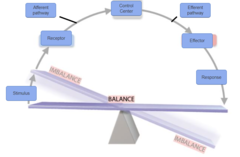
Effector
A structure that carries out the response.
Control center
The structure that receives information about the variable, compares it to the homeostatic value of the variable, and determines a response.
Variable
The factor being regulated.
Negative feedback mechanism
A series of steps that causes a variable to change in the direction opposite to that of the initial change.
Set point
The level (or range of levels) at which a variable is to be maintained; the homeostatic value.
Afferent pathway
The pathway that takes information about the variable to the control center.
Receptor
A sensor that detects a change in the variable.
Homeostasis
The ability of the body to maintain relatively stable internal conditions in spite of changes in the outside environment.
Efferent pathway
The pathway that takes information from the control center to the structure(s) that carries out the response.
Blood levels of the readily available fuel, glucose, are tightly regulated by two chemical messengers. One of these, called insulin, decreases blood glucose. The other chemical messenger, called glucagon, increases blood glucose. Both chemical messengers are present at varying levels in the blood at all times. From the choices below, select all of the events that you think will happen in response to a decrease in blood glucose.
Select ALL that apply:
- Insulin levels increase
- Insulin levels decrease
- Glucagon levels increase
- Glucagon levels decrease
- Blood glucose levels begin to increase
- Blood glucose levels continue to decrease
- Blood glucose levels remain unchanged
- Insulin levels decrease
- Glucagon levels increase
- Blood glucose levels begin to increase
Glucose is an important nutrient in the blood whose levels are tightly controlled. At this point, all you need to be able to do is recognize how this fits into the general pattern of negative feedback mechanisms. We'll return to the details of blood glucose control in the chapter about the endocrine system.
Muscle often acts as a(n) ____________.
a.) Afferent pathway
b.) Efferent pathway
c.) Effector
d.) Control center
e.) Receptor
c.) Effector
In negative feedback mechanisms, effectors carry out the response that brings a controlled variable back to its set point. Muscles and glands often act as effectors.
Blood pressure is another example of a variable controlled by negative feedback, but one you have never encountered before. Apply what you have learned about negative feedback to place each choice in its correct position in the figure.
Blood pressure is a critical controlled variable. If it is too low, cells can be deprived of oxygen and nutrients. Blood pressure that is too high can burst tiny fragile blood vessels. (If this happens in the brain, it can lead to a stroke). At this point, all you need to be able to do is recognize how blood pressure control fits into the general pattern of negative feedback mechanisms. We'll return to the details of blood pressure control in the chapter about blood vessels.
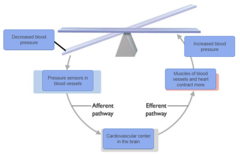
Drag the appropriate labels to their respective targets.
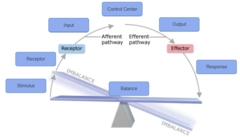
Drag the appropriate labels to their respective targets.

You have been asked to teach the principles of CPR to a group of teens training to be lifeguards. You use a diagram of the thoracic cavity to help you explain how chest compressions can maintain circulation. Which view of the chest would best illustrate this point?
a.) Transverse
b.) Sagittal
c.) Frontal
d.) Oblique
b.) Sagittal
A sagittal view would clearly show that the heart is located between the sternum and the spine, allowing chest compressions to squeeze blood from the heart into the aorta.
Drag the appropriate labels to their respective targets.
Label the dorsal and ventral body cavities and their subdivisions.
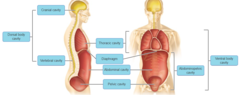
Drag the appropriate labels to their respective targets.
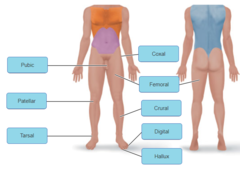
Drag the appropriate labels to their respective targets. Figure shows Posterior/Dorsal view.
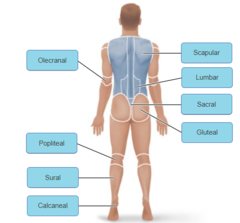
Label the levels of structural organization in the human body.
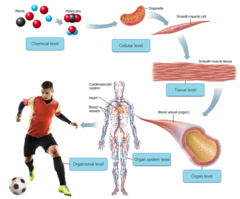
Which of the following organs is least likely to be damaged in an automobile accident?
a.) stomach
b.) intestines
c.) urinary bladder
d.) liver
c.) urinary bladder
The urinary bladder is very well protected in the pelvic cavity by the two hip bones.
Using the anatomical terminology presented in this video, how would you describe the location of a bruise on the front right lower leg?
a.) posterior, proximal to hip
b.) anterior, distal to knee
c.) posterior, distal to hip
d.) anterior, proximal to knee
b.) anterior, distal to knee
What directional term would be used to indicate sunburn on a patient's back?
a.) distal
b.) posterior
c.) anterior
d.) proximal
b.) posterior
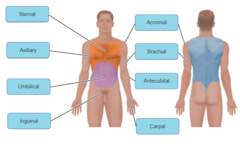
Drag the appropriate labels to their respective targets.

Parents bring a toddler to the emergency department after she tripped and fell on the sidewalk. You note a submental laceration. As you evaluate this girl, you are most concerned about trauma to which other anatomic region?
a.) Otic
b.) Orbital
c.) Oral
d.) Occipital
c.) Oral
If the child landed forcefully on her chin, she may have damaged her teeth or tongue, which are within her oral region.
Label the planes of the body.
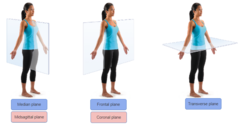
You go home for the holidays after your first semester of nursing school, and your grandma tells you that the doctor removed a nevus from her left scapular region. What procedure did she have done?
a.) She had a mole removed from her left shoulder blade.
b.) She had a mole removed from her left knee.
c.) She had a mole removed from her left sternal region.
d.) She had a mole removed from the back of her ear.
a.) She had a mole removed from her left shoulder blade.
The prefix _______ means nature or physical.
phys-
The prefix ________ means middle.
medi-
The prefix _________ means under, beneath, or less than normal.
hypo-
The prefix ________ means abnormally small.
micro-
The prefix __________ means across, beyond, or through.
trans-
____________ is the study of the nature of the body and how it functions.
Physiology
The study of the cells in gastric pits is an example of __________ anatomy.
microscopic
The body region located beneath the stomach is the _________ region.
hypogastric
The area where the heart is located is the ___________, which lies between the two lungs.
mediastinum
A body section that is cut across the body horizontally is a ________ section.
transverse
What is the function of serous fluid?
a.) It enables organs, such as the heart and the stomach, to slide
across cavity walls and each other without friction.
b.) It prevents the organs from drying out when in contact with air.
c.) It helps the stomach and other organs maintain neutral buoyancy
within body cavities, even during fluctuations in atmospheric
pressure, or when gases, such as oxygen or methane, are present
in varying ratios.
d.) It aids in the repair of damaged organs.
a.) It enables organs, such as the heart and the stomach, to slide across cavity walls and each other without friction.
The slippery serous fluid allows the organs to slide without friction across the cavity walls and one another as they carry out their routine functions. This freedom of movement is especially important for mobile organs, such as the pumping heart and the churning stomach.
Return to Assignment