OMFPR 3 - Radiation Safety and Protection (Dr. Campos)
 Call Kai
 Learn
Learn Practice Test
 Spaced Repetition
 Match
Match Flashcards
 Knowt Play
1/99

There's no tags or description
Looks like no tags are added yet.
Name | Mastery | Learn | Test | Matching | Spaced | Call with Kai | Chat |
|---|
No analytics yet
Send a link to your students to track their progress
100 Terms
about how much background radiation (in mSv) do you receive per year just by living in the Unites States?
3.1 mVs

about how much total radiation from medical exposure (in mSv) do you receive per year in the Unites States?
3.0 mVs

about how much radiation total (in mSv) (background and medical) do you receive per year in the Unites States?
6.2 mVs
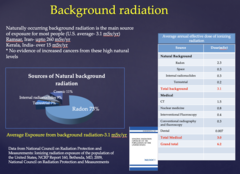
What is the largest source of background radiation?
Radon (73%)
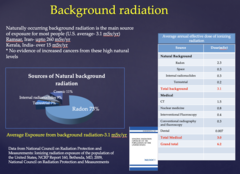
T/F: In Ramsar, Iran you receive up to 260 mSv/year and in Kerala, India you recieve over 15 mSv/year but there is no evidence of increased cancers from these high natural levels
True
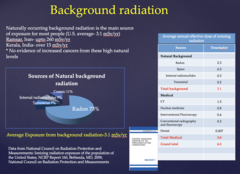
Define the following:
- A gas released from ground that enters home and buildings
- Largest source of background radiation
radon

Radioactive decay products of radon emit alpha particles that affect cells in which body part?
lungs

Radioactive decay products of radon emit ________ particles that affect cells in the lung, potentially leading to lung cancer
alpha

According to the radiation exposure of US NCRP report, how has background radiation changed from the 1980s to 2006?
Decreased (83% to 50%)

According to the radiation exposure of US NCRP report, how has medical radiation changed from the 1980s to 2006?
Increased (15% to 48%)
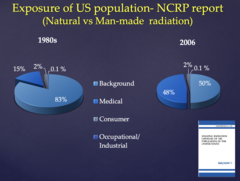
According to the radiation exposure of US NCRP report, how has consumer radiation changed from the 1980s to 2006?
Same (2%)
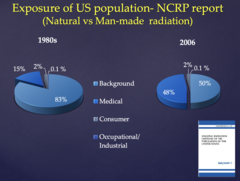
According to the radiation exposure of US NCRP report, how has occupational/industrial radiation changed from the 1980s to 2006?
Same (0.1%)

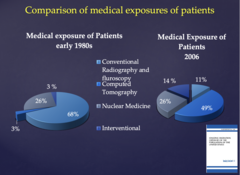
How has the medical exposure of patients changed from the 1980s to 2006 regarding conventional radiography and fluroscopy?
Decreased (68% to 11%)

How has the medical exposure of patients changed from the 1980s to 2006 regarding computed tomography?
Increased (3% to 49%)
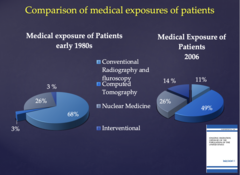
How has the medical exposure of patients changed from the 1980s to 2006 regarding nuclear medicine?
Same (26%)

How has the interventional medical exposure of patients changed from the 1980s to 2006?
Increased (3% to 14%)
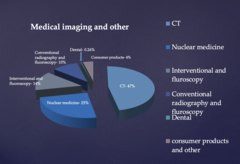
Which of the following medical imaging modalities contributes the largest share to population radiation exposure?
A) CT
B) Nuclear medicine
C) Interventional and fluoroscopy
D) Conventional radiography and fluroscopy
E) Dental
F) Consumer products and other
A) CT
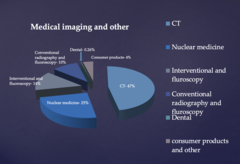
T/F: Dental imaging accounts for less than 1% of the population's total medical radiation exposure
True (0.26%)
as set by the National Council of Radiation Protection (NCRP) what is the recommended annual dose limit ionization exposure for a dentist?
50 mSv
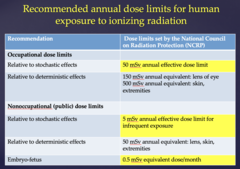
as set by the National Council of Radiation Protection (NCRP) what is the recommended annual dose limit ionization exposure for a dental assistant?
50 mSv (relative to stochastic effects)

as set by the National Council of Radiation Protection (NCRP) what is the recommended annual occupational dose limit ionization exposure, relative to deterministic effects?
- 150 mSv annual equivalent: lens of eye
- 500 mSv annual equivalent: skin, extremities

as set by the National Council of Radiation Protection (NCRP) what is the recommended annual dose limit ionization exposure for a front desk manager at a dental office?
5 mSv (relative to stochastic effects)

as set by the National Council of Radiation Protection (NCRP) what is the recommended annual nonoccupational (public) dose limit ionization exposure, relative to deterministic effects?
50 mSv annual equivalent: lens, skin, extremities

as set by the National Council of Radiation Protection (NCRP) what is the recommended annual dose limit ionization exposure for a dental assistant that is pregnant?
0.5 mVs (relative to stochastic effects)
as set by the National Council of Radiation Protection (NCRP) what is the recommended annual dose limit ionization exposure for a patient at a dental office?
does not apply

T/F: Rectangular collimators reduce radiation dose compared to round collimators
True

T/F: All of the following are organizations that tell us how to properly use radiation in practice:
- American Dental Association
- The American Academy of Oral and Maxillofacial Radiology
- National Council on Radiation Protection and Measurements
- Image gently
True

What are the three guiding principles in radiation protection?
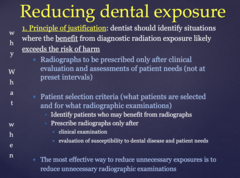
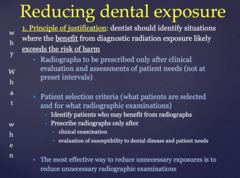
1. Principle of justification
2. Principle of optimization
3. Dose limitation

What guiding principle in radiation protection states that dentists should identify situations where the benefit from diagnostic radiation exposure likely exceeds the risk of harm?
Principle of Justification
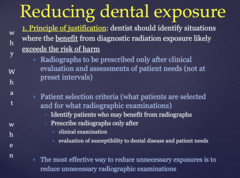
Which principle does this follow?
Radiographs to be prescribed only after clinical evaluation and assessments of patient needs (not at preset intervals)
Justification

What principle does this follow?
Patient selection criteria (what patients are selected and for what radiographic examinations)
- Identify patients who may benefit from radiographs
- Prescribe radiographs only after clinical examination and evaluation of susceptibility to dental disease and patient needs
Justification
What principle does this follow?
The most effective way to reduce unnecessary exposures is to reduce unnecessary radiographic examinations
principle of justification
Which principle?
Radiographic exposures are necessary only when, in the dentist's judgment, it is reasonably likely that the patient will benefit by the discovery of clinically useful information in the radiograph
justification

What guiding principle in radiation protection states that dentists should use every reasonable means to reduce unnecessary exposure to their patients and themselves?
-This philosophy is often referred to as the ALARA
Principle of optimization

what does ALARA stand for?
As
Low
As
Reasonably
Achievable

What guiding principle in radiation protection states that dose limits are used for public and occupational exposures? This principle applies to dentist and their staff that are occupationally exposed but does not apply to patients.
Dose Limitation
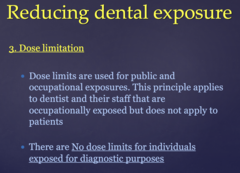
Dose limitations apply to everyone except:
A) The dentist
B) The patient
C) The dental assistant
D) The pregnant dental office manager
B) The patient

t/f: there are no dose limits for individuals exposed for diagnostic purposes
true

what is the ADA guideline for prescribing dental radiographs for new patient that is being evaluated and is an adolescent with permanent dentition?
- Posterior bitewings and panoramic exam
OR
- Posterior bitewings and selected periapical images

what is the ADA guideline for prescribing dental radiographs for new patient that is an adult?
- Posterior bitewings and panoramic exam
OR
- Posterior bitewings and selected periapical images
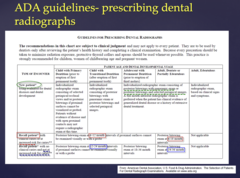
what is the ADA guideline for prescribing dental radiographs for a recall child patient that has clinical caries or an increased risk for caries?
posterior bitewing exam every 6-12 months if proximal surfaces cannot be evaluated clinically
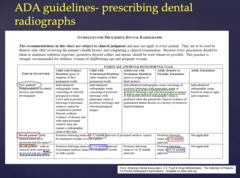
what is the ADA guideline for prescribing dental radiographs for a recall adult patient that has clinical caries or an increased risk for caries?
posterior bitewing exam every 6-18 months

what is the ADA guideline for prescribing dental radiographs for a recall child patient that has no clinical caries nor increased risk for caries?
posterior bitewing exam every 12-24 months if proximal surfaces cannot be evaluated clinically
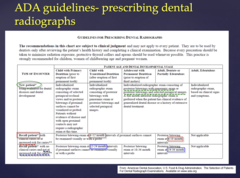
what is the ADA guideline for prescribing dental radiographs for a recall adult patient that has no clinical caries nor increased risk for caries?
posterior bitewing exam every 24-36 months
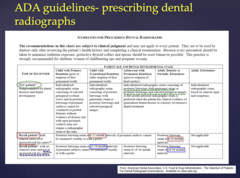
what is the ADA guideline for prescribing dental radiographs for a recall patient with periodontal disease?
clinical judgement is needed

when selecting a receptor, a film of a speed slower than ___-speed should not be used for dental radiographs
E

F-speed receptors have more or less exposure than E-speed?
less (20-50% less)

Which receptor speed is most recommended?
F (fastest)
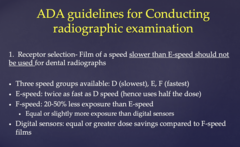
Which of the following is the slowest receptor speed: D, E, or F?
D
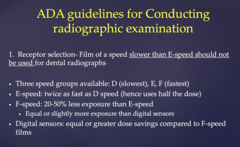
Which type of receptor is most recommended?
digital sensors

What have an equal or greater dose savings compared to F-speed films?
digital sensors

Rare-earth intensifying screens combined with high speed screen film is recommended for what?
significant dose reduction

T/F: Digital imaging has significant dose reduction compared to screen films
false (no significant dose reduction)
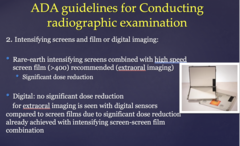
Which of the following is apart of ADA guidelines for conducting radiographic examination?
1. Receptor selection
2. Intensifying screens/film or digital imaging
3. Decrease source-to-skin distance (or focal spot to film)
4. Rectangular collimation
5. Filtration
6. Lead aprons
7. Film and sensor holders
8. Kilovoltage (kVp)
9. Miliampre-seconds (mA-s)
10. Interpreting the images in appropriate conditions
11. Protecting personnel
12. Quality assurance
13. Continuing education for dentist/staff
All are apart of ADA guidelines!
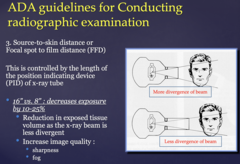
What is controlled by the length of the position indicating device (PID) of x-ray tube?
FFD (focal spot to film distance) or source-to-skin distance

16" vs 8" FFD decreases exposure by how much?
10-25%

When distance is decreased (FFD), what happens to tissues, the x-ray beam, and image quality?
- Reduction in exposed tissue as beam is less divergent
- Increase in image quality (sharpness/fog)
What type of collimation decreases radiation dose compared with a circular?
Rectangular
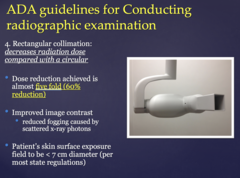
the use of a rectangular collimator reduces patient radiation exposure dose by ___ %
60% (5 fold dose reduction)

what shape collimator is the best way to reduce patient radiation exposure dose by 60%?
rectangular

How does rectangular collimation improve images?
reduce fogging caused by scattered x-ray photons
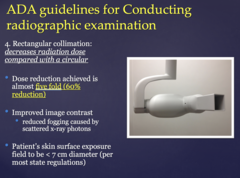
What is the regulated patient skin surface exposure field?
less than 7 cm diameter

What is a benefit of rectangular collimation?
limits size of x-ray bean to size of intraoral sensory (reduces unnecessary exposure)

Define the following:
Removes low energy x-ray photons from x-ray beam that don't contribute to image formation
filtration
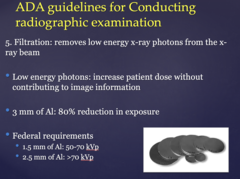
What do low energy photons do?
increase patient dose without contributing to image formation
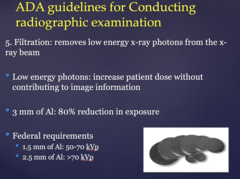
an aluminum filter of ___mm will result in a 80% reduction in exposure
3 mm

per federal requirements, an aluminum filter of ___mm is needed for 50-70 kVp
1.5mm
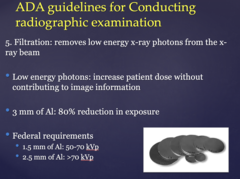
per federal requirements, an aluminum filter of ___mm is needed for >70 kVp
2.5mm

t/f: Lead aprons are required at TUSDM to reduce exposure to gonad and thyroid glands
true
T/F: If all recommendations from NCRP are followed, lead aprons are not necessary
True
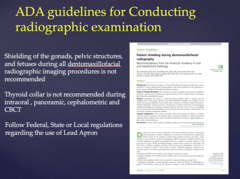
T/F: Shielding of the gonads, pelvic structures, and fetuses during all dentomaxillofacial radiographic imaging procedures is not recommended
True
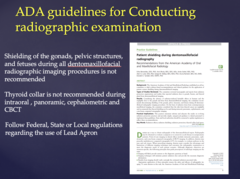
what types of imaging should you NOT use a thyroid collar (4)?
- Intraoral
- Panoramic
- Chephalometric
- CBCT

T/F: Follow federal, state or local regulations regarding the use of lead apron
True
What aligns the receptor to the collimated beam?
film and sensor holders

What do film and sensor holders reduce?
cone cutting (unacceptable images)
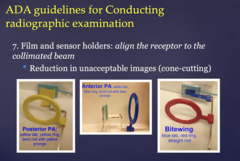
Which of the following film and sensor holders is used for a posterior PA?
A) Yellow tab, yellow ring, bent rod with yellow prongs
B) White tab, blue ring, bent rod with blue prongs
C) Blue tab, red ring, straight rod
A) Yellow tab, yellow ring, bent rod with yellow prongs
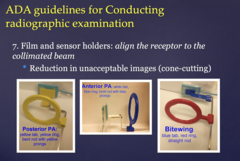
Which of the following film and sensor holders is used for a anterior PA?
A) Yellow tab, yellow ring, bent rod with yellow prongs
B) White tab, blue ring, bent rod with blue prongs
C) Blue tab, red ring, straight rod
B) White tab, blue ring, bent rod with blue prongs

Which of the following film and sensor holders is used for a bitewing?
A) Yellow tab, yellow ring, bent rod with yellow prongs
B) White tab, blue ring, bent rod with blue prongs
C) Blue tab, red ring, straight rod
C) Blue tab, red ring, straight rod

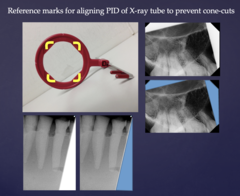
You need to use reference marks for aligning PID of X-ray tube to prevent ____________
Cone-cuts
Operating potential of dental x-ray machines must range between _____-_____ kVp
50-100

Operating potential of dental x-ray machines must range between 50 and 100 kVp but should range between _____-_____ kVp
60-80
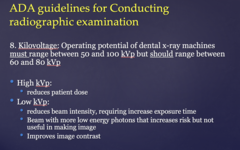
What does high kVp do?
Reduces patient dose

What type of kVp does the following?
- Reduces beam intensity, requiring increase exposure time
- Beam with more low energy photons that increases risk but not useful in making image
- Improves image contrast
Low

Define the following:
Amperage and time settings for optimal quality radiographs
Miliampere-seconds (mA-s)
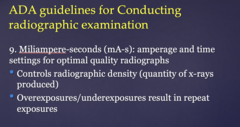
What has the following characteristics?
- Controls radiographic density (quantity of xrays produced)
- Overexposures/ underexposures result in repeat exposures
Miliampere-seconds (mA-s)

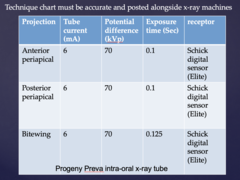
T/F: Anterior periapicals, posterior periapicals, and bitewings typically have a 6 mA tube current and 70 kVp potential difference with an exposure time of ~0.1 sec and a schick digital sensor (elite) receptor
True
T/F: The dentist should evaluate radiographs under appropriate conditions for analysis and diagnosis
True
Where are digital radiographs best interpreted?
On a computer screen in a darkened room
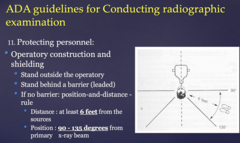
if no wall or barrier is available to shield yourself while taking an x-ray, what is the position-and-distance rule?
- 6ft away
- At a 90-135 degree angle from the x-ray source

Where should you stand when taking an x-ray?
outside the operatory

What should you stand behind when taking an x-ray?
barrier (leaded)
if a pediatric patient is having a hard time sitting still while you're trying to complete imaging and is shaking the sensor, what is the safest thing to do?
A) Hold the sensor still and take the x-ray
B) Have the assistant hold the sensor still
C) Have the patient's parent hold the child still
D) Have the patient hold the sensor still
C) Have the patient's parent hold the child still (appropriate shielding should be provided to the caregiver)
Can an operator hold the sensor during an exposure?
NO

t/f: operators and patients should not hold x-ray tube
true
T/F: Personnel monitoring devices should be provided to dental office personnel operating x-ray machines to monitor exposure
True

What has the following characteristics:
- Special type of sensitive film in a special holder with metallic filters
- Attached to external area
- Reasonably accurate (~20 mR)
- Not for periods of longer than 1 month
Film badges

What has the following characteristics:
- Lithium fluoride crystal
- Absorb energy which will be read by a special reader
- Reusable
- More sensitive and accurate (~5 mR)
TLD (Thermoluminescent Dosimeter)

T/F: Quality assurance protocols for x ray machine, imaging receptor, film processing, lead aprons should be developed and implemented in every dental practice
True
Continuing education for dentists and staff: To learn about Safety updates, equipment that can _____________ radiation exposure and _____________ diagnostic quality of radiographs
decrease, improve

How can you talk with a patient who is nervous about radiation exposure (understandably)?
- Allow patient to express their thoughts
- Acknowledge patient
- Explain why radiographs are necessary (interproximal caries, extent of periodontal bone loss suggested by probing on clinical exam, painful tooth etc.)
- Describe the numerous measures you take to reduce patient exposures (Digital sensors, rectangular collimation)
- Comparisons of exposure (background equivalent exposure- see the attached chart)
- Additionally, explain you will only make exposures that you specifically need to make a diagnosis.
- For new patients- assure them you will contact their previous dentist to obtain previous radiographs to avoid repeat exposures
- Always discuss benefits when discussing risks with patients
