10. Cell Cycle and Cell Division
 Call Kai
 Learn
Learn Practice Test
 Spaced Repetition
 Match
Match Flashcards
 Knowt Play
1/155

Earn XP
Description and Tags
Pretty much every line from NCERT. Suitable for IAT and probably also NEET. Question mode: Flashcards only. Answer mode: Answer with definition. I recommend reading the chapter once and then jumping straight into flashcards. Good luck with exams!
Name | Mastery | Learn | Test | Matching | Spaced | Call with Kai | Chat |
|---|
No analytics yet
Send a link to your students to track their progress
156 Terms
What is ploidy?
Ploidy refers to the number of complete sets of chromosomes in a cell. It is a key concept in genetics and biology.
Cell division is a very important process in all living organisms. During the division of a cell, DNA replication and cell growth also take place. All these processes, i.e., cell division, DNA replication, and cell growth, hence, have to take place in a coordinated way.
Why so?
to ensure correct division and formation of progeny cells containing intact genomes.
What is a “cell cycle”?
The sequence of events by which a cell duplicates its genome, synthesises the other constituents of the cell and eventually divides into two daughter cells is termed cell cycle.
Which stage of the cell cycle does cell growth (in terms of cytoplasmic increase) occur in?
All of them, cell growth (in terms of cytoplasmic increase) is a continuous process.
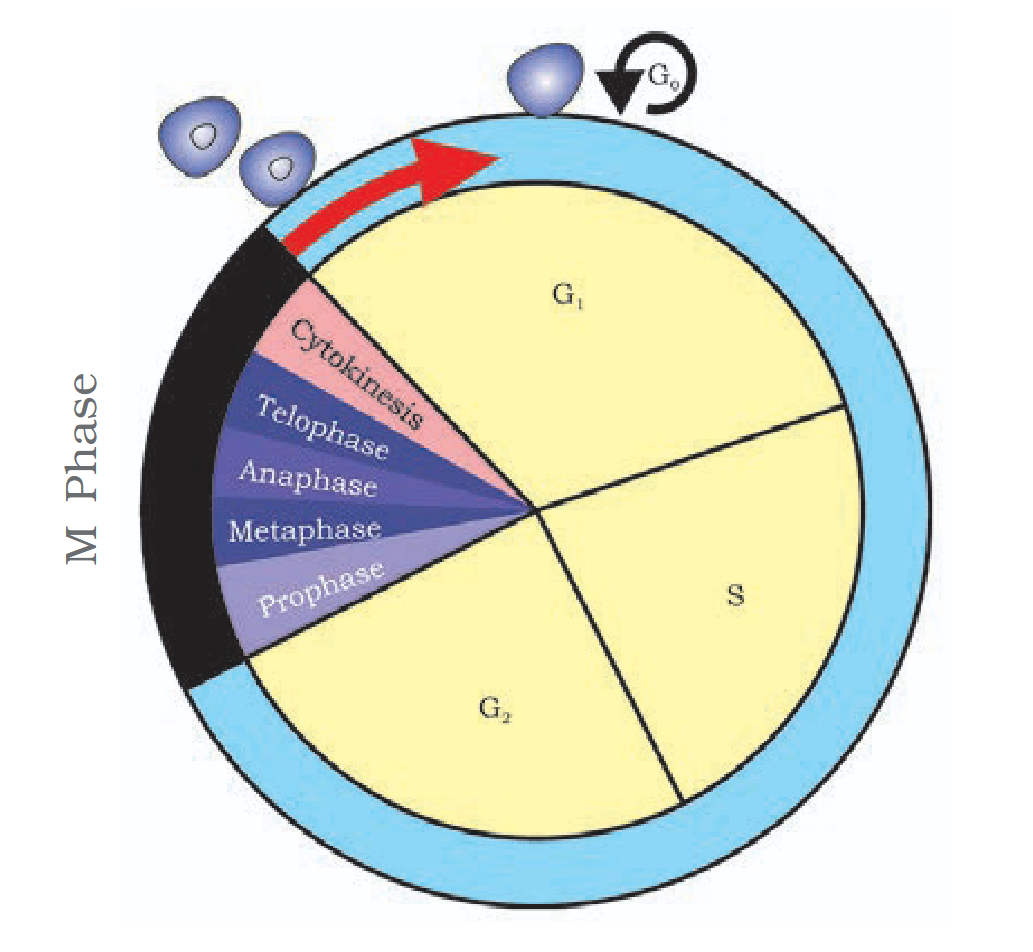
What is the blue phase called?
Interphase
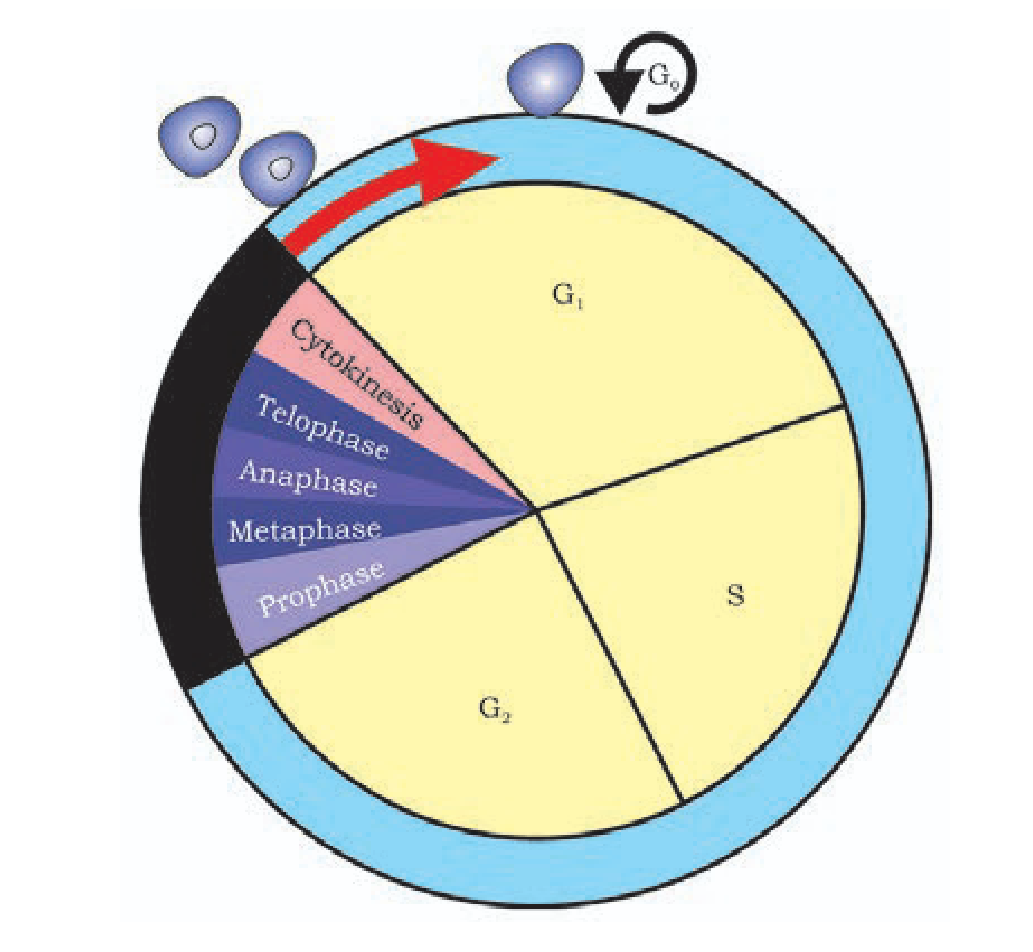
What is the black phase called?
M-phase
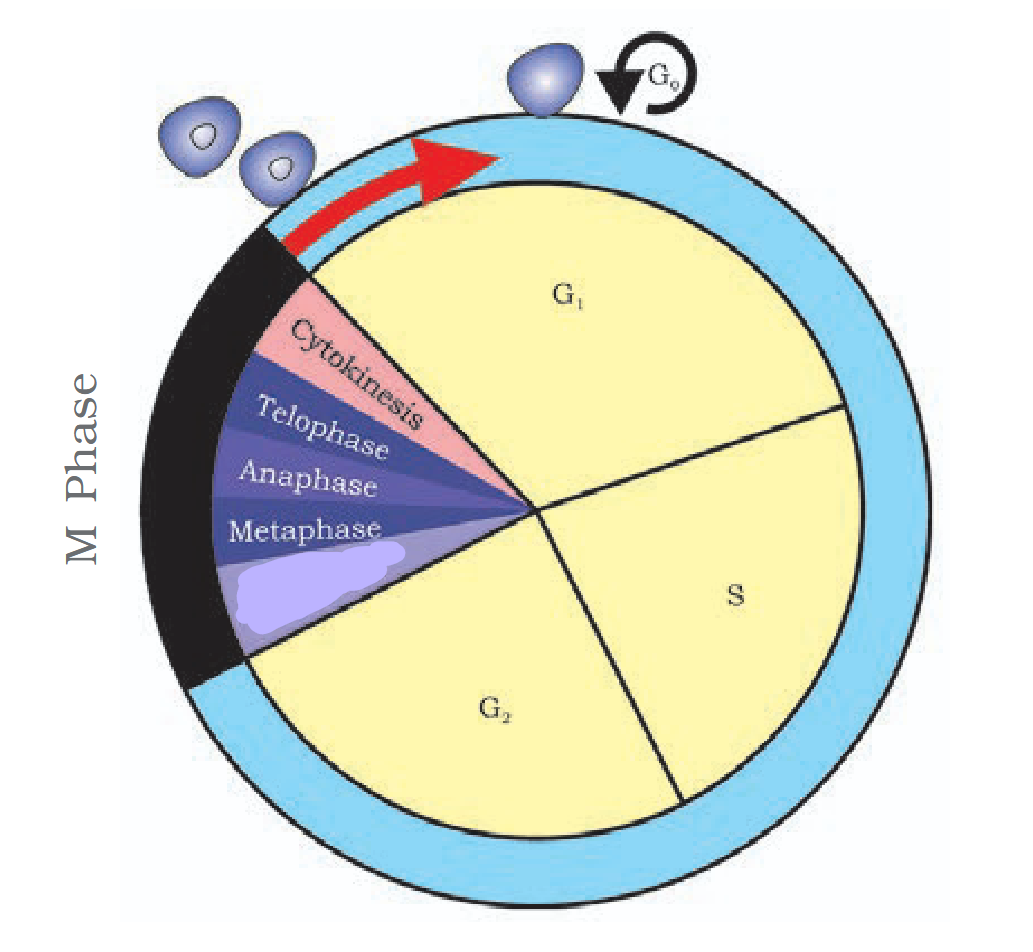
What is the censored part termed?
Prophase
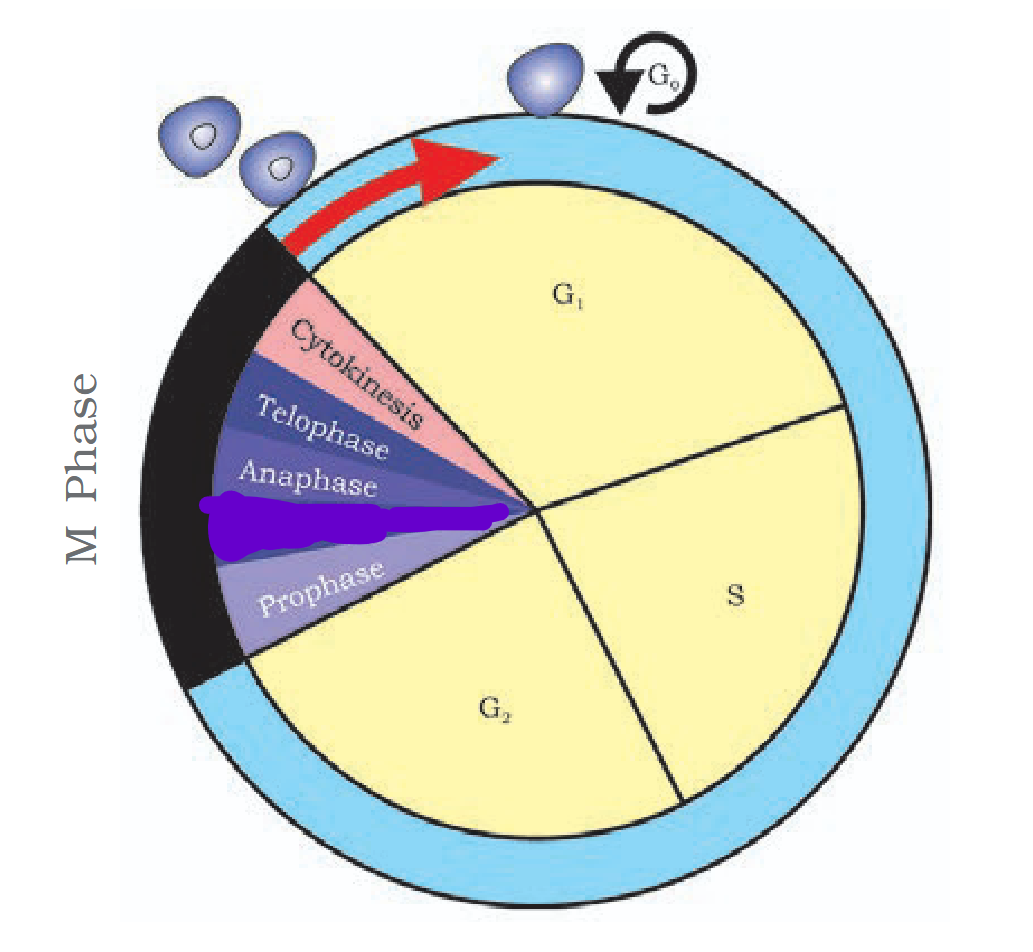
What is the censored part termed?
Metaphase
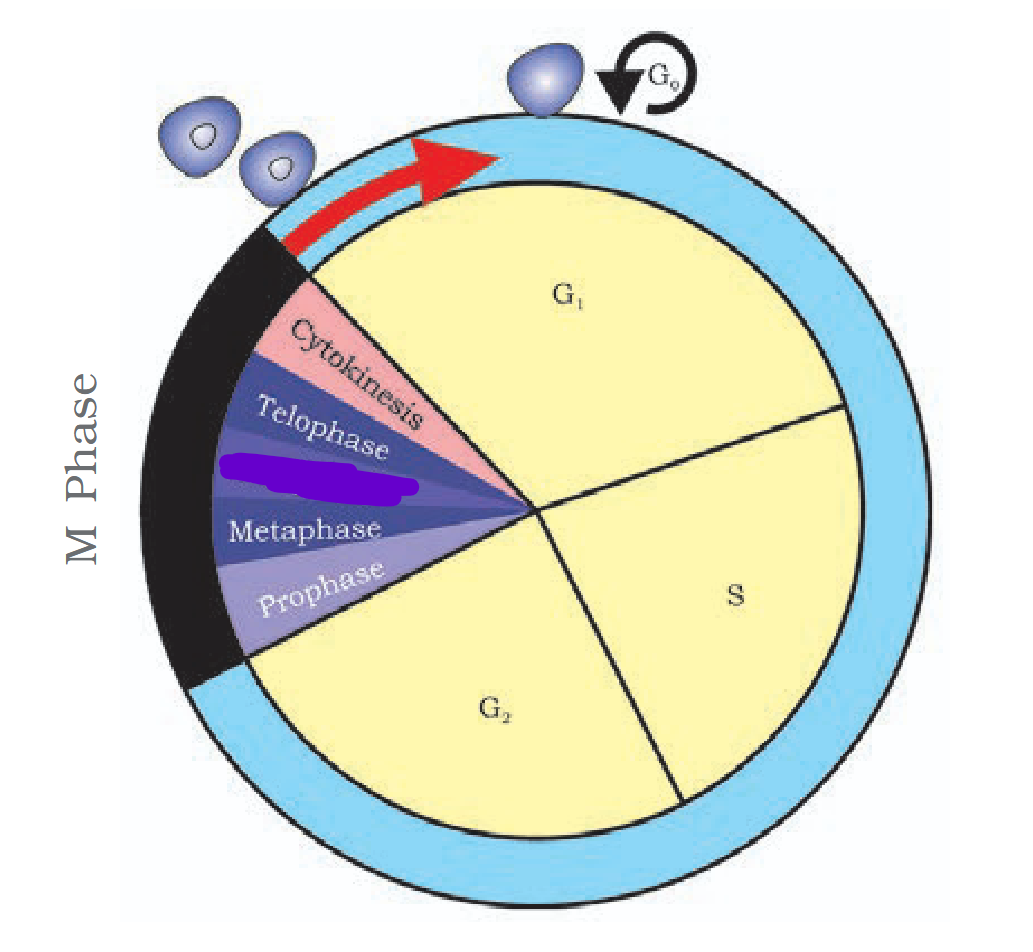
What is the censored part termed?
Anaphase
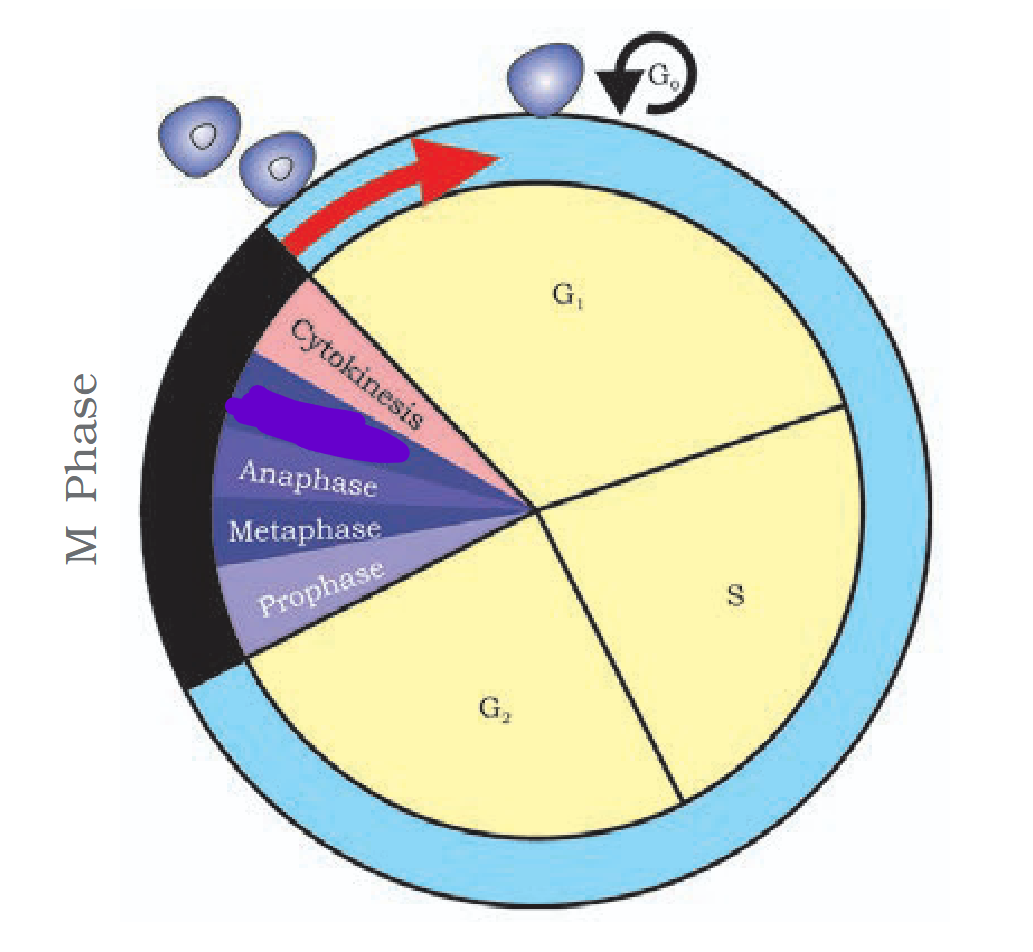
What is the censored part termed?
Telophase
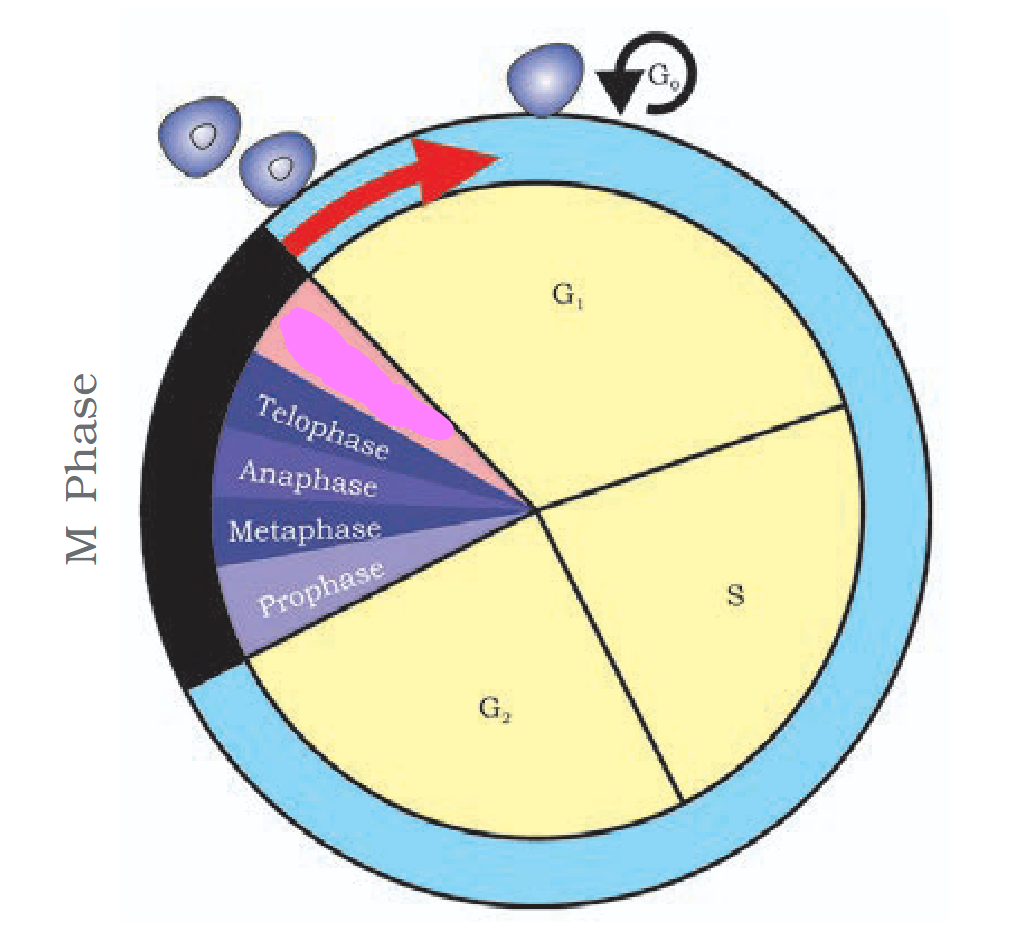
What is the censored part termed?
Cytokinesis
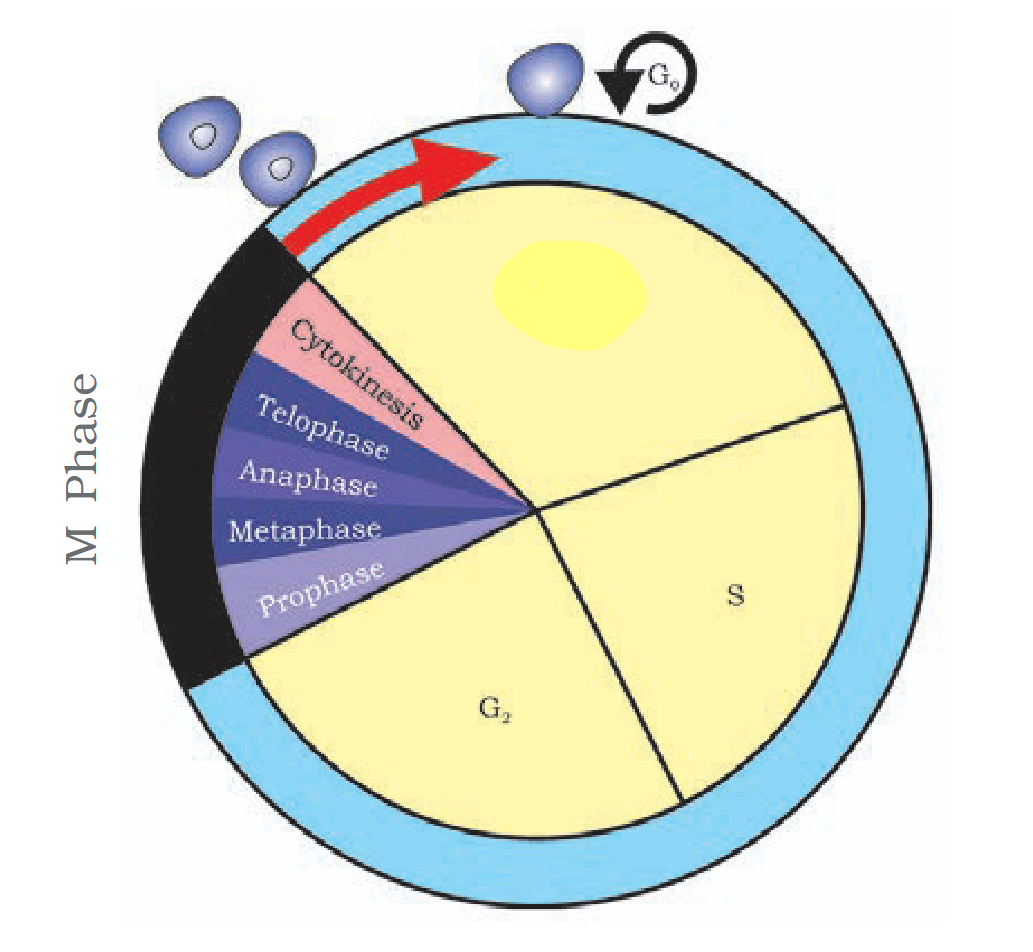
What is the censored part termed?
G1 phase (Gap 1)
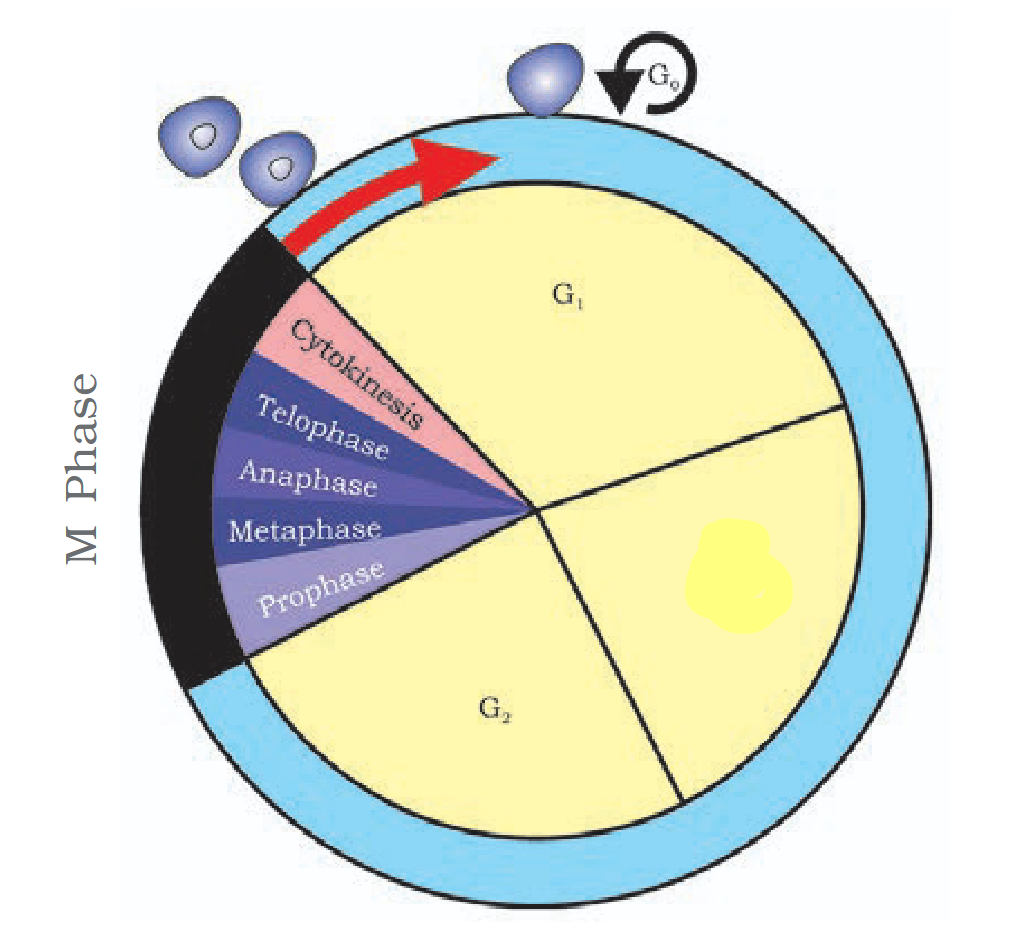
What is the censored part termed?
S phase (Synthesis)
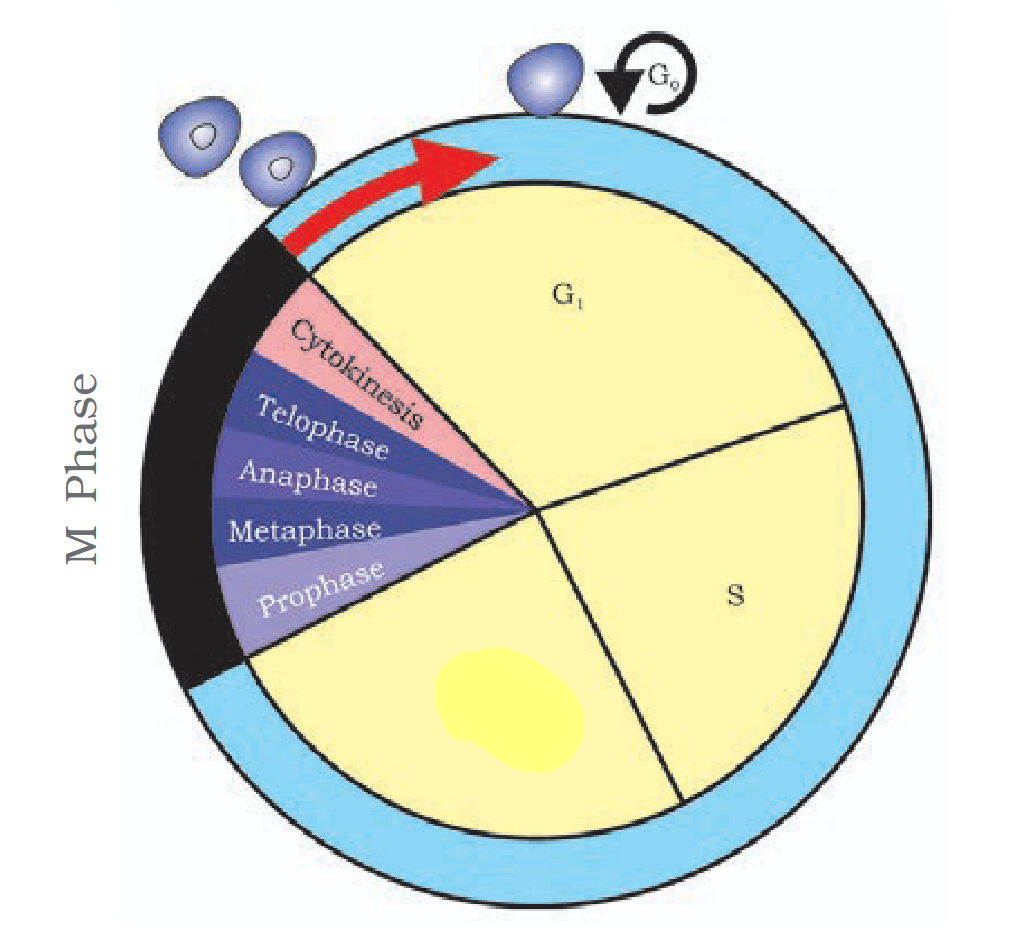
What is the censored part termed?
G2 phase (Gap 2)
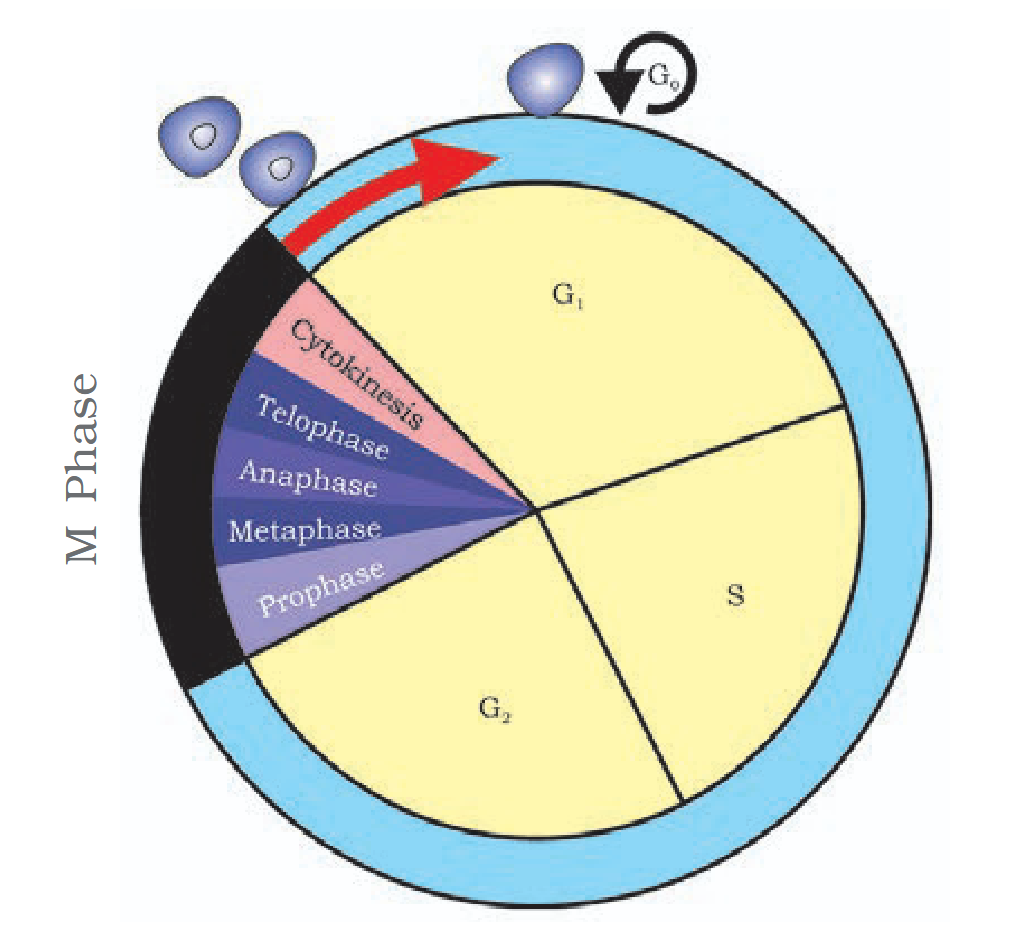
What is the G0 phase?
Cells in this stage remain metabolically active but no longer proliferate unless called on to do so depending on the requirement of the organism.
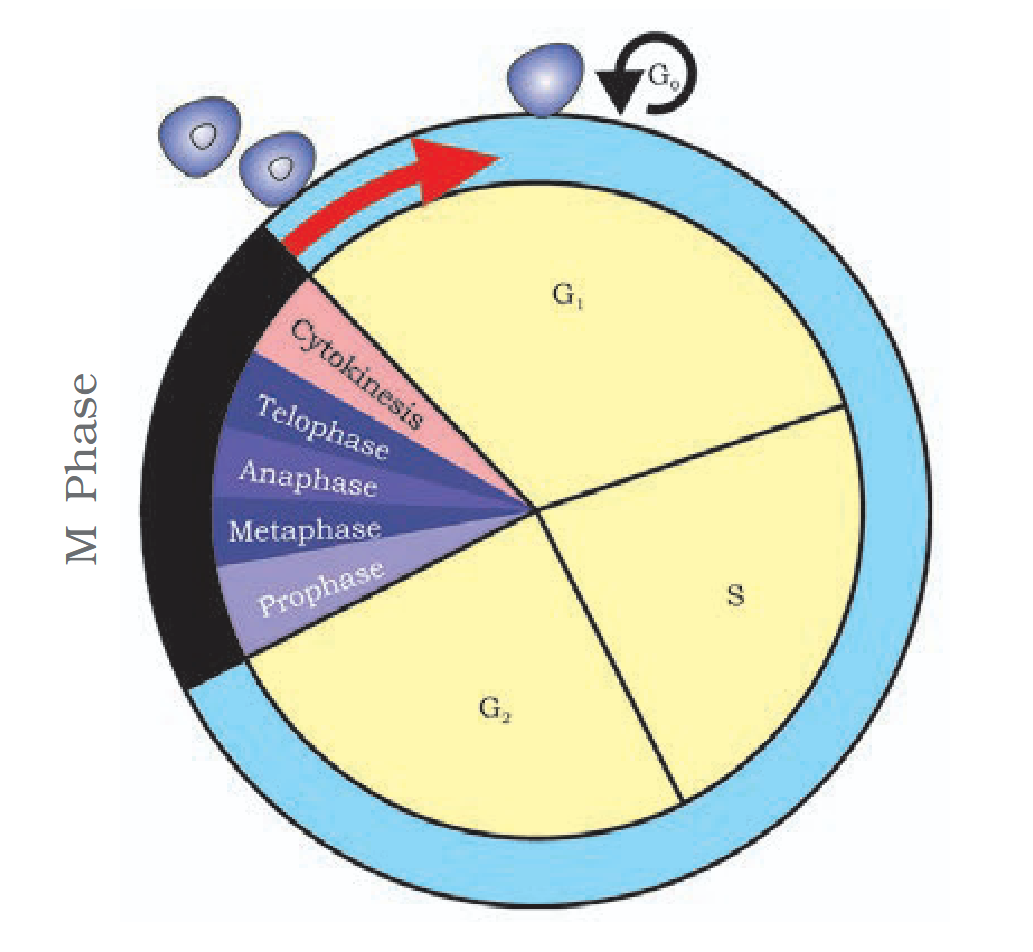
What is another name for G0 phase?
quiescent stage
The cell cycle is divided into two basic phases. What are their names?
Interphase
M-phase
The interphase lasts more than ______% of the duration of cell cycle.
The interphase lasts more than 95% of the duration of cell cycle.
It is significant to note that in the 24 hour average duration of cell cycle of a human cell, cell division proper lasts for how long?
only about 1 hour.
What is the M-phase of cell cycle?
The M-Phase represents the phase when the actual cell division or mitosis occurs.
What is the interphase of cell cycle?
Interphase represents the phase between two successive M phases.
What are the two basic subparts of M-Phase of cell cycle?
Karyokinesis
Cytokinesis
What is karyokinesis?
nuclear division in a cell, corresponding to the separation of daughter chromosomes
What is cytokinesis?
division of cytoplasm of a cell into two cells
What is another name for interphase (from cell cycle)?
resting phase
What are the three stages that Interphase is divided into?
G1 phase (Gap 1)
S phase (Synthesis)
G2 phase (Gap 2)
What is the G1 phase of cell cycle?
G 1 phase corresponds to the interval between mitosis and initiation of DNA replication.
What are the key activities that happen inside a cell during G1 phase of cell cycle?
During G1 phase the cell is metabolically active and continuously grows.
What are the key activities that happen inside a cell during S phase of cell cycle for most cells?
S or synthesis phase marks the period during which DNA synthesis or replication takes place. During this time the amount of DNA per cell doubles.
During S phase of cell cycle, there is an increase in chromosome number.
True or false?
False.
There is no increase in the chromosome number; if the cell had diploid or 2n number of chromosomes at G1, even after S phase the number of chromosomes remains the same, i.e., 2n.
What are the key activities that happen inside a cell during S phase of cell cycle for animal cells?
S or synthesis phase marks the period during which DNA synthesis or replication takes place. During this time the amount of DNA per cell doubles.
In animal cells, during the S phase, DNA replication begins in the nucleus, and the centriole duplicates in the cytoplasm.
What are the key activities that happen inside a cell during G2 phase of cell cycle?
During the G2 phase, proteins are synthesised in preparation for mitosis while cell growth continues.
If a cell is to not continue dividing, when does it leave the cell cycle, and which phase does it enter?
It exits the cell cycle after M-Phase, and before Interphase. It enters the G0 phase or quiescent stage of cell cycle.
Some cells in the adult animals do not appear to exhibit division. Some can exhibit division occasionally, under what circumstances?
Many cells divide only occasionally, as needed to replace cells that have been lost because of injury or cell death.
What is an example of animal cells that generally do not appear to exhibit division?
Human heart cells
In animals, mitotic cell division is only seen in which type of cells?
In animals, mitotic cell division is only seen in the diploid somatic cells.
In animals, mitotic cell division is only seen in the diploid somatic cells.
What are the exceptions to this?
There are few exceptions to this where haploid cells divide by mitosis, for example, male honey bees.
In animals, mitotic cell division is only seen in diploid cells. True or false?
True.
In animals, mitotic cell division is only seen in the diploid somatic cells.
In plants, mitotic ell division is only seen in diploid cells. True or false?
False.
Plants can show mitotic divisions in both haploid and diploid cells.
Which is the most dramatic period of cell cycle?
[NEET PYQ i think]
M-phase
Why is Mitosis also called “equational division”?
Since the number of chromosomes in the parent and progeny cells is the same, it is also called as equational division.
Important, remember:
Though for convenience mitosis has been divided into four stages of nuclear division (karyokinesis), it is very essential to understand that cell division is a progressive process and very clear-cut lines cannot be drawn between various stages.
okay
What are the four stages of Karyokinesis in Mitosis?
Prophase
Metaphase
Anaphase
Telophase
Stages of karyokinesis do not have well-defined boundaries, but characteristics they can be identified by.
Prophase is marked by what?
Prophase is marked by the initiation of condensation of chromosomal material.
What are the three processes that begin in mitotic prophase?
The chromosomal material becomes untangled during the process of chromatin condensation
The centrosome, which had undergone duplication during S phase of interphase, now begins to move towards opposite poles of the cell.
Each centrosome radiates out microtubules called asters.
What is the mitotic apparatus?
Each centrosome radiates out microtubules called asters. The two asters together with spindle fibres forms mitotic apparatus.
What are aster fibres?
Aster fibres are star-shaped cellular structures that consist of a centrosome and are associated with microtubules during early mitotic stages in animal cells.
What are spindle fibres?
Spindle fibres are a form of protein structure that forms the mitotic spindle during cell division.
What is the function of asters in animal cells?
Separate chromosomes to poles and help to organize and position spindle apparatus
What is the function of spindle fibres?
Movement of chromosomes during cell division and dividing of genetic material.
Out of asters and spindle fibres, which get attached to chromosomes?
spindle fibres
In which kingdom cells do asters occur?
animal cells
In which kingdom cells do spindle fibres occur?
both animal and plant cells
What can be observed inside a cell at the end of mitotic prophase?
cell organelles
chromosomes
centrosomes
Cells at the end of prophase, when viewed under the microscope, do not show golgi complexes, endoplasmic reticulum, nucleolus and the nuclear envelope.
Chromosomes are seen to be composed of two chromatids attached together at the centromere.
Each centrosome is at opposite poles of the cell and radiates out microtubules called asters.
Depict early prophase and late prophase in mitosis
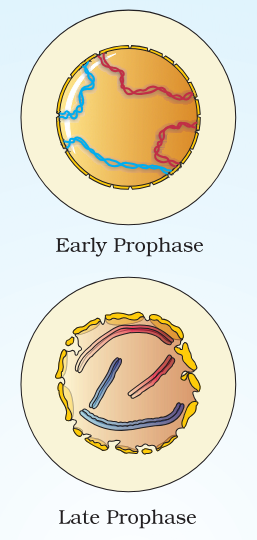
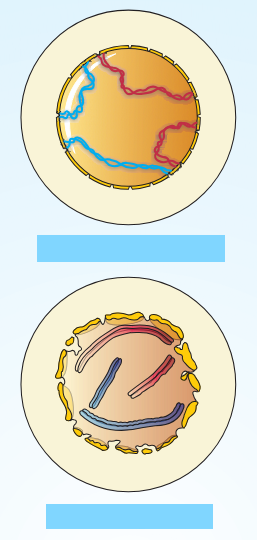
Which stage of M-phase is this?
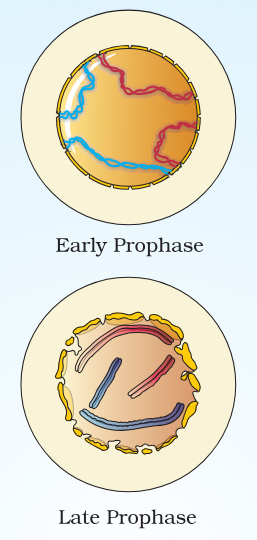
What marks the start of Metaphase of cell division?
The complete disintegration of the nuclear envelope marks the start of the second phase of mitosis.
Why are chromosomes spread through the cytoplasm during Metaphase of cell division?
The complete disintegration of the nuclear envelope marks the start of the second phase of mitosis, hence the chromosomes are spread through the cytoplasm of the cell.
Which stage of cell cycle is morphology of chromosomes easily studied?
Metaphase
Why is Metaphase the stage of cell cycle the stage in which morphology of chromosomes is easily studied?
By this stage, condensation of chromosomes is completed and they can be observed clearly under the microscope.
What does a metaphase chromosome look like?
At this stage, metaphase chromosome is made up of two sister chromatids, which are held together by the centromere. Small disc-shaped structures at the surface of the centromeres are called kinetochores.
What is the purpose of kinetochores?
These structures serve as the sites of attachment of spindle fibres (formed by the spindle fibres) to the chromosomes that are moved into position at the centre of the cell.
What are kinetochores (structure)?
Small disc-shaped structures at the surface of the centromeres are called kinetochores.
What is the characteristic of mitotic Metaphase?
The metaphase is characterised by all the chromosomes coming to lie at the equator with one chromatid of each chromosome connected by its kinetochore to spindle fibres from one pole and its sister chromatid connected by its kinetochore to spindle fibres from the opposite pole.
The metaphase is characterised by all the chromosomes coming to lie at the equator with one chromatid of each chromosome connected by its kinetochore to spindle fibres from one pole and its sister chromatid connected by its kinetochore to spindle fibres from the opposite pole.
The plane of alignment of the chromosomes is called what?
“Metaphase plate”
What are the two key features of mitotic Metaphase?
Spindle fibres attach to kinetochores of chromosomes.
Chromosomes are moved to spindle equator and get aligned along metaphase plate through spindle fibres to both poles.
Depict transition to metaphase and metaphase in mitosis
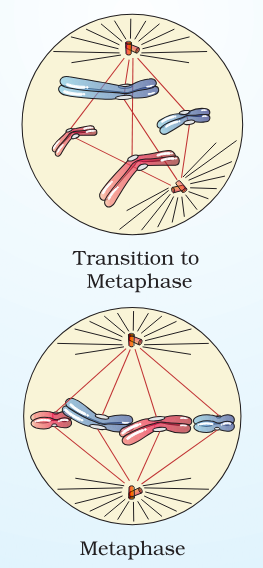
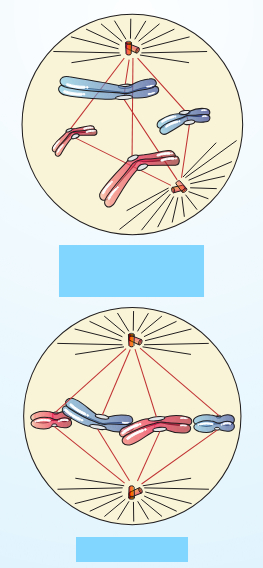
Which stage of M-phase is this?
Metaphase
What marks the onset of mitotic anaphase?
At the onset of anaphase, each chromosome arranged at the metaphase plate is split simultaneously and the two daughter chromatids, now referred to as daughter chromosomes of the future daughter nuclei, begin their migration towards the two opposite poles.
What is the shape of each chromatid (chromosome) during mitotic anaphase?
As each chromosome moves away from the equatorial plate, the centromere of each chromosome remains directed towards the pole and hence at the leading edge, with the arms of the chromosome trailing behind.
What are the two characteristic events of mitotic anaphase?
Centromeres split and chromatids separate
Chromatids move to opposite poles
In which mitotic phase do chromatids split and move to opposite poles?
Anaphase
in which mitotic phase do chromosomes align at the equator of the cell?
Metaphase
In which mitotic phase are asters formed?
Prophase
What marks the beginning of telophase?
The chromosomes that have reached their respective poles decondense and lose their individuality.
Out of the four phases of karyokinesis in Mitosis, in which phases can chromosomes be distinctly viewed?
Metaphase
Anaphase
What are the three key events of mitotic Telophase?
Chromosomes cluster at opposite spindle poles and their identity is lost as discrete elements.
Nuclear envelope develops around the chromosome clusters at each pole forming two daughter nuclei.
Nucleolus, golgi complex and ER reform.
Depict mitotic anaphase.
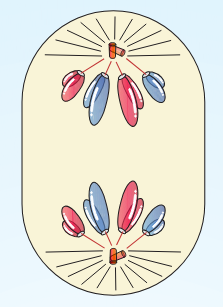
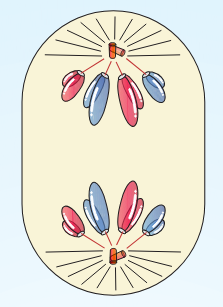
Which stage of Mitosis is this?
Anaphase
Depict mitotic telophase
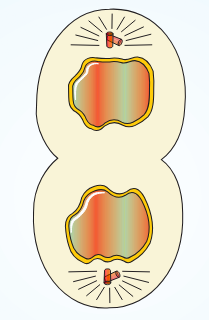
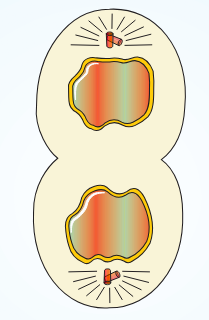
Which stage of Mitosis is this?
Telophase
How is cytokinesis initiated in animal cells?
In an animal cell, this is achieved by the appearance of a furrow in the plasma membrane.
How does cytokinesis take place in animal cells?
In an animal cell, this is achieved by the appearance of a furrow in the plasma membrane. The furrow gradually deepens and ultimately joins in the centre dividing the cell cytoplasm into two.
How is cytokinesis initiated in plant cells?
In plant cells, wall formation starts in the centre of the cell and grows outward to meet the existing lateral walls.
How does cytokinesis take place in plant cells?
In plant cells, wall formation starts in the centre of the cell and grows outward to meet the existing lateral walls. The formation of the new cell wall begins with the formation of a simple precursor, called the cell-plate that represents the middle lamella between the walls of two adjacent cells.
Why can’t cytokinesis happen in plant cells with the formation of a furrow in the plasma membrane, like in animal cells?
Plant cells are enclosed by a relatively inextensible cell wall, thererfore they undergo cytokinesis by a different mechanism.
During cytokinesis in plant cells, wall formation starts in the centre of the cell and grows outward to meet the existing lateral walls. The formation of the new cell wall begins with the formation of a simple precursor, called the ____-_____ that represents the middle lamella between the walls of two adjacent cells.
During cytokinesis in plant cells, wall formation starts in the centre of the cell and grows outward to meet the existing lateral walls. The formation of the new cell wall begins with the formation of a simple precursor, called the cell-plate that represents the middle lamella between the walls of two adjacent cells.
What gets distributed between two daughter cells during cytokinesis?
genetic material in two different nuclei
cell organelles, like mitochondria and plastids
Karyokinesis is always followed by cytokinesis. True or false?
False.
In some organisms karyokinesis is not followed by cytokinesis as a result of which multinucleate condition arises leading to the formation of syncytium.
What is a syncytium?
In some organisms karyokinesis is not followed by cytokinesis as a result of which multinucleate condition arises leading to the formation of syncytium.
What is an example of a syncytium?
liquid endosperm in coconut
Why is animal cell division called astral division?
Because it involves the formation of asters
What are homologous chromosomes?
Two or more chromosomes which have the same character or gene (regardless of expression) at the same locus.
What actually triggers cell division in the first place?
Cell growth (in terms of cytoplasmic increase) is a continuous process. Cell growth results in disturbing the ratio between the nucleus and the cytoplasm. It therefore becomes essential for the cell to divide to restore the nucleo-cytoplasmic ratio.
Which three types of cells in humans are constantly dividing by mitosis and being replaced?
cells of the upper layer of the epidermis
cells of the lining of the gut
blood cells
Which types of cells constantly divide by mitosis, resulting in continuous growth?
meristematic tissues (apical and lateral cambium)
What are meiocytes?
specialised diploid cells made for meiosis
What is meiosis?
Meiosis is a specialised kind of cell division that reduces the chromosome number by half and results in the production of haploid daughter cells.
What are the two sequential cycles of meiosis?
Meiosis I
Meiosis II
How many cycles of DNA replication take place during Meiosis?
1