Stats 2300 Week 7 - Central Limit Theorem and Standard Error
 Call Kai
 Learn
Learn Practice Test
 Spaced Repetition
 Match
Match Flashcards
 Knowt Play
1/19

Earn XP
Description and Tags
A set of practice flashcards covering vocabulary and core concepts from the Week 7 Stats 2300 lecture on the Central Limit Theorem and Standard Error.
Name | Mastery | Learn | Test | Matching | Spaced | Call with Kai | Chat |
|---|
No analytics yet
Send a link to your students to track their progress
20 Terms
Fundamental Problem
The reality that the population has a mean and a standard deviation which are hidden from us, while our sample descriptives are fragile, fleeting, and can change with different samples.
Sampling Error
An inevitable occurrence where results differ between samples, requiring an understanding of all possible samples to judge if a specific result is tall, short, or accurate.
Central Limit Theorem (CLT)
A concept addressing uncertainty that predicts a normal distribution and guarantees that the distribution of sample means centers exactly on the population mean μ.
Law of Large Numbers (LLN)
The principle that sampling once does not guarantee a correct mean or deviation, but data collections illustrate accuracy more reliably as they grow (e.g., flipping a coin multiple times).
Individual
The statistical "sub-unit" that varies from the sample; the most basic level in the statistical hierarchy.
Sample
The fundamental, though incomplete, unit in statistics which is made up of individuals.
Population
The "meta" unit in statistics representing objective reality; it is composed of samples, which are in turn composed of individuals.
Standard Error (SE)
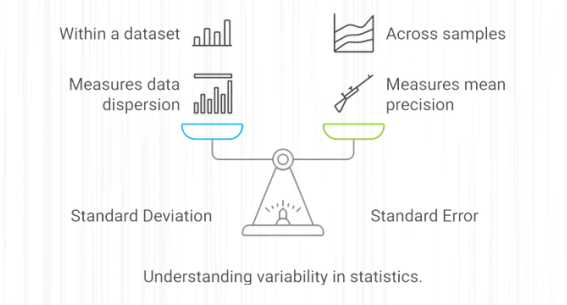
The standard deviation of all possible sample means, representing the variability of "the group" rather than the individual.
Standard Error of the Mean (SEM) Logic
Applying "n" two times: once to divide individual deviations from the mean to apply it to the group, and a second time to apply it to the population.
n
Sample size.
df
Degrees of freedom.
n-1
s2
Sample variance.
s
Standard deviation of a sample.
μ
The population mean.
Standard Error Formula
σM=nσ, where σ is the population standard deviation and n is the sample size.
Law of Diminishing Returns (Sample Size)
The principle that as sample size increases, the standard error decreases, but gains in precision get smaller; for instance, to halve the standard error, the sample size must be quadrupled.
T-test
A statistical test used in psychology to assert whether an effect worked by determining where a sample mean fits within the population.
Statistical Inference
A process that relies on managing uncertainty under stated conditions rather than absolute truth, asking the probability of observing data if assumptions hold.
standard error vs. standard deviation
sample size matters because?
as sample size increases, the standard error decreases