Unit 6.1: Control of Microbial Growth
 Call Kai
 Learn
Learn Practice Test
 Spaced Repetition
 Match
Match Flashcards
 Knowt Play
1/22

There's no tags or description
Looks like no tags are added yet.
Name | Mastery | Learn | Test | Matching | Spaced | Call with Kai |
|---|
No analytics yet
Send a link to your students to track their progress
23 Terms
Why do we bother controlling microbial growth?
We control microbial growth because it can cause food spoilage, disease, and contamination
What are the two general categories that control microbial growth?
Physical methods
Chemical methods
What is the definition of sterilization?
Sterilization is the destruction of all living microorganisms, including endospores
What is commercial sterilization?
Commercial sterilization destroys microorganisms that would cause spoilage in canned or packaged foods
What is disinfection and disinfectant?
Disinfection destroys vegetative pathogens on inanimate objects / surfaces
Disinfectant is an agent that disinfects
What is antiseptic?
Antiseptics are disinfectants used for living tissue
What is Degerming? What is an example of degerming?
Degerming is the mechanical removal of microbes from a small area of living tissue
An example of degerming would be washing hands
What is Aseptic?
Aseptic refers to techniques that are used to prevent contamination by microbes
What is preservation?
Preservation is the use of mechanisms to delay the spoilage of perishable items
What is Biocide?
Biocide is a treatment that can kill microbes
What is Bacteriocide?
Bacteriocide is a treatment that can kill bacteria
What is bacteriostatic?
Bacteriostatic is a treatment that can only inhibit the growth of bacteria
What are some examples of Critical items (sterile)
Surgical instruments
IV fluids
What are some examples of Semi-critical items (high level of disinfection)
Dental mirror
Respiratory equipment
What are some examples of Non-critical items? (light disinfectant)
Crutches
Wheelchairs
What does AMA stand for?
AMA = anti-microbial agent
What rate do bacteria generally die off when exposed to an AMA?
Bacteria generally die off at a constant rate when exposed to an AMA
What is the D-Value?
The D-Value is the time needed to reduce the number of microbes by 90%
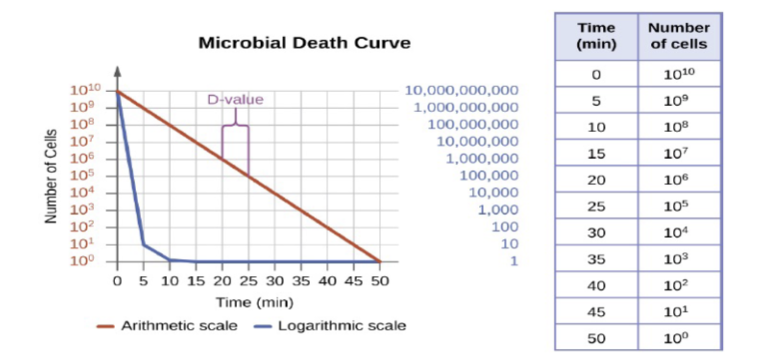
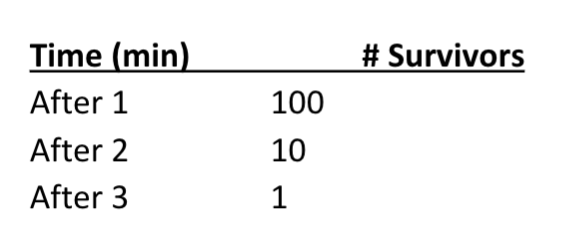
What is an example of the D-Value?
Based on the table, the D-Value would be 1 minute because 90% of the population is killed every minute
What can alter the effectiveness of AMA?
Number of microbes: the higher the number, the longer it takes
Time of exposure
Environmental influences: Temperature, presence of organic matter may prevent the action of some AMAs
Microbial characteristics: Bacteria being gram positive vs. gram negative, Viruses being enveloped vs. non-enveloped
What type of bacteria do Biocides tend to be more effective against? Why?
Biocides tend to be more effective against Gram-positive bacteria (Staph & Strep) because they lack Gram-negative’s outer membrane
What specifically do we do to microbes to kill them?
Alter cell membranes and cell walls (physical damage): Change in membrane permeability can cause cellular contents to leak out leading to cell lysis
What specifically do we do to microbes to kill them? pt. 2
Disruption of cellular metabolism and reproduction: Protein damage leads to loss of function, affecting metabolic pathways. DNA/RNA damage prevents reproduction