Onc 2.1 Midterm
 Call Kai
 Learn
Learn Practice Test
 Spaced Repetition
 Match
Match Flashcards
 Knowt Play
1/41

There's no tags or description
Looks like no tags are added yet.
Name | Mastery | Learn | Test | Matching | Spaced | Call with Kai | Chat |
|---|
No analytics yet
Send a link to your students to track their progress
42 Terms
inheritance patterns of primary immunodeficiencies?
x-linked → chronic granulomatous disease (&G6PD), wiskott-aldrich, XLA, lymphoproliferative (sapped effect), SCID, hyper IgM (CWALSH)
autosomal recessive → the remaining
x-linked agammaglobulinemia (XLA) category? etiology? markers? clinical features?
B cell (humoral) → manifest @ 1st yr of life
BTK mut. → pre-B cell arrested growth → no light chain/surface marker (IgG/A/M/E/D absent)
recurrent RT + EC infections, rudimentary germinal centers, absent tonsil, small LN
Tx w/ large dose y-globulin infusion
IgA deficiency category? etiology? markers? clinical features?
B cell (humoral) → manifest @ 1st yr of life
selective IgA absence (dec. IgA, normal IgG/M, inc. IgE)
mucosal infections, allergic disease, transfusion rxn, TIG prophylaxis
Tx w/ antibiotics
x-linked (B+T) vs autosomal (B) hyper IgM category? etiology? markers?
B cell (humoral) → manifest @ 1st yr of life
CD40L (T) def. → dec. CD40 (B) act.
indicated via opp. infection (PCP pneumonia, chronic diarrhea, oral thrush)
CD40/AID def. → dec. class switch
inc. IgM, dec. IgG/A/E/D
x-linked (B+T) and autosomal (B) hyper IgM clinical features? treatment?
neutropenia (dec. sFcyRIII) → IC bacterial, pyogenic, fungal infections
via T cell not binding w/ MO CD40 → dec. cytokines = ineffective granulopoiesis
poorly organized, lack 2ndary follicle (should have act. B cell) + germinal center
Tx w/ antibiotics + periodic y-globulin infusion
common variable immunodeficiency (CVI) category? etiology? markers? clinical features?
B cell (humoral) → manifest @ 1st yr of life
impaired B cell diff. (dec. IgG/A/M, dec. plasma cell)
sinopulmonary infections, autoimmunity, giardia
transient hypo y globulinemia (HyG) category? etiology? markers? clinical features?
B cell (humoral) → manifest @ 1st yr of life
delayed IgG synth. (placenta) = dec. IgG in infancy
mild infections, resolves w/ age
x-linked vs autosomal SCID category? etiology? markers? clinical features?
T cell/combined → manifests early + Tx w/ BMT
defective IL2Ry (= T-, B+, NK-)
defective ADA, JAK3 (ILRy defect = B+), PNP (B±, NK+), RAG (NK+)
dec. TREC
CD3 (T), CD20 (B), CD16 (NK)
x-linked and autosomal SCID clinical features? treatment?
recurrent viral, bacterial, fungal (strep. pneumocystis, candida) → thrush, otitis media
failure to thrive, chronic diarrhea
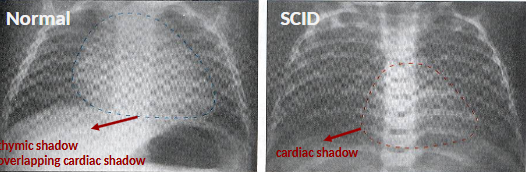
absent thymus (only cardiac shadow present), germinal centers, T cells
omenn syn. (RAG mut.) → erythroderma, hepatosplenomegaly
Tx w/ antibiotics + Ig (immediate) → BMT (long term)
digeorge syndrome category? etiology? markers? clinical features?
T cell/combined → manifests early + Tx w/ BMT
22q11.2 del. → thymic aplasia
dec. T cells, dec. PTH =dec. Ca
recurrent infections, tetany, tetralogy of fallot
dec. LN paracortex development → dec. mature T cells
x-linked WAS category? etiology? markers? clinical features?
T cell/combined → manifests early + Tx w/ BMT
WASP mut. → cytoskeleton defect (dec. IgM, inc. IgA/E, dec. platelets)
eczema, encapsulated bacterial infection
Tx w/ BMT
ataxia-telangiectasia category? etiology? markers? clinical features?
T cell/combined → manifests early + Tx w/ BMT
ATMK mut. → dec. DNA repair via failure to halt progression
= inc. AFP, dec. IgA
ataxia, telangiectasia (dilated caps), sinopulmonary infections
MHC I vs II deficiency category? etiology? markers? clinical features?
T cell/combined → manifests early + Tx w/ BMT
TAP mut. = dec. CD8 → chronic lung + skin inflammation; viral infection
CIITA/RFX mut. = dec. CD4 + IgG/A/M/E/D → SCID-like
x-linked chronic granulomatous disease (CGD) category? etiology? markers? clinical features?
phagocyte defect
NADPH oxidase defect (dec. NBT/DHR)
abscess, granuloma, inc. cat. + infection, -nitroblue
G6PD dec.= inc. oxidative injury → heinz bodies + bite cells
leukocyte adhesion deficiency (LAD) category? etiology? markers? clinical features?
phagocyte defect
CD18 (B2 integrin) defect (inc. neutrophils, dec. CD18)
dec. wound healing, no pus, delayed separation of cord (omphalitis)
chediak-higashi syndrome category? etiology? markers? clinical features?
phagocyte defect
LYST mut. → dec. vesicle trafficking (giant granules)
progressive neurodegenerative, lymphoma-like phase, albinism, recurrent pyogenic infections, peripheral neuropathy (PLAIN)
hyper-IgE syndrome (job’s) category? etiology? markers? clinical features?
phagocyte defect
STAT3 mut. → dec. Th17 (inc. IgE, eosinophilia)
eczema, pulm + skin infections, cold abscesses (staph.)
hereditary angioedema (HAE) category? etiology? markers? clinical features?
complement defect
dec. C1 esterase inhibitor (C1NH) = dec. C4, inc. bradykinin
Type 1 (quantitative def.) or Type 2 (dysfunctional)
classical path act., edema, epiglottal swelling
Tx w/ ruconest, berinert, lanadelumab
C3 vs C5-C9 deficiency category? etiology? markers? clinical features?
complement defect
central opsonin defect = dec. C3 + IgG → recurrent encapsulated bacterial infection (e.g strep)
MAC form. defect = dec. term. complement → neisseria infection
origin of leukemias? characteristics? ancillary studies?
lymphoid or myeloid neoplasm (involves blood + BM)
tumor cells/WBC in peripheral blood
immunotyping (flow cytometry or immunochemistry) OR cytogenic analysis (karyotype or FISH)
acute vs chronic leukemia?
dec. normal hematopoietic act. via marrow replacement → blastocytosis + pancytopenia
leukocytosis w/ anemia, thrombocytopenia, neutropenia
fatigue bleeding/bruising, infection, bone pain
inc. clonal hematopoietic act./hypercellular marrow → mature cells w/ preserved function until late
cytopenia late
fatigue, weight loss, splenomegaly
process of myeloid neoplasms? categorization?
clonal expansion of hematopoietic progenitors → accumulate in marrow (expansile infiltration) → disrupts normal hematopoiesis + marrow failure → EMH (= splenomegaly)
acute or chronic (myelodysplastic or myeloproliferative)
acute myeloid leukemia (AML) mechanism? characteristics?
clonal proliferation of myeloblasts = granular (>20% blasts in periphery) → bone pain, fever, bruising, hepatosplenomegaly
MOP → auer rods (stain red) + inc. circulating myeloblasts on smear
ALL + AML = rapid + aggressive vs chronic
acute promyelocytic leukemia (AML)?
t(15;17) → PML::RARA
DIC is common = clotting cascade issue
Tx w/ all-trans retinoic acid (vit. A)
inv (16) (p13;q22) → CFB::MyHII
abnormal eosinophils
t(8;21)(q22;22) → RUNI::RUNXITI
granulocytes
myelodysplastic syndrome mechanism? cause? treatment?
ineffective hematopoiesis (dysplastic precursor) → defective cell maturation/differentiation → clonal cytopenia (anemia common)
easy bruise/bleed, fatigue, weight loss/LOA, petechiae, fever, freq. infection, weakness, SOB
de novo mutation or environmental exposure (benzene, chemo, radiation) → risk of transformation of AML
Tx w/ allogenic HSC transplant (HLA match), hypomethylating agent/chemo (azacitidine, decitabin), immunosuppressive therapies (ATG, cyclosporine, alemtuzumab)
MDS via Chr. 5q del. Tx w/ lenalidomide
myeloproliferative neoplasm mechanism? characteristics? types?
JAK2/CALR/MPL mut. → mature myeloid clonal proliferation → marrow hypercellularity (cytoses)
splenomegaly + EHM; middle aged
chronic myeloid leukemia (CML), polycythemia vera (PV), essential thrombocytopenia (ET), myelofibrosis
chronic myeloid leukemia (CML) mechanism? smear? progress to? treatment?
t(9;22) + chimeric fusion BCR-ABL → constitutive oncogene act. → granulocytosis
spectrum of myeloid maturation (myeloblasts, promyelocytes, neutrophils, basophils, eosinophils) → via defective adhesion of clonal cells to BM = enter blood early
accelerate/transform to AML (or less common ALL) = “blast crisis”
Tx w/ imatinib → BCR-ABL TK inhibitor
what is the difference between CML and leukemoid reaction?
CML = LAP (-), basophilia, t(9;22) → inc. BCR-ABL
LR = LAP (+), reactive neutrophilia, toxic granulation, dohle bodies, cytoplasmic vacuoles
normal eosinophils/basophils
polycythemia vera (PV) mechanism? symptoms? signs of progression? treatment?
acquired JAK2 mut. = inc. RBC + dec. EPO
pruritis after shower, erythromelalgia (burning pain in hands/feet + red-blue discoloration via blood clots), hyper viscosity + thrombosis → cardio complications
conjunctival plethora, granulocytic proliferation, hepatosplenomegaly, medullary fibrosis, panmyelosis, thrombosis
Tx w/ phlebotomy, hydroxyurea, ruxolitinib (JAK1/2 inhibitor)
essential thrombocytopenia (ET) mechanism? symptoms? treatment?
massive proliferation of megakaryocytes + platelets
bleeding + thrombosis, sometimes erythromelalgia
paradoxical hemorrhage risk → inc. platelets = inc. vWF = coagulation imbalance = hemorrhage (instead of thrombosis)
Tx w/ cytoreductive drugs (hydroxyurea or anagrelide)
idiopathic myelofibrosis (IMF) mechanism? characteristics? secondary causes? treatment?
atypical megakaryocyte hyperplasia (via JAK2 kinase mut.) → inc. TGF-B → inc. fibroblast collagen deposition → inc. obliterative medullary fibrosis → splenomegaly
associated w/ teardrop poikilocytosis, leucoerythroblastic, splenomegaly, early cell line inc. → late stage pancytopenia
metastatic carcinoma, lymphomas, granulomatous disorders (TB, histoplasmosis, sarcoidosis)
Tx w/ ruxolitinib (JAK1/2 inhibitor)
acute monocytic leukemia? acute megakaryoblastic leukemia?
inc. proliferation of monoblasts; lack MPO
infiltrate gums
inc. proliferation of MK blasts; lack MPO
associated w/ DS before 5
lymphoid neoplasm? types?
derived from B, T, NK cell → Dx w/ flow cytometry (+ supplemental tests)
lymphoblasts → ALL (B or T)
mature → CLL/SLL, sezary/ATLL, hairy cell leukemia
acute lymphoblastic leukemia (ALL) markers? diagnosis? types?
TdT marker (lymphoblast), CD34 (HSC)
>20% blasts in periphery, common in children (associated w/ DS after 5)
agranular cytoplasm
B-ALL (CD10,19,22) → t(12;21) better prognosis + child vs t(9;22)/Ph+ worse prognosis + adult
T-ALL (CD 2-8)→ mediastinal mass (lymphoma) = thymic mass in teen
chronic lymphocytic leukemia (CLL) vs small lymphocytic lymphoma (SLL)? markers? smear?
mature B cell neoplasm → CLL (marrow, common in adult), SLL (nodal, tissue based)
asymptomatic + indolent (turn into aggressive diffuse large B cell lymphoma = richter transformation), AIHA
CD5, CD20, CD23 (pan-B cell markers)
smudge cell
note: also NHL
hairy cell leukemia markers? mechanism? characteristics? treatment?
mature B cell neoplasm (chronic) → CD103 + B cell markers (CD19,20,22)
BRAF mut. → filamentous, hairlike projection (fuzzy)
splenomegaly (pulp engorgement), pancytopenia, marrow fibrosis = dry tap; stains TRAP (+)
peripheral LAD uncommon
Tx w/ purine analogs (cladribine + pentostatin)
note: also NHL
sezary syndrome characteristics? ATLL?
CD4 + T cells
cut. T cell lymphoma → erythroderma/mycosis fungoides, cerebriform nuclei, LAD
CCD4, CCR10
peripheral T cell lymphoma → via HTLV-1 (japanese + caribbean) = hypercalcemia, lytic lesions, LAD, HSM, rash
flower cells, inc. CD2,3,5 (NOT 7)
non-neoplastic marrow proliferation disorders?
aplastic anemia
pure red cell aplasia
myelopathic anemia
aplastic anemia mechanism? features? types?
chronic primary hematopoietic failure → dec. blood forming elements → hypocellular marrow w/ lots of fat cells
pancytopenia, reticulocytopenia, thrombocytopenia, neutropenia, splenomegaly
acquired (idiopathic, acq. stem cell defect, immune), chemical, physical (while body irradiation, viral infection), inherited (fanconi, telomerase defect)
chemical cause of aplastic anemia?
dose related → alkylating agents, antimetabolite, benzene, chloramphenicol, inorganic-arsenicals
idiosyncratic → chloramphenicol, phenylbutazone, organic arsenicals, penicillamine, gold salts, methylphenylethlhydantoin, carbamazepine
pure red cell aplasia mechanism? acquired via?
diminished erythropoiesis → reticulocytopenia w/ isolated anemia
neoplasms, drug exposure, autoimmune disorders, infections
diamond-blackfan → constitutional/congenital disorder via defective erythroid maturation
familial/inherited or sporadic, triphalangeal thumbs
myelophthisic anemia mechanism?
BM wastage → replacement of normal hematopoietic marrow by infiltrative, granulomatous process
fibrosis, tumor (metastatic), histiocytic expansion (storage or proliferative disorder condition)
as infiltrative process expands → hematopoietic activity proportionally dec. → pancytopenia
precursors prematurely enter blood, produce leukoerythroblastosis