5SAHEe-Reading 3 (vowels)
 Call Kai
 Learn
Learn Practice Test
 Spaced Repetition
 Match
Match Flashcards
 Knowt Play
1/114

There's no tags or description
Looks like no tags are added yet.
Name | Mastery | Learn | Test | Matching | Spaced | Call with Kai | Chat |
|---|
No analytics yet
Send a link to your students to track their progress
115 Terms
Transcription
The process of representing speech sounds using symbols.
Phonetic dictionaries
Dictionaries that provide the pronunciation of words using phonetic symbols.
Vowels
Speech sounds produced with an open vocal tract, characterized by the absence of any significant constriction or blockage of airflow.
Accent
The way in which a person or group of people pronounce words, influenced by their regional or cultural background.
Length mark
A symbol used to indicate the difference in length between two vowel sounds.
Vowel quality
The characteristic sound quality of a vowel, determined by the position of the tongue and lips.
Phonetics instructors
Teachers who specialize in the study and instruction of phonetics.
British English
The variety of English spoken in the United Kingdom.
American English
The variety of English spoken in the United States.
Pronunciations
The way in which words are spoken or pronounced.
Reference books
Books that provide information and guidance on a particular subject.
Daniel Jones
An English phonetician who made significant contributions to the field of phonetics in the early 20th century.
Longman Pronunciation Dictionary
A dictionary that provides pronunciations of words in both British and American English.
Oxford Dictionary of Pronunciation for Current English
A dictionary that provides a wider range of pronunciations for both British and American English.
IPA symbols
Symbols used in the International Phonetic Alphabet to represent speech sounds.
National newscasters
News presenters who speak in a standardized manner that is considered representative of their country's accent.
Standard American Newscaster English
The standardized accent used by American newscasters.
Standard BBC English
The standardized accent used by British newscasters.
Regional accents
Variations in pronunciation that are specific to a particular region or area.
Comparative phonetic purposes
The use of phonetic symbols to compare and analyze different pronunciations.
Ad hoc symbols
Symbols created for specific purposes or situations.
IPA tradition
The established conventions and practices associated with the International Phonetic Alphabet.
Tongue tip trill
A specific type of trill produced by vibrating the tip of the tongue against the roof of the mouth.
Vowel Quality
The quality of different vowels, which is difficult to describe precisely due to the limitations of traditional articulatory descriptions.
Phonetics
The study of the physical sounds of human speech.
Articulatory Descriptions
Descriptions of how speech sounds are produced by the articulatory organs, such as the tongue and lips.
MRI Images
Images obtained using Magnetic Resonance Imaging, which can show the positions of the tongue during vowel production.
IPA Symbol
International Phonetic Alphabet symbol, used to transcribe speech sounds.
Vowel Height
The vertical position of the tongue during vowel production, which can vary among different vowels.
Vowel Retraction
The backward movement of the tongue in the mouth during vowel production.
Auditory Differences
Differences in how vowels sound to the ear.
Linguistic Contrasts
Differences in vowel sounds that are meaningful in a particular language.
Phonetic Vowel Transcription
The process of representing vowel sounds using phonetic symbols.
Tongue Position
The location of the tongue in the mouth during vowel production.
Continuum
A range or sequence of vowel sounds that blend into each other without distinct boundaries.
Gliding
Transitioning smoothly from one vowel sound to another.
Midwestern American Pronunciation
The typical pronunciation of vowels in the Midwestern region of the United States.
Scottish English
The variety of English spoken in Scotland, which may have different vowel pronunciations compared to other accents.
Boston English
The variety of English spoken in the Boston area, which may have unique vowel pronunciations.
Auditory Quality
The perceived sound quality of a vowel. To change the auditory quality of the vowel means to move from one to another.
high/low and front/back labels
should not be taken as descriptions of tongue positions. They are simply indicators of the way one vowel sounds relative to another. The labels describe the relative auditory qualities, not the articulations →matter of tradition, phoneticians thought they were describing tongue positions
High Front
A label used to describe the auditory quality of a vowel that is high and in the front of the mouth. Example [i] as in heed.
Low Front
A label used to describe the auditory quality of a vowel that has a low tongue position and is in the front of the mouth. Example [æ]
Mid-low front
A vowel sound that is between [ɛ] and [i], closer to [æ].
Low back
A vowel sound with a tongue position that is low and back in the mouth.
High, fairly back vowel
A vowel sound that is high and towards the back of the mouth.
The vowel space
Four corners of a space showing the auditory qualities of vowels
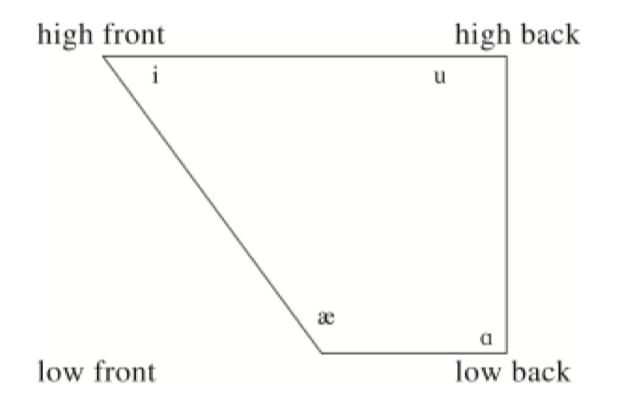
Fully back [u]
A vowel sound that is pronounced by rounding and protruding the lips more while moving the tongue back in the mouth while still keeping it raised toward the soft palate.
Acute and grave
Terms that have been used to describe front and back vowels, respectively, instead of using the terms front and back.→not widely used
Monophthongs
Vowels that are pronounced with a single, unchanging sound.
Diphthongs
Vowels that involve a glide or movement from one sound to another. In English, the first part of the diphthong is usually more prominent than the last. In fact, the last part is often so brief and transitory that it is difficult to determine its exact quality. Furthermore, the diphthongs often do not begin and end with any of the sounds that occur in simple vowels.
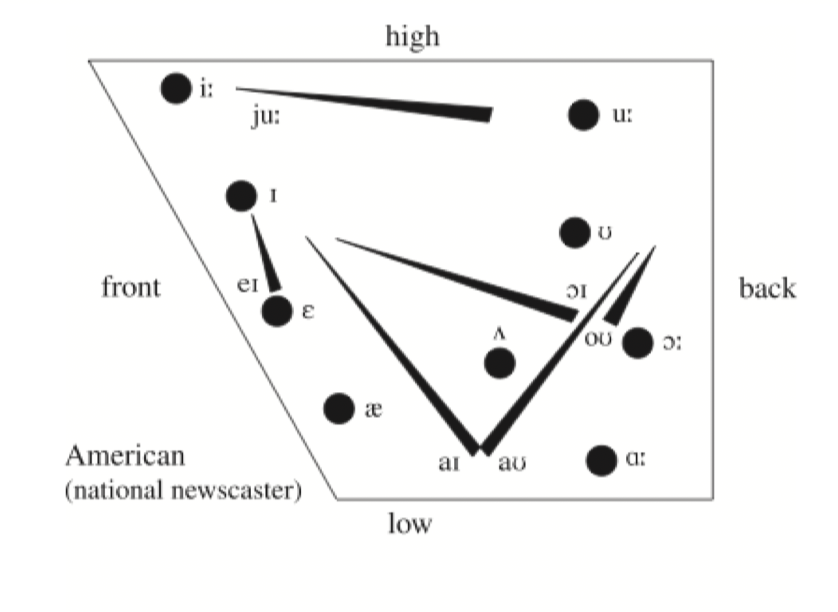
Standard American Newscaster English
A form of English spoken by many Midwestern speakers in the United States.
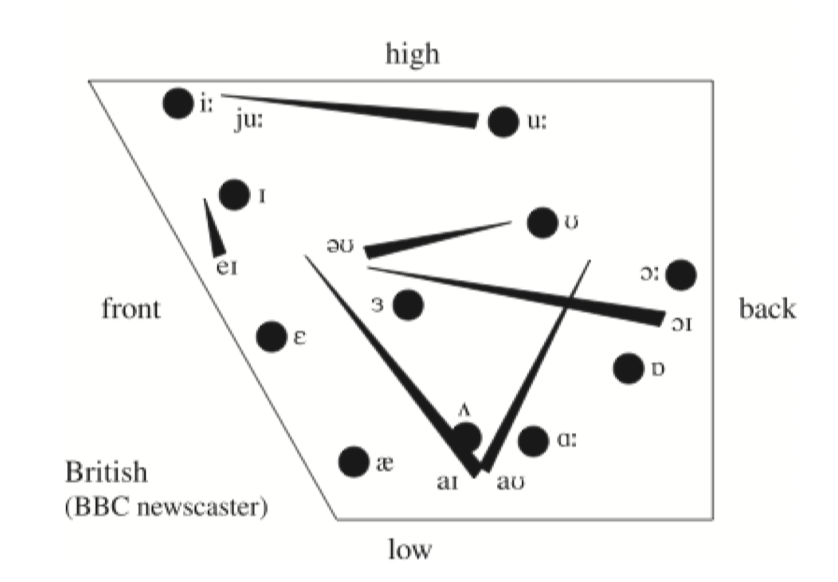
British English
The form of English spoken by BBC newscasters in the United Kingdom.
Auditory impressions
Perceptions of vowel sounds based on how they are heard.
Equal steps
The perception that vowel sounds differ by the same amount or distance from each other.
Glide
A smooth movement or transition from one sound to another.
Midlands and the North of England
Regions in England where certain vowel sounds may be pronounced differently, such as a lower and more back vowel in "had".
Front vowels
Vowels produced with the front part of the tongue positioned close to the front of the mouth.
Back vowels
Vowels produced with the back part of the tongue positioned close to the back of the mouth.
Vowel qualities
Different sounds or qualities produced by vowels.
Nonsyllabic
A diacritic symbol used to indicate the less prominent portion of a diphthong.

Superscript letter
A method used to mark diphthongs, with the nonsyllabic element printed as a superscript letter.
Vowel
A speech sound produced with an open vocal tract, without any obstruction or closure.
Rhotacization
The process of adding an "r" sound or quality to a vowel. The vowel is r-colored. Describes an auditory property.
Retroflex vowels (two ways in which they can be produced)
Vowels produced with the tip of the tongue raised or the tongue in a high bunched position, resulting in an r-colored sound. In both there is a constriction in the pharynx caused by retraction of the part of the tongue near the epiglottis.
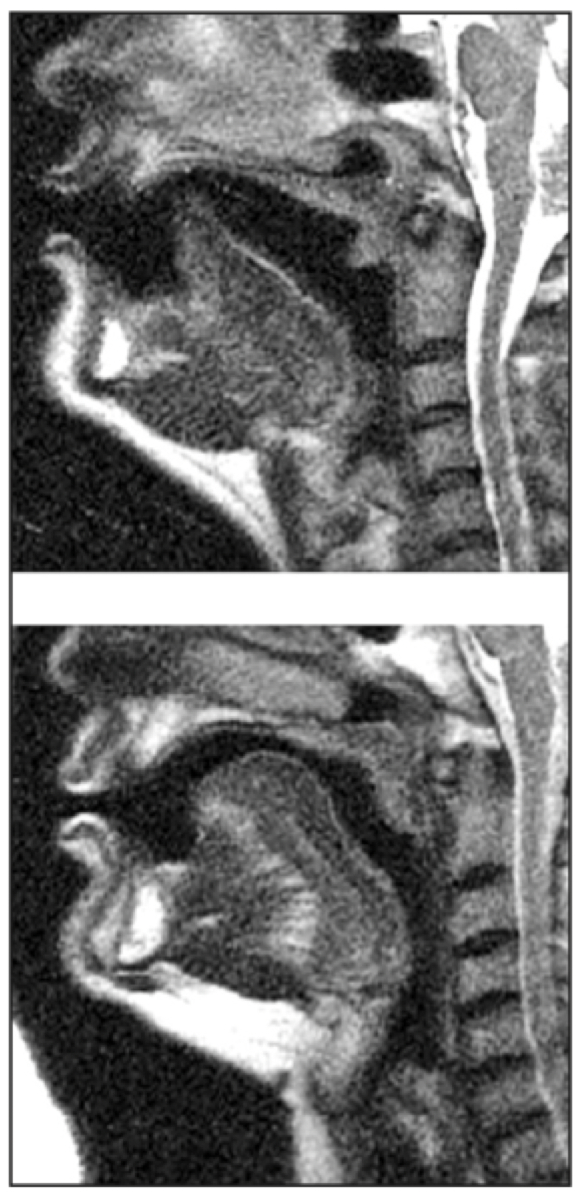
Rhotic
An accent or dialect of English that retains the rhotacized vowels, where vowels are followed by an "r" sound.
Non-rhotic
An accent or dialect of English that does not have rhotacized vowels, where the "r" sound is not pronounced after vowels.
[ɹ] vowel
mid-central vowel with added rhotacization.
Vowel space
The area in which vowel sounds are represented on a chart, based on their position in terms of height and backness.
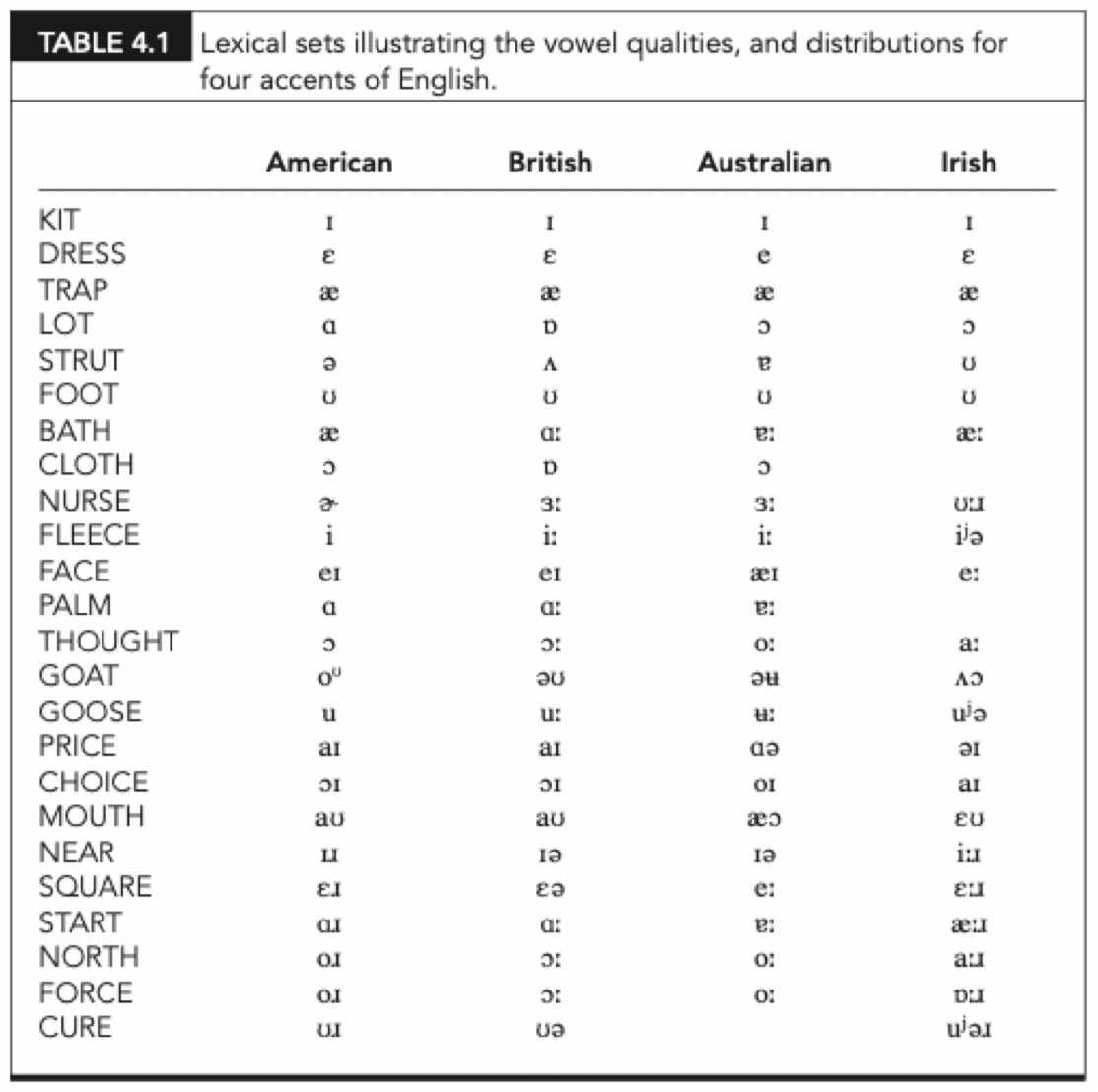
Lexical sets
Groups of words that share the same vowel sound in a particular accent or dialect of English. A system of categorizing English vowels based on their pronunciation in different accents. The lexical set system provides information about the three important parameters of accent variation in English vowels.
three important parameters of accent variation in English vowels
(1) the number of phonological vowel categories
(2) the phonetic vowel qualities
(3) the distribution of vowels
Mid-central vowel
A vowel sound that is neither high nor low, and is produced in the central part of the vowel space.
Standard Northern accents
Accents of British English spoken in the northern region of England.
BBC English
The accent used by broadcasters on the British Broadcasting Corporation (BBC).
Vowel contrasts
Differences in pronunciation between different vowel sounds.
Vowel systems
The collection of vowel sounds used in a particular accent or language.
Difference in distribution
A difference in how vowel qualities are used in different words.
Difference in system
A difference in the number of distinct vowels in an accent.
Phonetic vowel qualities
The specific sounds and characteristics of vowels in speech.
Cockney English
A traditional accent associated with working-class Londoners. ([ʌɪ] and [ɑɪ] in mate and might)
Estuary English
A modern accent spoken in the area around the River Thames in London. ([mɛɪt] and [mʌɪt] in mate and might)
Phonological vowel categories
The number of distinct vowel sounds in an accent.
Phonetic vowel qualities
The specific sounds and characteristics of vowels in speech.
Distribution of vowels
The patterns of vowel sounds used in different words.
TRAP, PALM, and BATH vowels
Specific sets of words pronounced with different vowel sounds in American and British English.
Accent differences
Variations in pronunciation between different accents of English.
Systemic differences
Differences in the overall vowel system of an accent.
Distributional differences
Differences in how vowel sounds are used in different words.
Vowel quality differences
Differences in the specific sounds and characteristics of vowels.
Accent variation
Differences in pronunciation between different accents of English.
Unstressed syllables
Syllables in words that do not receive emphasis or stress.
Mid-central vowel qualities
A range of vowel sounds that occur in English, represented by the symbol [ E ].
Grammatical function words
Words that serve a grammatical purpose in a sentence, such as "to," "the," and "at."
Vowel chart
A visual representation of vowel sounds, with vowels near the outside of the chart being more distinct from each other.
Reduced vowel
A vowel that has a central, reduced quality, often represented by the symbol [ə].
Lexical correspondences
Relationships between words that share similar vowel sounds, either in their full or reduced forms.
Diachronic processes
Historical changes in the pronunciation of words over time.
Synchronic process
The current state of pronunciation in a language.
Phonetically reduced
A vowel that has been reduced in its quality, often to a central, mid-central vowel sound.
Tense vowels
Vowels that are longer, higher, and less centralized than lax vowels. Vowels that occur in words with a final silent "e" in the spelling. (mate, kite)