e
 Call Kai
 Learn
Learn Practice Test
 Spaced Repetition
 Match
Match Flashcards
 Knowt Play
1/38

There's no tags or description
Looks like no tags are added yet.
Name | Mastery | Learn | Test | Matching | Spaced | Call with Kai | Chat |
|---|
No analytics yet
Send a link to your students to track their progress
39 Terms
What is epithelial tissue?
A sheet of cells that:
covers a body surface, or
lines a body cavity
What are the two types of epithelial tissue?
1. Covering and lining epithelium
Forms the outer layer of skin
Dips into and lines the open cavities of the:
urogenital system
digestive system
respiratory system
Covers the walls and organs of the closed ventral body cavity
2. Glandular epithelium
Forms the glands of the body
What are the functions of epithelium?
Protection
Absorption
Filtration
Excretion
Secretion
Sensory reception
What does polarity mean in epithelial tissue?
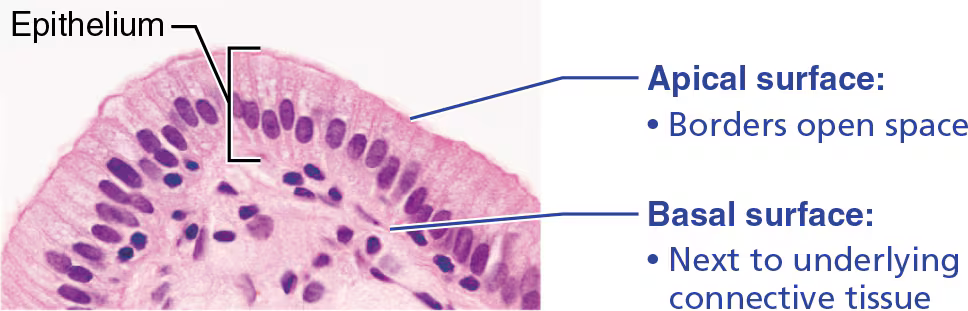
Epithelia exhibit apical-basal polarity because they have two different surfaces:
Apical surface
Not attached to surrounding tissue
Exposed to either:
the outside of the body, or
the cavity of an internal organ
Basal surface
Attached to the underlying connective tissue
For this reason, we say that epithelia exhibit apical-basal polarity.
What are microvilli, and what is their significance in epithelial tissue?
Increase the exposed surface area
In epithelia that absorb or secrete substances, microvilli are often so dense that the cell apices have a fuzzy appearance
This fuzzy appearance is called a brush border
What are cilia, and what do they do in epithelial tissue?
Some epithelia, such as the epithelium lining the trachea, have motile cilia
These cilia propel substances along the free surface of the epithelium
What is the basal lamina, and what are its composition and functions?
A thin, noncellular supporting and adhesive sheet
Consists largely of:
Glycoproteins secreted by epithelial cells
Some fine collagen fibers
Acts as a selective filter, determining which molecules diffusing from the underlying connective tissue are allowed to enter the epithelium
Acts as scaffolding along which epithelial cells can migrate to repair a wound
What are the junctions in epithelial cells, and what do they do?
With the exception of glandular epithelia, epithelial cells fit closely together to form continuous sheets.
Adjacent epithelial cells are tied together by:
Tight junctions → prevent substances from leaking through the spaces between cells
Desmosomes → keep cells from pulling apart
What is the basement membrane, and what are its functions/components?
Located between epithelial and connective tissues
Reinforces the epithelial sheet
Helps the epithelium resist stretching and tearing
Includes:
the epithelial basal lamina
the reticular lamina
What is the reticular lamina, and what is it made of?
Located deep to the basal lamina
Consists of a layer of extracellular material
Contains a fine network of collagen protein fibers
These fibers belong to the underlying connective tissue
What does avascular mean in epithelial tissue?
Avascular = contains no blood vessels
Epithelium is avascular
What does innervated mean in epithelial tissue, and how are epithelial cells nourished?
Innervated = supplied by nerve fibers
Epithelial cells are nourished by substances that diffuse from blood vessels in the underlying connective tissue
What is epithelial regeneration, and why is it important?
Epithelium has a high regenerative capacity.
Some epithelia are exposed to friction, causing their surface cells to rub off
Other epithelia are damaged by hostile substances in the external environment, such as:
bacteria
acids
smoke
If and when apical-basal polarity and lateral contacts are destroyed, epithelial cells begin to reproduce rapidly
As long as epithelial cells receive adequate nutrition, they can replace lost cells by cell division
What are simple epithelia, and what are their main functions?
Consist of a single cell layer
Typically found where a thin epithelial barrier is desirable
Mainly involved in:
Diffusion or filtration → simple squamous
Absorption and secretion → simple cuboidal and simple columnar
Protection is not one of their specialties
What are stratified epithelia, and what are their key characteristics?
Composed of 2 or more cell layers stacked on top of each other
Common in high-abrasion areas where protection is important, such as:
skin surface
lining of the mouth
Named according to the shape of the cells in the apical layer
Regenerate from below:
basal cells divide
new cells are pushed apically
they replace older surface cells
What are the characteristics of squamous cells?
Flattened and scale-like
Have a flattened, disc-shaped nucleus
What are the characteristics of cuboidal cells?
Boxlike
Approximately as tall as they are wide
Have a spherical nucleus
What are the characteristics of columnar cells?
Tall and column-shaped
Have a nucleus that is elongated from top to bottom
The nucleus is usually located closer to the cell base
Simple squamous epithelium
Description
Single layer of flattened cells
Disc-shaped central nuclei
Sparse cytoplasm
Simplest of epithelia
Function
Allows materials to pass by diffusion and filtration in sites where protection is not important
Secretes lubricating substances in serosae (linings of the ventral body cavity)
Location
Kidney glomeruli
Air sacs of the lungs
Lining of the heart
Blood vessels
Lymphatic vessels
Serosae
Simple cuboidal epithelium
Description
Single layer of cubelike cells
Have large, spherical, centrally located nuclei
Function
Secretion
Absorption
Location
Kidney tubules
Ducts and secretory portions of small glands
Ovary surface
Simple columnar epithelium
Description
Single layer of tall cells
Nuclei are round to oval
Many cells have microvilli
Some cells have cilia
May contain mucus-secreting unicellular glands (goblet cells)
Function
Absorption
Secretion of:
mucus
enzymes
other substances
The ciliated type propels mucus or reproductive cells by ciliary action
Location
Nonciliated type:
lines most of the digestive tract (stomach to rectum)
gallbladder
excretory ducts of some glands
Ciliated type:
small bronchi
uterine tubes
some regions of the uterus
Pseudostratified columnar epithelium
Description
Single layer of cells of differing heights
Some cells do not reach the free surface
Nuclei are located at different levels
May contain mucus-secreting cells
May bear cilia
Function
Secretes substances, especially mucus
Propels mucus by ciliary action
Location
Ciliated variety:
trachea
most of the upper respiratory tract
Nonciliated types:
sperm-carrying ducts in males
ducts of large glands
Stratified squamous epithelium
Description
Thick epithelium composed of several cell layers
Basal cells are cuboidal or columnar and metabolically active
Surface cells are squamous
In the keratinized type, surface cells are full of keratin and dead
Basal cells are active in mitosis and produce the cells of the more superficial layers
It is the most widespread type of stratified epithelium
Function
Protects underlying tissues in areas subject to abrasion
Location
Nonkeratinized type forms the moist linings of the:
esophagus
mouth
vagina
Keratinized type forms the epidermis of the skin, which is a dry epithelium
Forms the external surface of the skin and extends a short distance into every body opening that is directly continuous with the skin
Transitional epithelium
Description
Resembles both stratified squamous and stratified cuboidal epithelium
Basal cells are cuboidal or columnar
Surface cells are:
dome-shaped when less stretched
squamous-like depending on the degree of organ stretch
Function
Stretches readily
Allows stored urine to distend urinary organs
Location
Lines the:
ureters
bladder
part of the urethra
What is endothelium?
A type of simple squamous epithelium
Provides a slick, friction-reducing lining in:
lymphatic vessels
all hollow organs of the cardiovascular system, including blood vessels and the heart
Capillaries consist exclusively of endothelium
Its exceptional thinness promotes efficient exchange of nutrients and wastes between the blood and surrounding cells
What is mesothelium?
A type of simple squamous epithelium
Found in the serous membranes
These membranes:
line the ventral body cavity
cover the organs within it
What modifications of columnar cells make the digestive tract ideal for secretion and absorption?
Columnar cells
Dense microvilli on the apical surface of absorptive cells
Tubular glands made primarily of cells that secrete mucus-containing intestinal juice
Together, these modifications make the digestive tract ideal for secretion and absorption.
Stratified cuboidal epithelium
Rare in the body
Typically has 2 layers of cuboidal cells
Found mainly in the ducts of larger glands, including:
sweat glands
mammary glands
Stratified columnar epithelium
Has a limited distribution in the body
Found in small amounts in:
the pharynx (throat)
the male urethra
some glandular ducts
Often occurs at transition areas or junctions between two other types of epithelia
Only the apical layer is columnar
What is a gland, and what does it secrete?
Consists of one or more cells that make and secrete a particular product
This product is called a secretion
A secretion is usually an aqueous fluid containing proteins
Some glands instead release lipid-rich or steroid-rich secretions
What do endocrine and exocrine mean?
Endocrine = internally secreting
Exocrine = externally secreting
What are unicellular and multicellular epithelial glands?
Unicellular glands
Are scattered within epithelial sheets
Multicellular epithelial glands
Most form by invagination (inward growth) of an epithelial sheet
The epithelial sheet grows into the underlying connective tissue

Endocrine glands
Lose their ducts during development → often called ductless glands
Produce hormones, which are chemical messengers
Hormones are secreted by exocytosis directly into the extracellular space
From there, they enter the blood or lymphatic fluid
Then travel to specific target organs
Are structurally diverse:
Most are compact multicellular organs
Some are individual hormone-producing cells scattered throughout the body, such as in the digestive tract lining (mucosa)
These scattered cells are collectively called the diffuse endocrine system
Secretions vary and include:
modified amino acids
peptides
glycoproteins
steroids
Not all endocrine glands arise from epithelial tissue
Exocrine glands
Secrete products onto body surfaces such as the skin, or into body cavities
Unicellular exocrine glands secrete by exocytosis
Multicellular exocrine glands release secretions through an epithelium-walled duct
The duct transports the secretion to the epithelial surface
Exocrine glands are diverse
Unicellular exocrine glands
Include mucous cells and goblet cells
All such glands in humans produce mucin
Mucin is a complex glycoprotein
It dissolves in water when secreted
Once dissolved, mucin forms mucus → a slimy coating that protects and lubricates surfaces
Goblet cells
Accumulating mucin distends the top of the cell, making it look like a glass with a stem
Are sprinkled among columnar cells in the epithelial linings of the:
intestinal tract
respiratory tract
Mucous cells
Are not interspersed with other cells
Are not goblet-shaped
Multicellular exocrine glands
Two basic parts
Epithelium-derived duct
Secretory unit (acinus) made of secretory cells
Supportive connective tissue
In all but the simplest glands, supportive connective tissue:
Surrounds the secretory unit
Supplies it with blood vessels and nerve fibers
Forms a fibrous capsule that extends into the gland and divides it into lobes
Structural classification
Based on the duct:
Simple → unbranched duct
Compound → branched duct
Further classified by the shape of the secretory units:
Tubular → secretory cells form tubes
Alveolar → secretory cells form small flask-like sacs
Tubuloalveolar → contains both tubular and alveolar secretory units

Merocine glands
A type of multicellular exocrine gland
Secrete products by exocytosis
The secretory cells are not altered in any way during secretion
Examples include:
pancreas
most sweat glands
salivary glands
Holocrine gland
A type of multicellular exocrine gland
Secretory cells accumulate products inside themselves until they rupture
The ruptured cells are replaced by division of underlying cells
Holocrine secretions contain:
the synthesized product
dead cell fragments
The only example in humans is the sebaceous (oil) glands of the skin
Apocrine gland
There is controversy over whether humans have this gland type
Secretory cells accumulate products just beneath the free surface
Eventually, the apex pinches off, releasing:
secretory granules
a small amount of cytoplasm
The cell then repairs the damage, and the process repeats