mammals
 Call Kai
 Learn
Learn Practice Test
 Spaced Repetition
 Match
Match Flashcards
 Knowt Play
1/67

There's no tags or description
Looks like no tags are added yet.
Name | Mastery | Learn | Test | Matching | Spaced | Call with Kai | Chat |
|---|
No analytics yet
Send a link to your students to track their progress
68 Terms
taxonomy?
the practice & science of naming and classifying organisms. Taxo = Group; Nom =Name
Classification
the ordering of species into groups and naming the groups.
Systematics
science of classifying organisms based on their evolutionary relationships
Binomial Nomenclature
a system for naming all organisms in which there are two names, one for the genus and one for the species
Hierarchy of Classification
Domain Kingdom Phylum Class Order Family Genus Species
Subspecies
Mammal domain
eukarya
mammal kingdom
animalia
mammal phylum
chordata
mammal subphylum
vertebrata (arcopterygii, Tetrapoda, Amniota, Synapsida_
traits of mammals?
hirsute
lactogenic
endotherms
hirsute
covered in hair that has Alpha beta keratin
Mammal are what for kids
viviparous with amniotic sac
Monotremes
platapus
Enucleated red blood cells
No nucleus in blood cell creat4es more space for oxygen binding; allows folding and getting into small areas
Muscular diaphragm
creates space between lung and heart; pulls oxygen down on inhale to increase lung capacity
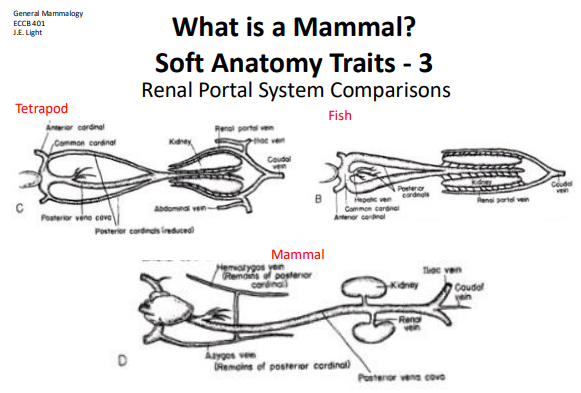
No renal portal system
Our kidneys aren’t a stop-off point no more; more efficient blood movement, tied to terrestrial movement, after movement to oxygen
Nitrogenous wastes excreted as urea
liver
dermal?
layer under skin
Integumentary
skin
Complex facial dermal muscles
for whiskers
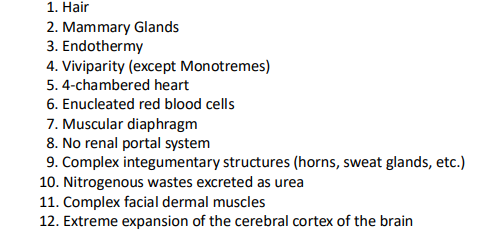
mammal soft anatomy
makes mammals a more efficient organism (no fossilization)
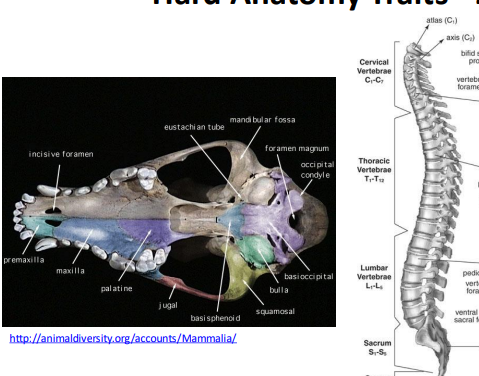
Double occipital condyle
spheres at the back of the head
where spinal cord fits in at the atlas
creates more flexible movement in head
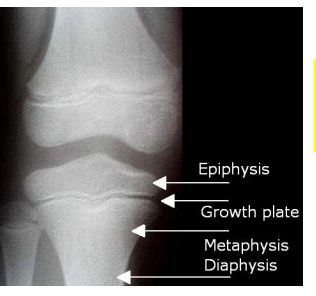
Epiphyseal line on long bones
where bone growth occurs
In between shaft of bone and where the bone articulates
Is cartilaginous (stronger bones and joints)
Less breakage in middle but strong joints at that area
growth plate
diaphysis and epiphysis
dentary bone
singular jaw bone
squamosal
moves dentary
diphyodont teeth
2 sets of teeth
baby and adult
heterodont dentition
multiple type of teeth
Hard secondary palate
for eating while breathing
seperate nasal cavity and mouth
Calcaneus
heel bone
for speed
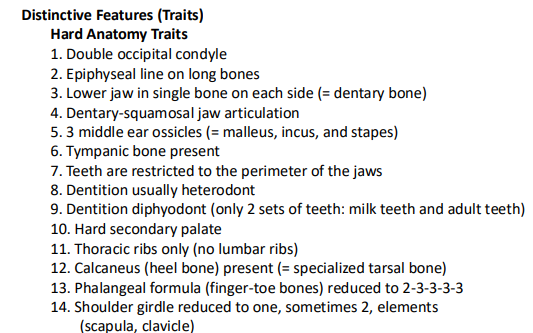
hard anatomy
to create a strong skeleton
systematics
Science of classifying organisms based on their evolutionary relationships
Determine evolutionary relationships using traits/data
Traits/data are analyzed to develop a phylogeny
Phylogeny
hypothesis of the evolutionary history/relationships of a taxon or group of related taxa.
Usually depicted as a “tree”
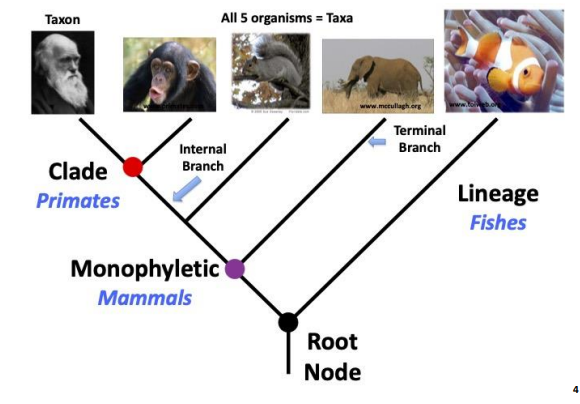
Phylogeny tree parts
Terminal Branch
Internal Branch
Node
Root
Taxon
Group of organisms that bear the same name; Plural = taxa Greek: arrangement or group
Lineage, Clade, Monophyly, Polyphyly, Paraphyly
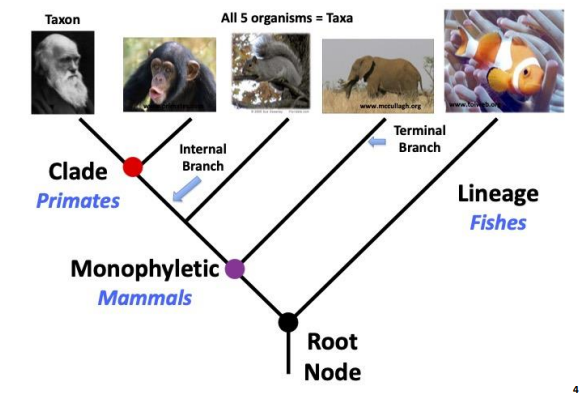
Taxa
all organisms represented
pural for taxon
internal branch
connect ancestors to decendents
terminal branch
only directly linked specific group
clade
includes internal branch
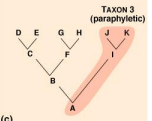
Monophyletic (Monophyly)
Taxon that includes all organisms descended from a single most recent common ancestor

Polyphyletic (Polyphyly)
Taxon that is composed of unrelated organisms descended from more than one common ancestor (does not include most recent common ancestor)
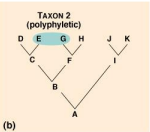
Paraphyletic (Paraphyly)
Taxon that does not include all organisms descended from a common ancestor
root
oldest/farthest branch
node
area where branches split
traits
Could be genetic data, morphological data, ecology, behavior, etc
how phylogentic trees are built
Synapomorphy
A trait that is shared by two or more taxa (shared derived trait)
Sympleisiomorphy
A shared ancestral character state
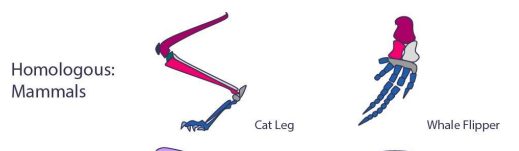
Homology/Homologous
Structures or properties with a similar evolutionary or phylogenetic origin, but not necessarily retaining a similar function, behavior, or identical structure
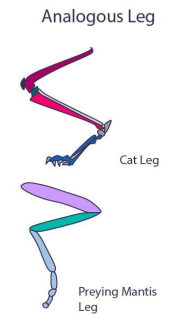
Analogy/Analogous
Structures or properties in two or more organisms that perform a similar function but the similarity is not the result of descent from a common ancestor
Morphology
Relationships determined via similarity
Comparative anatomy (need to determine homologous structures; not quantitative)
Morphometrics (measurements; quantifiable)
Karyology
Comparative cytogenetics
Isolation of chromosomes; infer relationships on morphology of chromosomes (structures holding DNA)
Molecular Methods
o Protein electrophoresis – movement of proteins in electric field
o Comparative Immunology – antigen/antibody reactions to infer relationships
o DNA X DNA Hybridization – Measures gross similarity between organisms
o RFLP (restriction fragment length polymorphisms)
o AFLP (amplified fragment length polymorphisms)
o Genetic data (gene, genome, SNPs, microsatellites)
Evolution
Change through time in a population/lineage
Evolutionary Trend
Directional change through time within a lineage
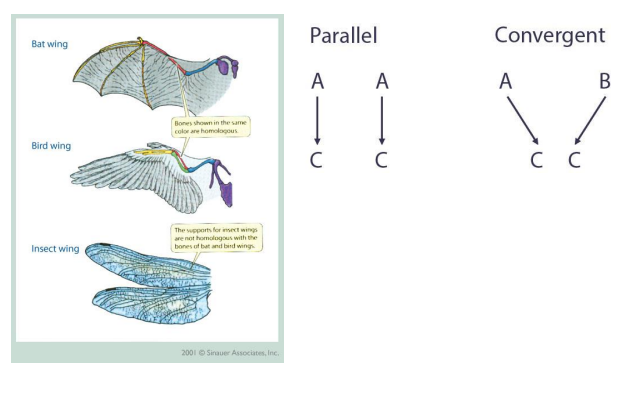
Convergent Evolution
Evolutionary trend observed in distantly-related organisms where each lineage shows independent evolution of superficially-similar features.
These lineages converge on the same trend/morphology via different developmental pathways
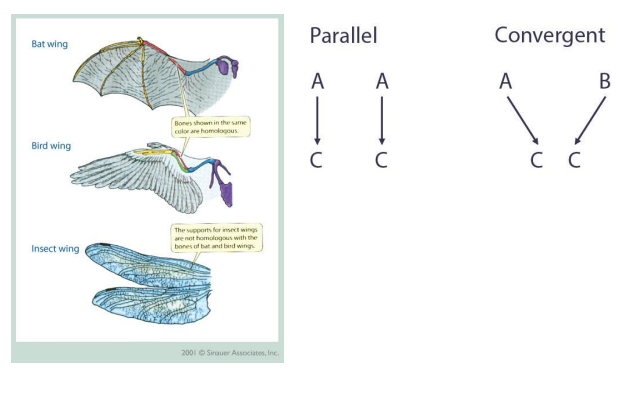
Parallel Evolution
Evolutionary trend observed in 2 lineages whom share a fairly recent common ancestor where each shows independent evolution of a similar feature via similar development pathways
not sister taxa
Homoplasy
A similarity in a character in two different species that arises from evolutionary convergence or parallelism, not common ancestry (noise)
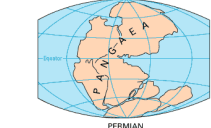
permian
225 million years ago
pangea
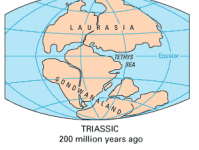
triassic
200 million years ago
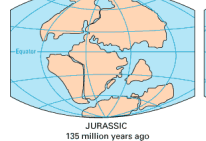
jurassic
135 million years ago
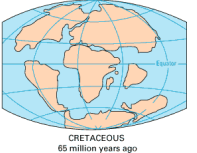
cretaceous
65 million years ago
Pangaea
ancient supercontinent
Alfred Wegener
Continental Drift
movement of large land masses of the earth’s surface
athenosphere moves lithosphere
Plate Tectonics
The theory that the earth’s crust is made up of a series of geological plates
Biogeography
Study of distribution of organisms, extinct and extant
Lithosphere
Earth’s crust
Athenosphere
layer under lithosphere
liquid
Vicariance
Geographic isolation of populations via development of natural barriers
Dispersal
Movement or spreading of organisms to new areas
caused by plates moving and shifter
creating speciation
Constantly creating new continental plates