Chapter 6 // Vertebral Column (Axial)
 Call Kai
 Learn
Learn Practice Test
 Spaced Repetition
 Match
Match Flashcards
 Knowt Play
1/29

Name | Mastery | Learn | Test | Matching | Spaced | Call with Kai | Chat |
|---|
No analytics yet
Send a link to your students to track their progress
30 Terms
How many bones make up the vertebral column, and what type of bones are they?
There are 26 irregular bones that make up the vertebral column.
Break down the 26 irregular bones that make up the vertebral column.
7 Cervical vertebrae (C1-C7), 12 Thoracic vertebrae (T1-T12), 5 Lumbar vertebrae (L1-L5), 1 Sacral/Sacrum (5 fused bones S1-S5), 1 Coccygeal/Coccyx (4 fused bones, sometimes 3/5)
What is the function of the intervertebral discs?
Shock absorbers; separated by pads of fibrocartilage that cushion the vertebrae.
What are the intervertebral discs made of?
Nucleus pulposus and annulus fibrosus
Which part of the intervertebral discs is gelatinous, acts like a rubber ball, and absorbs compressive stress?
Nucleus pulposus
Which part of the intervertebral discs act as an outer collar of ~12 concentric rings of ligament (outer rings) and fibrocartilage(inner rings)?
Annulus fibrosus
What connects bone to bone?
Ligaments
What is the function of the anterior longitudinal ligament?
It prevents hyperextension
What is the function of the posterior longitudinal ligament?
Prevents hyperflexion
What type of connective tissue is ligamentum flavum made of and what function does it serve?
Elastic connective tissue; stretches and recoils during flexion and extension of the body.
Which structure of the vertebrae is composed of two pedicles (“little feet”) and two laminae (“sheets”)?
The vertebral arch.
What do successful vertebral foramen form through which the spinal cord is transmitted?
The vertebral canal.
Which process is the median, posterior projection from the vertebral arch?
Spinous process
Which process projects laterally from each pedicle-lamina junction?
Transverse process
What forms movable joints with inferior articular processes of vertebra and typically faces toward the spinous process?
The superior articular process
What forms moveable joints with the superior articular process and typically faces away from the spinous process?
The inferior articular process
What are the lateral openings between adjacent vertebrae called?
Intervertebral foramina
What is the name for C1 vertebrae?
Atlas

What is the name for the C2 vertebrae?
Axis

Which cervical vertebrae contains no body and no spinous process?
C1 (Atlas)
What is the function of the C1 vertebrae?
Allows flexion and extension of the head on the neck (nodding “yes”)
What is the part of the C2 vertebrae that contributes as a “body” for the atlas?
Dens (odontoid process)
What is the function of the C2 vertebrae (axis)?
Acts as pivot for the rotation of the atlas and the skull, allows the head to shake side to side (“no”)
There is NO intervertebral disc between which two vertebrae?
C1 and C2 (Atlas and Axis)
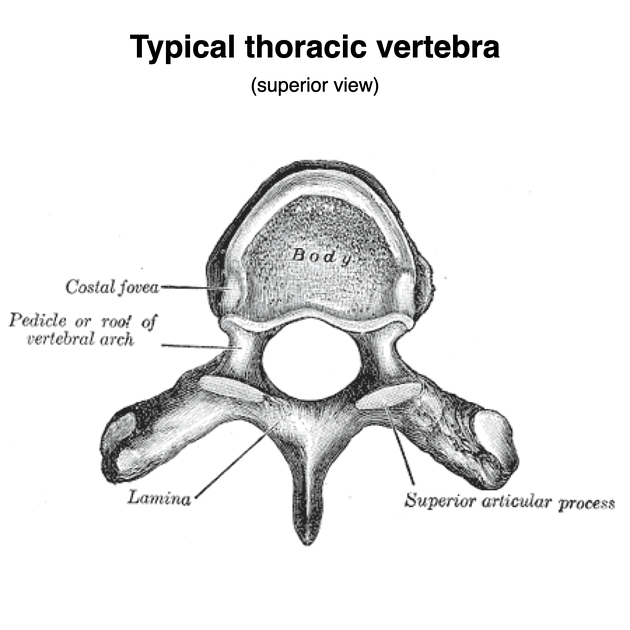
Which vertebral region has long, sharp spinous processes that project inferiorly and has the shape of a heart?
Thoracic vertebrae
Which vertebral region has short, blunt rectangular spinal processes that project directly posteriorly and have a massive, kidney-bean shaped body?
Lumbar vertebrae

Which vertebral region makes up the small of your back, has a curved, triangular shape, and is formed by 5 fused vertebrae?
The sacrum

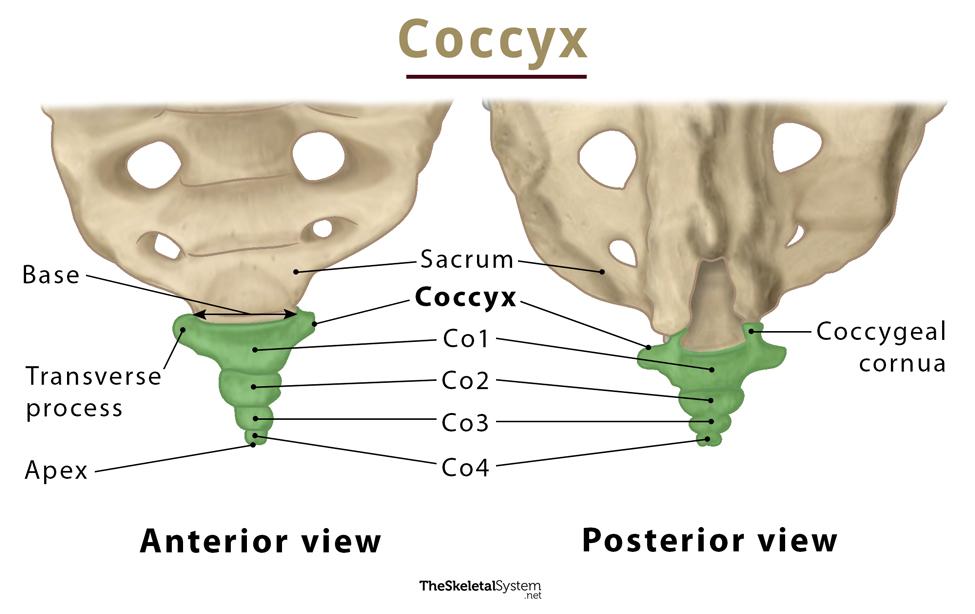
Which vertebral region makes up the tailbone, is small and triangular like a bird’s beak, consists of 4 fused vertebrae, and is almost completely useless?
The coccyx
As you move inferiorly from the atlas, you will note the free space for the spinal cord is greatest at C1. What function does this increased space serve?
The atlas provides more free space for the spinal cord than any other vertebrae. This extra space helps ensure that the spinal cord is not impinged on with the extensive amount of motion that occurs here.
Why are the largest vertebral bodies found in the lumbar region?
They bear the most weight.