Shoulder, Arm, and Breast
 Call Kai
 Learn
Learn Practice Test
 Spaced Repetition
 Match
Match Flashcards
 Knowt Play
1/112

There's no tags or description
Looks like no tags are added yet.
Name | Mastery | Learn | Test | Matching | Spaced | Call with Kai | Chat |
|---|
No analytics yet
Send a link to your students to track their progress
113 Terms
Clavicle - connections
Connects upper limb to truck through sternoclavicular and acromioclavicular joints
Clavicle - 2 confusions on radiological imaging
Late fusion of epiphyseal plate at sternal end with main shaft of clavicle
Failure of 2 ossification centers in shapt to fuse (typically bilateral)
Clavicle - ends
Sternal end - round
Acromial end - flat
Sternoclavicular joint - type of joint
saddle synovial joint w/ articular disc; functions as a ball and socket joint
Sternoclavicular - articular surfaces
Sternal end of clavicle and the clavicular notch on the manubrium of the sternum
Sternoclavicular - movements
flexion/extension, adduction/abduction, circumduction, some rotation (med/lat)
Sternoclavicular - strength
very strong due to ligaments, clavicle is more likely to fracture that be dislocated
Acromioclavicular joint - type
plane synovial joint w/ articular disc
Acromioclavicular joint - articular surfaces
Acromial end of clavicle and the acromion process of the scapula
Acromioclavicular joint - movements
slight gliding
Sternoclavicular joint - type
joint is synovial articulation between sternal end of clavicle, manubrium and 1st rib
Anterior and posterior SC ligaments
Reinforce joint capsule
Interclavicular ligament
Runs between 2 sternal ends of clavicles (superior)
Costoclavicular ligament
Anchors inferior sternal end to first rib
Superior acromioclavicular ligament
From acromion to acromiol end of clavicle (strengthened by coracoclavicular ligament)
Coracoclavicular ligaments
Conoid ligament - coracoid process of scapula to conoid tubercle
Trapezoid ligament - coracoid process to trapezoid line of clavicle
Glenohumeral (shoulder joint) - type
Ball and socket synovial joint
Shoulder joint - Articular surfaces
Glenoid cavity of scapula with head of humerus
Shoulder joint - movements
Flexion/extension, adduction/abduction, circumduction, rotation
Coracohumeral ligament (of glenohumeral joint)
Coracoid process of the scapula to the greater tubercle of the humerus (strengthens capsule superiorly)
Transverse humeral ligament (of glenohumeral joint)
Greater tubercle to lesser tubercle of humerus, on top of the tendon of the long head of the biceps brachii (forms canal for tendon of long head of biceps)
Coracoacromial ligament (of glenohumeral joint)
Coracoid process to acromion process of the scapula (prevents superior dislocation of humeral head; humorous or clavicle will fracture instead)
Glenohumeral joint - ligaments
Reinforce anterior part of joint capsule
Glenohumeral joint - ligament attachments
Edge of the glenoid cavity to the anatomical neck of the humerus
Dislocation of AC joint
Hard fall on shoulder or outstretched upper limb (shoulder separation: Both AC and coracoclavicular ligaments torn)
Dislocation of glenohumeral joint
Typically inferior dislocation, but clinically termed anterior (common), or posterior (rarer). Depends on position relative to long head of triceps. Joint capsule and labrum can be ripped. Axillary nerve may be damaged
Superior/descending Trapezius
Attaches from nuchal ligament to acromion of scapula and clavicle
Superior/descending Trapezius Action
Elevates scapula
Middle trapezious
Attaches from spinous process of thoracic vertebrae to spine of scapula
Middle trapezious action
retracts scapula
inferior/ascending trapezius
Lower than middle, but still spinous process of thoracic vertebrae to spine of scapula
inferior/ascending trapezius action
Depresses scapula
trapezius innervation
Spinal acessory nerve (and anterior rami of C3-C4)
Latissimus dorsi
Attaches from spinous process of thoracic and lumbar vertebrae, iliac crest and lower ribs to intertubercular sulcus (bicipital groove) of humerus
Latissimus dorsi action
adduct, extend, medially rotate arm
Latissimus dorsi innervation
Thoracodorsal nerve (C6-C8)
Rhomboid major and minor attachment
Attach from spinous process of C7/T1 (minor) and upper thoracic vertebrae (major) to medial border of scapula
Rhomboid major and minor action
retract scapula
rhomboid major and minor innervation
Dorsal scapular nerve
Levator scapulae attachments
Transverse process of cervical vertebrae to medial border of scapula
Levator scapulae action
elevates scapula
levator scapulae innervations
Dorsal scapular nerve and anterior rami of C3-C4
Deltoid attachments
All attach from deltoid tuberosity of humerus. Anterior from clavicle. Middle from acromion of scapula. Posterior from spine of scapula.
Deltoid action
All resist inferior displacement of humeral head. Anterior flexes and medially rotates arm. Middle abducts arm (after first 15 degrees). posterior extends and laterally rotates arm.
Deltoid innervation
Axillary nerve (C5-C6)
Supraspinatus attachment
Attaches from supraspinous fossa of scapula to greater tubercle of humerus
Supraspinatus action
Abducts arm (initiates abduction - first 15 degrees). Rotator cuff muscle - hold humeal head in glenoid cavity.
Supraspinatus innervation
Suprascapular nerve (C5-C6)
infraspinatus attachments
Attaches from infraspinous fossa of scapula to greater tubercle of humerus
infraspinatus action
Laterally rotates arm. Rotator cuff muscle - holds humeral head in glenoid cavity.
Infraspinatus innervation
Suprascapular nerve (C5-C6)
Teres minor attachements
Attaches from lateral border of scapula to greater tubercle of humerus
Teres minor action
Laterally rotates arm. Rotator cuff muscle - holds humeral head in glenoid cavity.
Teres minor innervation
Axillary nerve (C5-C6)
Teres major attachments
Attaches from inferior angle of scapula to intertubercular sulcus (bicipital groove) of humerus
Teres major action
Adducts and medially rotates arm
Teres major innervation
Lower subscapular nerve (C5-C6)
Rotator cuff injury
Typically due to repetitive use of upper limb above horizontal. Supraspinatus is most commonly injured. Cannot abduct arm first 15 degrees. If arm abducted passively middle deltoid can complete action
Adhesive capsulitis of glenohumeral joint
Also called “Frozen Shoulder". Adhesive fibrosis and scarring between the rotator cuff, bursa, and deltoid (inflammation, dislocation, bicipital tendinitis. Patient has difficulty abducting the arm, but can elevate and rotate the scapula to compensate.
Triceps brachii attachments
All heads attach to olecranon process of ulna. Long head attaches to infraglenoid tubercle of scapula. Medial and lateral heads attach to shaft of humerus.
Triceps brachii action
All extend forearm. Long head also resists inferior displacement of humeral head.
Triceps brachii innervation
Radial nerve (C6-C8)
Serratus anterior (ventralis) attachment
Attaches from lateral surface of ribs to medial border of scapula
Serratus anterior action
protracts scapula, stabilizes scapula against thoracic wall
Serratus anterior innervation
Long thoracic nerve (C5-C7)
Paralysis of serratus anterior (winged scapula)
If long thoracic nerve is injured medial border of scapula moves laterally and posteriorly away from thoracic wall. Arm cannot be abducted above horizontal position. Serratus anterior cannot rotate glenoid cavity to allow abduction.
can be durring mastectomy
Subscapularis (anterior) Attachments
Attaches from subscapular fossa of scapula to lesser tubercle of humerus
Subscapularis actions
Medially rotates arm (rotator cuff muscle: holds humeral head in glenoid cavity)
Subscapularis innervations
upper and lower subscapular nerves (C5-C6)
Coracobrachialis Attachments
Attaches from coracoid process of scapula to shaft of humerus
Coracobrachialis action
Flexes and adducts arm, resists inferior displacement of humeral head
Coracobrachialis innervation
Musculocutaneous nerve (C5-C7)
Biceps brachii attachments (together and of both heads)
Both attach to tuberosity of radius and bicipital aponeurosis. Short head: coracoid process of scapula. Long head: supraglenoid tubercle of scapula.
Biceps brachii actions (together and of short head)
Supinates forearm, flexes forearm when supinated. Short head: resists inferior displacement of humeral head.
Biceps brachii innervation
Musculocutaneous nerve (C5-C7)
Brachialis Attachments
Attaches from shaft of humerus to coronoid process of ulna and tuberosity of ulna
Brachialis action
Flexes forearm
Brachialis innervation
Musculocutaneous nerve (C5-C7) and radial nerve (C5-C7)
Pectoralis major attachments
Attaches from clavicle (head) or sternum and costal cartilages (head) to intertubercular sulcus (bicipital groove) of humerus.
Pectoralis major actions (both, and heads)
Both: adduct and medially rotate arm. Clavicular head flexes arm. Sternocostal head extends arm from flexed position.
Pectoralis major innervations
Both heads: Lateral pectoral nerve (C5-C7). Medial pectoral nerve (C8-T1) also innervates sternocostal head.
pectoralis minor attachments
Attaches from upper ribs to coracoid process of scapula
pectoralis minor action
Elevates upper ribs, syabilizes scapula against thoracic wall
pectoralis minor innervation
Medial pectoral nerve (C8-T1)
Subclavius attachment
Attaches from clavicle to first rib
Subclavius action
Depress clavicle
subclavius innervation
Nerve to subclavius (C5-C6)
Breast - Mammary glands
production of milk
modified sweat glands
Breast - Lactiferous ducts and sinuses
ducts-channel milk to nipple
sinus-store milk
Breast - Suspensory ligaments
Attach skin to deep fascia over pectoralis major
blood supply and drainage of medial breast
Internal thoracic artery (subclavian) and medial mammary branches [vein=same]
blood supply and drainage of superior breast
Pectoral branch of thoracoacromial trunk (axillary) [vein=same]
blood supply and drainage of lateral breast
Lateral thoracic artery (axillary) [vein=same]
Lymphatic of breast laterally drains to…
axillary and clavicular lymph nodes
subclavian trunk
Lymphatic of breast medially drains to…
parasternal lymph nodes
bronchomediastinal trunk
lymphatic of brest inferiorly drains to…
Abdominal (subdiaphragmatic) lymph nodes
intestinal trunk
Breast changes/cancer
Carcinoma most common in superolateral quadrant
breasts change due to age, hormones, pregnancy/nursing
cancer is usually adenocarcinoma (epithelium of lactiferous ducts)
Tumor pressing on suspensory ligaments can cause dimpling
Edema (excess fluid) can cause abnormal contours or orange peel appearance
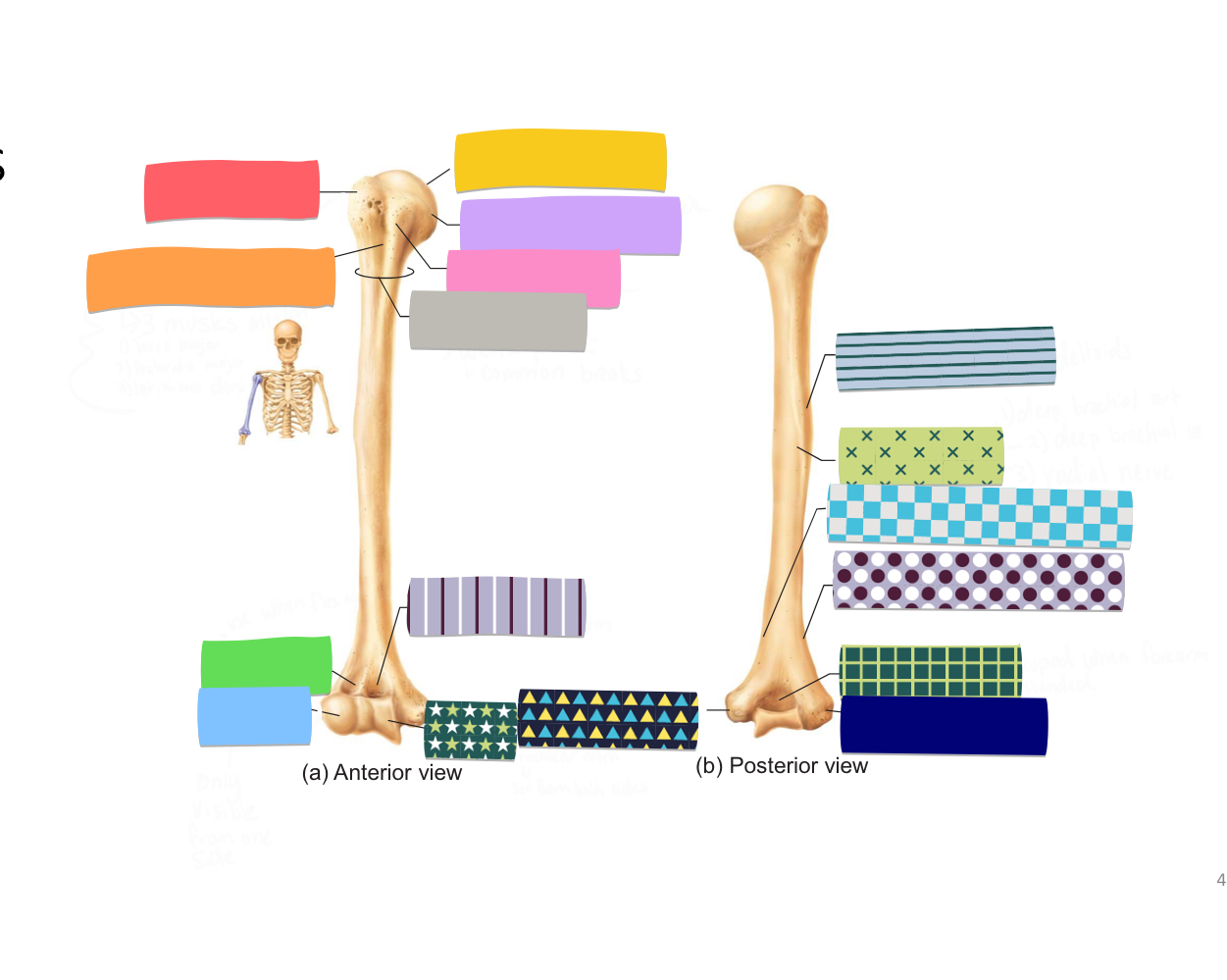
Humorous - red and orange
red - greater tubercle
orange - bicipital groove
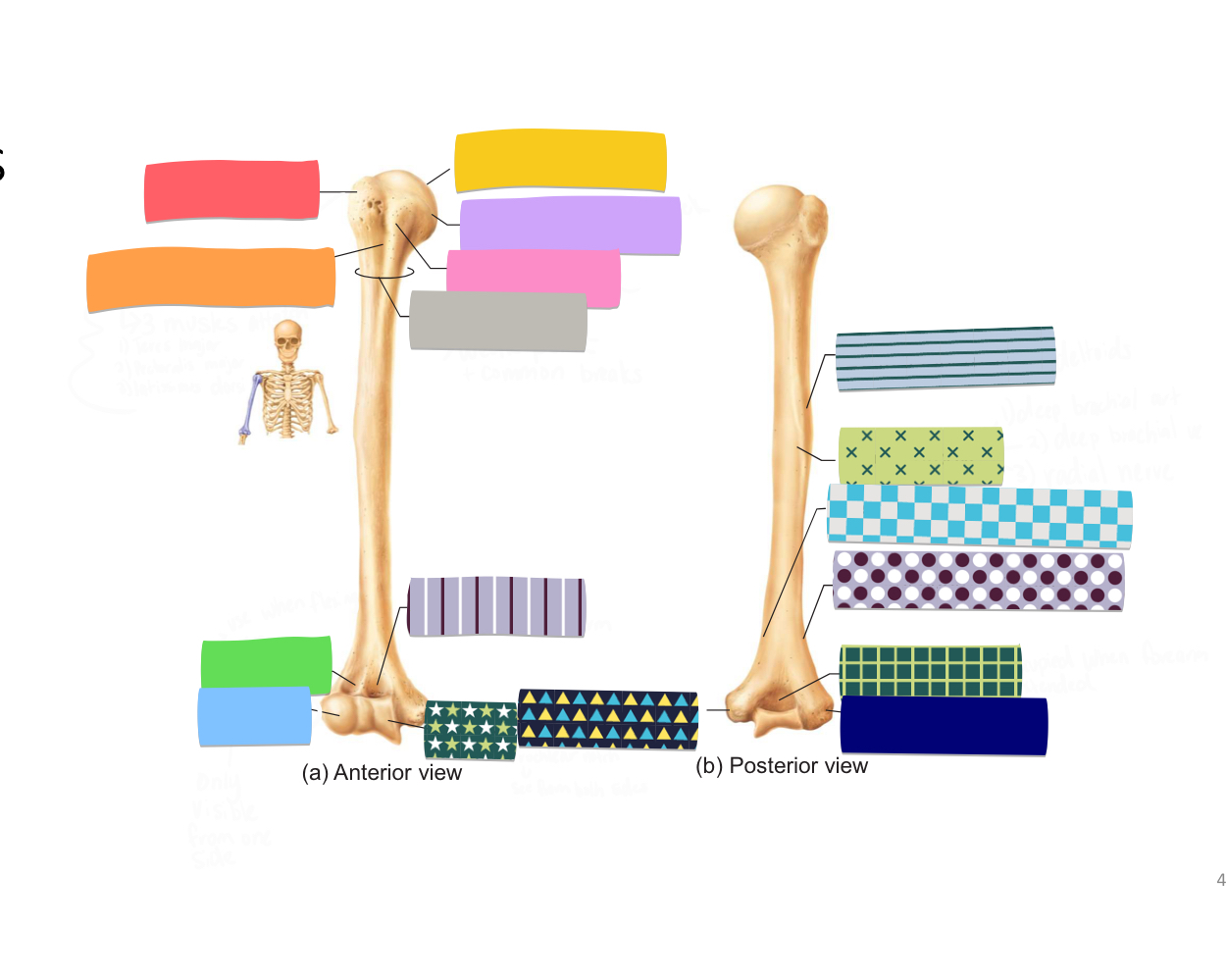
humerus - green and blue
green - radial fossa
blue - capitulum
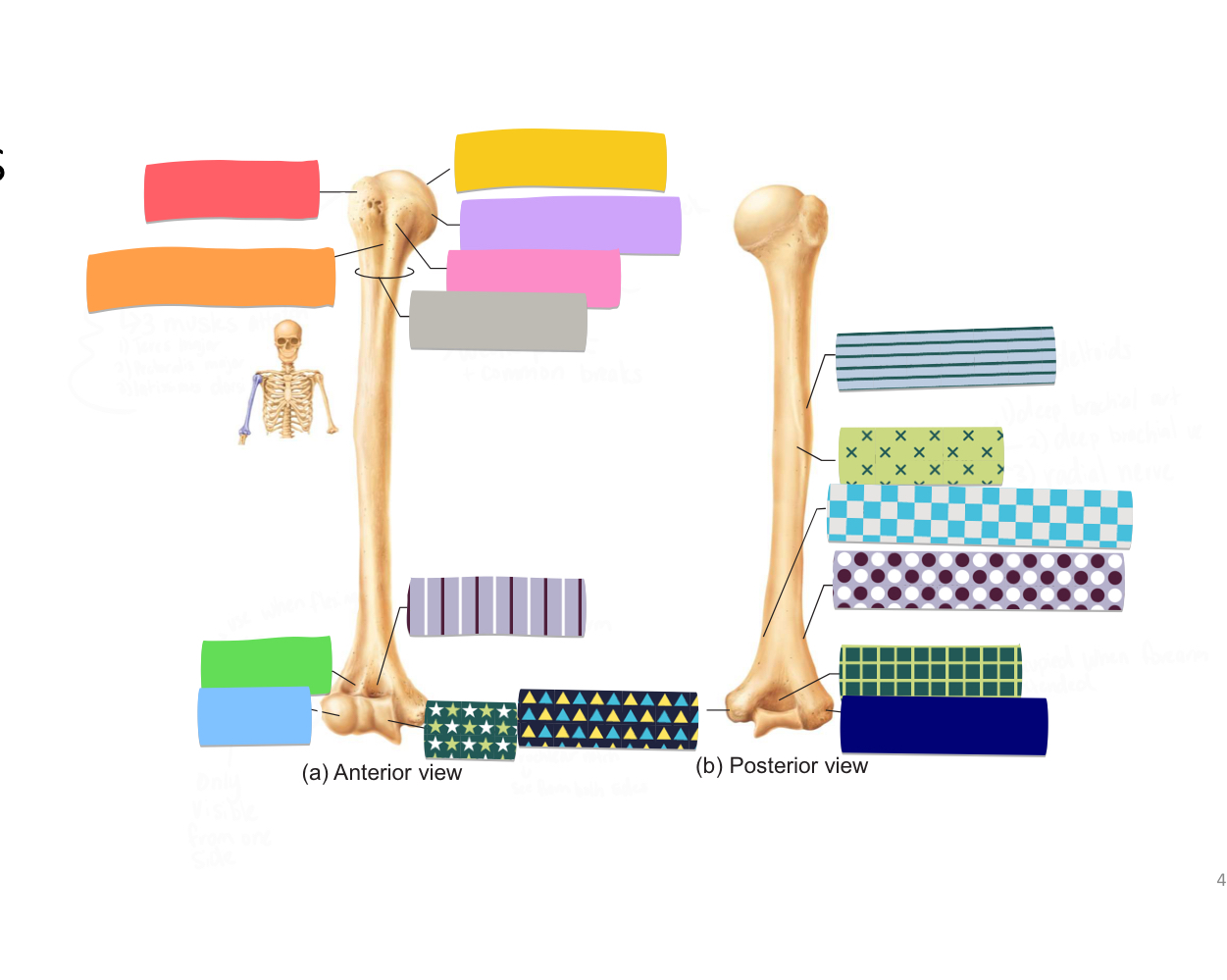
humerus - yellow and purple
yellow - head of humerous
purple - anatomical neck