9: Physical and Cognitive Development in Middle and Late Childhood
 Call Kai
 Learn
Learn Practice Test
 Spaced Repetition
 Match
Match Flashcards
 Knowt Play
1/68

There's no tags or description
Looks like no tags are added yet.
Name | Mastery | Learn | Test | Matching | Spaced | Call with Kai | Chat |
|---|
No analytics yet
Send a link to your students to track their progress
69 Terms
body growth and change
slow, consistent growth is seen in middle and late childhood
growth averages 2-3 inches per year
weight gain averages 5-7 pounds per year
Head circumference and waist circumference decrease in relation to body height. Bones continue to ossify during middle and late childhood but yield to pressure and pull more than mature bones
the brain
total brain volume stabilizes
significant changes in structures and regions occur, especially in the prefrontal cortex
cortical thickness increases
activation of some brain areas increase, while in others it decreases
brain pathways and circuitry involving the prefrontal cortex, the highest level in the brain, continue to increase
motor development
Motor skills become smoother and more coordinated in middle and late childhood
Girls outperform boys in their use of fine motor skills
Improvement of fine motor skills during middle and late childhood results from increased myelination of the central nervous system.
exercise
A higher level of physical activity is linked to a lower level of metabolic disease risk, based on measures of cholesterol, waist circumference, and insulin levels.
Regular physical activity combined with a high level of calcium intake increases bone health
Aerobic exercise benefits include:
lower incidence of obesity
improved attention and memory, and cognitive inhibitory control
effortful and goal-directed thinking and behavior
creativity
ways to get children to exercise
offer physical activity programs at school facilities
improve physical fitness activities in schools
have children plan community and school activities
encourage families to focus more on physical activity
health, illness, and disease
middle and late childhood is a time of excellent health
accident and injuries are the leading of death in this period
motor vehicle accidents are the most common cause of sever injury, as passenger or pedestrian
safety belt restraints and child booster seats are highly recommended
overweight children
the percentage of US children at risk has increased dramatically
both heredity and environmental contexts are related
environmental factors include declining physical activity, eating habits and contexts, and heavy screen time
potential consequences for overweight children
diabetes, hypertension, elevated blood cholesterol, and low self-esteem
intervention programs encourage:
parents to engage in healthier lifestyles themselves
healthier food and more exercise
Cardiovascular disease is uncommon in children, but environmental experiences and behavior can sow the seeds
Many elementary-school-aged children already have one or more of the risk factors
hypertension
obesity
higher body mass index
Adult coronary disease is linked to childhood elevated blood pressure and high body fat levels
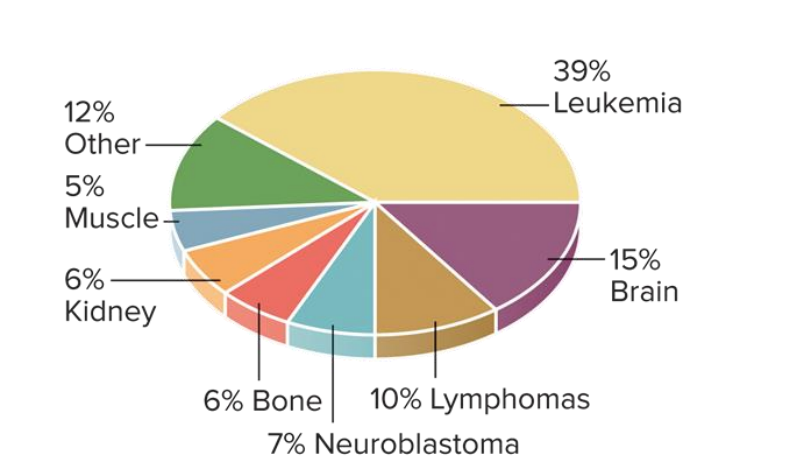
Cancer is the second leading cause of death in children who are 5 to 14 years old.
the most common child cancer is leukemia
Today, children with cancer are surviving longer because of advancements in cancer treatment.
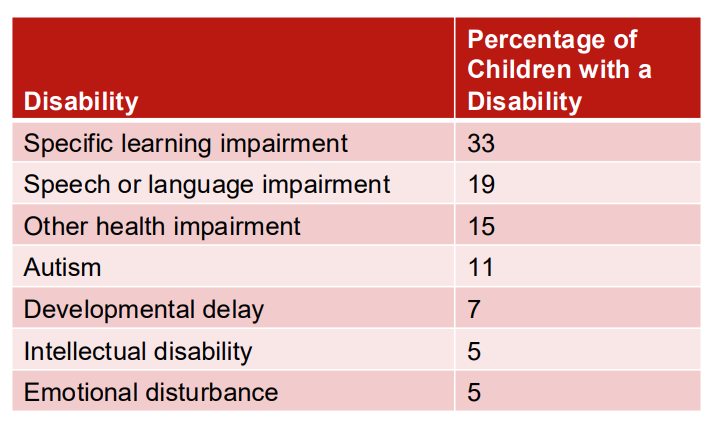
scope of diabilities
in the US, 14% of 3-21y/o received special education or related services in 2019 to 2020, an increase o 4% since 1980 to 1981
note the US department of education includes both students with a learning disability and students w/ ADHD in the category of “learning disability”
Learning disabilities:
difficulty in learning involving understanding or using spoken or written language
can appear in listening, thinking, reading, writing, or spelling
dyslexia, dysgraphia, dyscalculia
dyslexia
a sever impairment in the ability to read and spell
dysgraphia
difficulty in handwriting
dyscalculia
a developmental arithmetic disorders
Attention deficit hyperactivity disorder (ADHD)
a disability characterized by inattention, hyperactivity, and impulsivity
boys are twice as likely to receive an ADHD diagnosis
Possible causes of ADHD
genetics
brain damage during prenatal or postnatal development
cigarette and alcohol exposure during prenatal development
high maternal stress during prenatal development
low birth weight
Children diagnosed with ADHD have an increased risk for
Lower academic achievement
Problematic peer relations
School dropout
Disordered eating
Adolescent parenthood
Substance use problems
Antisocial behavior
Criminal activity
Unemployment
Emotional and behavioral disorders consist of serious, persistent problems that involve
Relationships, aggression, depression, and fears associated with personal or school matters
Inappropriate socioemotional characteristics
boys are three ties as likely as girls to have these disorders
Autism spectrum disorders (ASD)
range from autistic disorder to Asperger syndrome and may have a genetic basis
Autistic disorder is a severe developmental ASD.
Has its onset in the first three years of life
Deficiencies in social relationships, abnormalities in communication, and restricted, repetitive, and stereotyped patterns of behavior
Deficits in cognitive processing of information
Identified five times more often in boys than girls
Asperger syndrome is relatively mild.
Relatively good verbal language skills and milder nonverbal language problems
Restricted range of interests and relationships; with obsessive, repetitive routines and preoccupations with a particular subject.
The current consensus is that autism is a brain dysfunction involving abnormalities in brain structure and neurotransmitters.
The children have deficits in cognitive processing but benefit from a well-structured classroom, individualized teaching, and small-group instruction
Behavior modification techniques are sometimes effective
Individualized education plan (IEP)
a written statement specifically tailored for the disabled student
Least restrictive environment (LRE)
a setting as similar as possible to the one in which nondisabled children are educated
Inclusion
educating a child with special education needs fulltime in the regular classroom.
Piaget’s concerete operational stage
ages 7-11
children can perform concrete operations and reason logically, and are able to classifiy things into different sets
seriation: the concrete operation that involves ordering stimuli along a quantitative dimension (ex. length)
transitivity: the ability to logically combine relations to understand cetain conclusions
Evaluating Piaget’s concrete operational stage:
Concrete operational abilities do not appear in synchrony
Education and culture exert strong influences on children’s development.
Neo-Piagetians
developmentalists who argue Piaget was partially correct, but his theory needs considerable revision
Elaborated on Piaget’s theory, increasing the emphasis on information processing, strategies, and precise cognitive steps.
During middle and late childhood, most children dramatically improve their ability to sustain and control attention
They pay more attention to task-relevant stimuli than to salient stimuli
long-term memory
a relatively permanent type of memory that holds huge amounts of information for a long period of time
increases w/ age during middle and late childhood
Working memory
a mental “workbench” where individuals manipulate and assemble information when making decisions, solving problems, and comprehending language
uses information from long-term memory in its work, and transmits information to long-term memory for longer storage
Autobiographical memory
As children age, their autobiographical narratives become more complete.
Mothers reminiscing with children in elaborative and evaluative ways appear to contribute
influenced by culture
Strategies
deliberate mental activities that improve the processing of information
Elaboration
engaging in more extensive processing of information
Thinking
Many of the cognitive topics just discussed can be considered part of executive function
Certain dimensions of executive function are most important for children’s cognitive development and school success:
Self-control/inhibition
Working memory
Flexibility
Executive function is a better predictor of school readiness than general IQ.
Critical thinking
involves thinking reflectively and productively, and evaluating evidence
One important aspect of critical thinking is mindfulness: being alert, mentally present, and cognitively flexible
Mindfulness training has been found to improve children’s attention self-regulation
Creative thinking
the ability to think in novel and unusual ways
Convergent thinking
produces one correct answer and is characteristic of the kind of thinking tested by standardized intelligence tests
Divergent thinking
produces many answers to the same question and is characteristic of creativity
Brainstorming
a process in which individuals come up with creative ideas in a group and play off each other’s ideas
Metacognition
cognition about cognition, or knowing about knowing
Consists of several dimensions of executive function, such as planning and self-regulation
Helps people perform cognitive tasks more effectively
Metamemory is knowledge about memory.
Intelligence
ability to solve problems and to adapt and learn from experiences
Individual differences
the stable, consistent ways in which people differ from each other
The Binet tests
Alfred Binet was initially asked to develop an intelligence test to identify students who did not benefit from the regular classroom
Binet developed the concept of mental age (MA): the individual’s level of mental development relative to others
William Stern developed the intelligence quotient (IQ): a person’s mental age divided by chronological age (CA), multiplied by 100
That is, IQ = MA/CA x 100
If mental age is the same as chronological age, the person’s IQ is 100.
The Wechsler scales
David Wechsler developed the Wechsler scales
Wechsler Preschool and Primary Scale of Intelligence—Fourth Edition (WPPSI-IV) for ages 2.5 to 7.25.
Wechsler Intelligence Scale for Children—Fifth Edition (WISC-5) for ages 6 to 16.
Wechsler Adult Intelligence Scale—Fourth Edition (WAIS-IV)
the WISC-5 provides an overall IQ score and also five composite scores, determining areas of strength or weakness
Verbal Comprehension, Working Memory, Processing Speed, Fluid Reasoning, and Visual Spatial
Sternberg’s triarchic theory of intelligence states intelligence comes in three forms
Analytical intelligence: the ability to evaluate, compare, and contrast
Creative intelligence: the ability to invent, originate, and imagine
Practical intelligence: the ability to ability to implement and put ideas into practice.
Gardner’s eight frames of mind
verbal
mathematical
spatial
bodily-kinesthetic
musical
interpersonal
intrapersonal
naturalist
the flynn effect
refers to a rapid increase in IQ scores worldwide, likely due to increasing levels of education, and factors such as the explosion of information to which people are now exposed.
Culture-fair tests
intended to be free of cultural bias and are difficult to create.
The first type includes items familiar to children from all socioeconomic and ethnic backgrounds
The second type has no verbal questions.
Tests reflect what the dominant culture values.
there are no culture-fair tests, only culture-reduced tests
Ethnic variations:
On standardized intelligence tests in the United States, African American and Latino children score lower than non–Latino White children, but the gap is narrowing
The gap especially narrows in college
A recent study using the Stanford-Binet found no differences in overall intellectual ability between non–Latino White and African American preschool children.
stereotype threat
the anxiety that one’s behavior might confirm a negative stereotype about one’s group
Using intelligence tests
Avoid stereotyping and expectations
Know that IQ is not the sole indicator of competence
Use caution when interpreting an overall IQ score.
the most distinctive feature of intellectual disabiliity
inadequate intellectual functioning
defined as a condition of limited mental ability in which the individual has a low IQ, difficulty adapting to everyday life, and first exhibits these characteristics by age 18
Organic intellectual disability
caused by a genetic disorder or brain damage
cultural-familial intellectual disability
there is no evidence of organic brain damage, but IQ is generally between 50 and 70
giftedness
People who are gifted have above-average intelligence (an IQ of 130 or higher) and/or superior talent for something
winner described three criteria for gifted children
precocity
marching to their own drummer
a passion to master
likely a product of both heredity and environment
Alphabetic principle
the letters of the alphabet represent sounds of the language
metalinguistic awareness
knowledge about language
Whole-language approach
stresses that reading instruction should parallel children’s natural language learning
Phonics approach
reading instruction should teach the basic rules for translating written symbols into sounds
Second-language learning
Bilingualism has a positive effect on children’s language cognitive development
some aspects of learning a second language also transfer to success in other areas
English language learners have been taught in one of two ways
instruction in English only or
a dual-language (or bilingual) approach
In support of the dual-language approach:
Children have difficulty learning a subject when it is taught in a language they do not understand
When both languages are integrated in the classroom, children learn the second language more readily and participate more actively