Science FInal Study Guide
 Call Kai
 Learn
Learn Practice Test
 Spaced Repetition
 Match
Match Flashcards
 Knowt Play
1/74

There's no tags or description
Looks like no tags are added yet.
Name | Mastery | Learn | Test | Matching | Spaced | Call with Kai | Chat |
|---|
No analytics yet
Send a link to your students to track their progress
75 Terms
What is the average speed of a car traveling 100 kilometers in 25 minutes?
4km/m
A racecar travels 2000 meters in 20 seconds. What is the racecar’s average speed?
100m/s
A plane traveled for about 2.5 hours at a speed of 1200km/hr. What distance did it travel?
3000km
What makes an object a good reference point for describing motion?
Something that does not move in reference to the object you are measuring
What is the term used to describe speed in a given direction?
Velocity
What is the term used to describe the rate at which velocity changes?
Acceleration
When objects slow down, are they accelerating? Why or why not
Yes, because its a change in speed or direction (deceleration)
Is a car driving at a constant speed of 10km/hr accelerating? Why or why not?
No, because the speed is constant at 10km/hr so it s not accelerating
Newton’s First Law of Motion
An object at rest will remain at rest unless acted upon by a nonzero net force
EX: Skateboard being stopped by a wall
Newton’s Second Law of Motion
An object’s acceleration depends on its mass and on the net force acting on it
EX: Adding dogs to a sled to increase its acceleration
Newton’s Third Law of Motion
If one object exerts a force on another object, the object exerts equal force in the opposite direction on the first object
EX: Swimmer in a pool
Law of Conservation of Momentum
In the absence of outside forces like friction, the total momentum of objects that interact don’t change
What is the difference between a balanced and an unbalanced force?
Balanced: Net force=0N
Unbalanced: Unequal force/causes movement
Sliding Friction
Occurs when 2 solid surfaces slide over each other
EX: Penguin on ice
Static Friction
Acts between objects that aren’t moving
EX: Pushing a couch across a roo
Fluid Friction
When a solid object moves through a fluid
EX: Animal swimming in water
Rolling Friction
When an object rolls across a surface
EX: Bike on a sidewalk
______is a resistance to motion.
Inertia
The force of gravity on a person or object on the surface of a planet is called_____.
Weight
_______describes how much matter is in a given volume.
Mass
Energy is the ability to do work or cause_______.
Change
Kinetic Energy
The energy an object has due to its motion
EX: A bowling ball has a greater mass so it has greater energy
Potential Energy
Energy that results from the position or shape of an object
EX: Winding a toy
Elastic Energy
Energy associated with objects that can be compressed or stretched
EX: Trampoline
Nuclear Energy
Type of PE stored in the nucleus of an atom
EX: Nuclear power plant
What materials are good conductors of electricity? Good insulators?
Conductors: Metals (silver)
Insulators: Rubber, glass, and wood
What is the difference between a series and a parallel circuit?
Series: Has one path, so if one light goes out all the other ones go out
Parallel: Has multiple paths for energy to flow through so if one light goes out, energy can still keep other lights lit up
An unbroken path through which electric charges can flow is called a ______.
Electric circuit
What completes the path of a current in a circuit?
A closed conductive path
What determines the resistance of a wire?
Material, diameter, length, and temperature
What happens when more branches are added to a parallel circuit? What happens when more branches are added to a series circuit?
Parallel: resistance decreases, current increases
Series: gets dimmer
Energy is always_______in a circuit.
Conserved
Every magnet, regardless of its shape, has two_____.
Magnetic poles
The motion of liquid____in Earth’s outer core creates a magnetic field.
Iron
How does a compass work?
A compass is a device that has a magnetized needle that can spin freely.
What is the difference between the Earth’s magnetic poles and geographic poles?
Geographic poles are fixed points at N/S where the axis of rotation meets the surface, while magnetic poles are shifting locations where the planet’s magnetic field lines are vertical. They are not at the same location.
What creates mechanical waves?
A source of energy causes a medium to vibrate.
Which parts of a longitudinal wave are compressions? Which are rarefactions?
Compression: Closer together
Rarefaction: Farther apart
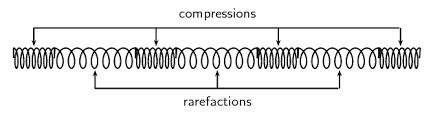
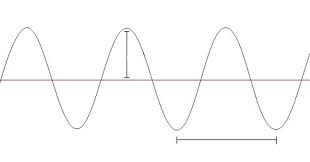
Label the parts of the wave.
Highest part: Crest
Lowest: Trough
Length between crests: Wavelength
Length between crests and the medium: Amplitude
How often a wave occurs is a wave’s______.
Frequency
How does a transverse wave move in a medium?
At a 90 degree angle
Ocean waves are an example of______.
Surface waves
Reflection
The bouncing back of an object or wave when it hits a surface it cannot pass through
EX: Mirror

Refraction
The bending of waves as they enter a new medium at an angle, caused by a change in speed.
EX: Putting a pencil in a cup of water

Interference
Interaction between waves that meet
EX: Constructive/Deconstructive interference
Resonance
The increase in the amplitude of a vibration when external vibrations match an objects’ natural frequency
EX: Falling bridge
The less energy a wave has, the smaller its______.
Amplitude
Energy can be neither destroyed nor______.
Created
How do sound waves move?
They move by vibrating the particles in a medium.
Sound travels as a_____.
Longitudinal wave
The_____of sound depends on the temperature, elasticity, and density of the medium through which the sound travels through.
Speed
What is the difference between how sound travels through a warm and cold temperatures?
Warmer=faster
Cooler=slower
Sound waves with frequencies above the normal range of human hearing are called_____.
Ultrasound
What property/properties of a sound depend on the energy and intensity of the sound waves?
Loudness
What are electromagnetic waves?
An electromagnetic wave is a transverse wave made up of vibrating electric and magnetic fields that move through space or some medium at the speed of light
Light that causes an electron to move so much that it is knocked out of a metal is called the_______effect.
Photoelectric
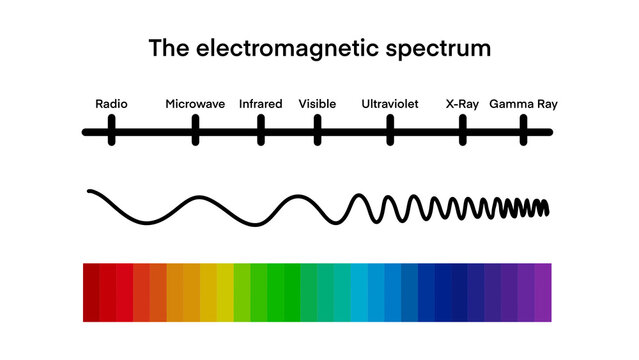
Be able to label the parts of the electromagnetic spectrum.
Radio waves
Microwaves
Infrared waves
Visible light (ROYGBIV)
Ultra-violet waves
X-rays
Gamma rays
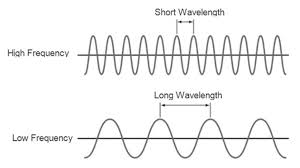
High____= Low______
Low_____= High_____
High frequency = Low wavelength
Low Frequency = High wavelength
List a common use of each wave on the electromagnetic spectrum
Radio: radio programs
Microwave: phone communication
Infrared: heat lamps
Visible light: rainbow
Ultraviolet: produces vitamin D
X-rays: makes images of bones and teeth
Gamma rays: examines body’s internal structures
What does a thermogram record?
Images of infrared radiation emitted by an object
How does a radar work?
Uses reflected microwaves to detect objects and measure their distance and speed
What is the difference between AM and FM radio waves?
AM stations use kilohertz (kHz) and FM stations megahertz (MHz)
A material that reflects or absorbs all the light that strikes it is_____.
Opague
Force
Unit of measurement: Newtons
Formula: F = m x a
Frequency
Unit of measurement: Hz
Formula: not needed
Acceleration
Unit of measurement: m/s squared
Formula: A = Vf - Vi divided by T
Speed
Unit of measurement: m/s
Formula: S = d/t
Distance
Unit of measurement: m
Formula: D = s x t
Slope
Formula: Rise/Run
Resistance in a circuit
Formula: R = voltage/current
Energy/Work
Unit of measurement: Joules
Formula: W = f(d)
Time
Unit of measurement: varies
Formula: Final Speed-Initial Speed divided by Acceleration
GPE
Unit of measurement: Joules
Formula: weight x height
Velocity
Unit of measurement: m/s (direction)
Formula: V = displacement/time
Wave speed
Unit of measurement: Hz
Formula: V = f x w