Y10 Motion - Physics
 Call Kai
 Learn
Learn Practice Test
 Spaced Repetition
 Match
Match Flashcards
 Knowt Play
1/29

Earn XP
Description and Tags
The fundamentals of physics.
Name | Mastery | Learn | Test | Matching | Spaced | Call with Kai | Chat |
|---|
No analytics yet
Send a link to your students to track their progress
30 Terms
Force
The push or pull upon an object resulted from the interaction from another object.
Inertia
Causes an object to resist changes to its current state of motion.
Acceleration
The change in velocity (speed or direction).
Speed
The measure of how fast an object is moving.
A car speeds up. What happens to the forces?
Acceleration and thrust.
A box is not moving. What can you say about the forces?
Gravity
Net force
The total of all of the forces.
Formula for force
Force (N) = mass (m) x acceleration (g)
Common types of forces
Applied force, normal forces, friction, air resistance, pushing force, tension
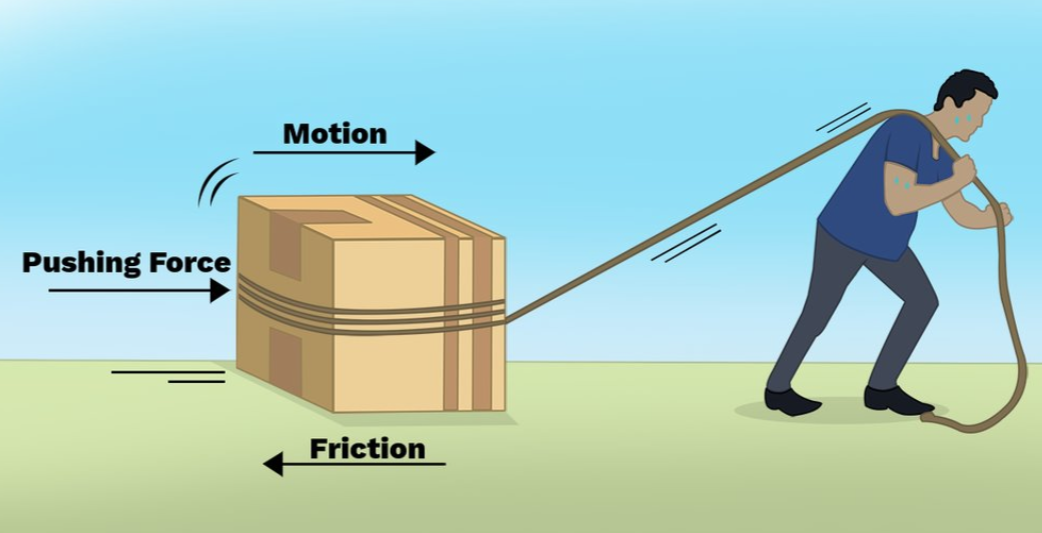
Pushing force
An external effort applied to an object that moves away from the source of force or changes its motion.
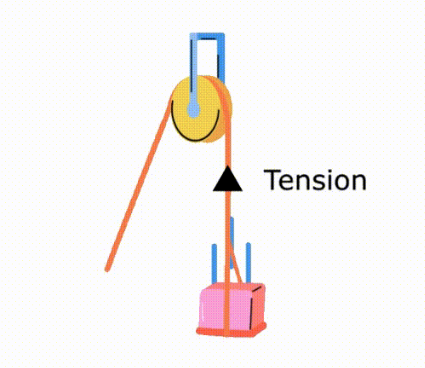
Tension
Force in a rope, cable, or string, when pulled tightly.
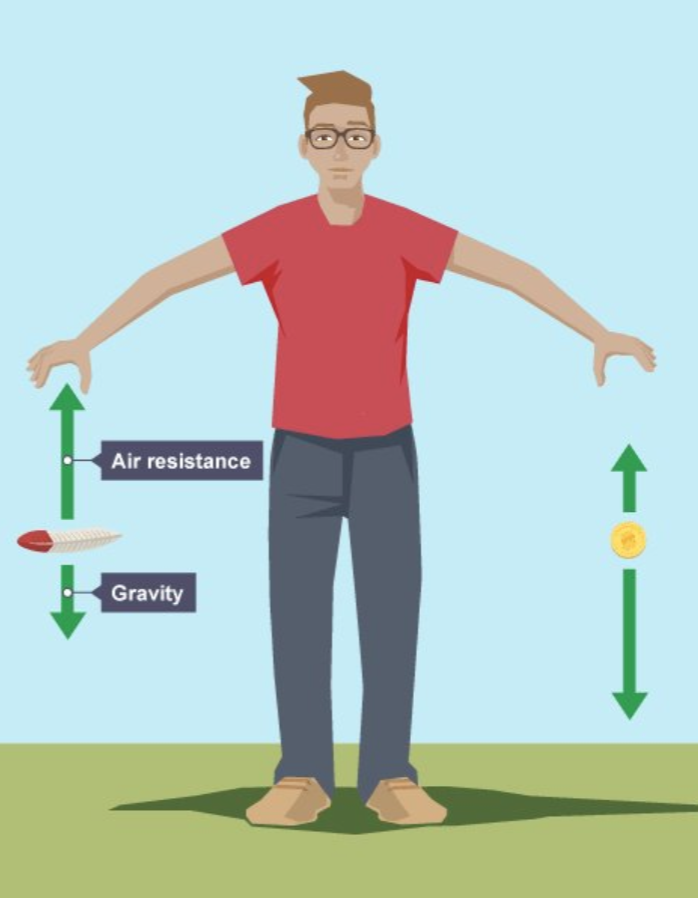
Air resistance
A type of friction that slows down objects moving through the atmosphere.
Newton’s first law of motion
Inertia
Newton’s second law of motion
Acceleration, F = m*a
Newton’s third law of motion
Action and reaction forces.
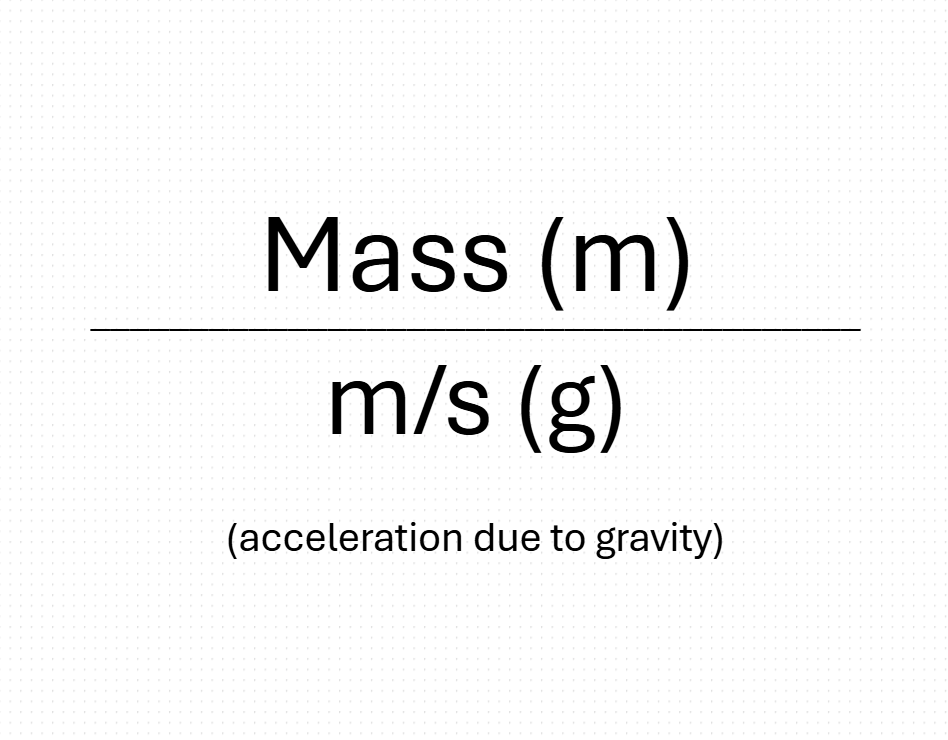
Formula for weight (w)
w = mass*gravity(m/s)
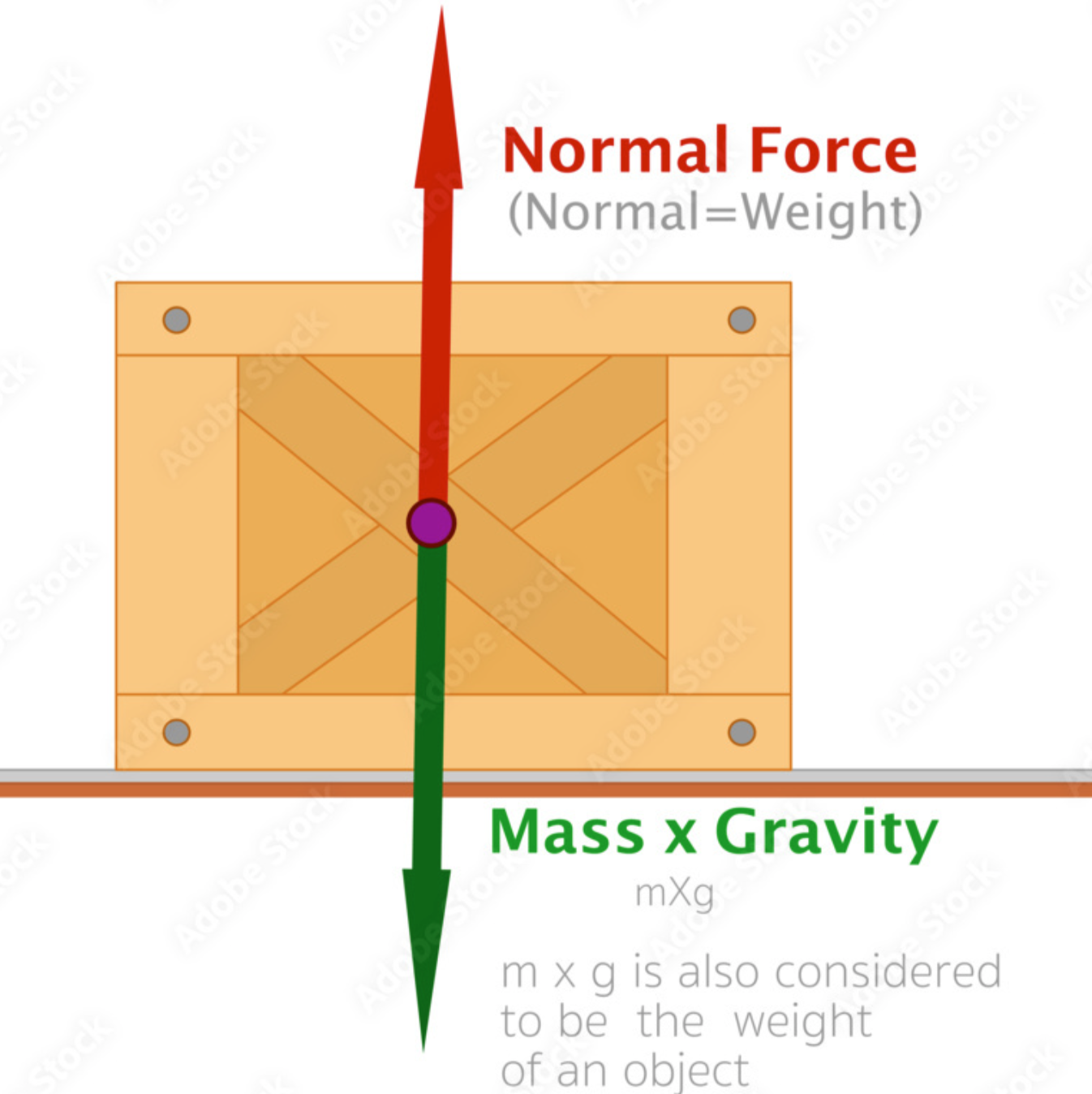
Normal force (N)
The support force from the surface.
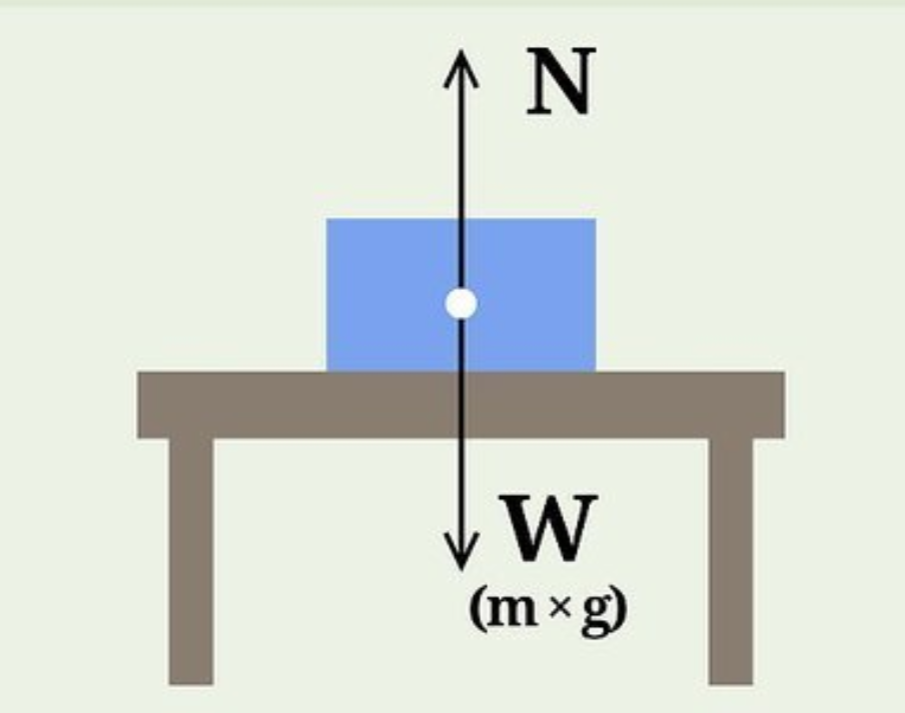
Weight
The downwards force that is always present.
Applied force
Any push or pull from a person or an object and can cause acceleration if unbalanced.
Friction
Opposite direction of motion or attempted motion.
friction causation
Caused by surfaces rubbing together.
When does tension only work?
When the rope is taut, not slack.
Scalar
A quantity or measurement defined by its magnitude.
Scalar vs Vector
Scalar is described the magnitude alone (size or amount), while vector quantities are described by both magnitude and distance
Distance (d)
The distance an object travels is the amount of ground it covers between two points.
Unit for distance (d)
(m)
Is distance scalar or vector?
d = scalar
Scalar examples
Mass, temperature, volume, time, distance, and speed.
Vector examples
Displacement (△x), velocity (v), acceleration (a), force (f), momentum (p).
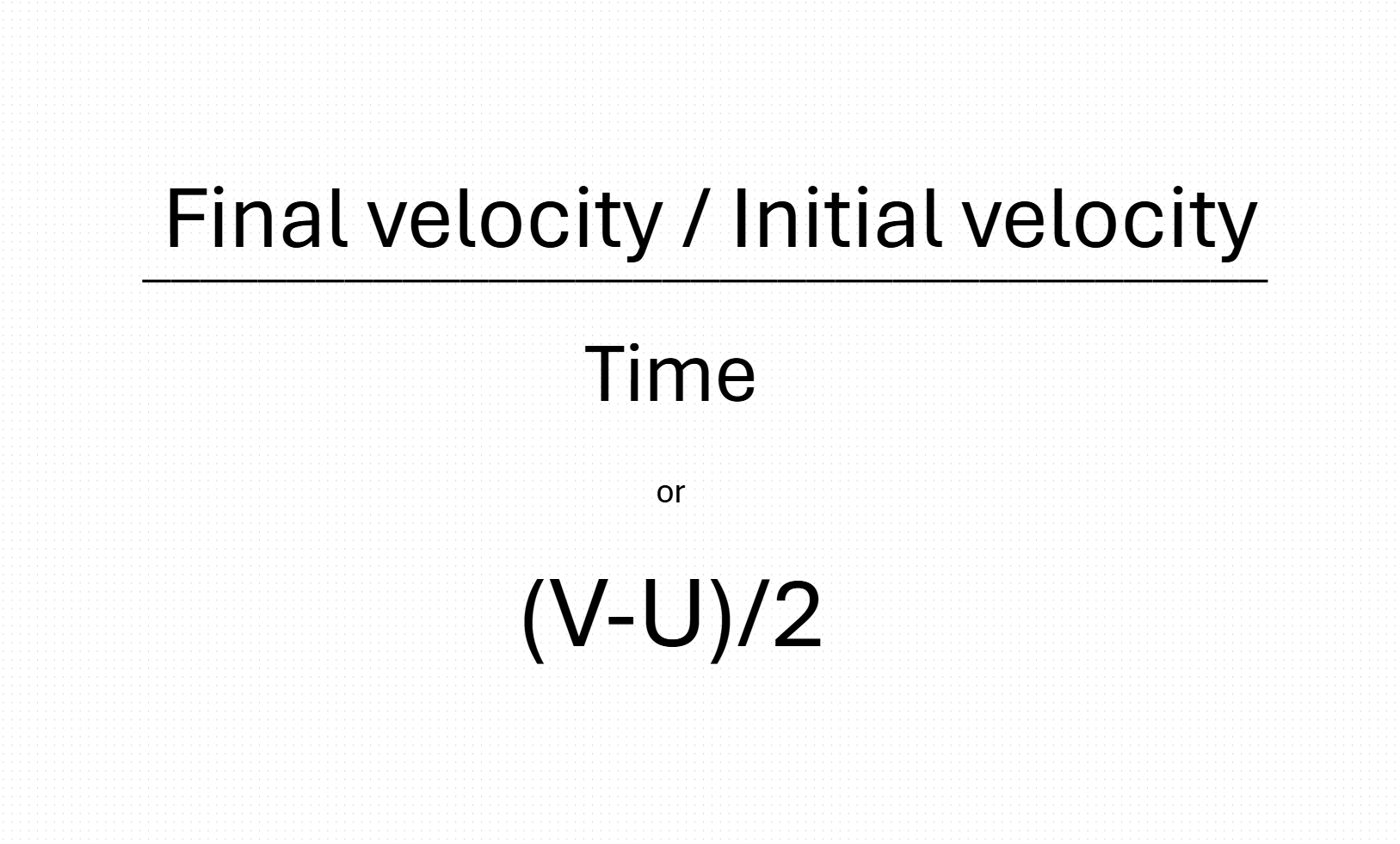
Acceleration formula
(final velocity - inital velocity)/2 | (v-u)/2