Upper Respiratory Passageways: Nose, Nasal Vestibule, and Nasal Cavity (Week 1, Mod 9)
 Studied by 0 people
 Call Kai
 Learn
Learn Practice Test
 Spaced Repetition
 Match
Match Flashcards
 Knowt Play
1/30

There's no tags or description
Looks like no tags are added yet.
Name | Mastery | Learn | Test | Matching | Spaced | Call with Kai |
|---|
No study sessions yet.
31 Terms
What are the respiratory passageways leading to and from the lungs collectively called?
Ancillary organs
Trachea
Bronchi
Larynx
What are the 4 overall major components of the respiratory system?
1) Ancillary organs
2) Lungs
3) Diaphragm - MAIN MUSCLE OF RESPIRATION
4) Muscles of the thoracic wall
What are the 5 general functions of the respiratory system?
1) Gas exchange
Ancillary organs → regulate volume and air conditioning
Lung alveoli → blood gas. barrier
2) Vocalization / phonation
3) Olfaction
4) Temperature regulation - important for hairy-skinned animals… lack sweat glands on skin
5) Acid-base balance - particularly during exercise
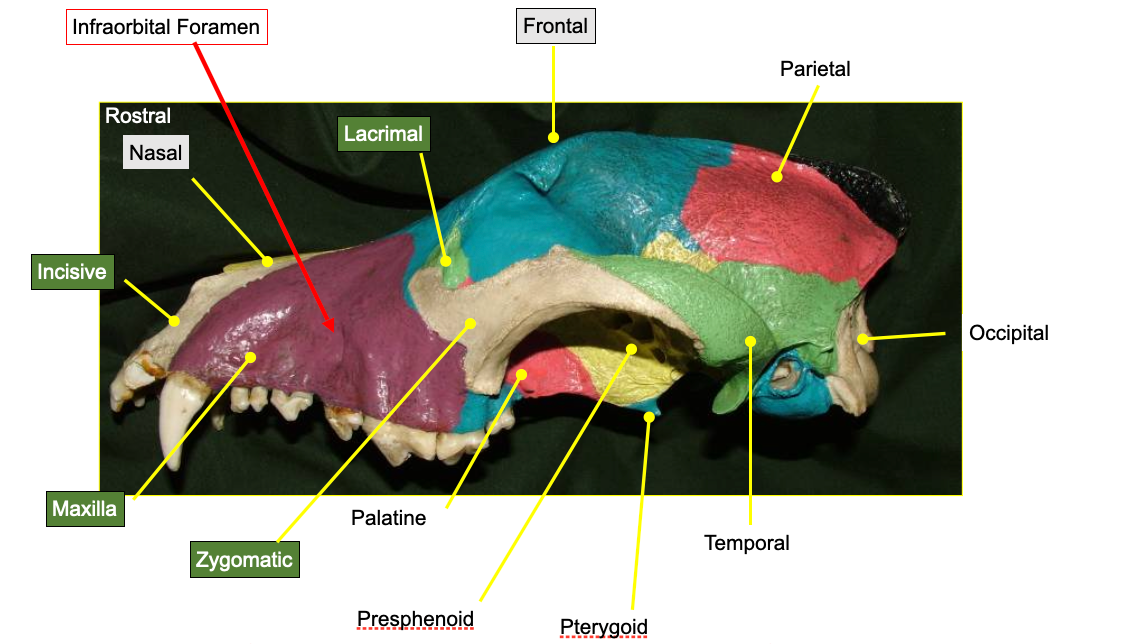
List the lateral bony boundaries of the nasal cavity (Hint: there are 4)
1) Maxilla
2) Lacrimal
3) Incisive
4) Zygomatic arch
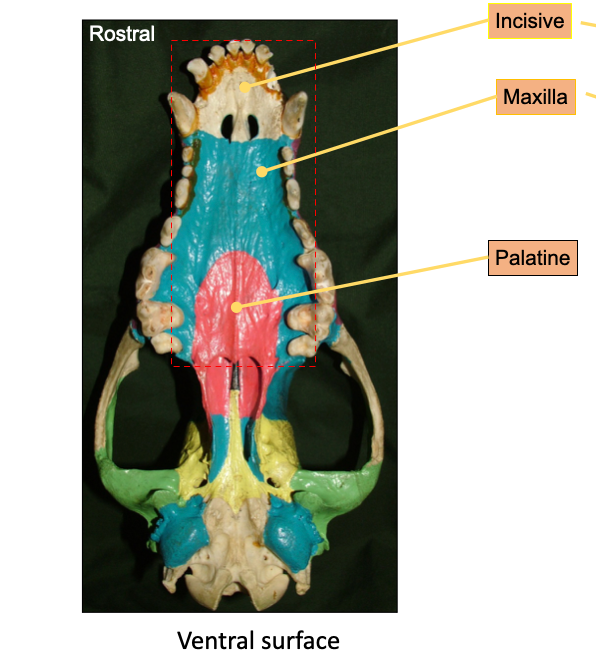
What 3 bones make up the VENTRAL boundary of the nasal cavity?
1) Incisive
2) Maxilla
3) Palantine
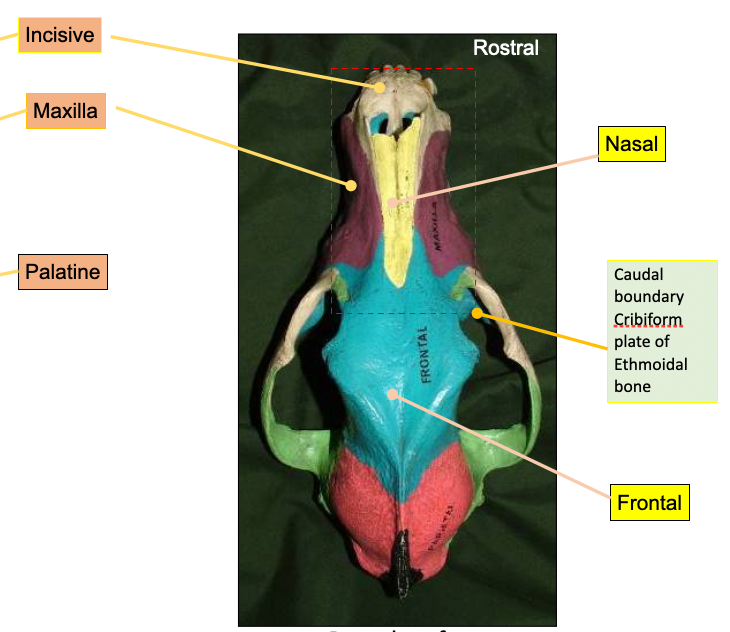
What 4 bones make up the DORSAL boundary of the nasal cavity?
Also, what’s the ONE bony CAUDAL boundary?
1) Incisive
2) Maxilla
3) Nasal
4) Frontal
Caudal boundary: CRIBIFORM PLATE
Very porous
Olfactory nerves PENETRATE through here
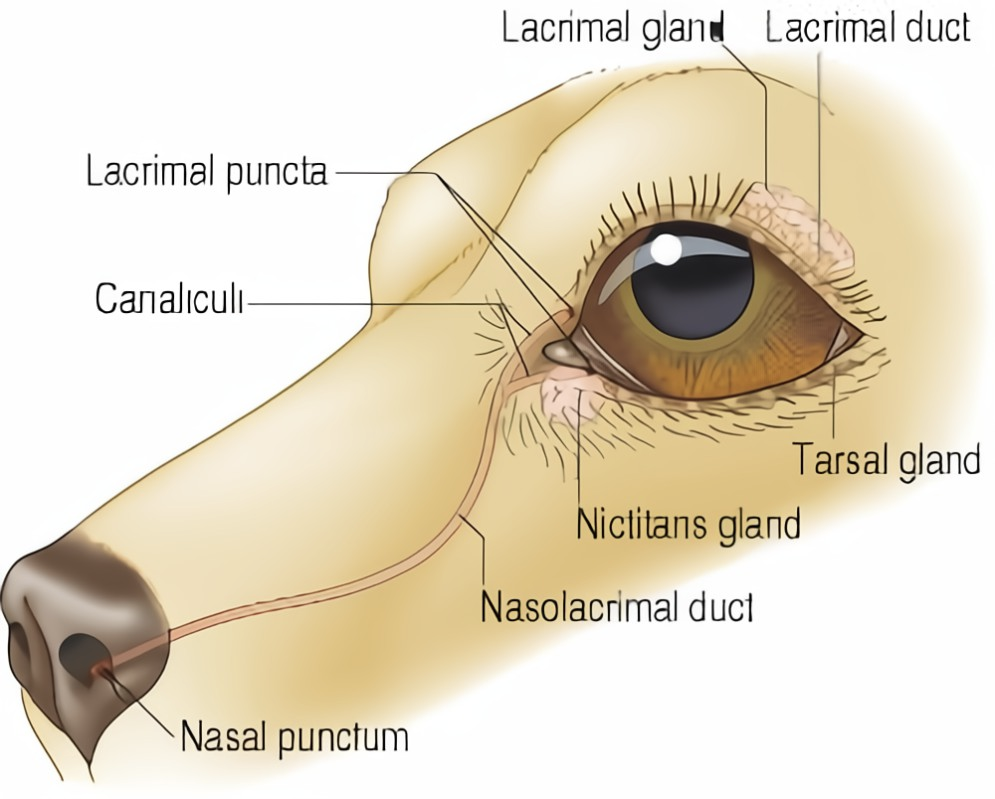
How is the skin of the nose moistened if there are no glands on the actual epithelium of the nose?
Secretions of the lacrimal gland (via nasolacrimal duct) and the lateral nasal glands
Lateral nasal glands are found in mucosa in a DEPRESSION of the maxillary bone
What artery brings blood supply to the nose?
The sphenopalantine artery (branch of MAXILLARY artery)
What are the 3 major muscles responsible for movement of the muzzle?
1) Superficial M. levator nasolabialis
“Snarl muscle”; responsible for dilating the nostril and elevating the upper lip
2) Deep M. levator labii maxillaris
Elevates upper lip and EXPOSES TEETH (maxillaris)
3) M. Caninus
ALSO helps to lift the upper lip and expose the teeth
Muscles of “facial expression”
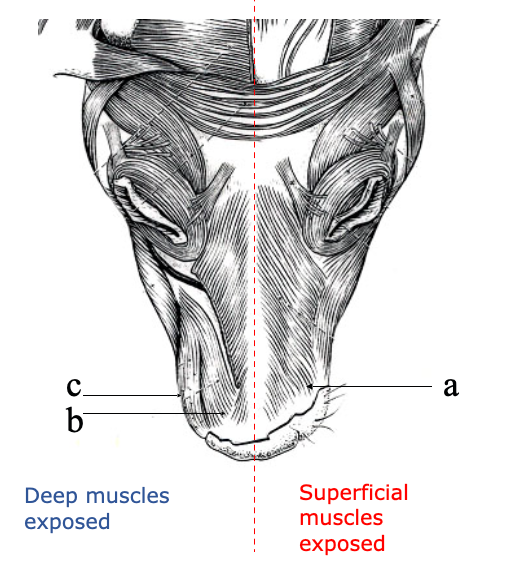
What nerve provides MOTOR supply to the muscles of the muzzle?
Facial nerve (CN VII)
What nerve provides SENSORY INNERVATION to the nose?
Infraorbital nerve
Branch of Trigeminal (CN V)
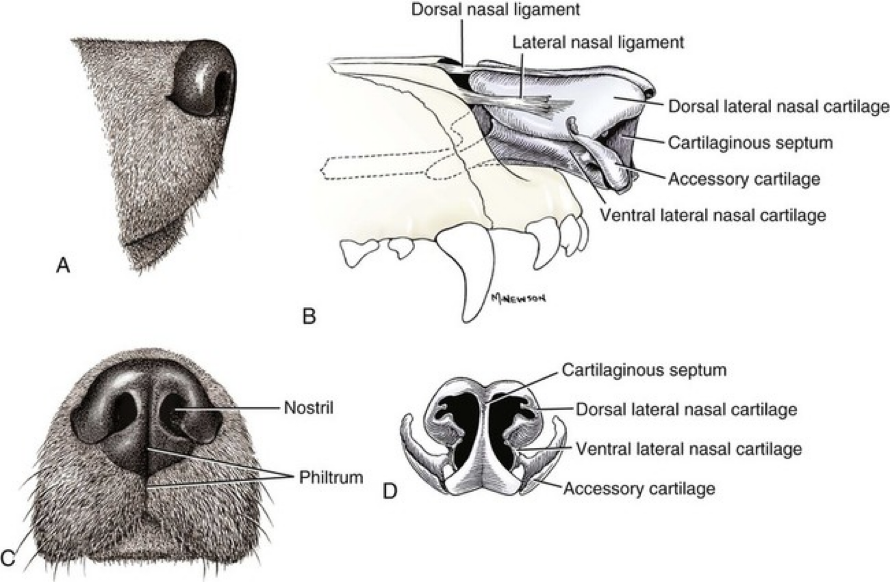
Describe the nasal vestibule… what is it supported by? What structure divides it into two separate passageways?
• The nostrils lead to the nasal vestibule
• The nasal vestibule extends beyond the bony skull - supported by series of cartilages
Cartilages are what give the visible nose and nostrils its structure
• The cartilaginous nasal septum divides the vestibule into two separate passageways that lead into the nasal cavity (which is ALSO divided into left and right sides by the nasal septum)
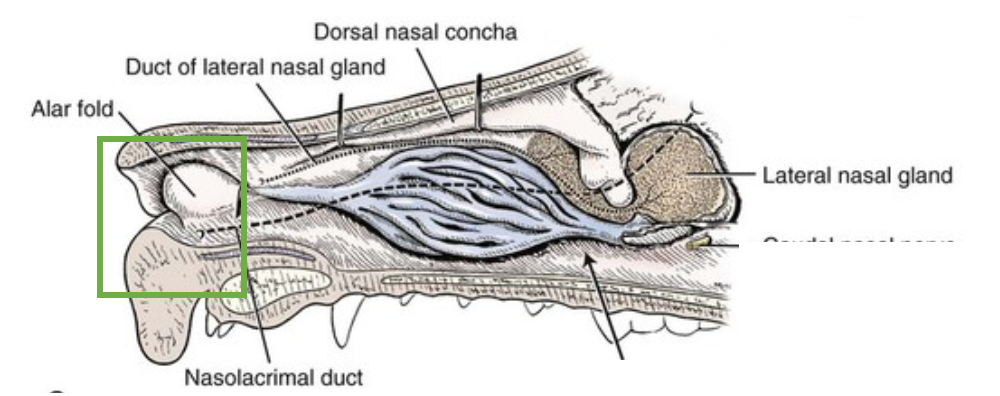
Describe the mucosa of the nasal vestibule… what structures does it give rise to? What two ducts are associated with this mucosa?
Nasal vestibule mucosa divides into 3 folds:
Alar fold (largest)
Dorsal fold
Basal fold
Associates with:
Nasolacrimal (NL) duct - terminates just below alar fold
Lateral nasal gland ducts
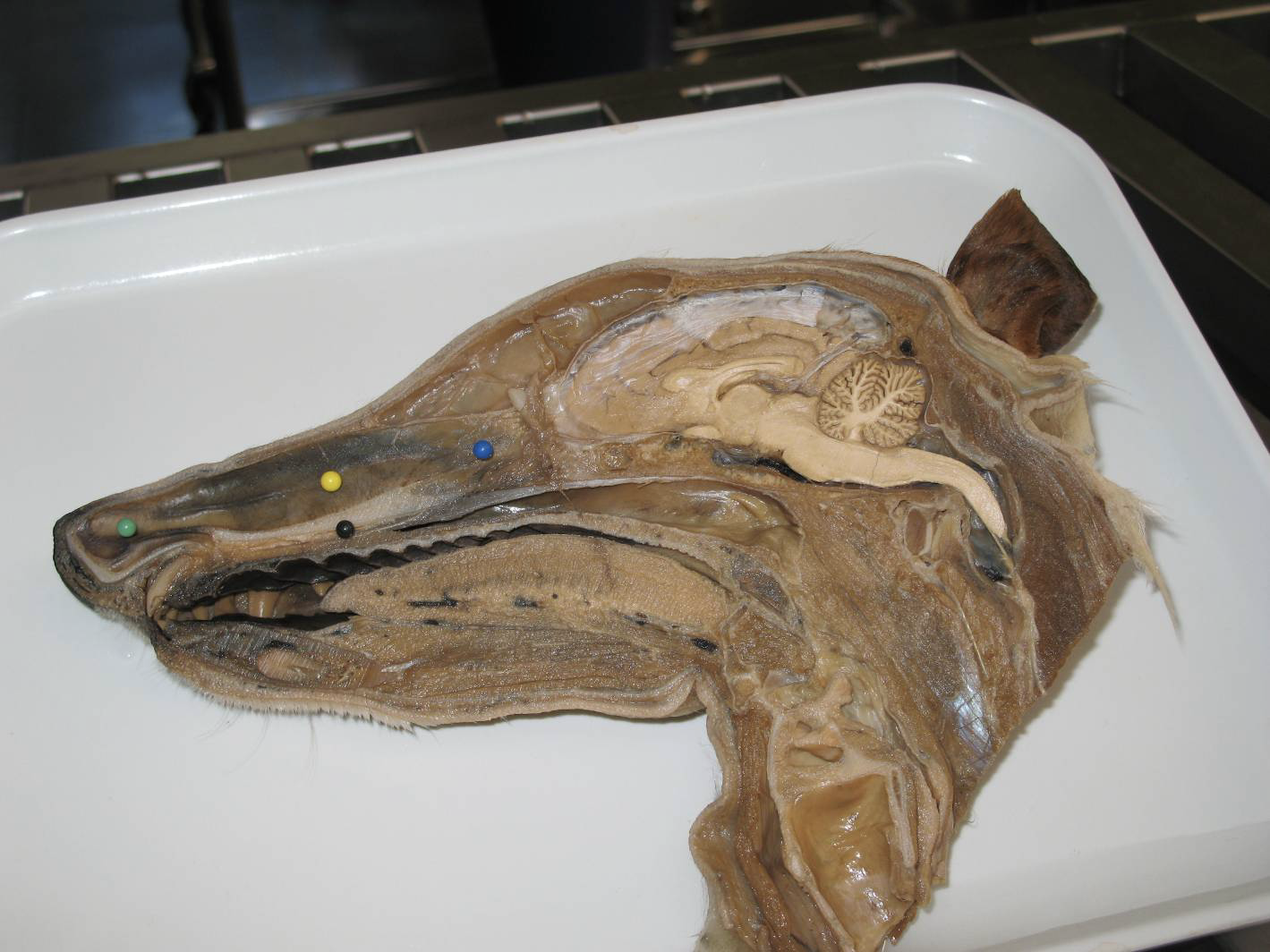
Describe the structure of the nasal septum as it passes caudally through the skull… What does it attach to caudally?
Is cartilage rostrally (green), but becomes bony as it passes caudally
Attaches to the ethmoid bone (blue)
What structure supports the nasal septum ventrally? Describe its structure within the skull.
The nasal septum is supported by the Vomer
Extends beyond the caudal extent of the hard palate to attach at the base of the cranium
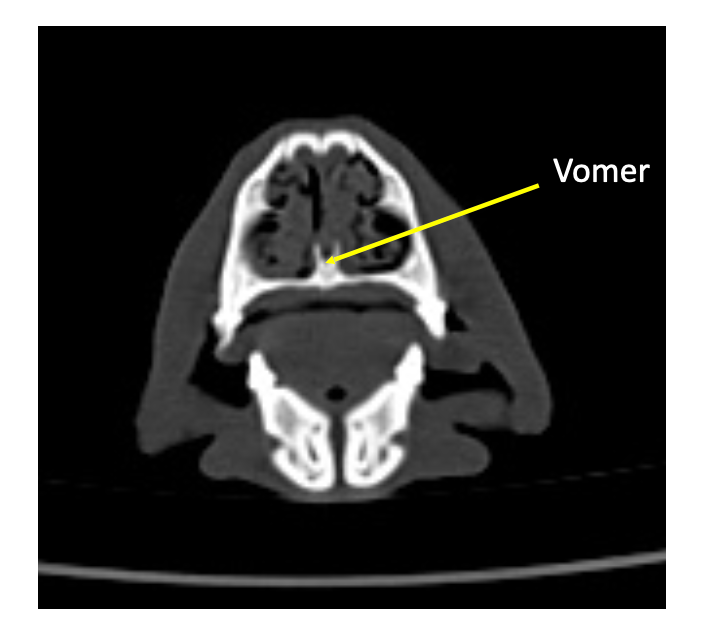
What is the other name for the nasal cavities?
Conchae
What are the 3 conchae within the dog muzzle, and what are their features and functions?
Dorsal and Ventral Conchae
Fragile, “scrolled” bony networks covered in vascular mucosa
Function: “air conditioning”
Direct, slow, clean, warm, and moisten
Think of all the complexity here acting as a filter that the air needs to pass through
Ethmoidal Conchae and Middle Conchae
Covered in olfactory epithelium
Function: smell
Associates with the ethmoid bone
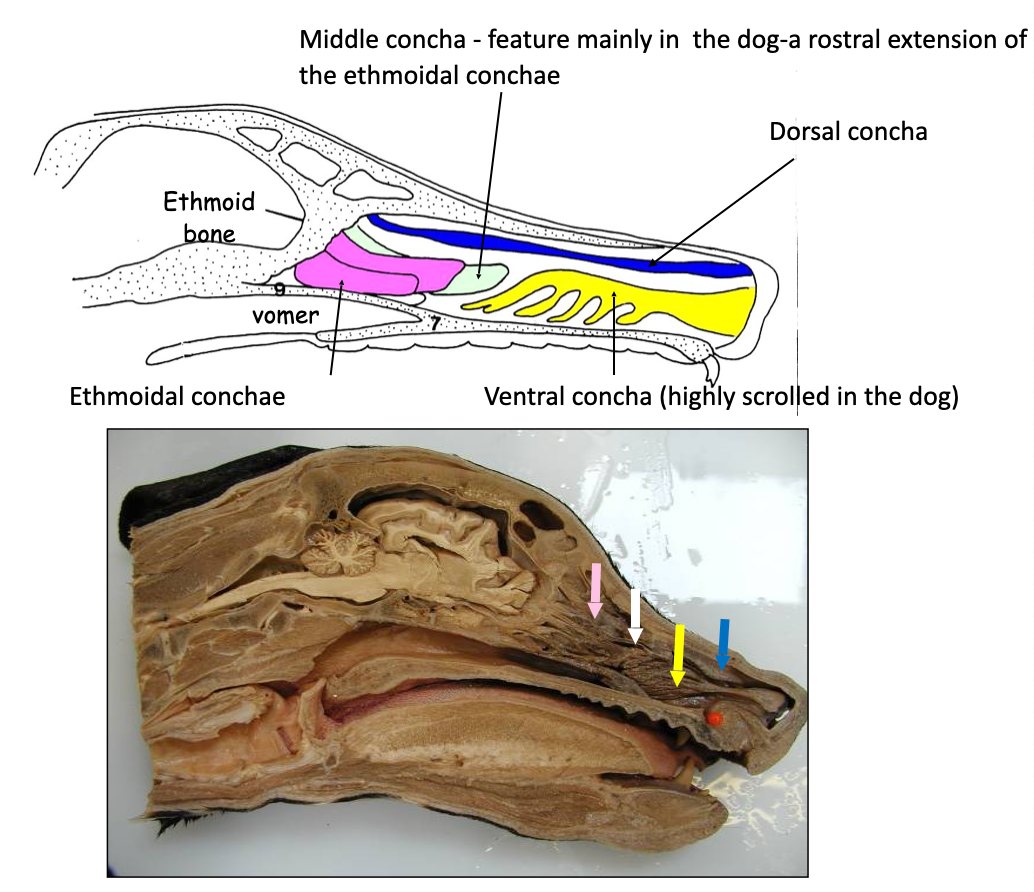
How is air directed through the conchal labyrinth during inhalation?
Is directed via a series of passageways called meatuses; this is where the air can pass through
What are the 4 meatuses that are highlighted in this lecture?
1) Dorsal nasal meatus
2) Middle nasal meatus
3) Common nasal meatus
4) Ventral nasal meatus
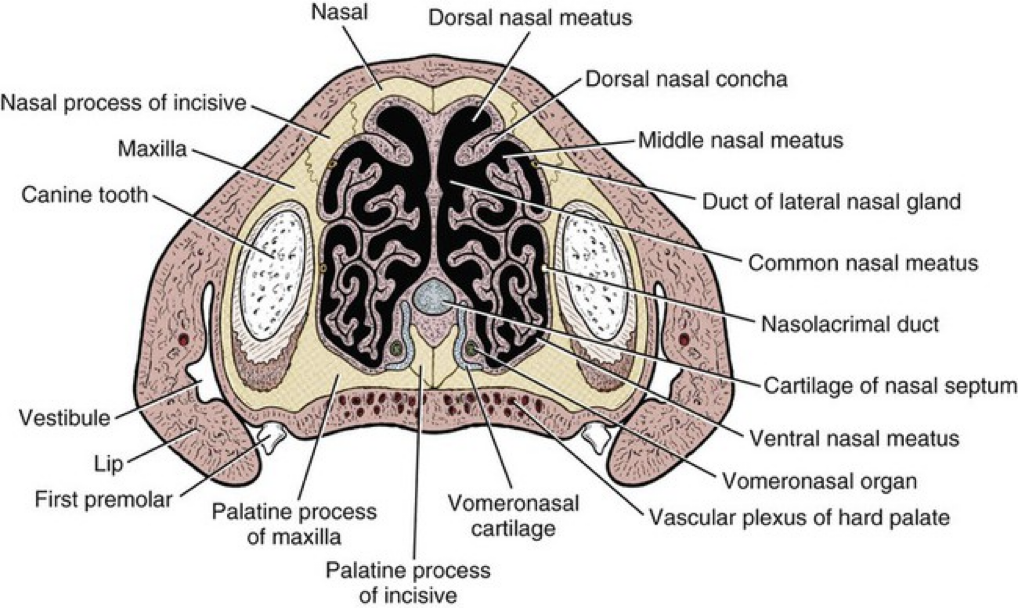
How are brachycephalic breeds at a disadvantage when it comes to the structure of their skulls?
The nasal cavity area is much reduced in brachycephalic breeds due to foreshortening of the skull and crowding of soft tissues
Soft tissues DO NOT change structure with the shortened skulls… instead, the same amount of tissue that is within non-brachycephalic dogs is ALSO in brachycephalic breeds, causing obstruction of airways
Essentially, brachycephalic breeds can BARELY breathe through their noses, so most need to breathe through their mouths
BUT soft tissues of the mouth (tongue and soft palate) obstruct the airway as well; are also compressed in the shortened skull
What are the paranasal sinuses, and how do they associate with the nasal cavities?
Paranasal sinuses are air-filled spaces within skull bones that border each nasal cavity; are directly linked TO the nasal cavities
Vary between species and ages (small in juveniles)
Lined by respiratory epithelium
What are the 4 functions of the paranasal sinuses? What are the 4 paranasal sinuses named? Which one is the most clinically significant?
Functions:
Lighten the skull
Protects the cranium
Increases surface area for muscle attachment WITHOUT adding weight
Contribute to resonance
Names:
Lateral frontal sinus
Medial frontal sinus
Rostral frontal sinus
Maxillary recess
In general, the overall frontal sinus is susceptible to infection (ex: aspergillosis in dogs) due to its many compartments
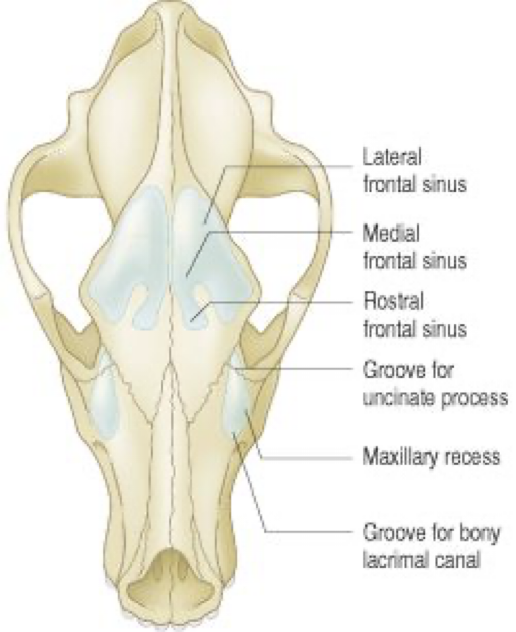
What is the location of the maxillary recess? Is it classified as a true sinus in carnivores?
The maxillary recess is NOT A TRUE SINUS IN CARNIVORES
Is a wide opening opposite to the upper 4th premolar
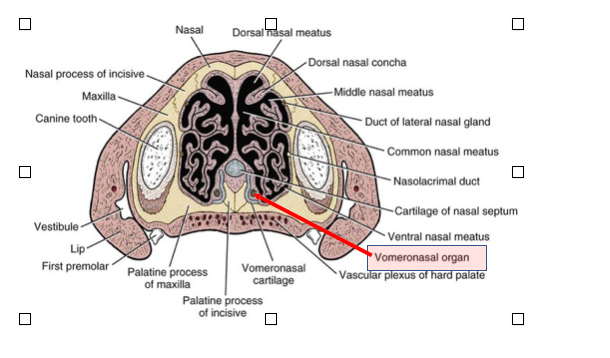
Describe the vomeronasal organ… where is it located in relation to the nasal cavities? Describe its structure and function.
Location: IN the ventral nasal meatus on either side of the nasal septum.
Tubular structure lined with specialised olfactory mucosa
Contains serous and mucous glands
Function: Detects pheromones
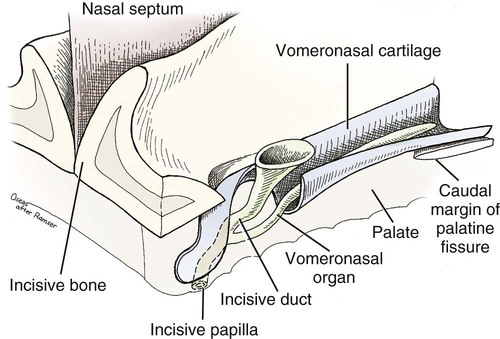
What are the incisive ducts? What is their function?
Connect the oral cavity (via the incisive papilla) to the vomeronasal organ.
Function: Allows appraisal of small amounts of fluid from the oral cavity by the vomeronasal organ’s olfactory mucosa
ENHANCES TASTE and pheromones
Are paired ducts, connecting the oral and nasal cavities
Run rostro-ventrally; passes through the palatine tissues and opens on the incisive papilla
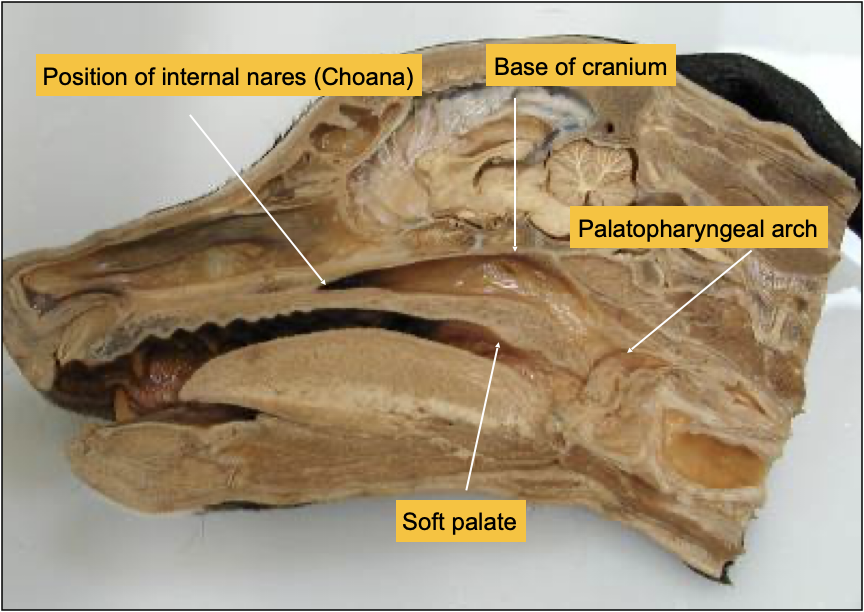
Describe the nasopharynx… what are its rostral, caudal, dorsal, and ventral borders?
Rostral - Internal nares (choana); open up into a common space
Caudal - Palatopharyngeal arch
Dorsal - Base of cranium
Ventral - Soft palate
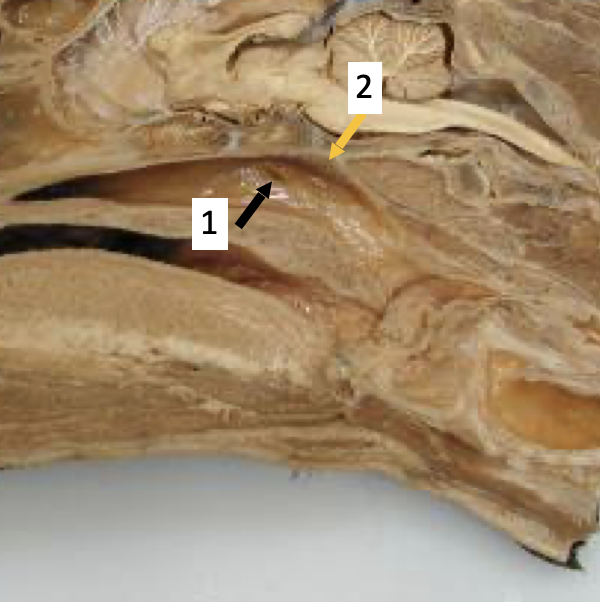
What are the 2 major features of the nasopharynx, and what are their functions?
Openings of the Auditory tubes
Lead to Tympanic bulla or middle ear
Lined by respiratory epithelium- infection
Function -equalisation of pressure
The Pharyngeal tonsil:
Part of retro-pharyngeal lymph centre
Lymphatic tissue- immuno surveillance
What is the function of the common pharynx/ laryngopharynx? What is the aditus of the larynx?
Dual role: passage for both breathing and swallowing
Pharyngeal muscles form the wall; they constrict, dilate, and shorten
Oesophagus lies dorsal and caudal to the larynx and trachea
Larynx supported by the hyoid apparatus and moves rostrally during swallowing
Aditus (laryngeal inlet; entrance point for air) position varies between species
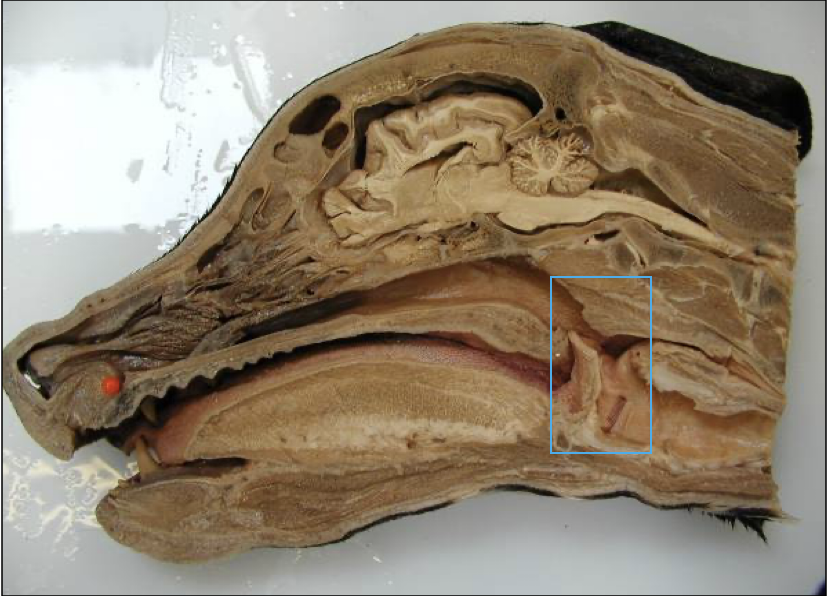
How is the larynx hindered in its function in brachycephalic dogs?
In many brachycephalic dogs, the soft palate is disproportionately long and rests over the entrance to the larynx causing respiratory difficulties
What is the blood supply of the laryngopharynx? (hint: 2 arteries)
Ascending pharyngeal artery
Cranial laryngeal artery
What is the sensory and motor nerve supply to the laryngopharynx?
Sensory:
Trigeminal n. (V)
Glossopharyngeal n. (IX)
Motor:
Glossopharyngeal n (IX)
Vagus n (X)