Quiz 1

0.0(0)
Studied by 0 people
call kaiCall Kai
Locked
learnLearn
examPractice Test
spaced repetitionSpaced Repetition
heart puzzleMatch
flashcardsFlashcards
GameKnowt Play
Card Sorting

1/204

encourage image

There's no tags or description

Looks like no tags are added yet.

Last updated 12:06 AM on 8/26/26
Name
Mastery
Learn
Test
Matching
Spaced
Call with Kai
Chat

No analytics yet

Send a link to your students to track their progress

205 Terms

1
New cards

Intersection

Definition of Biochemistry

  • The ________ of Biology and Chemistry

    • The molecules and mechanims of living things

    • Describes in molecular terms the structures, mechanism and chemical processes shared by living things.

    • Provides insights and practical applications to medicine, agriculture, nutrition and industry

      • How molecules affect living things!


2
New cards

Fundamental Principles

Foundations in Biochemistry → _______

  • Cellular

  • Chemical

  • Physical

  • Genetic

  • Evolution


3
New cards

Hierarchy

Cellular Foundations → Cells are the Fundamental Units of Life

  • There is a _______ of organization to living things

  • At each level of organization, novel properties emerge.

  • Life is an emergent property of cells.

  • Living organisms have common characteristics

    • Organization

    • The expression and transmission of genetic information

    • The transfer and transformation of energy and matter

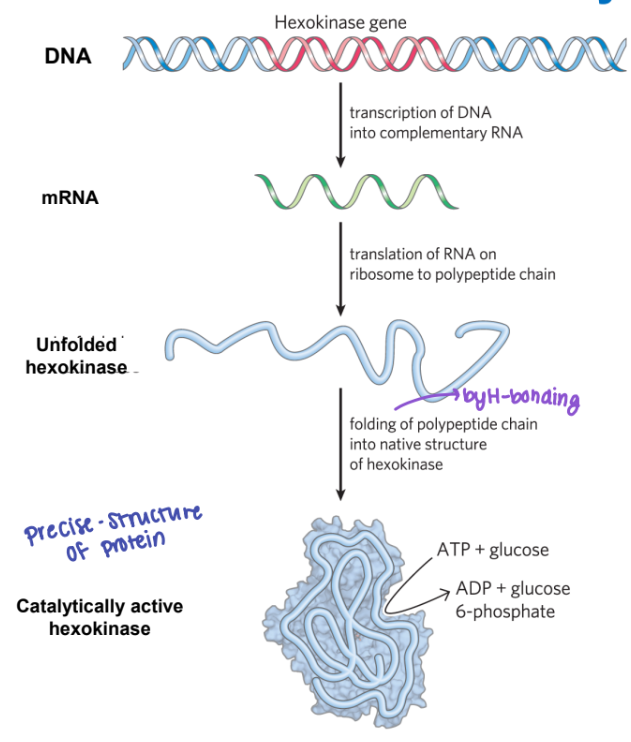
    • Interactions

    • Evolution - conservation and diversity


<p><strong><u>Cellular Foundations → Cells are the Fundamental Units of Life </u></strong></p><ul><li><p>There is a _______ of organization to living things </p></li><li><p>At each level of organization, novel properties emerge.</p></li><li><p><strong>Life is an </strong><span style="color: red;"><strong>emergent property of cells</strong></span><strong>. </strong></p></li><li><p><span style="color: blue;"><strong><mark data-color="blue" style="background-color: blue; color: inherit;">Living organisms have common characteristics </mark></strong></span></p><ul><li><p><strong>Organization</strong></p></li><li><p><strong>The expression and transmission of genetic information </strong></p></li><li><p><strong>The transfer and transformation of energy and matter</strong></p></li><li><p><strong>Interactions </strong></p></li><li><p><strong>Evolution - conservation and diversity </strong></p></li></ul></li></ul><p></p>
4
New cards

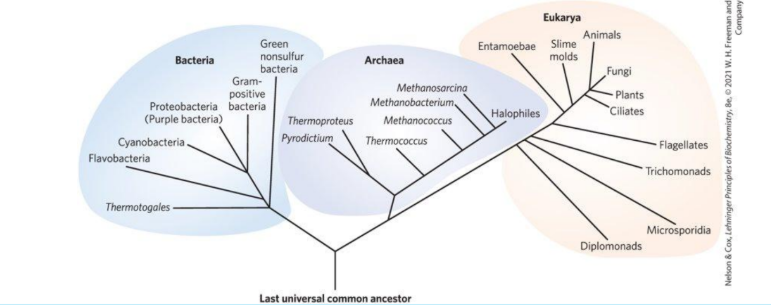
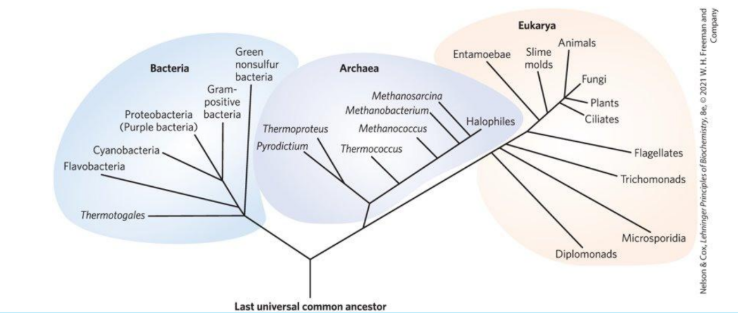
Bacteria

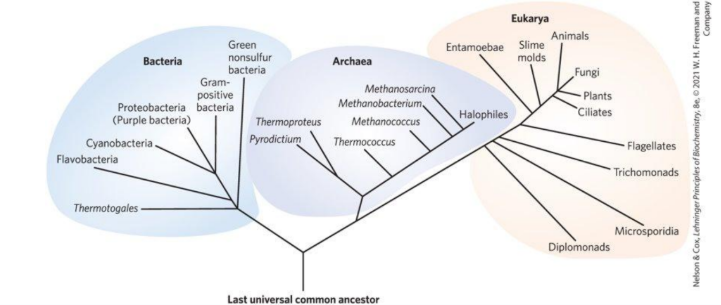
Phylogeny of the Three Domains of Life (associated with different types of cells)

  • ___________: inhabit soils, surface waters, and the tissues of other living or decaying organisms → Prokaryotic cells

<p><strong><u>Phylogeny of the Three Domains of Life (associated with different types of cells)</u></strong></p><ul><li><p>___________: inhabit soils, surface waters, and the tissues of other living or decaying organisms →<span style="color: green;"><strong> Prokaryotic cells </strong></span></p></li></ul><p></p>
5
New cards

Archaea

Phylogeny of the Three Domains of Life (associated with different types of cells)

  • ___________: inhabit extreme enviornments. More similar to Eukarya

<p><strong><u>Phylogeny of the Three Domains of Life (associated with different types of cells)</u></strong></p><ul><li><p>___________: inhabit extreme enviornments. More similar to Eukarya </p></li></ul><p></p>
6
New cards

Eukarya

Phylogeny of the Three Domains of Life (associated with different types of cells)

  • ___________: All eukaryotic organisms


<p><strong><u>Phylogeny of the Three Domains of Life (associated with different types of cells)</u></strong></p><ul><li><p>___________: All eukaryotic organisms </p></li></ul><p></p>
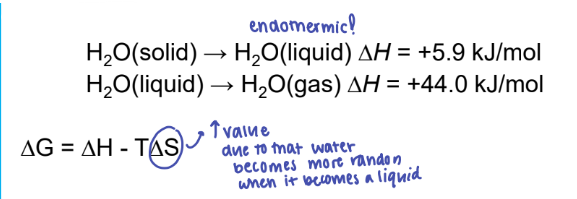
7
New cards

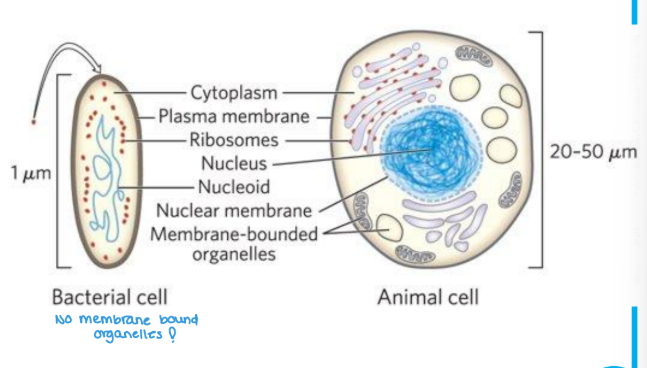
Organelles

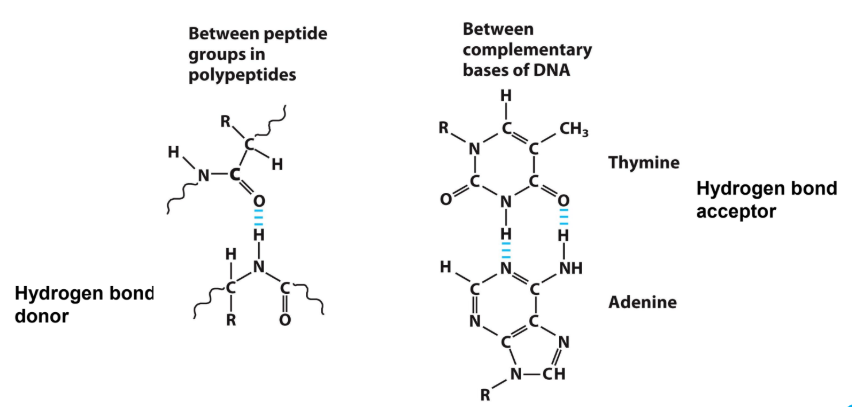
Prokarytoic and Eukaryotic Cells

  • All Cells Contain…

    • DNA

    • Ribosomes

    • Cytosol (Cytoplasm)

    • Plasma (cell) membrane

Bacteria/Prokaryotic Cells have no membrane bound _____
<p><strong><u>Prokarytoic and Eukaryotic Cells </u></strong></p><ul><li><p><strong>All Cells Contain… </strong></p><ul><li><p>DNA</p></li><li><p>Ribosomes</p></li><li><p>Cytosol (Cytoplasm) </p></li><li><p>Plasma (cell) membrane </p></li></ul></li></ul><p><span style="color: blue;"><strong><mark data-color="blue" style="background-color: blue; color: inherit;">Bacteria/Prokaryotic Cells have no membrane bound _____</mark></strong></span></p>
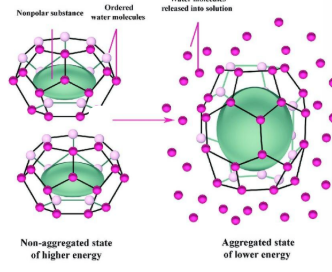
8
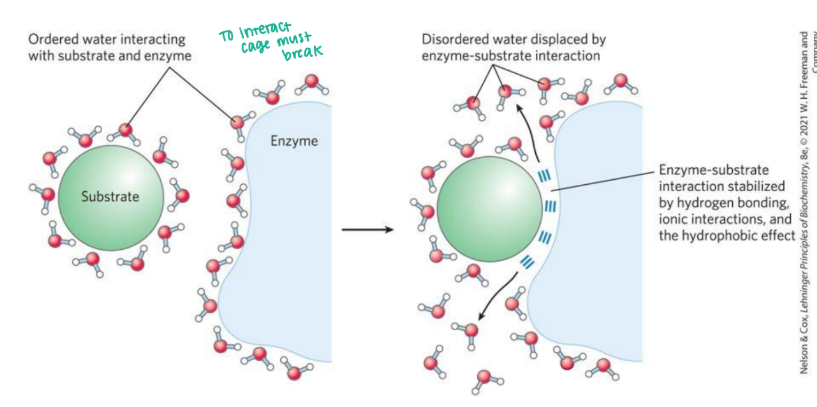
New cards

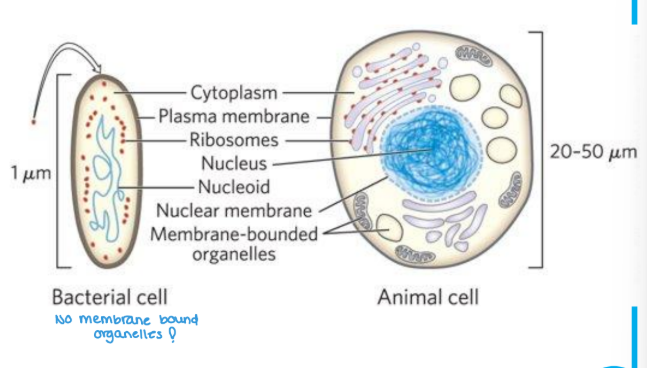
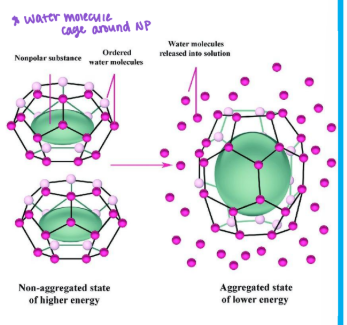
nucleus

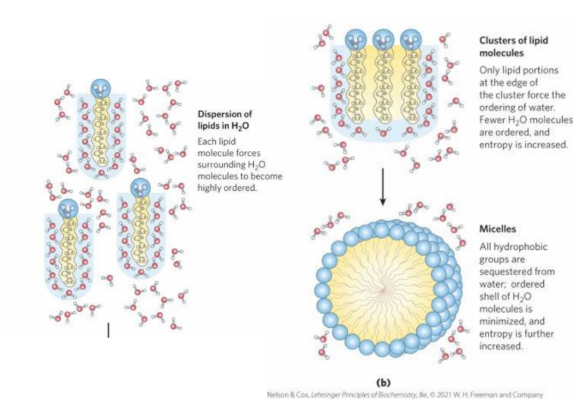
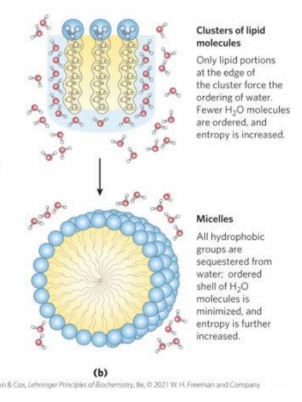
Prokaryotic and Eukaryotic Cells

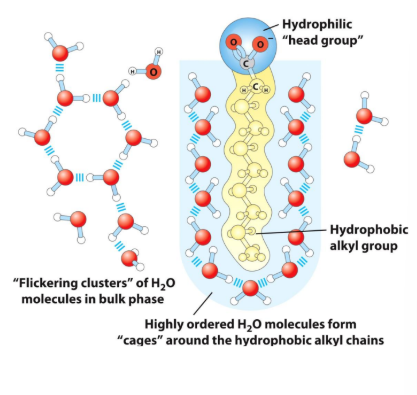
  • Eukaryotic Cells - DNA in a membrane bound ______ with other membrane bound organelles

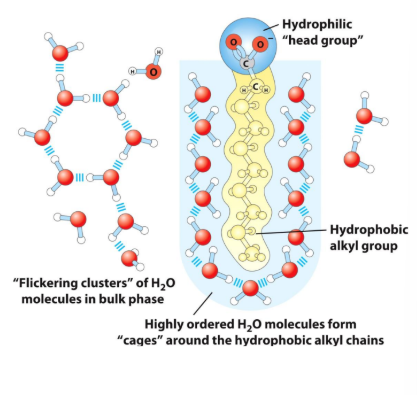
<p><strong><u>Prokaryotic and Eukaryotic Cells </u></strong></p><ul><li><p><span style="color: red;"><strong><mark data-color="red" style="background-color: red; color: inherit;">Eukaryotic Cells </mark></strong></span>- DNA in a membrane bound ______ with other membrane bound organelles </p></li></ul><p></p>
9
New cards

Diffusion

Cellular Dimensions are limited by ______

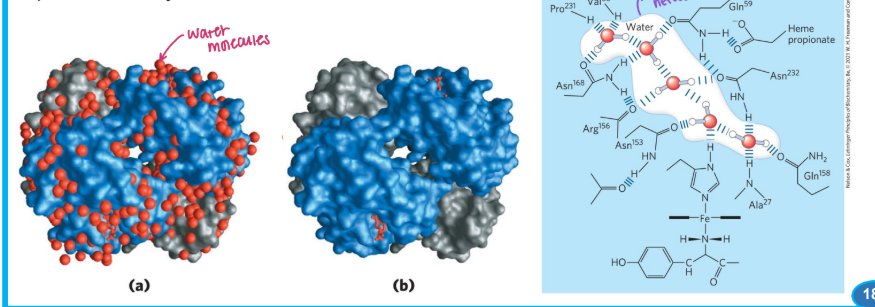
  • Cells are microscopic

    • 5 to 100um in diameter (Eukaryotic cells are typically larger)

    • unicellular microorganisms: 1 to 2 um long

  • Upper limit cell size is likely set by the rate of diffusion and the need to deliver O2 to all parts of the cell

    • as size increase, surface to volume ration decreases, many animal cells have highly folded or convoluted surfaces

<p><span style="color: blue;"><strong><u><mark data-color="blue" style="background-color: blue; color: inherit;">Cellular Dimensions are limited by ______</mark></u></strong></span></p><ul><li><p>Cells are <strong>microscopic </strong></p><ul><li><p>5 to 100um in diameter (Eukaryotic cells are typically larger)</p></li><li><p>unicellular microorganisms: 1 to 2 um long </p></li></ul></li><li><p><span style="color: red;"><strong><mark data-color="yellow" style="background-color: yellow; color: inherit;">Upper limit cell size</mark></strong></span><mark data-color="yellow" style="background-color: yellow; color: inherit;"> is likely set by the </mark><strong><u><mark data-color="yellow" style="background-color: yellow; color: inherit;">rate of diffusion</mark></u></strong><mark data-color="yellow" style="background-color: yellow; color: inherit;"> and</mark><span style="color: blue;"><strong><mark data-color="yellow" style="background-color: yellow; color: inherit;"> the need to deliver O2 to all parts of the cell </mark></strong></span></p><ul><li><p>as size increase,<strong> surface to volume ration decreases</strong>, many animal cells have <span style="color: green;"><strong><mark data-color="green" style="background-color: green; color: inherit;">highly folded or convoluted surfaces </mark></strong></span></p></li></ul></li></ul><p></p>
10
New cards
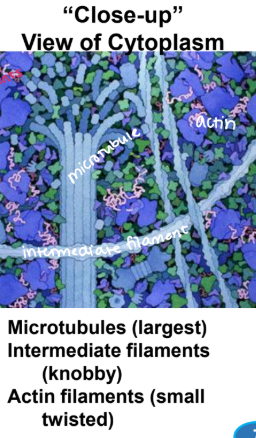
  • Actin Filaments

  • Microtubules

  • Intermediate Filaments


The Cytoskeleton of the Cell (Structure of the Cell)

  • Protein filaments form a meshwork → Dynamic

  • 3 types:

    • ______ - 6nm width, made from G-actin (interact with each other)

    • _______- 23nm width, made from tubulin (largest)

    • _______- 10nm width, made from alpha-keratin


<p><strong><u>The Cytoskeleton of the Cell (Structure of the Cell)</u></strong></p><ul><li><p><span style="color: blue;"><strong>Protein filaments</strong></span> form a meshwork → Dynamic </p></li><li><p><strong>3 types: </strong></p><ul><li><p>______ - 6nm width, made from <span style="color: red;"><strong><mark data-color="yellow" style="background-color: yellow; color: inherit;">G-actin </mark></strong></span>(interact with each other)</p></li><li><p>_______- 23nm width, made from <span style="color: red;"><strong><mark data-color="yellow" style="background-color: yellow; color: inherit;">tubulin</mark></strong></span> (largest)</p></li><li><p>_______- 10nm width, made from <span style="color: red;"><strong><mark data-color="yellow" style="background-color: yellow; color: inherit;">alpha-keratin </mark></strong></span></p></li></ul></li></ul><p></p>
11
New cards

noncovalently

Cytoskeleton Protein Filaments

  • Structure: each filament is composed of protein monomers bound _________ to form a long polymer.

<p><strong><u>Cytoskeleton Protein Filaments</u></strong></p><ul><li><p><strong>Structure</strong>: each filament is <span style="color: blue;"><strong>composed of protein monomers </strong></span>bound _________ to form a long polymer. </p></li></ul><p></p>
12
New cards

Cell Division

Cytoskeleton Protein Filaments

  • Function: provide shape and organization, as well as helping cells and organelles move

    • Important for _____ - cytoskeleton reorganizes cellular componenets to be divided between daughters


13
New cards
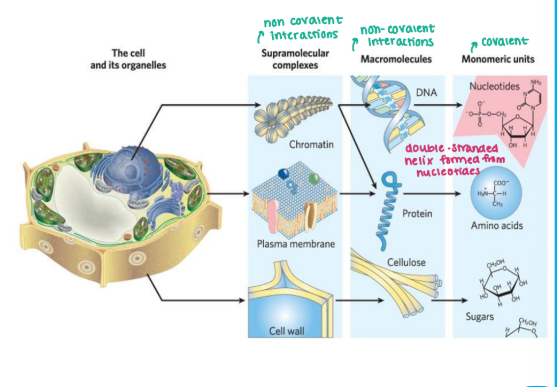
  • Supramolecular

  • Noncovalent Interactions


Cells Build ______ Structures

  • Cells use a small set of carbon-based metabolites to create

    • Polymeric machines

    • Supramolecular structures

    • information repositories

  • Held together by ________

    • Hydrogen bonds

    • Ionic interactions

    • Van der Waals interactions

    • The hydrophobic effect


<p><strong><u>Cells Build ______ Structures </u></strong></p><ul><li><p><strong>Cells use a small set of</strong><span style="color: purple;"><strong> carbon-based metabolites</strong></span><strong> to create </strong></p><ul><li><p>Polymeric machines </p></li><li><p>Supramolecular structures</p></li><li><p>information repositories </p></li></ul></li><li><p><strong>Held together by <mark data-color="purple" style="background-color: purple; color: inherit;">________</mark></strong></p><ul><li><p>Hydrogen bonds</p></li><li><p>Ionic interactions</p></li><li><p>Van der Waals interactions</p></li><li><p>The hydrophobic effect </p></li></ul></li></ul><p></p>
14
New cards

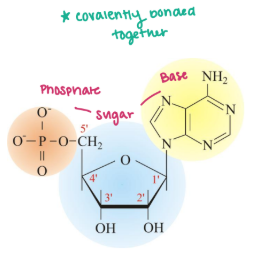
Nucleic Acids

Nucleic Acid Macromolecules

  • ________ = DNA and RNA = polymers of nucleotides

    • Store and transmit genetic information

    • Some RNA molcules have structural and catalytic roles in supramolecular complexes

    • Phosphate → sugar → base covalently bonded together

<p><strong><u>Nucleic Acid Macromolecules </u></strong></p><ul><li><p>________ =<span style="color: blue;"><strong> DNA and RNA = polymers of nucleotides </strong></span></p><ul><li><p>Store and transmit <strong>genetic information</strong> </p></li><li><p>Some RNA molcules have structural and <span style="color: red;"><strong>catalytic</strong></span> roles in supramolecular complexes </p></li><li><p>Phosphate → sugar → base covalently bonded together </p></li></ul></li></ul><p></p>
15
New cards

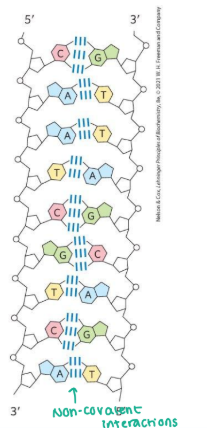
Non-covalent

Nucleic Acid Macromolecules

  • Nucleic Acid interactions are ______

Intramolecular (of nucleic acid) = covalent

Intermoleculer (between two nucleic acids) = noncovalent H-bond
<p><strong><u>Nucleic Acid Macromolecules</u></strong></p><ul><li><p>Nucleic Acid interactions are ______</p></li></ul><p>Intramolecular (of nucleic acid) = covalent</p><p>Intermoleculer (between two nucleic acids) = noncovalent H-bond</p>
16
New cards
  • Genome

  • Genomics


Nucleic Acid Macromolecules

  • ______ = entire sequence of a cells DNA or RNA

  • _______ = the characterization of the structure, function, evolution and mapping of genomes


17
New cards

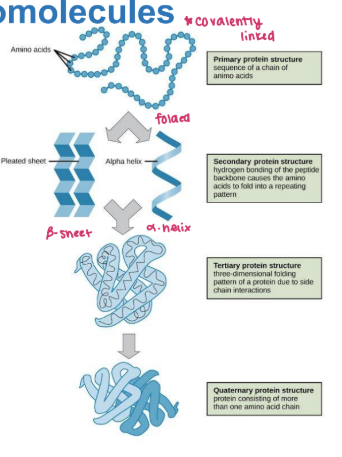
Proteins

Protein Macromolecules

  • __________ - long polymers of amino acids

    • Can function as enzymes, structural elements, signal receptors, transporters

    • Covalently linked, can fold to secondary structure to form a B-sheet or a- helix

<p><strong><u>Protein Macromolecules </u></strong></p><ul><li><p>__________ - long polymers of <span style="color: green;"><strong>amino acids </strong></span></p><ul><li><p>Can function as <strong>enzymes</strong>, structural elements, signal receptors, transporters </p></li><li><p><span style="color: green;"><strong><mark data-color="green" style="background-color: green; color: inherit;">Covalently linked</mark></strong></span>, can fold to secondary structure to form a B-sheet or a- helix </p></li></ul></li></ul><p></p>
18
New cards
  • Proteome

  • Proteomics


Protein Macromolecules

  • ______- sum of all the proteins functioning in a cell

  • _____- the systematic characterization of this protein complement under a specific set of conditions


19
New cards

Simple Sugars

Polysaccharide Macromolecules

  • Polysaccharides = polymers of ________

    • energy rich fuel stores

    • rigid structural components of cell walls (in plants and bacteria)

    • extracellular recognition elements that bind to proteins on other cells

  • Glycome = entire complement of carbohydrate-containing molecules in a cell
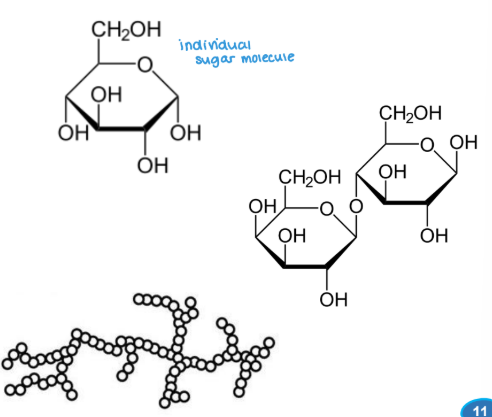

<p><strong><u>Polysaccharide Macromolecules </u></strong></p><ul><li><p><span style="color: blue;"><strong><u>Polysaccharides</u></strong></span> = polymers of ________</p><ul><li><p>energy rich fuel stores </p></li><li><p>rigid structural components of cell walls (in plants and bacteria)</p></li><li><p>extracellular recognition elements that bind to proteins on other cells </p></li></ul></li><li><p><strong><mark data-color="yellow" style="background-color: yellow; color: inherit;">Glycome </mark>= entire complement of carbohydrate-containing molecules in a cell </strong></p></li></ul><p></p>
20
New cards

hydrocarbon

Lipid Molecules

  • Lipids - water-insoluble _____ derivatives

    • structural components of membranes

    • energy-rich fuel stores

    • pigments

    • intracellular signals

  • Lipidome - the lipid containing molecules in a cell
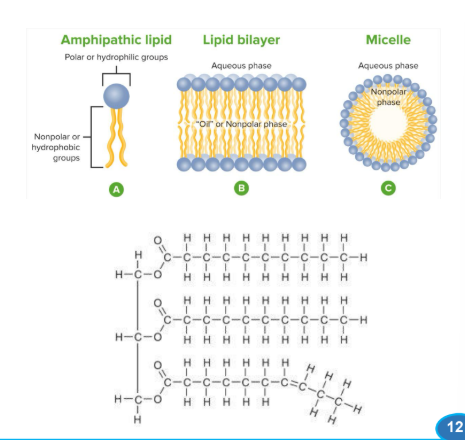

<p><strong><u>Lipid Molecules </u></strong></p><ul><li><p><strong>Lipids </strong>-<strong><mark data-color="blue" style="background-color: blue; color: inherit;"> </mark></strong><span style="color: blue;"><strong><mark data-color="blue" style="background-color: blue; color: inherit;">water-insoluble _____ derivatives </mark></strong></span></p><ul><li><p>structural components of membranes </p></li><li><p>energy-rich fuel stores</p></li><li><p>pigments</p></li><li><p>intracellular signals </p></li></ul></li><li><p><strong><mark data-color="yellow" style="background-color: yellow; color: inherit;">Lipidome</mark> - the lipid containing molecules in a cell </strong></p></li></ul><p></p>
21
New cards

Complex Mixture

Cells are a ______ of Biological Molecules
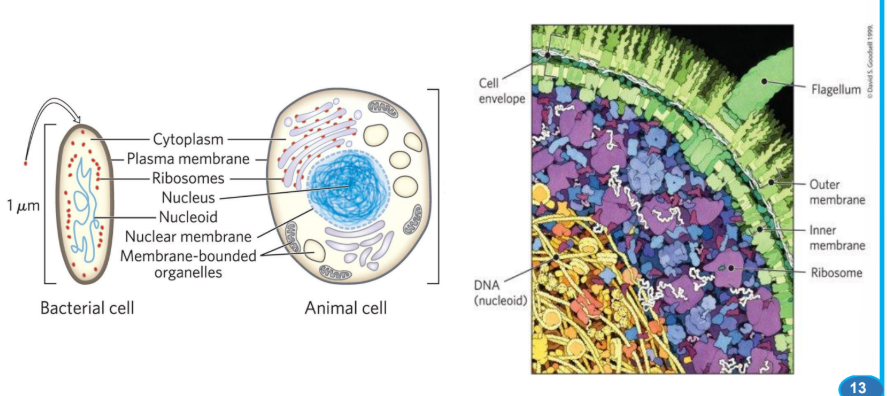
<p><strong>Cells are a ______ of Biological Molecules </strong></p>
22
New cards

99%

Chemical Foundations

  • Elements are essential for animal life and health

    • less than 30 of the naturally occuring elements are essential to life

    • most at the lowest atomic weight

    • hydrogen, oxygen, nitrogen, and carbon are ____ of an organism

Bulk - essential in large amounts

Trace - essential in small amounts
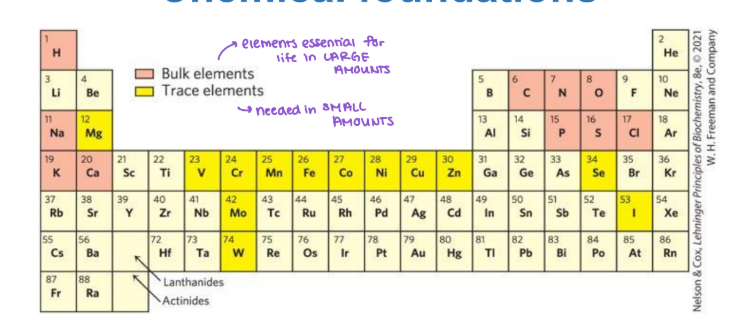
<p><strong><u>Chemical Foundations </u></strong></p><ul><li><p><span style="color: blue;"><strong><mark data-color="blue" style="background-color: blue; color: inherit;">Elements are essential for animal life and health </mark></strong></span></p><ul><li><p>less than 30 of the naturally occuring elements are essential to life </p></li><li><p>most at the lowest atomic weight </p></li><li><p><strong><mark data-color="yellow" style="background-color: yellow; color: inherit;">hydrogen, oxygen, nitrogen, and carbon are ____ of an organism </mark></strong></p></li></ul></li></ul><p><strong><mark data-color="red" style="background-color: red; color: inherit;">Bulk </mark></strong><mark data-color="red" style="background-color: red; color: inherit;">- essential in large amounts</mark></p><p><strong><mark data-color="red" style="background-color: red; color: inherit;">Trace</mark></strong><mark data-color="red" style="background-color: red; color: inherit;"> - essential in small amounts </mark></p>
23
New cards

double bond

Geometry of Carbon Bonding

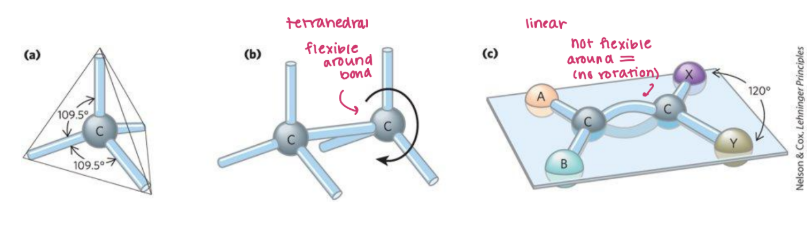
  • Classic 4 bonds = tetrahedral arrangement

  • Carbon can form covalent bonds to form linear and branched chains, with free rotation around each single bond

  • Carbon can form H,S,P and form form single and double bonds with O and N (limited rotation about the axis of a _____)

<p><strong>Geometry of Carbon Bonding </strong></p><ul><li><p>Classic 4 bonds = <span style="color: purple;"><strong>tetrahedral arrangement </strong></span></p></li><li><p>Carbon can form <strong>covalent bonds to form linear and branched chains</strong>, with free rotation around each single bond </p></li><li><p>Carbon can form H,S,P and form form single and double bonds with O and N <span style="color: blue;"><strong>(limited rotation about the axis of a _____) </strong></span></p></li></ul><p></p>
24
New cards

Polyfunctional

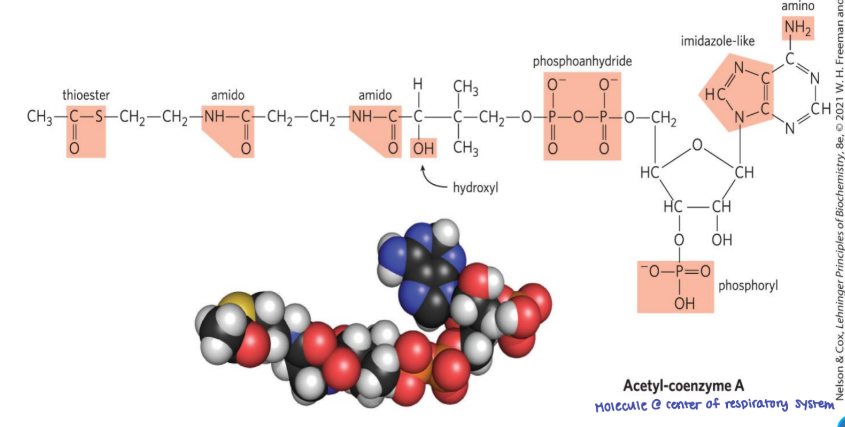
Many Biomolecules are ______
<p><strong>Many Biomolecules are ______</strong></p>
25
New cards

Configuration

_______: the fixed spatial arrangement of atoms

<p>_______: the <strong>fixed spatial arrangement of atoms </strong></p>
26
New cards

Stereoisomers

________: molecules with the same chemical bonds and same chemical formula

27
New cards

Stereospecific

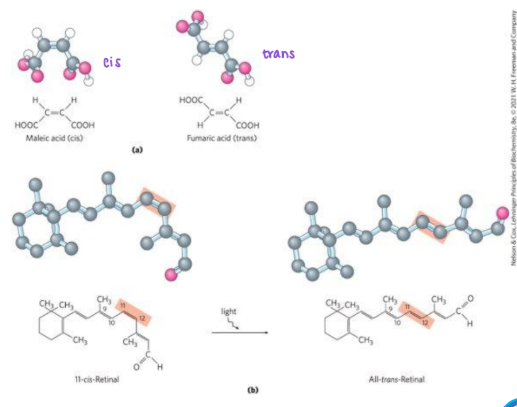
_________: requiring specific conformations in the interaction molcules
<p>_________: requiring specific conformations in the interaction molcules </p>
28
New cards

Geometric Isomers or Cis/trans isomers

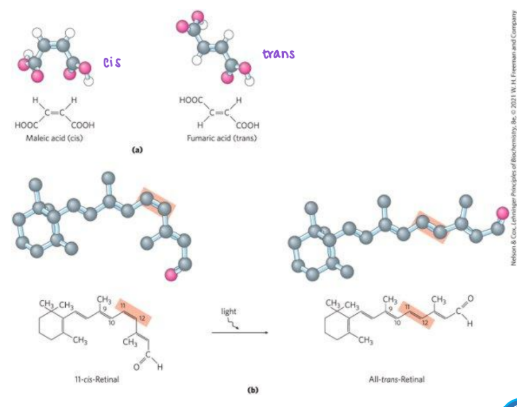
________: differ in the arrangement of substituent groups with respect to the double bond
<p>________: differ in the<strong> arrangement of substituent groups with respect to the double bond </strong></p>
29
New cards

Asymmetric Carbons

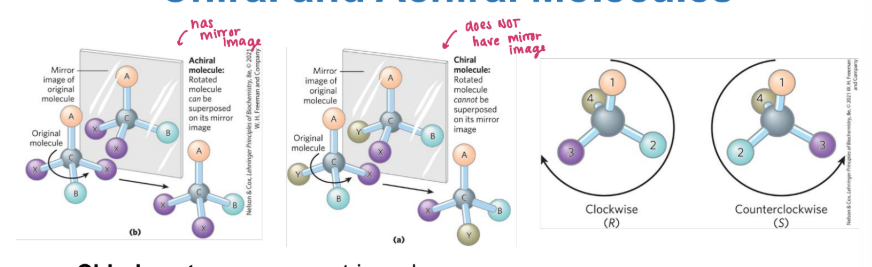
Chiral and Achiral Molecules

  • Achrial = can be superposed (mirror image is the smae)

  • Chiral = cannot be superposed (mirror image is different)

    • R/S

  • Chiral centers = _____

A molecule can have 2^n stereoisomers, where n is the number of chiral

carbons

• Each group attached to a chiral carbon is assigned a priority, where:

—OCH3 > —OH > —NH2 > —COOH > —CHO > —CH2OH > —CH3 > —H

<p><strong><u>Chiral and Achiral Molecules </u></strong></p><ul><li><p><strong>Achrial </strong>= can be superposed (mirror image is the smae)</p></li><li><p><strong>Chiral </strong>= cannot be superposed (mirror image is different) </p><ul><li><p>R/S</p></li></ul></li><li><p><strong><mark data-color="yellow" style="background-color: yellow; color: inherit;">Chiral centers = _____</mark></strong></p></li></ul><p>A molecule can <span style="color: blue;"><strong>have 2^n stereoisomers, where n is the number of chiral</strong></span></p><p><span style="color: blue;"><strong>carbons</strong></span></p><p>• Each group attached to a chiral carbon is assigned a priority, where:</p><p>—OCH3 &gt; —OH &gt; —NH2 &gt; —COOH &gt; —CHO &gt; —CH2OH &gt; —CH3 &gt; —H</p><p></p>
30
New cards
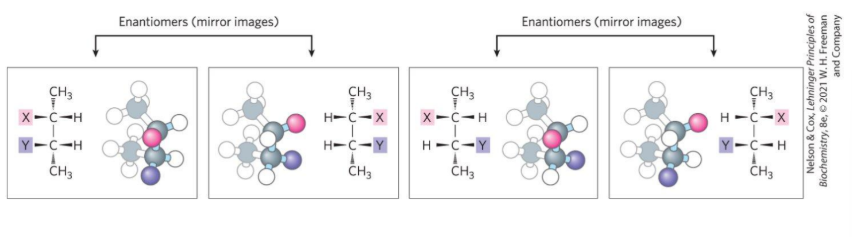
  • Enantiomers

  • Diastereomers


Enantiomers and Diastereomes

  • _____: stereoisomers that are mirror images of each other (all chiral centers changed)

  • ______: stereoisomers that are not mirror images of each other (not all centers changed)

<p><strong><u>Enantiomers and Diastereomes </u></strong></p><ul><li><p><mark data-color="red" style="background-color: red; color: inherit;">_____</mark>: stereoisomers that are mirror images of each other <strong>(all chiral centers changed)</strong></p></li><li><p><mark data-color="red" style="background-color: red; color: inherit;">______</mark>: stereoisomers that are not mirror images of each other <strong>(not all centers changed) </strong></p></li></ul><p></p>
31
New cards

Dynamic Steady State

Physical Foundations

  • Small molecules, macromoleules and supramolecular complexes are CONTINOUSLY synthesized and broken down.

  • This constant synthesis and breaking down is known as _________. Living cells maintain themselves in a dynamic steady state distant from equilibrium with its surrounding.


32
New cards

Energy

Maintaining a dynamic steady state requires the constant investment of ______.

  • Organisms extract energy from the enviornment in two main ways

    • Photoautotrophs

    • Chemotrophs


33
New cards

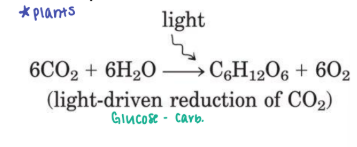
Photoautotrophs

Extracting Energy for Dynamic Steady State

This is the process for ______
<p><strong><em>Extracting Energy for Dynamic Steady State </em></strong></p><p><strong><em>This is the process for ______</em></strong></p>
34
New cards

Chemotrophs

Extracting Energy for Dynamic Steady State

This is the process for ______

<p><strong><em>Extracting Energy for Dynamic Steady State </em></strong></p><p><strong><em>This is the process for ______</em></strong></p>
35
New cards

First Law of Thermodynamics

The Laws of Thermodynamics

  • ________: in any physical or chemical change, the total amount of energy in the universe remains constant, although the frm of the energy may change.


36
New cards

Second Law of Thermodynamics

The Laws of Thermodynamics

  • ________: randomness in the universe is constantly increasing


37
New cards

Entropy (S)

_____- represents the randomness or disorder of the components of a chemical system.

  • Creating and maintaining order requires work and energy.

  • INCREASING entropy makes reactions more spontaneous


38
New cards

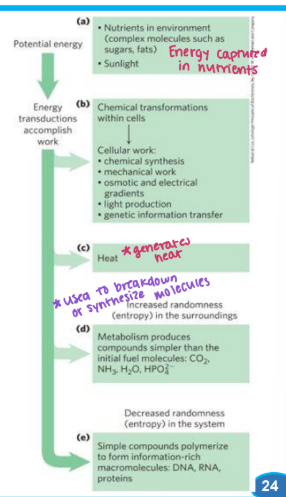
Work

Energy is captured in nutrients/sunlight that energy accomplishes ____ → chemical transformations within cells, generates heat, and the synthesis and breakdown of molecules.
<p><strong>Energy is captured in nutrients/sunlight</strong> that energy accomplishes ____ → <mark data-color="yellow" style="background-color: yellow; color: inherit;">chemical transformations within cells, generates heat, and the synthesis and breakdown of molecules. </mark></p>
39
New cards
  • enthalpy

  • absolute temperature

  • entropy


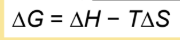
  • Free Energy, G, of a closed system → H - TS

    • H represents ____

    • T represents _______

    • S represents ____


<ul><li><p><strong>Free Energy, G, of a closed system → H - TS</strong></p><ul><li><p>H represents ____</p></li><li><p>T represents _______</p></li><li><p>S represents ____</p></li></ul></li></ul><p></p>
40
New cards

Enthalpy

_____, H - heat content, roughly reflecting the number and kinds of bonds.
<p>_____, H - heat content, <strong>roughly reflecting the number and kinds of bonds. </strong></p>
41
New cards

Free-Energy Change

When a chemical reaction occurs, ________.

**Know this equation
<p>When a <strong>chemical reaction occurs</strong>, ________. </p><p>**Know this equation </p>
42
New cards

Spontaneous

Negative DeltaG = _______

43
New cards

Nonspontaneous

Positive DeltaG = _______

44
New cards

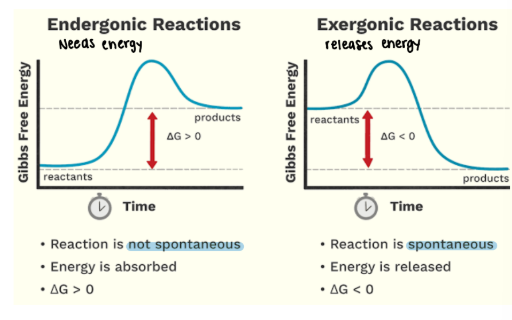
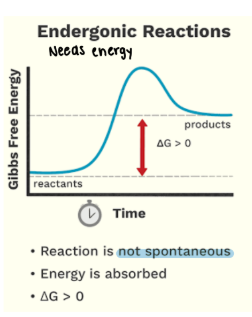
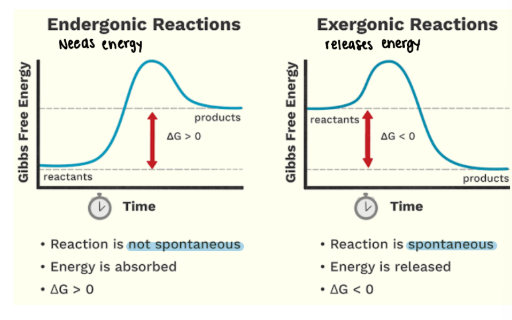
Endergonic

_______ Reactions

  • Reaction is NOT spontaneous

  • Energy is absorbed

  • Delta G > 0


<p><strong>_______ Reactions </strong></p><ul><li><p>Reaction is <span style="color: red;"><strong>NOT spontaneous</strong></span> </p></li><li><p>Energy is <strong>absorbed </strong></p></li><li><p><strong>Delta G &gt; 0 </strong></p></li></ul><p></p>
45
New cards

Exergonic Reactions

_________ Reactions

  • Reaction is spontaneous

  • Energy is released

  • Delta G < 0


<p><strong>_________ Reactions</strong></p><ul><li><p>Reaction is <span style="color: green;"><strong>spontaneous </strong></span></p></li><li><p>Energy is <strong>released</strong></p></li><li><p><strong>Delta G &lt; 0 </strong></p></li></ul><p></p>
46
New cards

Equilibrium Constant

The _________, Keq

  • where [A]eq is the concentration of A, [B]eq is the concentration of B, and so on, when the system has reached equilibrium.


<p><strong>The _________, Keq </strong></p><ul><li><p>where [A]eq is the concentration of A, [B]eq is the concentration of B, and so on, <strong>when the system has reached equilibrium. </strong></p></li></ul><p></p>
47
New cards

Sponatneous

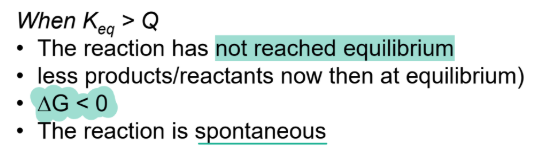
When Keq > 1

  • Products are > Reactants

  • Delta Go < 0 (Negative)

  • Reaction is _______


48
New cards

Not spontaneous

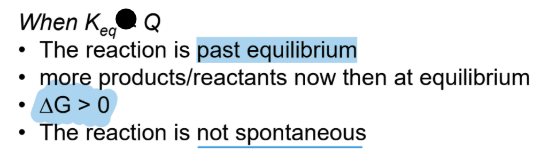
When Keq < 1

  • Products are < Reactnats

  • Delta Go > 0 (Positive)

  • Reaction is _______


49
New cards

Equilibrium

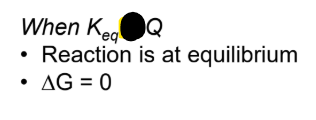
When Keq = 1

  • Products = Reactants

  • Delta Go = 0

  • Reaction is at ________


50
New cards

Standard free-energy change

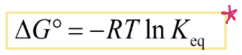
__________ of a reaction under standard conditions, 298K pressure, 1 atm; and all solutes at 1M concentration. R is the gas constant. This is a known value.

**Know this formula
<p>__________ of a<strong> reaction under </strong><span style="color: blue;"><strong>standard conditions</strong></span>, 298K pressure, 1 atm; and all solutes at 1M concentration. R is the gas constant. This is a <strong>known value. </strong></p><p><strong>**Know this formula </strong></p>
51
New cards

ACTUAL

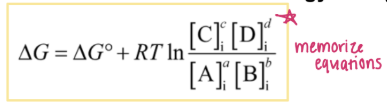
The _____ free-energy change for chemcial reactions under NON-STANDARD conditions is a function of the standard free-enery change. DeltaGo

**Know this formula
<p>The _____ free-energy change for chemcial reactions under <span style="color: blue;"><strong>NON-STANDARD conditions</strong></span> is a <strong>function </strong>of the <strong><mark data-color="yellow" style="background-color: yellow; color: inherit;">standard free-enery change. DeltaGo</mark></strong></p><p><strong>**Know this formula </strong></p>
52
New cards

Mass-Action Ratio

Q = the __________, the ratio of initial concentration of products over reactants

53
New cards

=

knowt flashcard image
54
New cards

<

knowt flashcard image
55
New cards

>

knowt flashcard image
56
New cards

Exergonic

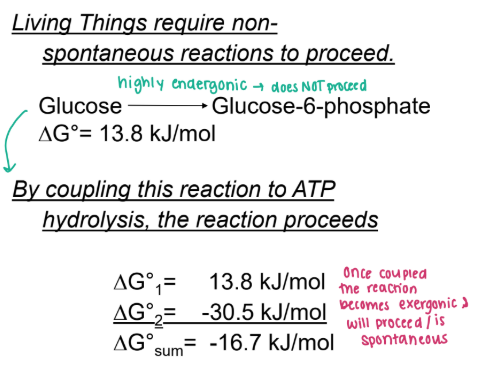
Living Things require non-spontaneous reactions to proceed, such as this reaction (below that has a postive DeltaGo) → By coupling this reaction to ATP hydrolysis, the reaction proceeds

  • Once coupled the reaction becomes _____ and will proceed because it is sponaneous (negative DeltaGo)

<p><strong>Living Things require </strong><span style="color: blue;"><strong>non-spontaneous reactions</strong></span><strong> to proceed</strong>, such as this reaction (below that has a postive DeltaGo) → By <span style="color: blue;"><strong><u>coupling </u></strong></span>this reaction to <strong>ATP hydrolysis, the reaction proceeds </strong></p><ul><li><p><strong><mark data-color="red" style="background-color: red; color: inherit;">Once coupled the reaction becomes _____ and will proceed because it is </mark></strong><span style="color: red;"><strong><mark data-color="red" style="background-color: red; color: inherit;">sponaneous </mark></strong></span><strong><mark data-color="red" style="background-color: red; color: inherit;">(negative DeltaGo)</mark></strong></p></li></ul><p></p>
57
New cards

deoxyribonucleotides

Genetic Foundations

  • Genetic Information is encoded in DNA

  • Deoxyribonucleic acid, DNA is a sequence of monomeric subunits, nucleotides, called ____________

    • DNA encode the instrictures for forming all other cellular components

    • provides a template to produce identical DNA molecules


58
New cards

Deoxyribonucleotides

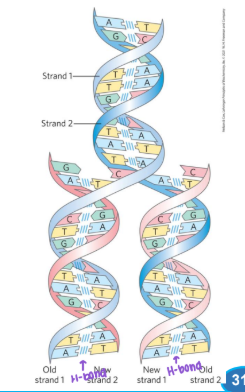
___________- monomeric subunits that make up the DNA polymer, they covalently bond to each other
<p>___________- monomeric subunits that make up the DNA polymer, they <strong>covalently </strong>bond to each other </p>
59
New cards

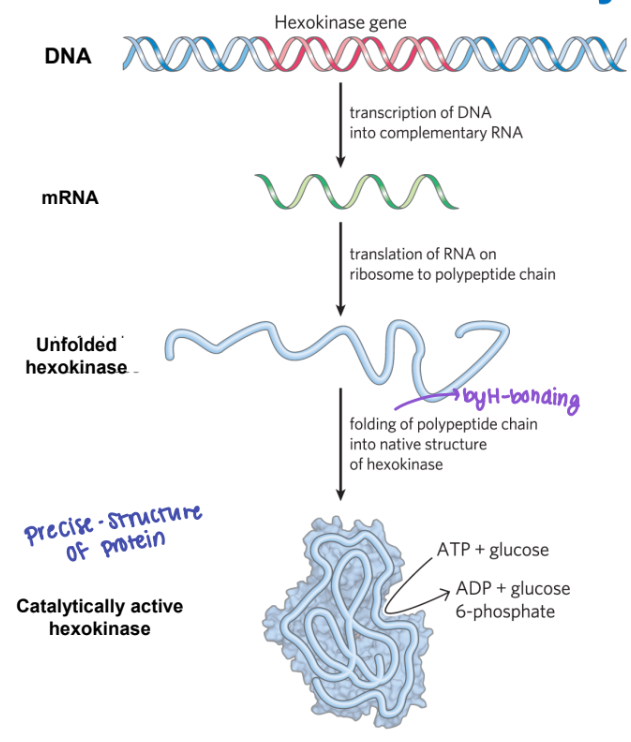
Native Conformation

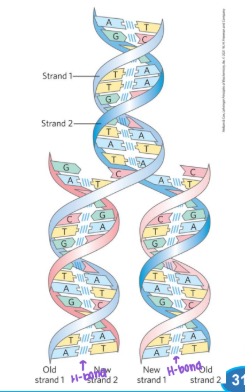
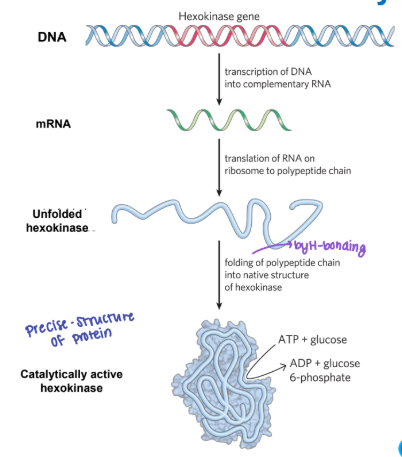
  • Each deoxyribonucleotide (DNA) in one strand pairs specifically with a complementary deoxyribonucleotide in the opposie strand

  • Each DNA molecule deterimes the ________ of a protein or its precise three-dimensional structure

<ul><li><p>Each <strong>deoxyribonucleotide (DNA) in one strand pairs specifically with a complementary deoxyribonucleotide </strong>in the opposie strand </p></li><li><p>Each DNA molecule deterimes the ________ of a protein or its precise three-dimensional structure </p></li></ul><p></p>
60
New cards

Hydrogen Bonds

DNA strands are held together by ________

<p><strong>DNA strands </strong>are held together by ________</p>
61
New cards

Hereditary Instructions

Changes in __________ allow for diversity
<p>Changes in __________ allow for diversity </p>
62
New cards

Native Conformation

______: precise three-dimensional structure of a protein, crucial to protein function
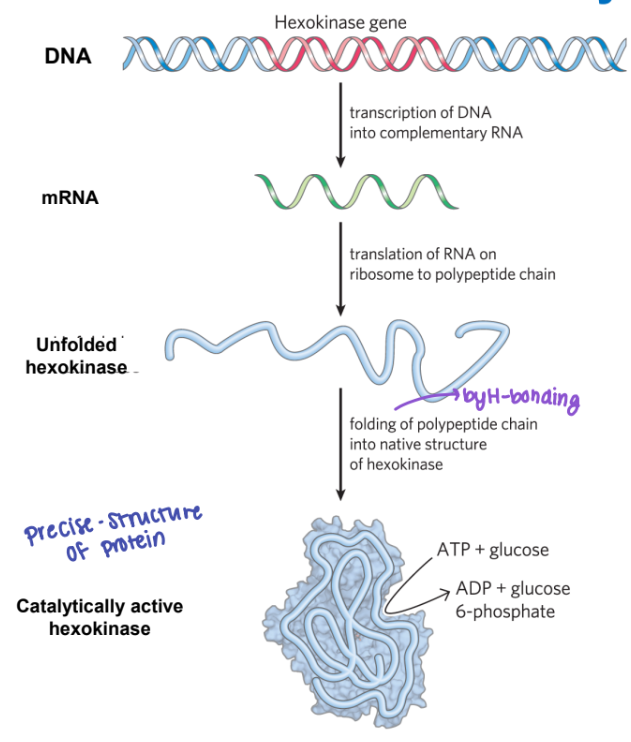
<p>______: precise<strong> three-dimensional structure of a protein</strong>, crucial to protein function </p>
63
New cards

Nucelotide Sequence

Mutation

  • Changes in the ______ of DNA

  • changes the instructions for a cellular component

  • can be beneficial/detrimental


<p><strong><u>Mutation </u></strong></p><ul><li><p>Changes in the ______ of DNA </p></li><li><p>changes the <strong>instructions for a cellular component </strong></p></li><li><p>can be beneficial/detrimental </p></li></ul><p></p>
64
New cards

Unmutated

Wild Type: ______ cells

<p><strong><u>Wild Type:</u></strong> ______ cells </p>
65
New cards

soluble

Most intermediates of metabolism nucleic acids and proteins, are _____ in water.

66
New cards

spontaneously

Lipid bilayers, the likely forerunners of biological membranes, form ________ in water, and are stabilized by their interaction with water.

  • Lipid + Water = Lipid Bilayers


67
New cards

ionization behavior

The __________ of water, weak acids and bases dissolved in water can be represented by one or more equilibrium constants.

68
New cards

Buffer

An aqueous solution of weak acid and its salt makes a _____ that resists changes in pH in response to added acid or base (narrow pH range)

69
New cards

Neutral Physiological pH

Ezymes which catalyze all the processes inside a cell, function optimally at near _________ (~7).

  • Exceptions are enzymes that are in a compartment with a high or low pH.


70
New cards

tetrahedral

Chemical/Physical Properties of Water

  • Two sets of electron pairs and hydrogen atoms form a _____ arrangement around oxygen.


71
New cards

Dipole Nature

Chemical/Physical Properties of Water

  • Water has _____ due to the localized partial positive charges of hydrogens and the partial negative charge on the oxygen (Oxygen is more electronegative)
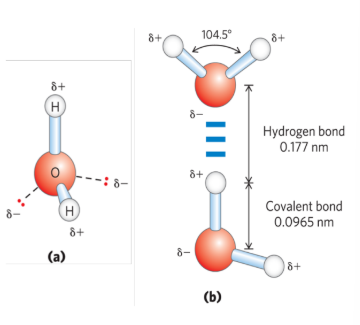

<p><strong><u>Chemical/Physical Properties of Water </u></strong></p><ul><li><p>Water has _____ due to the <span style="color: green;"><strong>localized partial positive charges of <mark data-color="green" style="background-color: green; color: inherit;">hydrogens</mark></strong></span> and the <span style="color: red;"><strong>partial negative charge on the <mark data-color="red" style="background-color: red; color: inherit;">oxygen (Oxygen is more electronegative)</mark></strong></span></p></li></ul><p></p>
72
New cards

Hydrogen Bond

Chemical/Physical Properties of Water

  • __________: is the electrostatic attraction between the oxygen atom of one water molecule and the hydrogen of another.
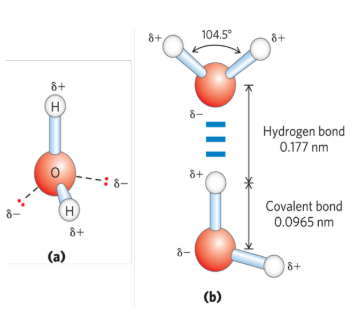

<p><strong><u>Chemical/Physical Properties of Water </u></strong></p><ul><li><p>__________: is the <strong>electrostatic attraction</strong> between the <span style="color: blue;"><strong>oxygen atom of one water molecule and the hydrogen of another. </strong></span></p></li></ul><p></p>
73
New cards

Covalent Bonds

Chemical/Physical Properties of Water

  • Hydrogen bonds are longer and weaker than _________.

    • hydrogen bond in liquid water = 23 kJ/mol

    • covalent bond in water molecules = 470 kJ/mol
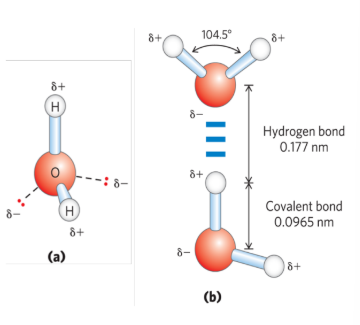

<p><strong><u>Chemical/Physical Properties of Water</u></strong></p><ul><li><p>Hydrogen bonds are <strong>longer </strong>and <strong>weaker </strong>than _________. </p><ul><li><p><mark data-color="yellow" style="background-color: yellow; color: inherit;">hydrogen bond in liquid water = 23 kJ/mol</mark></p></li><li><p><mark data-color="yellow" style="background-color: yellow; color: inherit;">covalent bond in water molecules = 470 kJ/mol</mark></p></li></ul></li></ul><p></p>
74
New cards

liquid water

Chemical/Physical Properties of Water

  • Hydrogen bonds in __________ are fleeting, constantly breaking and reforming and last approximately 1-20ps (10^-12s)


<p><strong><u>Chemical/Physical Properties of Water </u></strong></p><ul><li><p>Hydrogen bonds in __________ are fleeting, <span style="color: blue;"><strong>constantly breaking and reforming and last approximately 1-20ps (10^-12s) </strong></span></p></li></ul><p></p>
75
New cards
  • 4

  • 3.4

  • 4


____ hyrdogen bonds possible per water molecule, however…

  • liquid water averages ____ hydrogen bonds/water molecule.

  • Ice occupies all ____ hydrogen bonds/water molecule.

**entropy effect is important for clathrate-like structures (later)
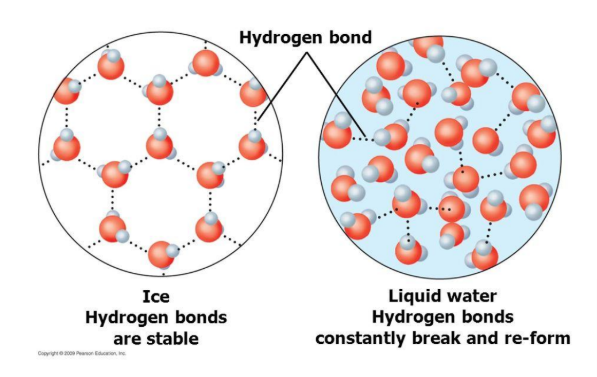
<p>____ hyrdogen <strong>bonds possible per water molecule</strong>, however…</p><ul><li><p><span style="color: blue;"><strong><mark data-color="blue" style="background-color: blue; color: inherit;">liquid water</mark></strong></span> averages ____ hydrogen bonds/water molecule.</p></li><li><p><span style="color: blue;"><strong>Ice </strong></span>occupies all ____ hydrogen bonds/water molecule. </p></li></ul><p>**entropy effect is important for clathrate-like structures (later) </p>
76
New cards

Stable

In ICE hydrogen bonds are _____
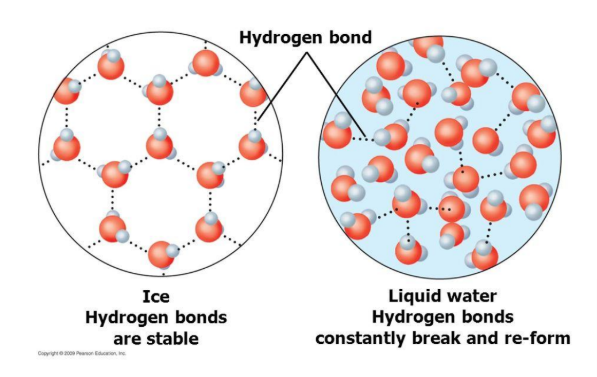
<p>In <strong>ICE </strong>hydrogen bonds are _____</p>
77
New cards

break

In liquid water, hydrogen bonds constantly ____ and re-form.
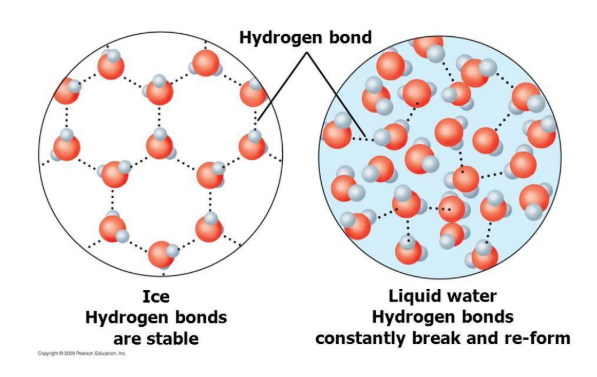
<p>In <strong>liquid water</strong>, hydrogen bonds constantly ____ and re-form. </p>
78
New cards

Entropy

Thermodynamic Properties of Water

  • During melting or evaporation, heat is taken up by the system, and the ____ of the aqueous system increases.

    • Evaporation/Melting are endothermic.


<p><strong><u>Thermodynamic Properties of Water </u></strong></p><ul><li><p>During <strong>melting </strong>or <strong>evaporation</strong>, <span style="color: red;"><strong><mark data-color="red" style="background-color: red; color: inherit;">heat </mark></strong></span>is taken up by the system, and the ____ of the aqueous system increases. </p><ul><li><p><strong>Evaporation/Melting are </strong><span style="color: blue;"><strong>endothermic</strong></span><strong>. </strong></p></li></ul></li></ul><p></p>
79
New cards

Spontaneous

At room temperature, melting and evaporation occur ______________:

  • Free-energy change (DeltaG) must be negative because Delta H is positive, the increase in Delta S drives these changes.

    • It becomes more random when it becomes a liquid/gas


<p>At <strong><u>room temperature</u></strong>, <span style="color: blue;"><strong>melting and evaporation occur</strong></span> ______________:</p><ul><li><p>Free-energy change (DeltaG) must be negative because Delta H is positive, the increase in Delta S drives these changes.</p><ul><li><p>It becomes more random when it becomes a liquid/gas</p></li></ul></li></ul><p></p>
80
New cards

Amphipathic

Water interacts with Polar, Nonpolar and _________ Biomolecules → molecules that have polar and nonpolar regions.
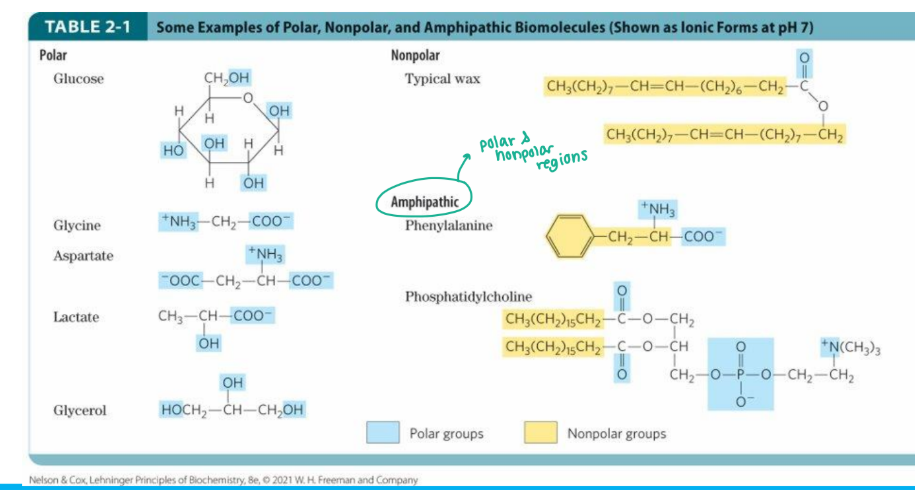
<p>Water interacts with <strong>Polar</strong>, <strong>Nonpolar </strong>and _________ Biomolecules → molecules that have polar and nonpolar regions. </p>
81
New cards

electronegative atom

Water Forms Hydrogen Bonds with Polar Biolmolecules

  • Hydrogen bonds readily form between an ________ (the hydrogen acceptor) and a hydrogen atom covalently bonded to another electronegative atom (the hydrogen donor)
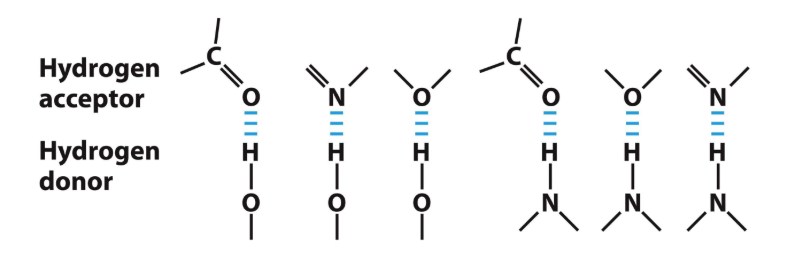

<p><strong><u>Water Forms Hydrogen Bonds with Polar Biolmolecules </u></strong></p><ul><li><p><strong>Hydrogen bonds</strong> readily form between an ________ <span style="color: blue;"><strong><mark data-color="blue" style="background-color: blue; color: inherit;">(the hydrogen acceptor)</mark></strong></span> and a <strong>hydrogen atom covalently bonded to another electronegative atom</strong> <span style="color: green;"><strong><mark data-color="green" style="background-color: green; color: inherit;">(the hydrogen donor)</mark></strong></span></p></li></ul><p></p>
82
New cards

Water

Examples of Hydrogen Bonding Between Molecules

  • _____ can act as the hydrogen bond acceptor or donor.


<p><strong><u>Examples of Hydrogen Bonding Between Molecules</u></strong></p><ul><li><p>_____ can act as the hydrogen bond acceptor or donor.</p></li></ul><p></p>
83
New cards

Review

Examples of Hydrogen Bonding Between Biomolecules

  • Review


<p><strong><u>Examples of Hydrogen Bonding Between Biomolecules </u></strong></p><ul><li><p>Review</p></li></ul><p></p>
84
New cards

Stronger

Hydrogen Bonds are Directional

  • Linear H-bonds are ____ than non-linear H-bonds

  • Hydrogen bonding is stronger when the three atoms involved, lie in a line
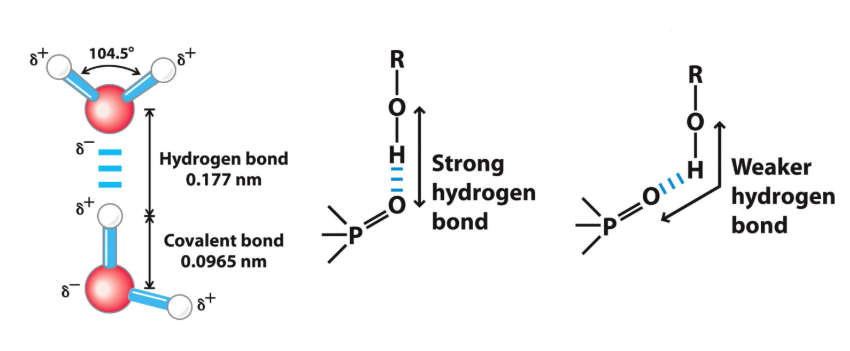

<p><strong><u>Hydrogen Bonds are Directional </u></strong></p><ul><li><p><span style="color: green;"><strong>Linear </strong></span>H-bonds are ____ than <span style="color: red;"><strong>non-linear </strong></span>H-bonds</p></li><li><p><strong>Hydrogen bonding is stronger when the three atoms involved, lie in a <em>line </em></strong></p></li></ul><p></p>
85
New cards

Number

Noncovalent Interactions are typically very weak and specific but they occur in large ____

86
New cards

charged

Noncovalent Interactions

  • Hydrophobic Interactions (displacement of water)

    • 0.4-4 kJ/mol

  • Pi stacking (aromatic ring stacking)

    • 0.4-4 kJ/mol

  • Van der Waals interactions (weak but many)

    • 0.4-4 kJ/mol

  • Hydrogen Bond

    • 4-40 kJ/mol

  • Electrostatic (opposite attract, likes repel)

    • 4-40 kJ/mol

  • Salt bridge (hydrogen bonding plus electrostatic)

    • e.g. carboxylate amino side-chain (Asp, Glu) to basic amino side-chain (Arg, Lys)

      • 40-400 kJ/mol

**Electrostatic and Salt Bridge are specifically between ___ molecules
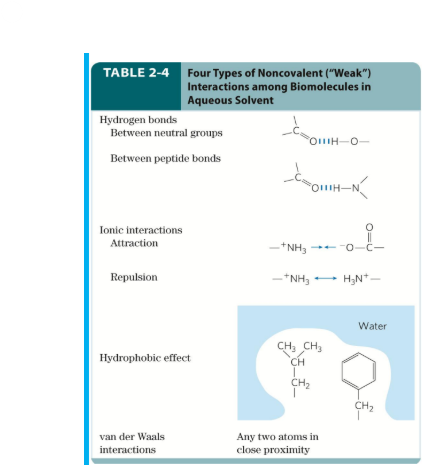
<p><strong><u>Noncovalent Interactions </u></strong></p><ul><li><p><span style="color: blue;"><strong>Hydrophobic Interactions (displacement of water)</strong></span></p><ul><li><p>0.4-4 kJ/mol</p></li></ul></li><li><p><span style="color: blue;"><strong>Pi stacking (aromatic ring stacking)</strong></span></p><ul><li><p>0.4-4 kJ/mol</p></li></ul></li><li><p><span style="color: blue;"><strong>Van der Waals interactions (weak but many) </strong></span></p><ul><li><p>0.4-4 kJ/mol</p></li></ul></li><li><p><span style="color: blue;"><strong>Hydrogen Bond</strong></span></p><ul><li><p>4-40 kJ/mol</p></li></ul></li><li><p><span style="color: blue;"><strong>Electrostatic (opposite attract, likes repel) </strong></span></p><ul><li><p>4-40 kJ/mol</p></li></ul></li><li><p><span style="color: blue;"><strong>Salt bridge (hydrogen bonding plus electrostatic)</strong></span></p><ul><li><p>e.g. carboxylate amino side-chain (Asp, Glu) to basic amino side-chain (Arg, Lys)</p><ul><li><p>40-400 kJ/mol</p></li></ul></li></ul></li></ul><p><strong>**Electrostatic and Salt Bridge are specifically between ___ molecules </strong></p>
87
New cards

soluble

Water interacts with Nonpolar Biomolecules

  • Non-polar biomolecules are poorly ____ in water.

  • Biologically important gases CO2, O2, N2 are nonpolar
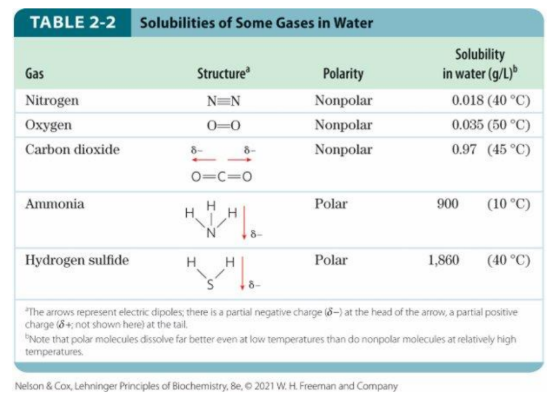

<p><strong><u>Water interacts with Nonpolar Biomolecules</u></strong></p><ul><li><p><strong>Non-polar biomolecules</strong> are poorly ____ in water. </p></li><li><p>Biologically important gases CO2, O2, N2 are <span style="color: blue;"><strong>nonpolar</strong></span></p></li></ul><p></p>
88
New cards

hydrophobic

Water interacts with Nonpolar Biomolecules

  • Nonpolar gases are _____, they do not dissolve well in water


<p><strong><u>Water interacts with Nonpolar Biomolecules</u></strong></p><ul><li><p>Nonpolar gases are _____, they do not dissolve well in water </p></li></ul><p></p>
89
New cards

Entropy

When nonpolar molecules move into aqueous solutions they decrease ____ by constraining motion

90
New cards

Cage

Nonpolar compounds interfere with hydrogen bonding amounh H2O molecules. The water becomes ordered around the molecule —> creates a water ____ around NP molecule
<p><strong>Nonpolar compounds</strong> interfere with<strong> hydrogen bonding amounh H2O molecules.</strong> <span style="color: blue;"><strong>The water becomes ordered around the molecule</strong></span> —&gt; creates a water ____ around NP molecule </p>
91
New cards

Unfavorable

The free-energy change for dissolve a nonpolar solute in water is ______

  • Delta H is positive

  • Delta S is negative (decreased entropy)

  • Delta G is positive


<p>The free-energy change for dissolve a nonpolar solute in water is ______</p><ul><li><p>Delta H is <strong>positive</strong></p></li><li><p>Delta S is <strong>negative </strong>(decreased entropy)</p></li><li><p>Delta G is <strong>positive </strong></p></li></ul><p></p>
92
New cards

Hydrophobic effect

Because NP + water is unfavorable, H2O molecules form a highly ordered, cage-like shell around each nonpolar solute molecule

  • Maximizes solvent-solvent hydrogen bonding

  • Clustering hydrophobic molecules reduces the amount of ordered water thereby increase entropy

This phenomenon is the ______

<p>Because NP + water is unfavorable<strong>, H2O molecules form a highly ordered, </strong><span style="color: blue;"><strong><em>cage-like shell</em></strong></span><strong> </strong>around each nonpolar solute molecule </p><ul><li><p>Maximizes solvent-solvent hydrogen bonding </p></li><li><p>Clustering hydrophobic molecules reduces the amount of ordered water thereby increase entropy </p></li></ul><p><strong>This phenomenon is the ______</strong></p><p></p>
93
New cards

Amphipathic Compounds

_______ contain regions that are polar (or charged) and regions that are nonpolar (ex: long chain fatty acids)

<p>_______ contain regions that are <strong>polar (or charged)</strong> and regions that are <strong>nonpolar </strong>(ex: long chain fatty acids)</p>
94
New cards
  • Favorbly

  • Avoid Contact


Amphipathic Compounds

  • Polar, hydrophilic region interacts ____ with H2O and tends to dissolve

  • Nonpolar, hydrophobic region tends to _______ with H2O and cluster together.

<p><strong><u>Amphipathic Compounds</u></strong></p><ul><li><p><strong>Polar, hydrophilic region </strong>interacts ____ with H2O and tends to dissolve</p></li><li><p><strong>Nonpolar, hydrophobic region</strong> tends to _______ with H2O and cluster together. </p></li></ul><p></p>
95
New cards

Lipid Bilayer

Amphipathic Compounds

  • Precursos of _____ formation

  • Free energy is unfavorabke, similar to non-polar molecules

<p><strong><u>Amphipathic Compounds</u></strong></p><ul><li><p>Precursos of _____ formation</p></li><li><p>Free energy is unfavorabke, similar to non-polar molecules </p></li></ul><p></p>
96
New cards

Hydrophobic Effect

Amphipathic Molecules in Water

  • _______- nonpolar regions cluster together, polar regions arrange regions → cluster to maxiize interactions with each other and not with the solvent.

<p><strong><u>Amphipathic Molecules in Water </u></strong></p><ul><li><p>_______- nonpolar regions cluster together, polar regions arrange regions → cluster to maxiize interactions with each other and not with the solvent. </p></li></ul><p></p>
97
New cards

Micelles

Amphipathic Molecules in Water

  • ________: thermodynamically stable structures of amphipathic compounds in water

<p><strong><u>Amphipathic Molecules in Water </u></strong></p><ul><li><p>________: thermodynamically stable structures of amphipathic compounds in water </p></li></ul><p></p>
98
New cards

Hydrophobic Effect

Effect of Water on Enzyme-Substrate Interactions

  • Ordred water interacting with substrate and enzyme (to interact the cage must break) → the disordered water is displaced by enzyme-substrate interaction which is stabilized by hydrogen bonding, ionic interactions and ________

<p><strong>Effect of Water on Enzyme-Substrate Interactions </strong></p><ul><li><p>Ordred water interacting with substrate and enzyme (to interact the cage must break) → the disordered water is displaced by enzyme-substrate interaction which is stabilized by hydrogen bonding, ionic interactions and ________</p></li></ul><p></p>
99
New cards

Weak Interactions

For macromolecules, the most stable structure usually maximizes _______

  • H2O molecules are often found to be bound so tightly to biomolecules that they are part of the crystal structure.

<p>For <strong>macromolecules</strong>,<span style="color: green;"><strong> the most stable structure usually maximizes _______</strong></span></p><ul><li><p>H2O molecules are often found to be bound so tightly to biomolecules that they are part of the crystal structure. </p></li></ul><p></p>
100
New cards

Ionized

Water is partially _____