QUIZLET COPY lines and leads (simucase)
 Call Kai
 Learn
Learn Practice Test
 Spaced Repetition
 Match
Match Flashcards
 Knowt Play
1/24

There's no tags or description
Looks like no tags are added yet.
Name | Mastery | Learn | Test | Matching | Spaced | Call with Kai | Chat |
|---|
No analytics yet
Send a link to your students to track their progress
25 Terms
What does the IV refer to?
Central intravenous line
Peripheral intravascular line
Distal intravenous catheter
Peripheral intravenous line
Peripheral intravenous line
What does IV therapy typically administer? Select all that apply
fluid
medication
blood products
oxygen
fluid
medication
blood products
What do the IV infusion computer and pump control?
Flow rate of the substance
Patient prognosis
Heart and respiratory rate
Allergic response to the substance
Flow rate of the substance
What information should you report to the nurse overseeing a patient's care?
You or the patient notice redness, swelling, and discharge at the IV insertion site.
The patient states their pain is under control.
You or the patient notice that the call bell is working.
The IV line is secured to the insertion site.
You or the patient notice redness, swelling, and discharge at the IV insertion site.
What does an arterial pressure line monitor?
Static atrial blood pressure
Instantaneous arterial blood pressure
Axillary access
Manual cuff blood pressure
Instantaneous arterial blood pressure

What risks exist to the patient who has an arterial pressure line? Select all that apply.
Bleeding risk if the line is dislodged
Infection risk at the insertion site
Air embolism if air enters the line
Headache from dehydration
Bleeding risk if the line is dislodged
Infection risk at the insertion site
Air embolism if air enters the line

What is maintained at the level of the heart for accurate readings?
Patient's hand
Transducer
Pressure bag
Transfusion
Transducer
Where is a PAC commonly found on the patient?
Abdomen, inserted into pulmonary artery
Leg, inserted into jugular vein
Neck, inserted into jugular vein
Arm, inserted into femoral vein
Neck, inserted into jugular vein
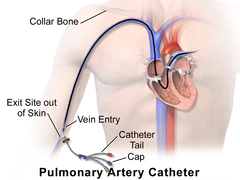
What access category do PACs have?
Central IV access
Peripheral IV access
Central IV access

Accidental dislodgement of a PAC poses what risks? Select all that apply.
Myocardial tissue irritation or damage
Allergic reaction
Arrhythmias and dysrhythmias
Asphyxiation
Aspiration
Myocardial tissue irritation or damage
Arrhythmias and dysrhythmias

What is another name for a chest tube?
Thoracostomy tube
Thoracic drain
Transcutaneous tube
Thoracolumbar tube
Thoracostomy tube

What is the purpose of a chest tube?
To remove air, fluid, or blood from the pelvic cavity
To remove air, fluid, or blood from the pleural cavity
To monitor hemodynamics of the pleural space
To promote a pneumothorax to increase oxygenation
To remove air, fluid, or blood from the pleural cavity
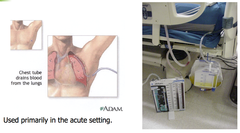
Which choice is not a contraindication to remove the patient from in-room suction for mobilization?
Lung transplant
Deconditioning
Lung surgery
Pneumothorax
Deconditioning
When mobilizing the patient, where should you keep the chest tube drain system?
Lower than the level of insertion on the patient
Higher than the level of insertion on the patient
Lower than the level of insertion on the patient

What are the components of a Jackson-Pratt device?
Tubing and bulb
Cable and IV bag
Indwelling monitor
Port with internal catheter
Tubing and bulb
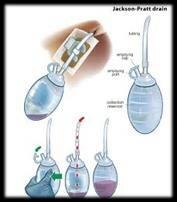
How do you manage the Jackson-Pratt drain for patient mobilization?
Contact nursing staff to remove the drain.
Empty the contents of the drain first.
Secure the drain to the patient's gown.
Release the cap and squeeze the bulb to ensure drainage.
Secure the drain to the patient's gown.
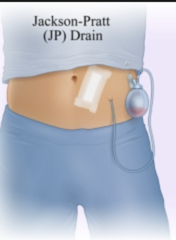
What are indications for a urinary catheter? Select all that apply.
Patient is unable to void independently.
Patient is in a room with other patients.
Patient cannot mobilize to the restroom.
Patient's urinary output must be tracked.
Patient is unable to void independently.
Patient cannot mobilize to the restroom.
Patient's urinary output must be tracked.
Where should the urinary catheter collection bag be positioned to maintain drainage flow?
Below the level of the patient's bladder
Above the level of the patient's bladder
Below the level of the patient's bladder
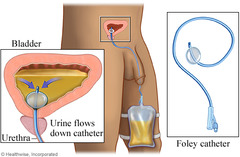
Which type of catheter is a Foley?
Intermittent, for short-term use
Indwelling, with a balloon tip inflated inside the bladder
Suprapubic, inserted through the abdominal wall into the bladder
External condom secured over the genitalia
Indwelling, with a balloon tip inflated inside the bladder
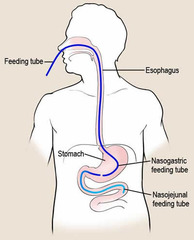
Where are feeding tubes commonly found?
Inserted in nares of the nose to provide supplemental nutrition
Inserted through the nose into pleural space for a pneumothorax
Inserted into the esophagus to provide supplemental oxygen
Inserted only in the event of an emergency.
Inserted in nares of the nose to provide supplemental nutrition
What statement about feeding tubes is true?
They cannot be disconnected by nursing staff for activity.
They can be disconnected by nursing staff for activity
They can be disconnected by nursing staff for activity
Which statement about a portable monitor is true?
The monitor must stay mounted to the wall or pole.
The monitor is mobile and can be disconnected for activity.
The monitor is mobile and can be disconnected for activity.
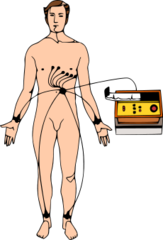
What does continuous telemetry commonly monitor? Select all that apply.
Heart rate
Arterial blood pressure
ECG activity
Pulse oximetry
Perceived exertion
Heart rate
Arterial blood pressure
ECG activity
Pulse oximetry
Which line or tube is not typically found in an ICU?
Intracranial pressure monitor
Lumbar drain
Umbrella monitor
Impella left ventricular assist device monitor
Umbrella monitor
When do you initially determine if a patient has tubes or lines?
When conferring with colleagues
During orientation to unit policies
After the session has concluded
While reviewing chart and during in-room observation
While reviewing chart and during in-room observation