Amino acids
 Call Kai
 Learn
Learn Practice Test
 Spaced Repetition
 Match
Match Flashcards
 Knowt Play
1/26

There's no tags or description
Looks like no tags are added yet.
Name | Mastery | Learn | Test | Matching | Spaced | Call with Kai | Chat |
|---|
No analytics yet
Send a link to your students to track their progress
27 Terms
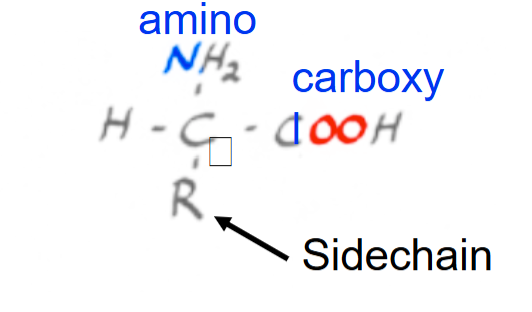
Amino Acid Structure
Amino NH2 Group, Carboxyl COO- group, H, R (side chain)
Peptide bond = bond b/w Amino group of one AA and carboxyl group of second AA
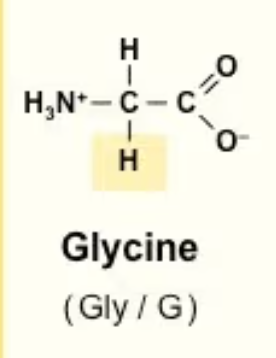
Glycine
Gly/G
literally just an H
Neither strongly polar nor nonpolar
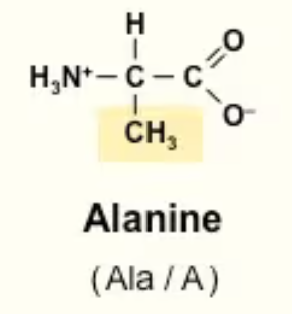
Alanine
Ala/A
Just a methyl group (CH3)
Non polar
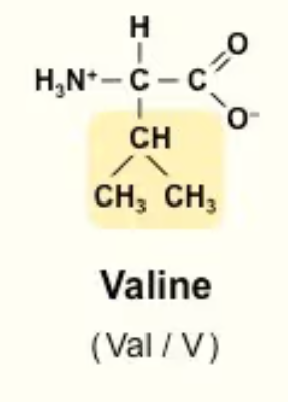
Valine
Val/V
HC—(CH3)2
Non polar
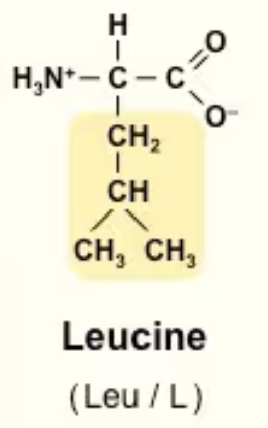
Leucine
Leu/L
Nonpolar
CH2—CH—(CH3)2
Isoleucine
Ile/I
Nonpolar
CH3—*CH—CH2—CH3
*marks the beta carbon attached to the alpha carbon

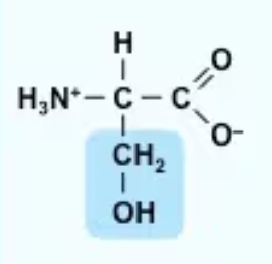
Serine
Ser/S
CH2—OH
Neither strongly polar nor nonpolar
Threonine
Thr/T
OH—*C—CH3
*marks the C attached to the alpha C
Neither strongly polar nor nonpolar

Aspartate/aspartic acid
Asp/D
*CH2—COO-
Polar
Acidic (can be - charged, typically charged at pH7)

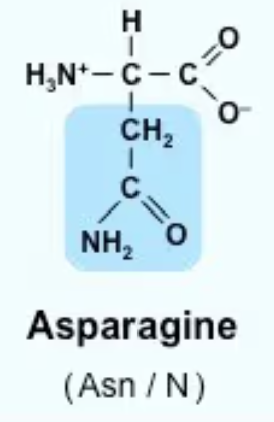
Asparagine
Asn/N
*CH2—CON
Polar
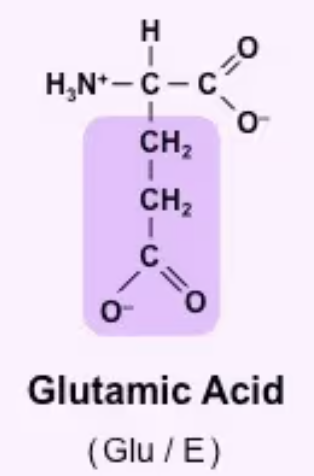
Glutamate/Glutamic Acid
Glu/E
*CH2—CH—COO-
Polar
Acidic (can be - charged, typically charged at pH7)
Glutamine
Gln/Q
*CH2—CH2—CONH2
Polar

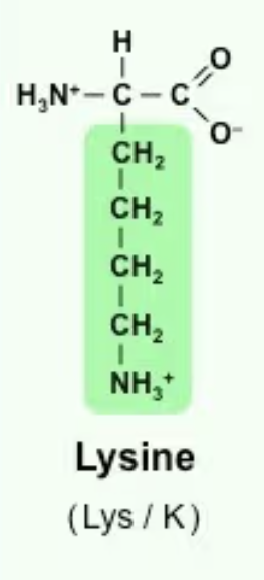
Lysine
Lys/K
*CH2—CH2—CH2—CH2—NH3+
Polar
Basic (can be + charged, typically charged at pH7)
Can be a chemical modification on proteins
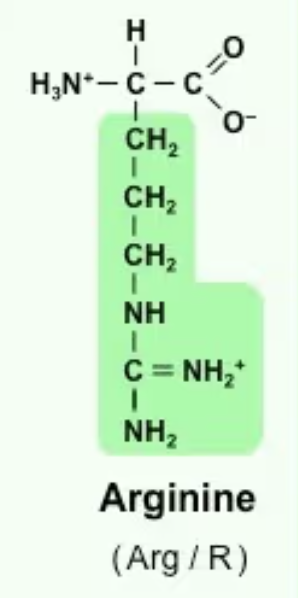
Arginine
Arg/R
*CH2—CH2—CH2—NH—CNH2+NH2
Note: The NH2+ is doubly bonded to the C, which is why it is positive charged
Polar
Basic (can be + charged, typically at pH7)
Histidine
His/H
Aromatic ring structure
*CH=CH—NH+=CH—NH—reattached to the beta C to form a ring
Polar
Basic (can be + charged, typically at pH7)
Often at enzyme active site accepting/donating H+
This ring structure can interconvert! Resonance!!

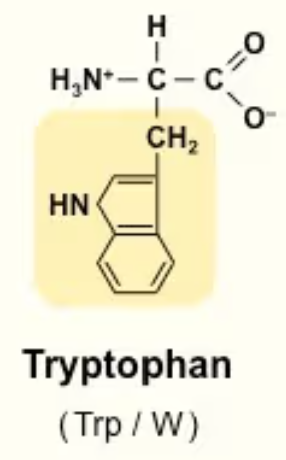
Tryptophan
Trp/W
Aromatic ring structure → 2 rings!!
Nonpolar
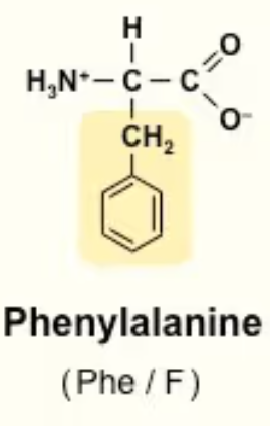
Phenylalanine
Phe/F
Alanine but with a phenyl attached! *CH2—Ph
Aromatic ring!!
Nonpolar
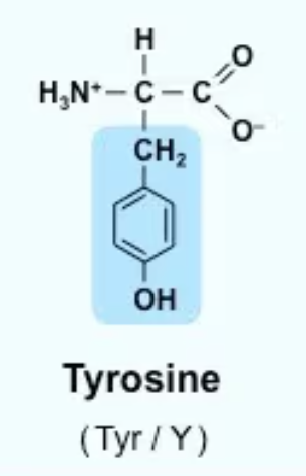
Tyrosine
Tyr/Y
*CH2—Ph—OH
Aromatic Ring!!
Neither strongly polar nor nonpolar
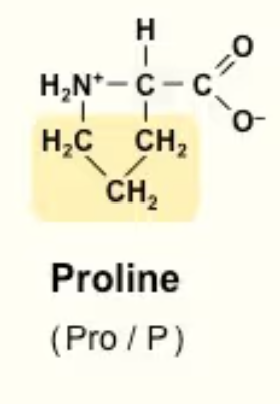
Proline
Pro/P
Special ring structure → it is relinked to the backbone N (amino group)
*CH2—CH2—CH2—NH2+ (the amino group on the alpha C)
Neither strongly polar nor nonpolar
restricted fit inside protein due to ring structure
Cannot be an H-bond donor if peptide bonded because it will not have an N—H
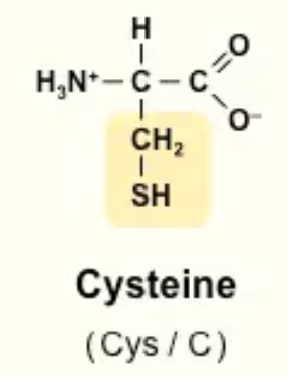
Cysteine
Cys/C
*CH2—SH
Nonpolar at pH<8
Can make disulfide bonds with itself
Methionine
Met/M
*CH2—CH2—S—CH3
Nonpolar

Aliphatic amino acids
hydrocarbons
Glycine, alanine, valine, leucine, isoleucine
Aromatic amino acids
Phenylalanine, tyrosine, tryptophan (and histidine)
Sulfur containing amino acids
Cysteine and methionine
Aliphatic-OH amino acids
containing OH, often in enzyme active site
Can be chemically modified (like with a phosphate) to change the enzyme
Serine and threonine
Acidic vs amid amino acids
Aspartate and glutamate are acidic and contain a -COOH group
Acidic AA will be at enzyme active site to donate/accept H+ and strongly interact with H2O and ions
Typically charged near pH7
Asparagine and glutamine will have the same structure as there similarly named counterpart, but with an amid (-CONH2) instead of COOH
Basic amino acids
Histidine, arginine, lysine
Typically charged near pH7