IPS1 - (A1) Matter
 Call Kai
 Learn
Learn Practice Test
 Spaced Repetition
 Match
Match Flashcards
 Knowt Play
1/63

Earn XP
Description and Tags
Proverbs 16:3
Name | Mastery | Learn | Test | Matching | Spaced | Call with Kai | Chat |
|---|
No analytics yet
Send a link to your students to track their progress
64 Terms
Chemistry
the science that describes matter - its properties, the changes it undergoes, and the energy changes that accompany those process
Chemistry
the central science
Branches of Chemistry
Organic Chemistry
Inorganic Chemistry
Analytical Chemistry
Biochemistry
Physical Chemistry
Organic chemistry
hydrocarbons and its derivatives
Inorganic chemistry
inorganic compounds, metals, minerals
Analytical chemistry
detection and identification of substance present (qualitative analysis) or amount of each substance (quantitative analysis)
Biochemistry
processes in living organism
Physical chemistry
behavior of matter
Matter
anything that has mass and occupies space
Mass
measure of the quantity of matter
Volume
amount of space
Energy
the capacity to do work or to transfer heat
Kinetic energy
energy in motion
Potential energy
energy at rest
Energy change: Exothermic
release of heat
Energy change: Endothermic
absorbs heat
Solid
molecules packed closely together orderly
rigid
Liquid
molecules are closed but randomly arranged
flows and assumes the shape of the container
Gases
molecules are far apart
fills any container completely
Melting
solid to liquid
Freezing
liquid to solid
Evaporation
liquid to gas
Condensation
gas to liquid
Deposition
gas to solid
Sublimation
solid to gas
Physical properties
can be observed or measured without changing the identity of the substance
Physical properties
color, hardness, melting point, boiling point
Chemical properties
exhibited by matter as it undergoes changes in composition
Chemical properties
hydrogen has the potential to ignite and explode given the right conditions
iron reacts with oxygen gas to form rust
a dry piece of paper burns
Physical properties
silver is a shiny metal that conducts electricity very well
sulfur is a yellow powder
pure water has density of 0.998 g/cm3 at 25 degree C
Extensive properties
dependent on the amount of the substance
Extensive property
- more substance, greater mass
Mass
Extensive property
- more substance, greater volume
Volume
Intensive properties
independent on the amount of the substance
Intensive properties
Density
Electrical conductivity
Melting point
Color
Hardness
Chemical change
one or more substances are used up
one or more new substances are formed energy is absorbed or released
irreversible
Chemical change
burning of paper
cooking an egg
souring of milk
fireworks exploding
Physical change
no change in chemical composition
reversible
Physical change
shredding of paper
boiling of water
breaking a bottle
ice cream melting
making a sand castle
Macbook falling out of the window
True
a physical change may suggest that a chemical change has also taken place
for instance, a color change, a warming, or the formation of a solid when two solutions are mixed could indicate a chemical change
Classification of matter
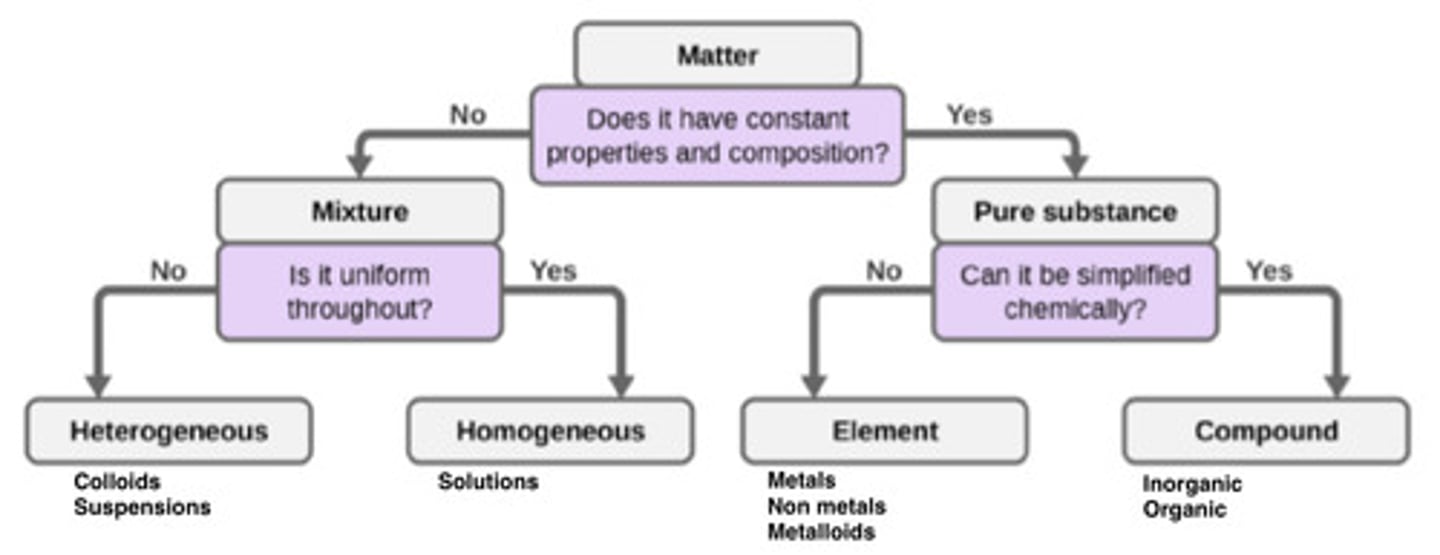
Mixture
variable composition
may be separated in to pure substances by physical methods (e.g. distillation, filtration)
Pure substance
fixed composition
cannot be separated into simpler substances by physical methods
Homogenous mixture
components are not distinguishable, single phase, same composition throughout (i.e. same amount in any areas)
Homogenous mixture
solution
Heterogenous mixture
components are distinguishable, multiple phases, do not have same composition throughout (i.e. different amount in various areas)
Heterogenous mixture
suspension
colloids
freshly squeezed orange juice
Compounds
can be decomposed to simpler substances by chemical change
consist of two atoms of two more elements bound together
Compound
water = 2H + 1O
table salt = NaCl
Elements
cannot be decomposed to simpler substances by chemical changes
consists of only one kind of atom
Ag (Silver)
Argentum
Gold (Au)
Aurum
Copper (Cu)
Cuprum
Iron (Fe)
Ferrum
Mercury (Hg)
Hydrargyrum
Potassium (K)
Kallium
Sodium (Na)
Natrium
Lead (Pb)
Plumbum
Antimony (Sb)
Stibium
Tin (Sn)
Stannum
Tungsten (W)
Wolfran
Nitrogen
the most abundant element in the atmosphere
Hydrogen
the most abundant element in the universe
Oxygen
the most abundant element in the Earth