Chapter 19: Free Energy and Thermodynamics
 Call Kai
 Learn
Learn Practice Test
 Spaced Repetition
 Match
Match Flashcards
 Knowt Play
1/41

There's no tags or description
Looks like no tags are added yet.
Name | Mastery | Learn | Test | Matching | Spaced | Call with Kai | Chat |
|---|
No analytics yet
Send a link to your students to track their progress
42 Terms
What does the first law of thermodynamics state?
Total energy is conserved; energy cannot be created or destroyed.
What is the equation representing the first law of thermodynamics?
ΔU = Q - W, where ΔU is the change in internal energy, Q is heat added to the system, and W is work done by the system.
What does the second law of thermodynamics describe?
Systems proceed from ordered (low entropy) to disordered states, and the entropy of the universe tends to increase.
What is entropy?
A measure of disorder in a system, which increases for irreversible processes.
What are irreversible processes?
Natural processes that cannot be undone without external intervention, such as heat flow from hot to cold objects.
What does the third law of thermodynamics state?
The entropy of a perfect crystalline structure approaches zero as the temperature approaches absolute zero (0 K).
What is Ludwig Boltzmann's entropy equation?
S = k ln W, where S is entropy, k is Boltzmann's constant, and W is the number of microstates.
what is a system?
portion of universe with which we are concerned
what are surroundings?
everything outside the system
What is an isolated system?
an isolated system cannot exchange energy or matter with its surroundings
What is a closed system?
can exchange energy but not matter with its surroundings
what is an open system?
an open system can exchange both energy and matter with its surroundings
What is enthalpy (H)?
The heat content of a system, where ΔH > 0 indicates heat absorbed and ΔH < 0 indicates heat released.
What is free energy (ΔG)?
The energy available to do work in a system, where ΔG < 0 indicates a spontaneous (exergonic) process and ΔG > 0 indicates a nonspontaneous (endergonic) process
What does it mean if ΔG = 0?
The system is at equilibrium.
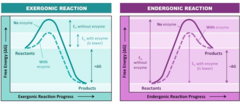
What is an exergonic reaction?
A reaction where ΔG < 0, indicating it is spontaneous.
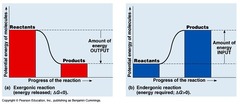
What is an endergonic reaction?
A reaction where ΔG > 0, indicating it is non-spontaneous.
if a spontaneous process proceeds from system of higher potential energy to lower potential energy what type of process is that?
exothermic
if a spontaneous process proceeds from system of lower potential energy to higher potential energy what type of process is that?
endothermic
What is the standard state for a reaction?
Conditions of 1 M concentration and 298 K temperature.
What is the relationship between spontaneity and entropy?
For a process to be spontaneous, the total entropy of the universe must increase.
What is the effect of temperature on spontaneity?
The spontaneity of a process can depend on the signs and magnitudes of ΔH and ΔS at different temperatures.
What is the equation for standard entropy change?
ΔS° = ΣnS°(products) - ΣnS°(reactants) at 25°C.
What does the equation ΔG = ΔG° + RT ln(Q) represent?
The change in free energy under non-standard conditions, where Q is the reaction quotient.
What is the significance of ΔG°?
It indicates the spontaneity of a reaction under standard conditions.
What happens to the entropy of the surroundings (ΔS_surr) during an exothermic process?
ΔS_surr increases as heat is released to the surroundings.
What are macrostates and microstates?
A macrostate is defined by measurable conditions, while microstates are the specific arrangements of particles that correspond to that macrostate.
How does the number of microstates relate to entropy?
More microstates correspond to higher entropy, as there are more ways to arrange the components of a system.
what happens to macrostates when there is a change of state?
the number of macrostates change
more energetically equivalent configurations molecules have = more macrostates
gases have more than liquids which have more than solids
when a system process is exothermic, what does that mean for the surroundings?
heat increases in surroundings as well as the entropy
What is Gibbs free energy/chemical potential?
amount of energy available to do work
When is ΔG negative?
When ΔH = (-) and ΔS = (+)
If ΔH is negative and ΔS is positive, what is the spontaneity for low and high temp?
low temp: spontaneous
high temp: spontaneous
If ΔH is positive and ΔS is negative, what is the spontaneity for low and high temp?
low temp: nonspontaneous
high temp: nonspontaneous
If ΔH is negative and ΔS is negative, what is the spontaneity for low and high temp?
low temp: spontaneous
high temp: nonspontaneous
If ΔH is positive and ΔS is positive, what is the spontaneity for low and high temp?
low temp: nonspontaneous
high temp: spontaneous
when the equilibrium constant (K) is less than 1, what is the free energy at standard state?
positive, spontaneous in reverse direction
when the equilibrium constant (K) is greater than 1, what is the free energy at standard state?
negative, spontaneous in forward direction
when the equilibrium constant (K) is equal to 1, what is the free energy at standard state?
0, at equilibrium
what does the graph look like when K is less than 1?
U curve where vertex is shifted more towards the left side
what does the graph look like when K is more than 1?
U curve where vertex is shifted more towards the right side
what does the graph look like when K is 1?
U curve is even on both sides, vertex in center