Social behaviour Chapter 9*
 Call Kai
 Learn
Learn Practice Test
 Spaced Repetition
 Match
Match Flashcards
 Knowt Play
1/20

Earn XP
Description and Tags
Social Behaviour
Name | Mastery | Learn | Test | Matching | Spaced | Call with Kai | Chat |
|---|
No analytics yet
Send a link to your students to track their progress
21 Terms
Social organizations:
Solitary
Pairs
Family groups
Herds/Flocks
Complex societies
Complex societies/Eusociality, social organisation
The highest level of social organization
Overlapping generations within a colony of adults
Division of labour into a caste system:
Single reproductive female (queen)
Sterile workers
Drones (male)
Soldiers
Cooperative care of brood
Costs and benefits of living in a group
Costs:
Greater conspicuousness
Easier to see a big group of animals
Competition
Food sharing
Dominance disputes
Disease transmission
Reduced reproductive fitness
Infidelity
Inbreeding
Infanticide
Benefits:
Reduced predation risks
“Many eyes” effect
Confusion by blending in
Information sharing
More reliable access to mate
Increased success in accessing food
Ability to take down larger pray
Ability to mob larger predators of kills
Shared rearing of offspring
Energy conservation
I.e. huddling together
The selfish herd*
A theory based on the assumption that predation risk is not evenly distributed across positions within a group
Individuals within a population attempt to reduce their predation risk by putting other conspecifics between themselves and predators
Edge effect
Higher exposure to predation risk at the edge of a group
Creates competition for good positions
Consider motivation vs. risk (e.g. hunger)
Part of the selfish herd theory
Position is affected by: social status, age, health, food motivation, reproductive status
Domain of danger
A key element in the theory is the domain of danger, the area of ground in which every point is nearer to a particular individual than to any other individual
Social networks
Animal social networks are descriptions of social structures
Networks consist of nodes connected by edges
Consists of nodes and edges
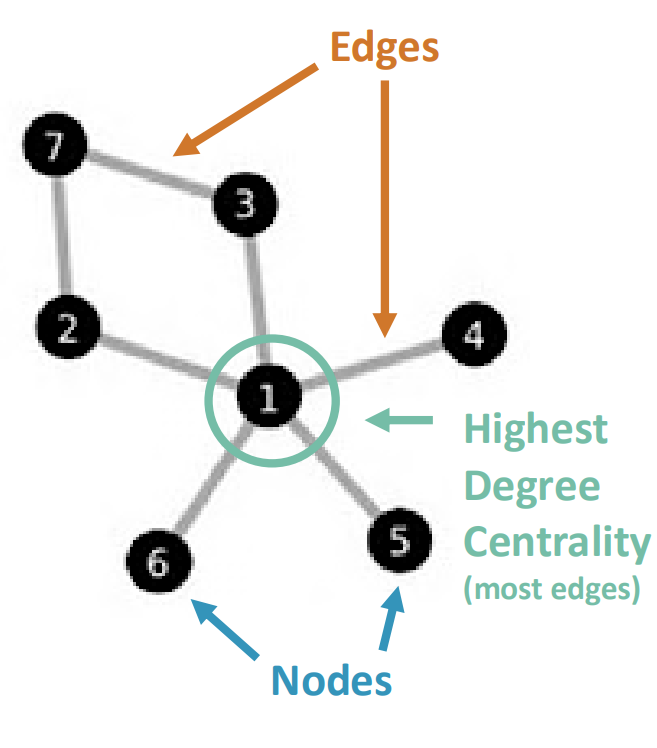
Centrality, social networks
A measure of an individual’s structural importance in a group based on its network position
Degree centrality, social networks
Based on the number of direct edges an animal has
An animal with more edges (degree node) will have more influence on those around it and possibly on the whole network (e.g. disease transmission)

Direct edges, social networks
A focal individuals immediate connections
Indirect edges, social networks
A focal individuals connections with individuals through other individuals
Bridges, social networks
Some individuals (nodes) serve as bridges in or between networks (node B)

Dominance
A social relationship reducing conflicts
Determines priority access to contested resources
mating opportunities, food, shelter
Not a personality trait, rank can change
Only applicable within a species
Signals and dominance
Can provide information about rank or fighting ability and helps in the establishment of dominance hierarchies
Can signal dominance, individual identity and fighting ability
A few examples of how rank is earned:
Signals
Age (birds born in succession)
Inherited rank
Affiliative
Relating to forming social and emotional relationships with others, or to the feeling of wanting to form these relationships
Tit for tat*
Kin selection*
Cooperative breeding*
Hamilton’s rule*