Pharmacokinetics and Drug Absorption: Key Concepts and Processes
 Call Kai
 Learn
Learn Practice Test
 Spaced Repetition
 Match
Match Flashcards
 Knowt Play
1/72

Earn XP
Description and Tags
Maya Pharm Cards
Name | Mastery | Learn | Test | Matching | Spaced | Call with Kai | Chat |
|---|
No analytics yet
Send a link to your students to track their progress
73 Terms
What is a drug?
Any chemical substance that, when administered to a living organism, produces a biological effect — used to prevent, diagnose, treat, or cure disease (or otherwise alter physiologic function).
What is pharmacokinetics?
The study of how a drug enters the body, circulates within it, is changed by it, and leaves the body — i.e., what the body does to the drug.
What are the 4 major steps of drug movement in pharmacokinetics (DAME)?
Absorption
Distribution
Metabolism
Excretion
In ADME, briefly define each step.
Absorption = getting the drug from its entry point into the circulation
Distribution = movement around the body through the circulation
Metabolism = converting the drug into a metabolite so it can be excreted
Excretion = removal from the body, typically via the kidneys in urine
What two factors determine whether, and how long, a drug can exert an effect?
(1) The amount of drug able to pass through a cell membrane
(2) The rate at which the drug moves through the body
What are cell membranes primarily composed of, and what does that mean for drug passage?
Composed primarily of:
1) lipids (fats)
2) Impermeable to ions and polar (charged) molecules — so drugs generally must be lipid-soluble to cross.
What 4 physicochemical properties influence whether a drug can cross a lipid membrane?
(1) Lipid solubility — more soluble = crosses easier
(2) Degree of ionization — charged molecules can't cross (need pores/channels)
(3) Molecular size — smaller crosses easier
(4) Shape — molecules can ""contort"" to fit through"
What are the 3 general ways molecules cross membranes?
(1) Diffusion
(2) Filtration
(3) Specialized transport
How does diffusion move drugs across a membrane?
Lipid-soluble drugs move passively from the compartment of highest drug concentration to the compartment of lowest concentration (no energy needed); this keeps drug moving forward through compartments.
How does filtration move drugs across a membrane?
Small water-soluble molecules pass through membrane pores by the bulk flow of water. Large water-soluble molecules are too big for the pores and must use specialized transport.
What are the two types of specialized transport (for large, ionized, water-soluble drugs)?
(1) Facilitated diffusion
(2) Active transport
How does facilitated diffusion work?
The drug forms a complex with a membrane component on one side, is carried through, and released on the inside — moves down a gradient, no energy required. (e.g., glucose movement, facilitated by insulin)
How does active transport work, and what does it require?
Movement of drug against both a concentration and an electrochemical gradient; requires energy (ATP). (e.g., some drugs moved in the kidneys and intestines)
What is pinocytosis?
" ""Cell drinking"" — a membrane sac engulfs the drug, carries it across the membrane, then ruptures to release it."
Many drugs are weak electrolytes (weak acids or bases). Why does this matter for absorption?
They can exist in an ionized or non-ionized state depending on the pH of the environment, and only the non-ionized form can diffuse across membranes.
Match ionization state to solubility and membrane crossing.
Non-ionized (no charge) = lipid soluble → can cross membranes
.
Ionized (polar/charged) = water soluble → cannot cross (needs pores/transport)
For a weak acid, is it lipid- or water-soluble in acidic vs. basic environments?
Acidic environment = lipid soluble (non-ionized)
Basic environment = water soluble (dissociates/ionizes)
For a weak base, is it lipid- or water-soluble in acidic vs. basic environments?
Acidic environment = water soluble (dissociates/ionizes)
Basic environment = lipid soluble (non-ionized)
Aspirin is a weak acid (( pK_a = 4.4 )). Explain its behavior in the stomach vs. plasma.
Stomach (acidic): ~1000 non-ionized (lipid-soluble) : 1 ionized → mostly lipid-soluble, so it absorbs across the stomach wall into plasma.
.
Plasma (pH 7.4): the ratio flips to ~1000 ionized : 1 non-ionized → mostly water-soluble, so it cannot pass back through the vessel wall into the stomach.
Differentiate enteral vs. parenteral routes.
Enteral = drug placed directly into the GI tract (oral, rectal).
.
Parenteral = bypasses the GI tract; includes injection routes, inhalation, and topical administration.
List the enteral routes of administration.
Oral and rectal
List the parenteral routes of administration.
Inhalation, intravenous, intramuscular, subcutaneous, sublingual, topical, transdermal (plus intrathecal, intraperitoneal, subgingival)
How does proximity to a blood vessel affect the rate of absorption?
The closer the site of administration is to a blood vessel, the faster the drug is absorbed.
What are the advantages of the oral route, and where are oral drugs mainly absorbed?
Cheapest, easiest, most convenient — and the most common route. Drugs are absorbed most commonly in the small intestine.
Name the oral delivery vehicles, plus one key fact about tablets and liquids.
Tablets (""scoring"" = line showing where it can be cut; enteric coating protects the drug through the stomach so it reaches the small intestine),
.
Capsules (gelatin), liquids (absorbed faster than tablets), quick-dissolve lozenges, and ""meltaways."""
What are the key features of the rectal route?
Suppositories/creams/enemas; used when a patient is vomiting or unconscious.
Local effect = hemorrhoids;
Systemic effect = anti-nausea/anti-emetic.
Drugs are poorly/irregularly absorbed, poor compliance; used for babies/toddlers.
What are the features of the inhalation route?
No needles;
rapid access to the circulation via the lungs.
Used for oxygen, nitrous oxide, and general anesthetics.
Acts locally (albuterol inhaler = bronchodilator for asthma) or systemically (general anesthetics).
Why is the intravenous (IV) route the route of choice in emergencies?
Produces the most rapid response with immediate onset; drug is placed directly into blood (no absorption needed), giving a predictable response and 100% bioavailability.
What are the characteristics of the intramuscular (IM) route?
Absorption occurs from high blood flow through skeletal muscle;
good for GI-irritating drugs;
gives a sustained effect (absorbed slowly).
Common for vaccinations; injected into deltoid or gluteal mass (major muscles with arteries & veins).
What determines whether a topical drug has a local vs. systemic effect?
Depends on concentration, dosage, rate of absorption, and integrity of the skin.
Local = does not penetrate intact skin (faster absorption when skin is broken);
systemic = topical corticosteroids and some topical local anesthetics.
What is the subgingival route, and which agents are used?
The newest route in dentistry — delivers antimicrobials into the gingival sulcus for localized bacterial kill.
Agents: tetracyclines (Arestin®, Atridox®) and a chlorhexidine ""chip"" (PerioChip®).
Tetracyclines are most effective against periodontal disease."
What is the subcutaneous route used for?
Injection beneath the skin into subdermal layers for systemic absorption (slow onset).
Uses: local anesthetics (dentistry),
the PPD test for tuberculosis,
insulin injections in diabetics.
What is the sublingual route, and its classic drug?
" Drug placed under the tongue in a very vascular area → rapidly absorbed.
Classic drug: nitroglycerin for angina — a "rescue"" vasodilator that dilates the coronary arteries (photosensitive drug)."
How does the transdermal (patch) route work?
Patches give slow, continuous release through a semi-permeable membrane.
Drugs must be lipid-soluble to penetrate the skin's lipid bilayer.
The patch drug is more concentrated (some is lost crossing skin); adverse local reactions may occur. Examples: hormone and smoking-cessation patches.
What is the intrathecal route used for?
Injection into the spinal subarachnoid space (beneath the meninges).
Used for spinal anesthesia (e.g., epidural for childbirth) and treatment of spinal meningitis.
What is the intraperitoneal route?
Places fluid into the peritoneal cavity for exchange of substances (large volumes run in, then removed)
a form of dialysis; carries a big risk of infection.
Match route to its rate-of-onset characteristic (7)
IV = controlled/continuous
IM = deliver large quantity
patch = slow continuous release
subcutaneous = slow onset
sublingual = rapid
Inhalation = rapid
ointments/sprays = dose control
Define drug absorption.
The movement of the drug from its site of administration into the plasma — frequently requiring passage across membranes.
Name the mechanisms of movement across membranes during absorption (3)
1) Passive diffusion
2) Carrier-mediated transport (active or facilitated)
3) Pinocytosis ("cell drinking")
Absorption factors: give examples related to the drug vs. the body.
Drug:
lipid/water solubility
molecular & particle size
degree of ionization
dosage form
formulation
concentration.
.
Body:
absorptive surface area
vascularity
pH
other substances present
GI motility
integrity of the absorptive surface
disease
Define bioavailability.
" The fraction of an administered drug that becomes available in the plasma.
Only IV gives 100% bioavailability; it is often influenced by the drug's ""vehicle."""
Why did bioavailability become important with generic drugs, and what is the FDA rule?
Generics have the same drug molecule but a different vehicle, which can change bioavailability.
The FDA mandates that a generic have at least 90% of the bioavailability of the parent (brand) compound.
Define drug distribution.
The (reversible) movement of a drug from its site of absorption to its site of action (target tissues) via the blood plasma
And the transfer between blood and extravascular fluids/tissues (fat, muscle, brain).
Drugs exist in two forms in the blood. What are they, and which is active?
1) Bound (to plasma proteins)
2) Free/unbound
.
Only the free (unbound) form can cross membranes and exert the effect — it is the ""active"" part."
What are the properties of the bound form of a drug?
No effect; stays in the compartment (vasculature); cannot cross membranes; acts as a reservoir.
As free drug leaves the plasma, what happens to the bound:unbound ratio?
Bound drug becomes "unbound" to replace it,
So the ratio of bound:unbound stays the same in the blood."
Into which fluid compartments are drugs distributed? (3)
1) Plasma
2) interstitial fluids
3) intracellular fluids.
Describe the blood-brain barrier and the placenta as distribution barriers.
BBB: only lipid-soluble, very small drugs cross to act on the CNS.
.
Placenta: most drugs cross easily; lipid-soluble drugs cross most easily.
What happens when two drugs compete for the same plasma protein binding site?
The drug with the highest binding affinity becomes bound (stays in blood longer)
the other stays free/unbound and is able to exert its effect on target tissue.
Define drug redistribution and its effect on drug action.
Definition: Movement of drug from its site of action to non-specific sites.
.
Redistribution from specific → non-specific sites terminates the drug's action.
.
Example: an IV anesthetic ""induction"" agent wears off as it redistributes from CNS → skeletal muscle → fat."
Define drug metabolism / biotransformation
The body's way of chemically changing a drug so it can be more easily excreted by the kidneys
Generally converting lipid-soluble drugs into water-soluble metabolites (which are less likely to bind plasma proteins or be stored in fat).
.
2 Phases
Where does most drug metabolism occur, and via what enzyme system?
Most commonly in the liver,
via the cytochrome P450 enzyme system.
The enzymes sit in microsomes (organelles in hepatocytes).
Other sites: kidney, GI, lung, skin, brain.
Describe Phase I of biotransformation.
The drug is modified through oxidation, reduction, or hydrolysis (exposing or altering a functional group)
It usually inactivates the drug and exposes a site that a Phase II reaction can act on.
Describe Phase II of biotransformation.
The drug is modified by conjugation (adding a large, bulky, polar endogenous molecule to the functional group exposed in Phase I.
(glucuronide, sulfate, glutathione))
.
This increases water solubility for kidney excretion; Phase II metabolites are pharmacologically inactive.
What is the effect of a P450 inducer on another drug?
An inducer speeds up metabolism.
Ex: Since metabolism inactivates drugs, if Drug A induces the metabolism of Drug B, the action of Drug B is reduced.
What is the effect of a P450 inhibitor on another drug?
An inhibitor slows metabolism.
Ex: Since metabolism inactivates drugs, if Drug A inhibits the metabolism of Drug B, the action of Drug B is increased.
What are the 3 mechanisms of biotransformation (by activity)?
(1) Active → inactive (most common)
(2) Inactive → active = ""prodrugs""
(3) Active → active (parent converted to a second active metabolite)"
How does liver pathology affect drug metabolism?
Liver function normally declines with age; cirrhosis, hepatitis, and drug damage impair metabolism → often requiring a dose modification.
What is the first-pass effect?
Orally administered drugs travel stomach → intestine → portal veins → liver, where P450 enzymes (in the intestinal epithelium and liver) metabolize much of the drug to inactive forms before it reaches systemic circulation.
Parenteral routes bypass this effect.
Define drug excretion and name the principal organ.
Also called drug elimination — the movement of a drug or its metabolites out of the body.
.
The principal organ is the kidney.
List the routes of drug excretion (Two Types)
1) Renal (kidney → urine; primary).
2) Non-renal: lungs, intestine (→ feces), skin, milk, bile, tears, sweat, hair, saliva.
What happens if a drug is still fat-soluble when it reaches the kidneys?
It is reabsorbed by the kidneys and placed back into the bloodstream (rather than excreted) — which is why metabolism must first make it water-soluble.
What is renal clearance, and what is a normal GFR?
Clearance = the volume of fluid the kidney clears ""free of drug"" per unit time (how excretion is measured; assessed via GFR).
Normal GFR ≈ 125 mL/min. Kidney function declines with age and disease; salivary drug concentration mimics plasma concentration."
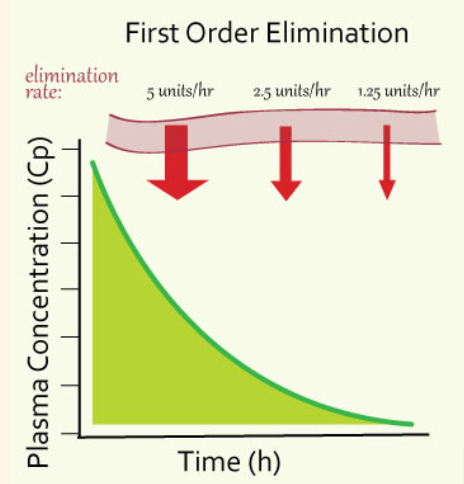
Describe first-order drug elimination.
A constant fraction (≈50%) of the drug is eliminated per unit time the amount eliminated depends on the plasma concentration.
Half-life is constant and concentration falls exponentially.
Applies to nearly all drugs.
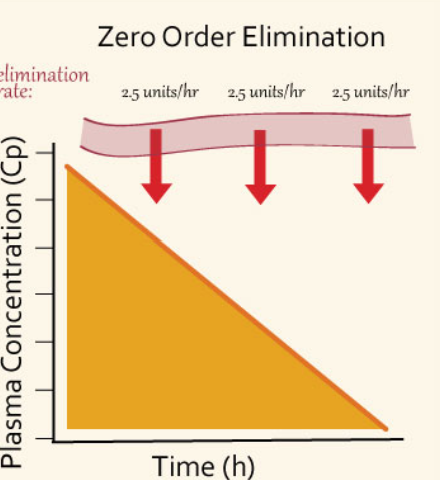
Describe zero-order drug elimination and give the classic example.
A constant amount of drug is eliminated per unit time (no half-life; occurs when the enzyme is saturated — more drug than enzyme).
.
Classic example: alcohol (~1 gram/hour). Also aspirin, phenytoin, warfarin, heparin, theophylline.
Distinguish distribution half-life from elimination half-life.
Distribution half-life = rapid drop in plasma concentration as ~50% of drug distributes through the body.
Elimination half-life = time required to excrete 50% of drug from the system.
Define a drug's half-life ((t_{1/2})) and relate it to duration of action.
The time for the drug's blood concentration to fall to 50%.
.
Short ( t_{1/2} ) → quickly removed → short duration of action.
Long ( t_{1/2} ) → slowly removed → long duration of action. It determines the dosing interval.
How many half-lives to clear a drug, and to reach steady state?
1) Approximately 4 to 5 half-lives to be cleared from the body
2) Conversely, ~4 to 5 half-lives to build up to a steady-state level.
What is the steady-state concentration (plateau)?
After repeated dosing at regular intervals; the rate of drug administration equals the rate of elimination, so the drug stops accumulating (equilibrium).
Reached after ~4-5 half-lives; time to steady state is independent of dosage.
What happens if a drug is taken too frequently (before the prior dose is eliminated)?
The new dose adds to residual drug still in the body, so the drug accumulates
because the rate of intake exceeds the rate of elimination (risk of toxicity).
What is the clinical consequence of a skipped/delayed antibiotic dose?
The plasma level drops below the therapeutic level; bacteria proliferate again and surviving bacteria become more resistant, making the antibiotic less effective and possibly requiring a more potent drug.
Differentiate a loading dose from a maintenance dose.
Loading dose = higher initial dose to compensate for drug distribution into tissues (reaches target level faster).
.
Maintenance dose = once steady state is reached, replaces only what is lost through metabolism and excretion.
How can first-order kinetics shift to zero-order, leading to toxicity?
If drug concentration saturates the liver's metabolizing capacity (at therapeutic or slightly-above levels), elimination changes from first-order to zero-order.
.
Continued dosing then causes rapid accumulation to toxic levels (rate of intake exceeds clearance).