Human Anatomy and Cell Biology Overview
 Call Kai
 Learn
Learn Practice Test
 Spaced Repetition
 Match
Match Flashcards
 Knowt Play
1/72

Earn XP
Description and Tags
Vocabulary flashcards reviewing cellular anatomy, major anatomical body regions, and abdominal regions and quadrants.
Name | Mastery | Learn | Test | Matching | Spaced | Call with Kai | Chat |
|---|
No analytics yet
Send a link to your students to track their progress
73 Terms
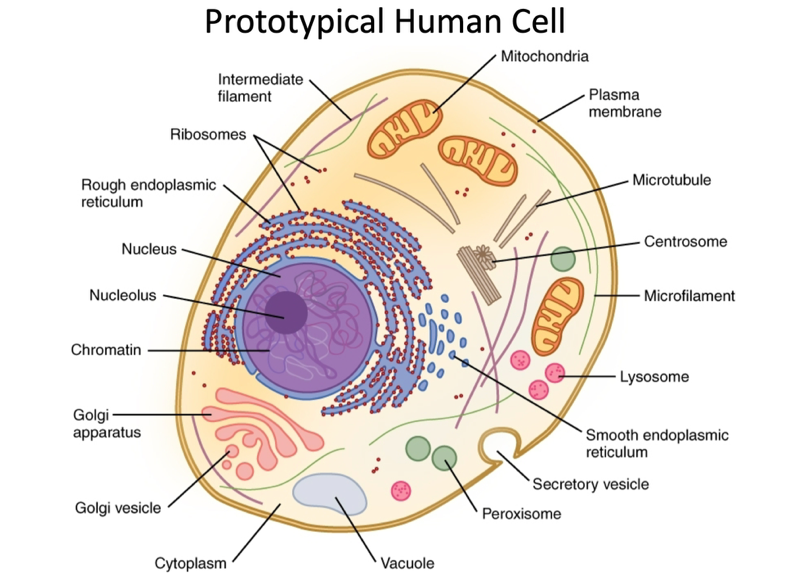
Prototypical Human Cell
A generalized diagrammatic model illustrating the major structural components and organelles of a human cell.
Nucleus
The membrane-enclosed organelle that houses genetic material in the form of chromatin and contains the nucleolus.
Nucleolus
A prominent structure inside the cell nucleus involved in ribosomal RNA synthesis and ribosome assembly.
Chromatin
The complex of DNA and proteins found within the nucleus of eukaryotic cells.
Mitochondria
Double-membrane organelles responsible for cellular respiration and generating ATP energy for the cell.
Rough Endoplasmic Reticulum
A network of membrane-bound sacs studded with ribosomes on its outer surface, specialized for protein synthesis and processing.
Smooth Endoplasmic Reticulum
A membrane network lacking ribosomes that functions in lipid synthesis and metabolic carbohydrate processing.
Ribosomes
Cellular structures that synthesize proteins, located floating freely in the cytoplasm or bound to the rough endoplasmic reticulum.
Golgi Apparatus
An organelle composed of flattened sacs that modifies, sorts, and packages proteins and lipids for secretion or delivery to other organelles.
Golgi Vesicle
Small membrane-bound transport sacs that bud off from or fuse with the Golgi apparatus.
Lysosome
A membrane-bound organelle containing digestive enzymes that break down cellular waste materials and foreign debris.
Peroxisome
A small organelle containing enzymes that perform oxidative reactions to neutralize toxic substances.
Centrosome
A structure near the nucleus that serves as the primary microtubule-organizing center during cell division.
Microtubule
A tubular, rigid cytoskeletal element involved in cell structure, intracellular transport, and mitotic spindle formation.
Microfilament
A thin cytoskeletal filament made of actin that provides structural support and assists in cellular movements.
Intermediate Filament
A class of cytoskeletal fibers that provide mechanical strength and stability to the cell structure.
Plasma Membrane
The phospholipid bilayer that encloses the cell contents and regulates the movement of molecules in and out of the cell.
Cytoplasm
The fluid material and structures enclosed within the plasma membrane surrounding the nucleus.
Vacuole
A membrane-bound cavity within the cytoplasm involved in cellular storage.
Secretory Vesicle
A vesicle that transports cellular substances to the plasma membrane for exocytosis into the extracellular space.

Regions of the Human Body
Anatomical division system identifying specific body areas from both anterior and posterior anatomical perspectives.
Cephalic
Anatomical term referring to the head region.
Cranial
Anatomical region referring to the portion of the skull enclosing the brain.
Frontal
Anatomical region referring to the forehead.
Ocular
Anatomical region referring to the eye.
Buccal
Anatomical region referring to the cheek.
Auricular
Anatomical region referring to the ear.
Nasal
Anatomical region referring to the nose.
Oral
Anatomical region referring to the mouth.
Mental
Anatomical region referring to the chin.
Cervical
Anatomical region referring to the neck.
Axillary
Anatomical region referring to the armpit.
Brachial
Anatomical region referring to the arm (upper arm).
Antecubital
Anatomical region referring to the front of the elbow.
Antebrachial
Anatomical region referring to the forearm.
Carpal
Anatomical region referring to the wrist.
Pollex
Anatomical term referring specifically to the thumb.
Palmar
Anatomical region referring to the palm of the hand.
Digital (phalangeal)
Anatomical region referring to the fingers or toes.
Patellar
Anatomical region referring to the anterior surface of the knee (kneecap).
Crural
Anatomical region referring to the anterior leg (shin area).
Tarsal
Anatomical region referring to the ankle.
Hallux
Anatomical term referring specifically to the great toe (big toe).
Acromial
Anatomical region referring to the point of the shoulder.
Dorsal
Anatomical region referring to the back.
Olecranal
Anatomical region referring to the posterior surface of the elbow.
Lumbar
Anatomical region referring to the lower back between the ribs and hips.
Sacral
Anatomical region referring to the posterior area between the hip bones.
Gluteal
Anatomical region referring to the buttocks.
Popliteal
Anatomical region referring to the area behind the knee.
Sural
Anatomical region referring to the posterior leg (calf).
Calcaneal
Anatomical region referring to the heel of the foot.
Plantar
Anatomical region referring to the sole of the foot.
Thoracic
Anatomical region referring to the chest area.
Abdominal
Anatomical region referring to the abdomen.
Umbilical
Anatomical region referring to the navel area.
Coxal
Anatomical region referring to the hip.
Inguinal
Anatomical region referring to the groin.
Femoral
Anatomical region referring to the thigh.

Abdominal Quadrants and Regions
Anatomical breakdown dividing the abdominopelvic cavity into nine distinct regions or four functional quadrants inferior to the diaphragm.
Epigastric Region
The upper central abdominal region located above the umbilical region and superior to the stomach.
Right Hypochondriac Region
The upper right abdominal region located superior to the right lumbar region and lateral to the epigastric region.
Left Hypochondriac Region
The upper left abdominal region located superior to the left lumbar region and lateral to the epigastric region.
Umbilical Region
The central abdominal region located surrounding the navel.
Right Lumbar Region
The middle right abdominal region located lateral to the umbilical region.
Left Lumbar Region
The middle left abdominal region located lateral to the umbilical region.
Hypogastric Region
The lower central abdominal region located inferior to the umbilical region.
Right Iliac Region
The lower right abdominal region located lateral to the hypogastric region.
Left Iliac Region
The lower left abdominal region located lateral to the hypogastric region.
Right Upper Quadrant (RUQ)
The upper right quarter of the abdominal cavity inferior to the diaphragm.
Left Upper Quadrant (LUQ)
The upper left quarter of the abdominal cavity inferior to the diaphragm.
Right Lower Quadrant (RLQ)
The lower right quarter of the abdominal cavity.
Left Lower Quadrant (LLQ)
The lower left quarter of the abdominal cavity.