biochem exam 1
 Call Kai
 Learn
Learn Practice Test
 Spaced Repetition
 Match
Match Flashcards
 Knowt Play
1/48

Earn XP
Description and Tags
strucutre tutorials
Name | Mastery | Learn | Test | Matching | Spaced | Call with Kai | Chat |
|---|
No analytics yet
Send a link to your students to track their progress
49 Terms
general strucutre of amino acid
sp3 hydrid, carboxyl group, alpha amino group, r group, H+
non polar AA specifics
each R group is hydrophobic
Glycine, Gly, G imporants
not chiral, simplest R group, most conf. flexible
Pro, P, Proline important
least conf flexible, R group covalent bond with its alpha amino group
Met, M, Methionine
aliphatic chain with sulfur, hydrophobic and flexible
Polar R groups
dipole-dipole, hydrogen bonding, exterior of globular proteins
Cys, C, cystine
Sulfhydryl, R-group covalent bond are disulfide bonds
when oxidized htefulrhydrl bonds for covalent bonds with toher sulfhydryls
Lys, Lys, K, Arginine, Arg, R basic quliaties
R groups can ahve protonated amine groups, gives them positive charge that can from ionic interaction with adjacent negative charges
His, Histidine basic quality
does not form ionic bonds like K & R, pKr=6.01 and is 10% protonated at a PH of 7.0 and has neutral characteristic
what has a negative charge at a PH of 7.0?
Aspartate, it is acidic
which of the following as a positive charge at a pH 7.0?
Lys, it is basic a
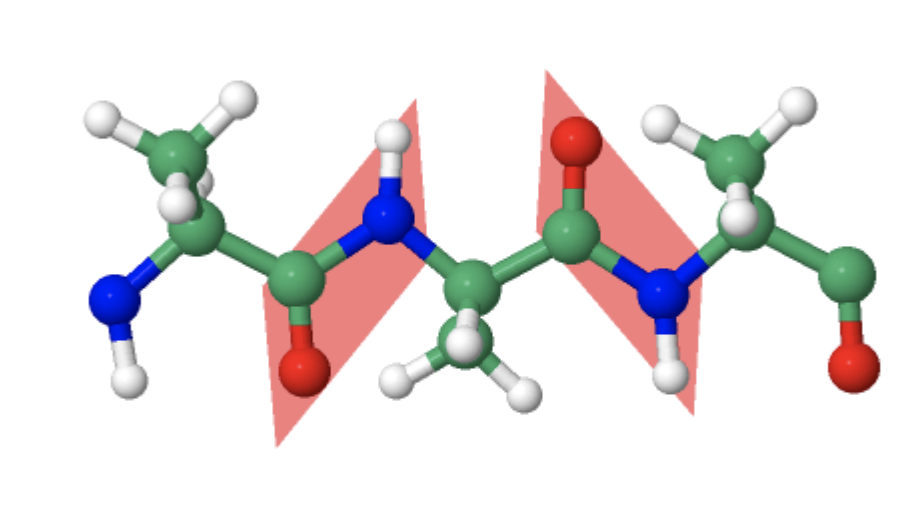
what does the red highlight show
peptide bond which
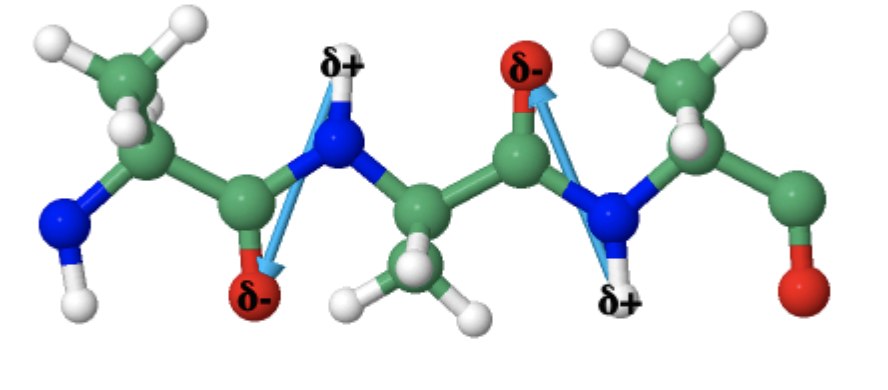
what does this show
the dipole-dipole moment. the negative is oxygen and will be a hydrogen bond acceptor, the postive end is the hydrogen which will be the hydrogen bond donor
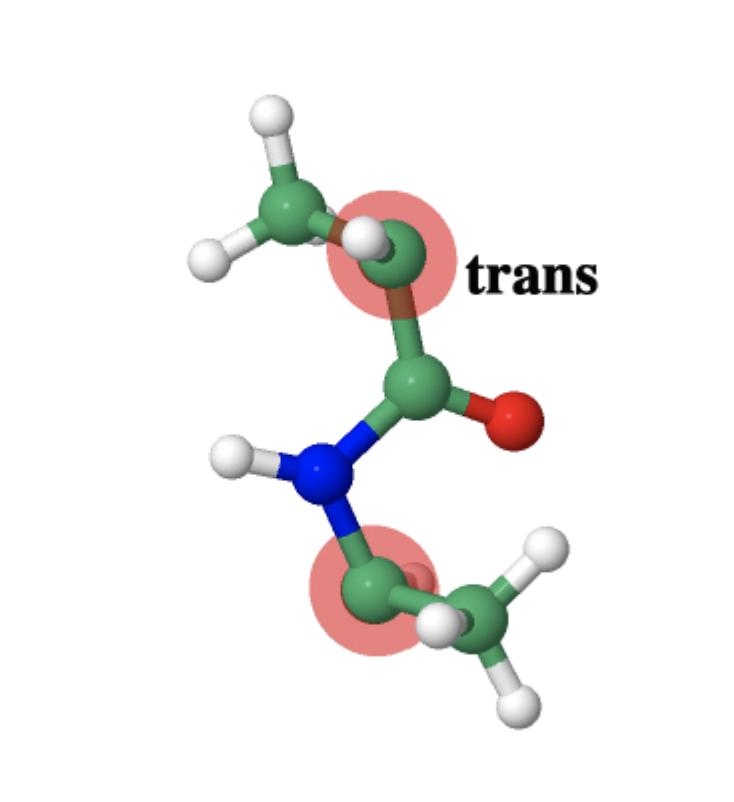
trans geometric isomer
observed in 99% of all peptides
cis configuration
beta carbons are overlapping
trans pro
small steric clash between beta carbon of serine which destabilizes the trans configuration (relative to trans configuration that lack a proline side chain)
cis pro
carbonyl carbon clases with beta carbon
phi angle
alpha carbon and c-N
psi angle
covalent bond between alpha carbon to carbonyl carbon
disallowed angle
physically impossible conformations due to steric clashes
rotamer changes
conformation changes of R groups between beta and g-carbons pr alpha and beta carbons
primary strucutre
all covalent bonds linking among acids together in a protein
3 major classes of proteins found in organisms
globular, membrane, filamentous proteins
secondary strucutre
recurring backbone strucutral patterns found in protein strucuture
globular proteins
soluble in aqueous environment of the cell,
number of peptide bonds
one less than the number of AA
first residue in an AA
N-terminus
membranous proteins
tightly associated with bio membranes
filamentus proteins
long filament strucutres with both extracellular and intracellular compartments
ramachandran plot
visualizing the phi/psi angle combination of very AA in a protein, the more concentrated areas means more aAA with that bond angle
favorable angles
+-180
why are angle unfavorable?
steric clashing- think 120 example
given what you have seen of the tertiary structure which wou;d you expect ot be true
configurations
change by breaking bonds
conformation
change by twisting- not breaking bonds
bond enthalpy depends on
geometry, distance, nature of surroundings,
bond enthalpy
a measure of the polarizability of the solvent, low for nonpolar solvents, high for polar solvents
hydrophobic effect
tendency of nonpolar solutes to come together when placed in a polar solvent
low entropy
high degree of order and concentration of energy
clathrate cage
molecular interaction water molecules will adopt when surrounding a molecule, resulting in an like structure of water
ionic bond
electrostatic interaction betwee two atoms with formal charges
acid v base
proton donors, proton acceptors
conjugate base
formed when an acid loses its proton
buffer
solution consisting of a conjugate acid/base pair that resist large changes in ph
transcriptome
total number of gene products that can be produced from the genome including products of alternative splicing
proteonome
entire collection of proteins that van be produced and is encoded for by an organisms genome
N terminus
1st amino group in the protein and the only amnio acid with a free alpha amino group
C terminus
last amnio acid, alpha carboxyl group
side chain stability delta dleta G meaning
larger the number the more unlikely it will b found in a alpha helix