BIOL 2160 EXAM V - Chapter 18-19
 Call Kai
 Learn
Learn Practice Test
 Spaced Repetition
 Match
Match Flashcards
 Knowt Play
1/82

There's no tags or description
Looks like no tags are added yet.
Name | Mastery | Learn | Test | Matching | Spaced | Call with Kai |
|---|
No analytics yet
Send a link to your students to track their progress
83 Terms
what are the main functions of the kidneys?
Primarily responsible for maintaining stability of ECF volume, electrolyte composition, maintain proper acid-base balance in the body and osmolarity of body fluids, primarily through regulating H2O balance
what is the main route for eliminating potentially toxic metabolic wastes and foreign compounds from the body?
kidneys
What is ECF?
extracellular fluid; fluid outside the cells and is whatever diffuses out of your blood plasma
what are the biggest problems if your kidneys aren’t functioning correctly?
dehydration and sepsis
what is sepsis?
toxification of the blood (can be lethal)
what is the main purpose of kidneys?
to produce perfect blood
what does the urinary system consists of?
kidneys, ureters, urinary bladder, and urethra
what are ureters?
hollow tubes that carry the urine from the kidneys to the bladder
what is the urinary bladder?
STORAGE; store urine until it is full, in order to keep you from needing to go to the bathroom every time your kidneys produce urine
what is the urethra?
the tube that carries urine to the outside of the body
what muscle lines the ureters?
smooth muscle-walled duct
what muscle lines the urinary bladder?
hollow, distensible, smooth-walled sac
why is the bladder involuntary?
because the bladder is made of smooth muscle thatyou can’t control when it contracts
what muscle surrounds the urethra?
skeletal muscle
why is the urethra voluntary?
because the muscles surrounding it are skeletal so as long you contract, you won’t urinate but the bladder contractions will be stronger than the skeletal muscle contractions, making you urinate
why is the urethra smaller in females?
because uterus occupies the space just above the bladder
what is the difference between the urethra structure in males compared to females?
males have longer and follows curving course from bladder to outside and has a dual function: Provides route for eliminating urine from bladder and Passageway for semen from reproductive organs while females just have it straight and short
what is the kidney made of?
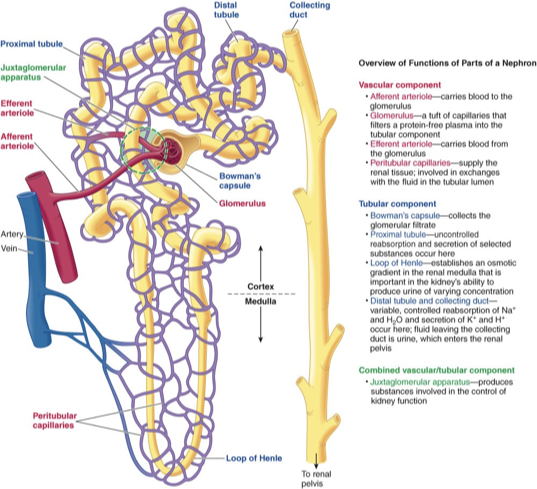
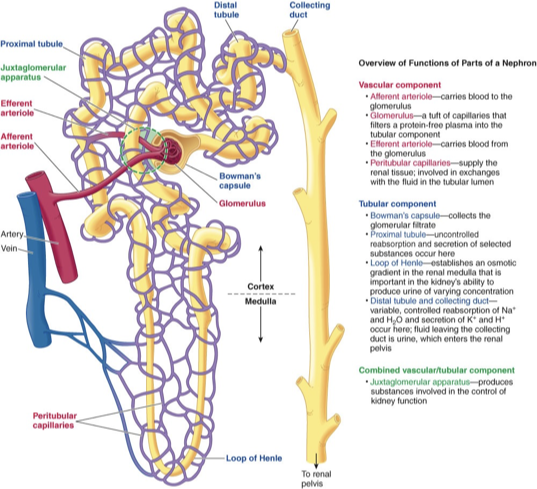
made up of over a million nephrons; which are the functional units of the kidney
what are the main parts of the nephron?
the vascular component and the tubular component
what does the vascular component carry?
carries blood that must be cleaned through the nephron
what does the tubular component carry?
carries the filtrate that will become urine
what are the parts of the vascular component?
afferent arteriole, glomerulus, efferent arteriole, peritubular capillaries
what are the parts of the tubular component?
Bowman’s capsule, proximal tubule, loop of henle (descending and ascending limbs), distal tubule and collecting duct
what is part of the combine vascular/tubular component?
juxtaglomerular apparatus
what is the dominant part of the vascular component?
glomerulus
what is the glomerulus?
ball of capillaries; Water and solutes are filtered through this as blood passes through it → filtrate will become urine
what is the tubular component made of?
Hollow, fluid-filled tube formed by a single layer of epithelial cells
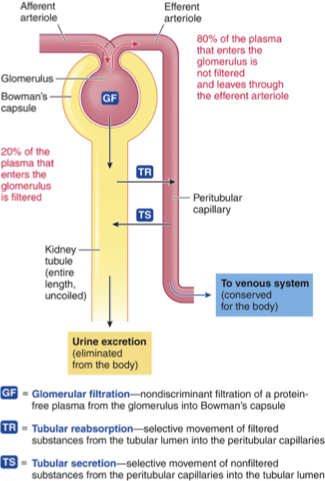
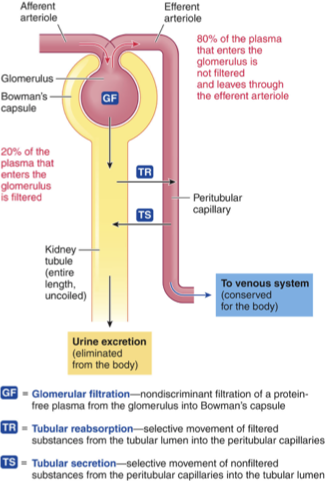
how much of the plasma entering the glomerulus gets fitered?
20%
how much of the plasma entering the glomerulus is not filtered and leaves through the efferent arteriole?
80%
why is only 20% of the plasma gets filtered through the glomerulus?
because filtration is a slow process and if the plasma got filtered 100% then there’s no blood available for the rest of the body
what are the listed basic renal processes?
Glomerular filtration, Tubular reabsorption, Tubular secretion, and Concentration
what is tubular reabsorption?
means things leaving the urine and going into the blood; things we are keeping in the body
what is tubular secretion?
means things leaving the blood and going into the urine; things that are leaving the body
where does the fluid go to after being filtered from the glomerulus?
Bowman’s capsule pass through three layers of the glomerular membrane
what are the crossed barriers in tubular reabsorption?
tubular fluid (start) → luminal membrane → cytosol of the epithelial cell → basolateral membrane → interstitial fluid → capillary wall → blood plasma (end)
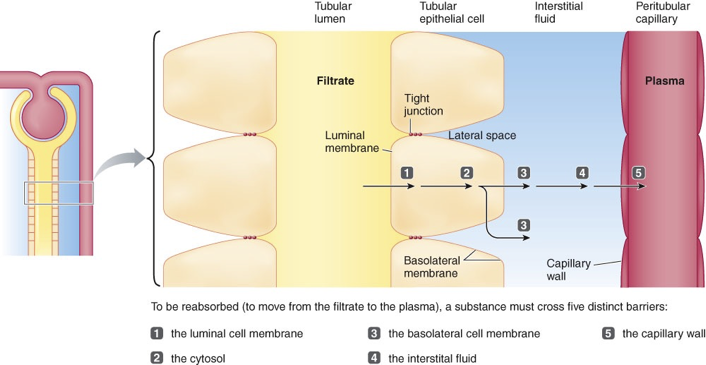
what is highly selective, is a variable process, and involves trans-epithelial transport?
tubular re-absoprtion
what is the luminal membrane?
the membrane of the epithelial cells that make up the wall of the tubule. And it’s the membrane that faces the inside of the tubule
what is the basolateral membrane?
is the membrane of the epithelial cell that faces the outside of the tubule
what is passive reabsorption?
No energy is required for the substance’s net movement and Occurs down electrochemical or osmotic gradients
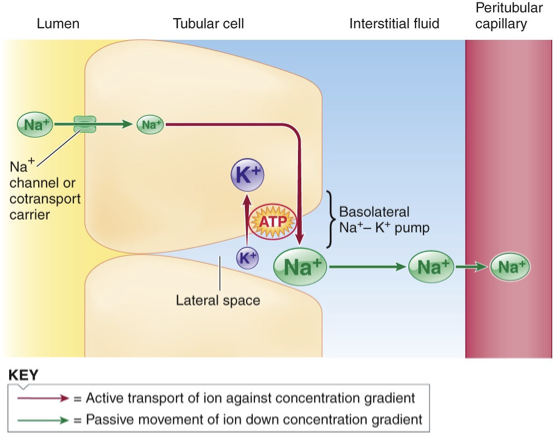
what is active reabsorption?
Occurs if any one of the steps in transepithelial transport of a substance requires energy and Movement occurs against electrochemical gradient
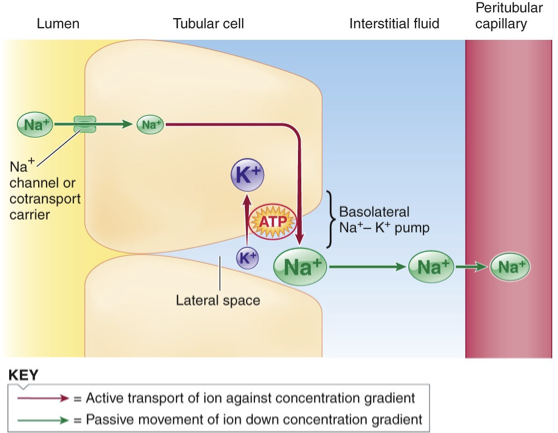
What happens if only one of the barriers being crossed requires energy, but the rest of the barriers are passive?
then the entire process is considered to be active transport, because without energy, that substance does not get reabsorbed
what is essential for Na+ reabsorption?
the Na+ - K+ ATPase pump in basolateral membrane
what percentage of Na + gets reabsorbed in the proximal tubule?
67%
what is the role of Na+ reabsorption in the proximal tubule?
Plays role in reabsorbing glucose, amino acids, H2O, Cl-, and urea
what percentage of the total energy spent by kidneys is used for Na+ transport?
80%
what percentage of Na+ gets reabsorbed in the ascending limb of the loop of henle?
25%
what is the role of Na+ reabsorption in the ascending limb of the loop of henle?
Plays critical role in kidneys’ ability to produce urine of varying concentrations
what is the role of Na+ reabsorption in the distal and collecting tubules?
Variable and subject to hormonal control; plays role in regulating ECF volume
what percentage of Na+ gets reabsorbed in the distal and collecting tubules?
8%
which part of the loop of henle does not reabsorbe Na+?
the descending limb of the loop of henle
what is the only barrier that requires energy when Na+ crosses during reabsorption?
the basolateral membrane of the epithelial cell
where is there more of Na+?
outside the cell than in
is sodium reabsorption considered active or passive?
active
what is glucose and amino acids reabsorbed by?
by sodium-dependent, secondary active transport
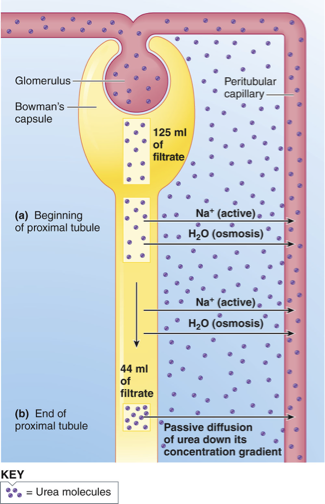
what produces a concentration gradient for urea from the tubule into the interstitial fluid?
The re-absorption of water into the blood surrounding the proximal tubule increases the concentration of urea inside the tubule, as water is lost from the tubule
why is urea reabsorbed as the end of the proximal tubule?
because there’s Na, amino acids, and glucose in the urea left so some urea is diffusing down its own concentration gradient into the blood
what is tubular secretion the opposite of?
tubular reabsorption
where foes tubular secretion occur?
from peritubular capillaries into the tubular lumen
what happens in tubular secretion?
toxins and anything the body has enough of like glucose, water, and K+ is secreted into the urine through the reverse process of the trans-epithelial transport; Kidney tubules can selectively add some substances to the filtrate
what is the important of H+?
regulating acid-base balance
where is H+ secreted in?
proximal, distal, and collecting tubules
what is the importance of K+?
Keeps plasma K+ concentration at appropriate level to maintain normal membrane excitability in muscles and nerves
where is K+ secreted in?
Secreted only in the distal and collecting tubules
where are organic ions secreted in?
Secreted only in the proximal tubule
what happens when the blood gets too acidic?
H+ gets secreted into the urine. This makes urine fairly acidic; “sterile” urine because pH is too low for most bacteria to grow in
what is the concentration of the filtrate and extracellular fluid at the bottom of the hoop of henle?
1200 mOsm
what happens to the osmolarity of the filtrate as the filtrate flows down and water leaves the tubule?
osmolarity of the filtrate increases
what increases the osmolarity of the filtrate?
the loss of water
which is highly permeable to water, but not to NaCl?
descending limb of the hoop of henle
which is impermeable to water, but permeable to NaCl?
ascending limb of the hoop of henle
what causes the filtrate to become more diluted than the extracellular fluid?
As highly concentrated filtrate flows up, NaCl diffuses, then is actively transported out of the tubule. But water does not follow
what is another name for vasopressin?
ADH (anti-diuretic hormone)
what are aquaporins?
water channels
what is the role of vasopressin?
to CONCENTRATE your urine
what happens to vasopressin during a water deficit?
the secretion of vasopressin increases. This increases water re-absorption
what happens to vasopressin during an excess of water?
the secretion of vasopressin decreases. Less water is reabsorbed. More is eliminated
what is a vasopressin inhibitor?
alcohol
where is vasopressin produced and stored in?
produced in the hypothalamus and stored in the posterior pituitary
what happens when you’re dehydrated?
The release of this substance signals the distal tubule for the re-absorption of water. The secretion of vasopressin increases the permeability of the tubule cells in the distal tubule and collecting duct to water by inserting aquaporins. An osmotic gradient exists outside the tubules for the transport of water by osmosis
for every 250 mLs of alcohol consumed, how much water is eliminated in your urine?
1000 mLs
what is micturition reflex?
Relaxation of external urethral sphincter muscle allowing urine to pass through urethra and out of the body
what is urinary incontinence?
Inability to prevent discharge of urine
what is micturition?
contraction of bladder pushes urine out of the body by stimulating stretch receptors; under voluntary control but cannot be delayed indefinitely