Biology - B3.1 gas exchange
 Call Kai
 Learn
Learn Practice Test
 Spaced Repetition
 Match
Match Flashcards
 Knowt Play
1/51

There's no tags or description
Looks like no tags are added yet.
Name | Mastery | Learn | Test | Matching | Spaced | Call with Kai | Chat |
|---|
No analytics yet
Send a link to your students to track their progress
52 Terms
Gas exchange definition
The absorption of one gas from the environment and release of another
Gas exchange and surface area to volume ratio
Only rapid enough if the surface area is large enough and the diffusion distance is short
E.g. small organisms or unicellular organisms can use their outer surface for gas exchange
Larger organisms need a specialised gas exchange surface (e.g. gills or lungs)
Properties of gas-exchange surfaces
Permeable (gas cross plasma membrane)
Large surface
Moist (dissolve before diffusing)
Thin
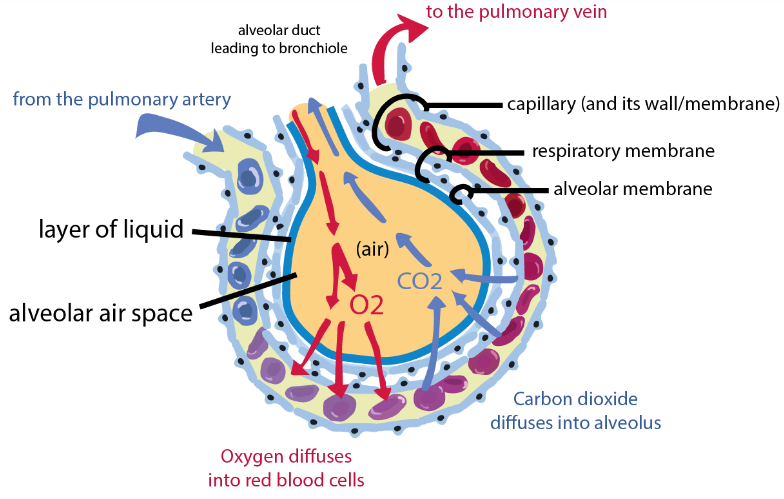
Concentration gradient mammalian lungs
Diffusion only occurs if there is a concentration gradient
So, in the lungs, a concentration gradient is established, as the blood brought to the lungs always has a lower oxygen content than the air breathed in.
Definition ventilation
Describes the movement of air in and out of the lungs (breathing), including the movement of water across the gills
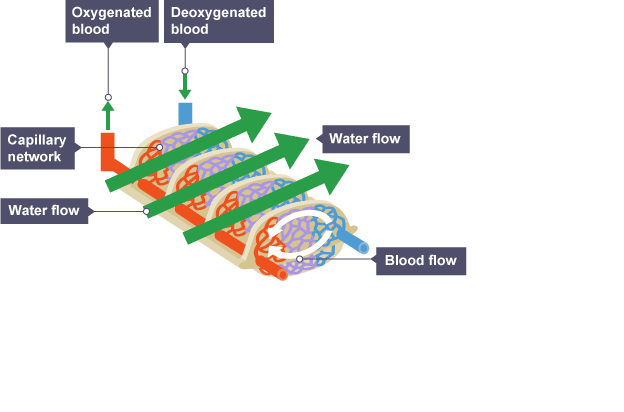
Concentration gradient in fish
Water flows across gills and blood flows in an opposite direction to the water making sure that the water (rich in oxygen) meets blood (low in oxygen)
Concentration gradient unicellular organisms
Active transport or passive transport across the outer surface, with the molecules retained in the contractile vacuole.
What parts of mammalian lungs have adaptations for efficient gas exchange?
Branching bronchioles,
Thin cells/type 1 pneumocytes
Thin endothelial cells of the capillaries
Extensive capillary beds around alveoli
Shape and extensive number of alveoli
What adaptations are there to increase rate of gas exchange in mammalian lungs?
Bronchioles branched to increase volume of air possible to enter and exit, also larger gas exchange surface
Type 1 pneumocytes are thin cells to reduce diffusion distance
The endothelial cells of the capillaries are thin to reduce the diffusion distance
There are many capillaries around the alveoli to increase the surface area of gas exchange, also allows constant flow of blood to establish a constant concentration gradient
Many alveoli and in broccoli shape to increase surface area
Type 2 pneumocytes
Type 2 pneumocytes release surfactant. These phospholipid type molecules form a monolayer above the moisture layer in the alveoli and reduce the surface tension to prevent implosion of lungs.
Breathing in and out fancy words
Inspiration and expiration
Main muscles involved in ventilation in humans
Intercostal muscles (in between the ribs), the diaphragm, the abdominal muscles
Pressure difference and breathing
To breath in, the pressure inside the lungs must be lower than outside which occurs with a larger volume.
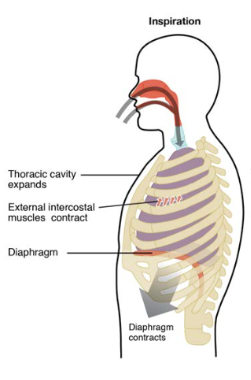
Muscle movement during inspiration
Muscles cause the volume to become larger
Diaphragm contracts and moves downwards
Abdominal wall muscles relax
External intercostal muscles contract, so the ribcage moves upwards and outwards
Internal intercostal muscles relax
Muscle movement during expiration
Volume decreases inside the thorax so the pressure increases
Diaphragm relaxes and moves upwards
Abdominal muscles relax
External intercostal muscles relax
Internal intercostal muscles relax
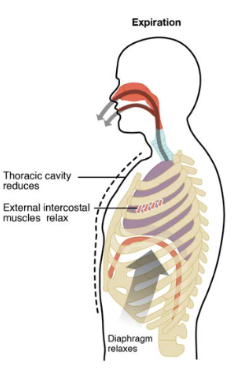
Muscle movement during exercise expiration
Same as normal expiration (diaphragm and external intercostal muscles relax) but abdomen wall muscles and internal intercostal muscles contract
Spirometer
Tool used to measure lung volume, a graph produced depicting volume of air breathed in and out.
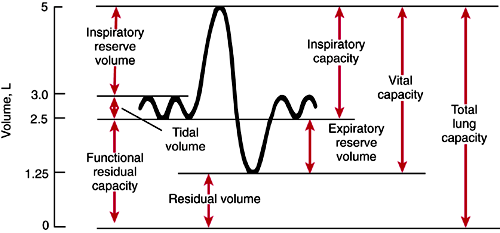
Definition tidal volume
The volume of fresh air that is inhaled/exhaled during a typical breath, usually around 0.5 litres
Definition vital capacity
The total volume of air that can be exhaled after a maximum inhalation
Definition inspiratory reserve volume
The volume of air a person can inhale forcefully after a normal inhalation
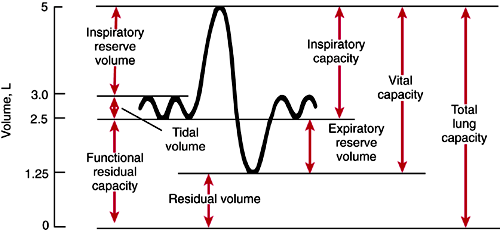
Definition expiratory reserve volume
The volume of air a person can exhale forcefully after a normal exhalation
Definition ventilation rate
the number of breaths per minute
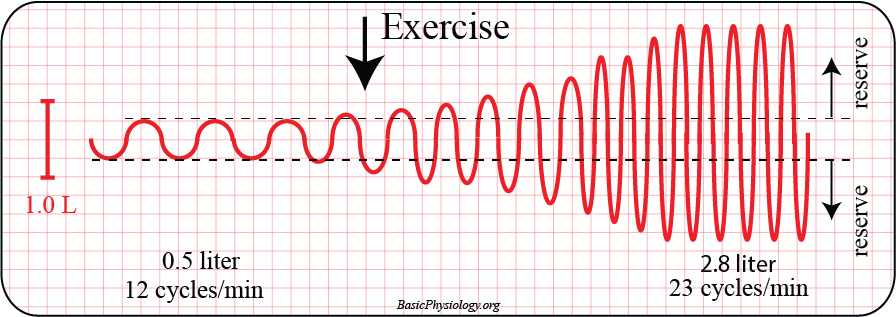
Tidal volume with exercise vs at rest
At rest the tidal volume is higher because the amount you breath out/in is higher just at a slower rate
At exercise the ventilation rate increases, increase in frequency
Bc when exercising need more oxygen to generate more ATP through aerobic respiration
How is the leaf structure adapted for gas exchange?
Waxy cuticle
Stomata and guard cells
Palisade mesophyll
Spongy mesophyll
Vascular bundles
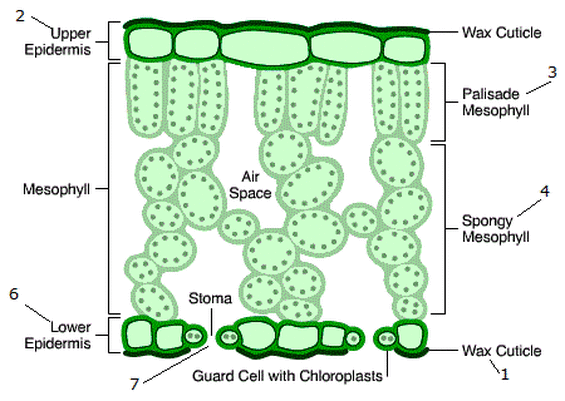
How is the waxy cuticle adapted for gas exchange?
Impermeable waxy cuticle to stop evaporation out of the leaf, so water drips down to soil
Waxy cuticle thicker on upper surface to prevent evaporation bc of higher temps and higher light intensity
How are stomata and guard cells adapted?
Stomata are holes at regular intervals to obtain carbon dioxide at all parts of the leaf
the guard cells prevent evaporation of water so close the stomata at low water levels and at higher temperatures
How is the palisade mesophyll adapted?
Many chloroplasts and located at the top of the leaf for most light available and increase in photosynthesis rate
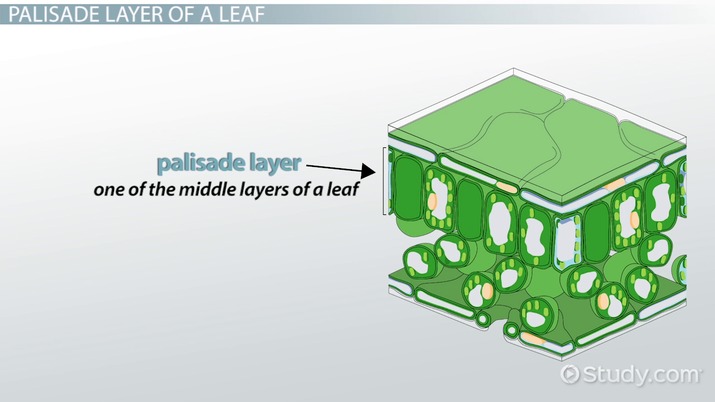
How is spongy mesophyll adapted?
Less chloroplasts bc get less light and don’t need to do as much photosynthesis
More spread out creating more air spaces to store/have CO2 which can access all cells
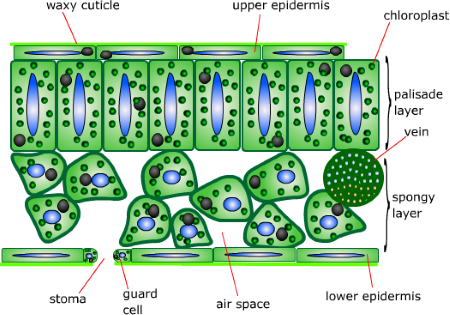
How are the vascular bundles adapted for gas exchange?
They are bundles of xylem and phloem between cells
Need them to bring water (xylem) and nutrients and sugars (phloem)
Plan diagram
Drawings that show the tissue distributions (layers) of structures, not individual cells, with labels obvi

Definition transpiration
Movement of water in plants, measured by the loss of water
Other def: continual loss of water from a leaf
Transpiration as a consequence of gas exchange in a leaf
CO2 enters the leaf for photosynthesis and water is lost bc it is a trade
CO2 enters through stomata and water is lost out of the stomata
Factors affecting rate of transpiration
Temperature (increase in temp, increases transpiration)
Humidity (increase in humidity, slower transpiration, more water outside, less strong concentration gradient)
Wind (increase in wind, reduces humidity, increases transpiration)
Light (bright light, stomata open, increase transpiration)
Stomatal density definition
Number of stomata per unit area of leaf structure
Stomatal density formula
stomatal density (mm-2) = (average number of stomata) / area of field view (mm2)

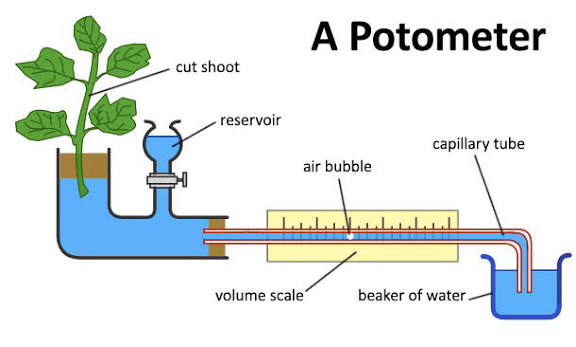
What does a potometer measure
Rate of transpiration
How does a potometer work?
Measure the volume of water taken up or the movement of air bubble
For a stem of a plant
Can change internal factors like number of stomata, surface area etc. or external factors like wind etc.
Structure of erythrocytes
Red blood cells have plasmam membrane filled with haemoglobin molecules (no nucleus)
Haemoglobin molecule is 4 alpha helix polypeptides with 4 irons
To what does oxygen bind?
Binds to an iron atom within the haem group
Conformational shape haemoglobin
The protein changes shape with a change in pH or temperature and when oxygen binds to it
Definition cooperative binding
The conformational shape haemoglobin experiences when oxygen binds makes it easer for the next oxygen molecule to bind.
Oxygen molecules working together to make it progressively easier
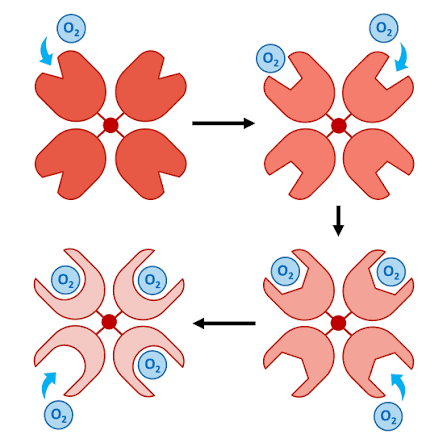
Definition affinity and trend
The ease with which haemoglobin accepts oxygen
High affinity = easy binding
Trend: more oxygens, easier for next to bind
Dissociation def and trend
The ease with which oxygen is released from te haemoglobin
Trend: more oxygens, harder to release oxygen
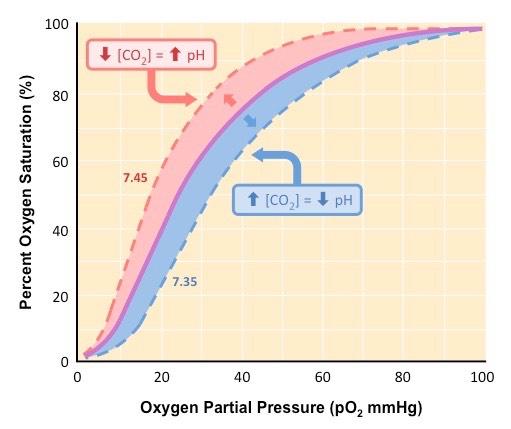
Definition oxygen dissociation curve
Shows how “full” with oxygen a proportion of haemoglobin molecules are
y-axis: percentage of haemoglobin that is saturated with oxygen, if 25% most proteins have 1 oxygen binded
x-axis: partial pressure
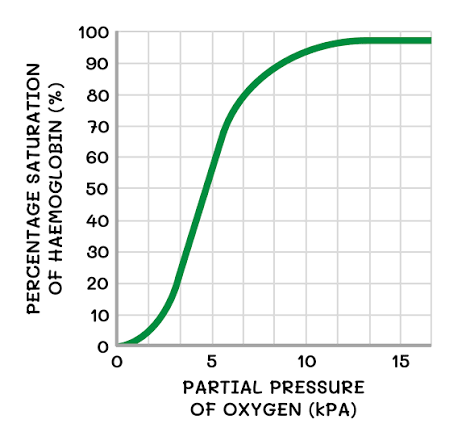
Definition partial pressure
Measure of the individual pressure of one gas within a mixture of gases
Depends on concentration of that gas as well as its pressure
Oxygen in this case, so PO2
Shape of the dissociation curve
Sigmoid shape because of the changing affinity when more oxygen is bound
At low PO2 its a plateau bc its difficult to attach the first oxygen
When there are one or two oxygens it binds more easily so a steep gradient (25% to 50%)
Flattens at the top bc maximum number
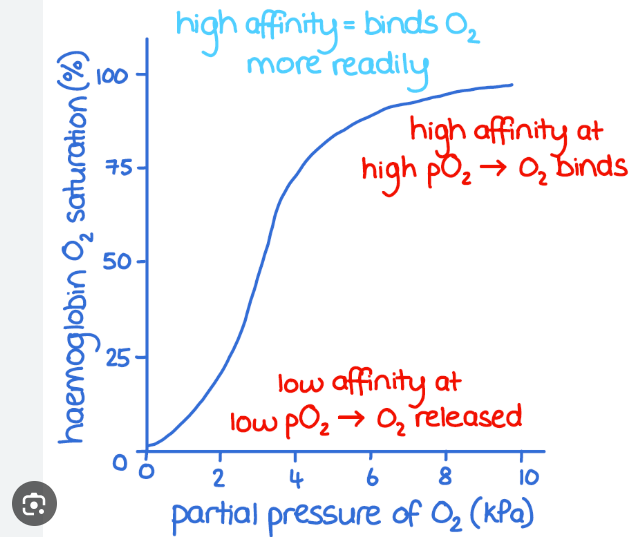
Dissociation graph with parts of the body
Areas with high PO2 (e.g. lungs) easily taken up more oxygen and at low PO2 (tissues) release it more easily
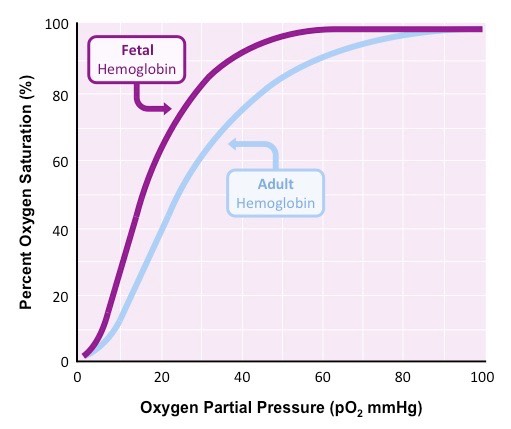
What is different for fetal haemoglobin?
It is structured slightly differently with a higher affinity, easier to take up more oxygen
Achieved through gene expression
What are the two way in which carbon dioxide changes the affinity of haemoglobin?
Decrease in pH
Allosteric site binding
Lower affinity with conformational change
Way in which carbon dioxide reacts with water
Reacts with water to form hydrogen ions (H+ ions) and hydrogen carbonate ions (HCO3-), decrease pH because H+ makes more acidic, conformational change
CO2 + H2O —> H+ + HCO3-
Way in which carbon dioxide binds to haemoglobin
Combines with each haemoglobin to form carbaminohemoglobin, bind to allosteric site, causing conformational change
Haemoglobin +4CO2 —> carbaminohemoglobin
Bohr shift
A shift in the oxygen dissociation curve depending on the partial pressure of carbon dioxide
High PCO2 is a shift to the right because at a random PO2 less oxygen bound to haemoglobin