🏛️Foundations of Microeconomics (Week 1)
 Call Kai
 Learn
Learn Practice Test
 Spaced Repetition
 Match
Match Flashcards
 Knowt Play
1/21

There's no tags or description
Looks like no tags are added yet.
Name | Mastery | Learn | Test | Matching | Spaced | Call with Kai | Chat |
|---|
No analytics yet
Send a link to your students to track their progress
22 Terms
Pareto Efficiency
A choice that maximizes efficiency while minimizing harm is called…
Tradeoffs, opportunity cost, marginality, incentives, and trade as a positive value
what are the five foundational concepts of microeconomics?
tradeoff
the concept that every choice has a sacrifice is called a…
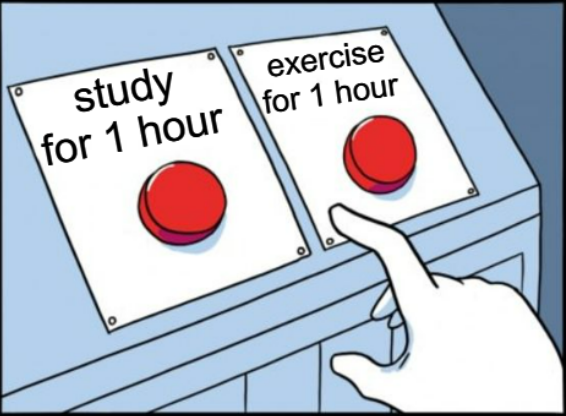
~Example: I study for four hours, but I could’ve gone out to dinner with my family. The tradeoff is four hours of family time.
incentive, money, direct, indirect
motivation for doing something is called a(n)…
~Example: I go to a job to get paid money. My incentive is the [TERM].
[TERM] incentives describe primary motivations (if you do x, I’ll give you y) and [TERM] incentives describe secondary motivations (i do x for y, but really to get z)
![<p>motivation for doing something is called a(n)…</p><p>~Example: I go to a job to get paid money. My incentive is the <strong>[TERM]</strong>.</p><p><strong>[TERM]</strong> incentives describe primary motivations (if you do x, I’ll give you y) and <strong>[TERM] </strong>incentives describe secondary motivations (i do x for y, but really to get z)</p>](https://assets.knowt.com/user-attachments/9ac2890e-9ad8-4e54-b1b1-ff7f8494158e.jpg)
opportunity cost, 8
the full cost/value of the best choice NOT taken is called the…
~Example: If I get 9 hours of sleep but could have gotten 8, 7, or 6 hours of sleep, the opportunity cost was [#] hours.
trade as a positive value
voluntary specialization generates benefits
marginality
the cost/benefit of the next increment is called…
comparative advantage
the ability of an agent to produce at a lower opportunity cost compared to another agent
absolute advantage
an agent’s ability to produce more of something than another agent
marginal thinking
evaluating whether the benefit of one more unit of something is greater than its costs

unintended consequence
unplanned result of an incentive, usually negative. I like to think of it as misalignment between an incentive and an outcome.
unlimited, limited, scarcity
why is there no such thing as a free lunch? Because wants are [TERM] and resources are [TERM], which creates [TERM]
![<p>why is there no such thing as a free lunch? Because wants are [TERM] and resources are [TERM], which creates [TERM]</p>](https://assets.knowt.com/user-attachments/cd2c30da-9e5c-4b35-9d95-825014a7d69d.png)
choice, goals, scarcity
three factors that define economics
Observe
Step one of the economist’s scientific method— [TERM] phenomena
![<p>Step one of the economist’s scientific method— [TERM] phenomena</p>](https://assets.knowt.com/user-attachments/2682b601-4077-4b1c-bbc6-291a57053953.jpg)
Hypothesis
Step 2 of the economist’s scientific method— Develop a [TERM]
![<p>Step 2 of the economist’s scientific method— Develop a [TERM]</p>](https://assets.knowt.com/user-attachments/279c2189-5d17-4ace-87df-ece17c60ea98.png)
Test, Model
Step 3 of the economist’s scientific method — [TERM] your hypothesis with a [TERM]
![<p>Step 3 of the economist’s scientific method — [TERM] your hypothesis with a [TERM]</p>](https://assets.knowt.com/user-attachments/b1d7209d-4c8a-45bd-91e0-303e548c8127.jpg)
Positive statement
A [TERM statement] is about how something IS, not about how it SHOULD BE
e.g. “The national debt is $40T.”
Normative statement
A [TERM statement] is about how something SHOULD BE, not about how it IS
e.g “It’s good if the national debt is $100B.”
ceteris paribus
the concept that all else must be held equal in a model in order to approach accuracy

causality
it is incredibly difficult to prove [TERM] in an experiment because of external factors that may complicate results
![<p>it is incredibly difficult to prove [TERM] in an experiment because of external factors that may complicate results</p>](https://assets.knowt.com/user-attachments/f8c49b1c-fecd-48c5-a259-88f2dab24355.jpg)
Endogenous factors
Model variables that can be controlled for inside a model are called [TERM factors]
Exogenous factors, realistic
Model variables that cannot be accounted for, the more of these are added to a model (becoming endogenous) the more [TERM] the model