Chapt 11 combined
 Call Kai
 Learn
Learn Practice Test
 Spaced Repetition
 Match
Match Flashcards
 Knowt Play
1/26

There's no tags or description
Looks like no tags are added yet.
Name | Mastery | Learn | Test | Matching | Spaced | Call with Kai | Chat |
|---|
No analytics yet
Send a link to your students to track their progress
27 Terms
Which of the following factors contributes to obesity the MOST?
gender
genetics
smoking
age
genetics
In an individual who is at rest, which of these tissues will expend the LEAST amount of energy per gram?
liver
brain
skeletal muscle
kidneys
skeletal muscle
In the last few decades, the rapid rise in the prevalence of obesity is largely attributed to:
the rising rate of type 2 diabetes.
changing environmental factors.
an aging population.
genetic changes.
changing environmental factors
If you decrease your energy expenditure by 300 kcal per day, how many fewer kilocalories would you need to eat to stay in energy balance?
300
400
450
150
300
Which two factors are MOST responsible for the rapid rise in the prevalence of obesity that has occurred in the last few decades?
genetics and behaviors
genetics and hormones
environment and behaviors
hormones and environment
environment and behaviors
Variations in basal metabolism from person to person are accounted for by individual differences in:
duration of physical activity.
fat-free mass (FFM).
intensity of physical activity.
the amount of protein consumed.
fat-free mass (FFM)
Fat secretes hormones that can cause low-grade chronic:
weight loss.
hunger.
illness.
inflammation.
inflammation
Estimate the total daily energy expenditure of an average, sedentary 165-pound American man without using an involved equation.
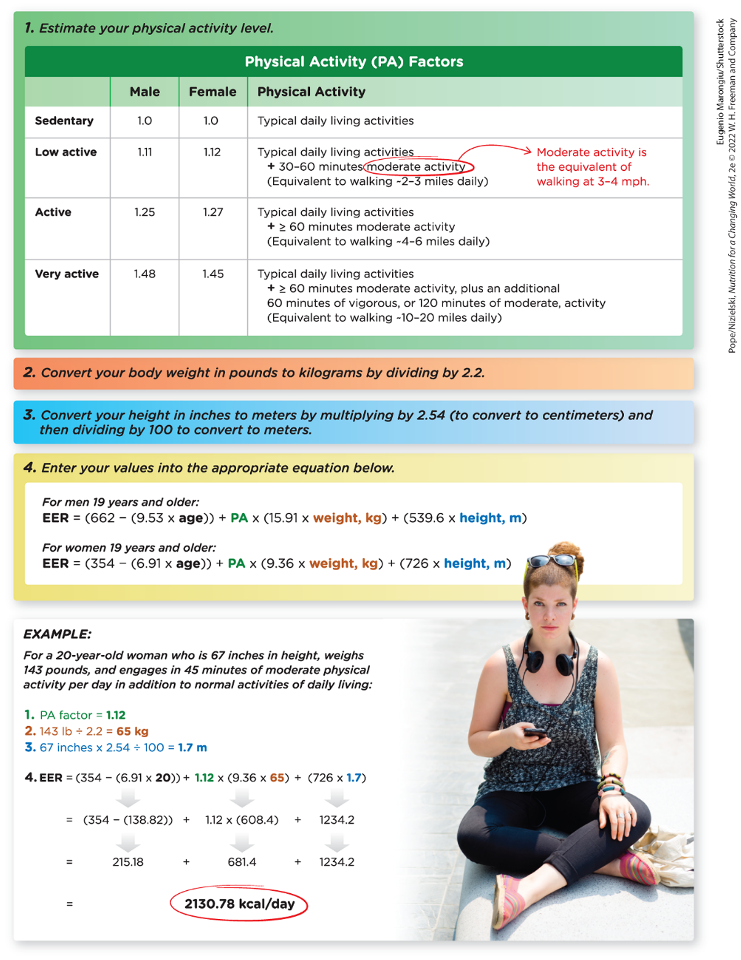
3000 kcal
1800 kcal
4000 kcal
2500 kcal
3,000
A reasonable estimate of BMR for a man with a normal body weight of 176 lb (80 kg) is about _____ kcal.
1800
1600
1920
1760
1920
A team of scientists is researching how the composition of a meal affects the amount of food consumed at a meal. What specific process are they studying?
taste preferences
hunger
appetite
satiation
satiation
In agreement with the laws of thermodynamics, what happens to excess energy that we consume?
The excess energy is destroyed.
Our BMR will decrease.
The excess energy is stored as fat.
The excess energy is excreted in urine.
The excess energy is stored as fat.
A man reduces his calorie intake to 1600 kcal per day, and maintains that level of intake for the duration of his low-calorie diet. After a few months on his calorie-restricted diet, he notices that he lost less weight during the fifth month of his diet than he did during the second month. What is the best explanation for this change in the rate of weight loss?
He has decreased the amount of time he spends being physically active.
A lighter body has a lower BMR and expends less energy when moving.
Less of his weight loss is from water losses during the fifth month.
After dieting for several months, his NEAT has decreased.
A lighter body has a lower BMR and expends less energy when moving.
In addition of the activities of daily living, what is the minimum level of physical activity that is required to be considered "very active"?
60 minutes of moderate physical activity daily
180 minutes of moderate physical activity daily
60 minutes of vigorous physical activity daily
60 minutes of moderate physical activity and 30 minutes of vigorous physical activity daily
180 minutes of moderate physical activity daily
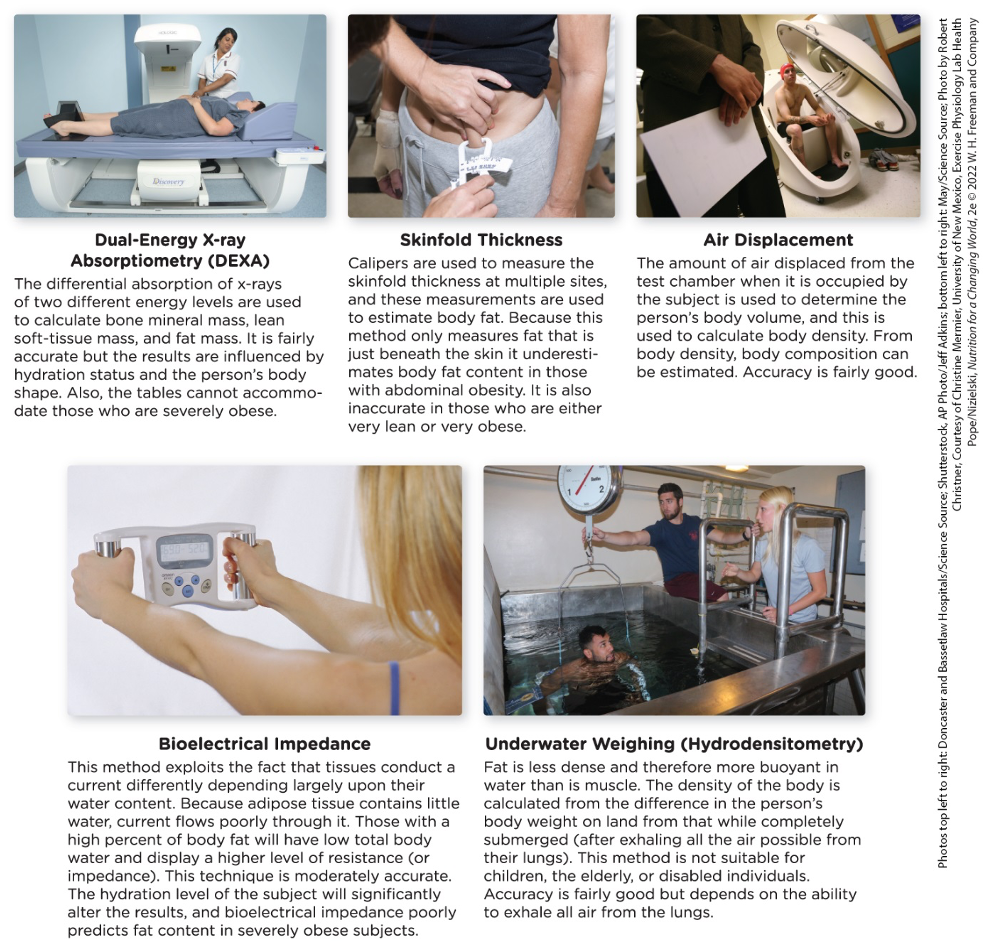
Which method of determining body composition calculates body fat percentage from an estimate of total body water content?
air displacement
skinfold thickness
underwater weighing
bioelectrical impedance
bioelectrical impedance
What is defined as the capacity to do work?
energy
What is is defined as the energy required to raise 1 gram (g) of water 1° Celsius (C)?
calorie
1 kcal is equal to ___ calories.
1,000 calories
What is defined as the energy required to raise 1 kilogram (kg) of water 1°C?
kilocalorie
What are two types of fat, or adipose tissue?
white adipose tissue (WAT) and brown adipose tissue (BAT)
What does white adipose tissue (WAT) do? Brown adipose tissue (BAT)??
WAT stores excess energy in the form of fatty acids in triglycerides and releases those fatty acids……BAT burns fatty acids and glucose to produce heat by a process called nonshivering thermogenesis (heat production).
When we hungry, our stomach begins to grumble. That grumbling is a hormone called ____.
ghrelin
Ghrelin is a 28 ______ hormone that is produced primarily in the stomach.
28–amino acid peptide
Satiation v.s. Satiety
-is the process that leads to the termination of a meal and refers to the sense of fullness that we feel while eating
-is the “do I wanna snack” it operates in between meals and affects when we feel hungry again
What two factors affect satiety?
gastric distention (how much our stomach has expanded to take in food) &
the release of hormones (determining fullness)
____ is a hormone that helps supress appetite
leptin
Hunger v.s Appetite
-biological impulse that drives us to seek out food and consume it to meet our energy needs.
-liking and wanting of food for reasons other than, or in addition to, hunger (sensory stimuli & pleasure of eatn it)