Unit 4 AOS 2: Key terms:
 Call Kai
 Learn
Learn Practice Test
 Spaced Repetition
 Match
Match Flashcards
 Knowt Play
1/35

There's no tags or description
Looks like no tags are added yet.
Name | Mastery | Learn | Test | Matching | Spaced | Call with Kai | Chat |
|---|
No analytics yet
Send a link to your students to track their progress
36 Terms
Wellbeing:
a state in which an individual is mentally, physically, and socially healthy and secure.
Mental wellbeing:
an individual’s psychological state, including their ability to think, process information, and regulate emotions.
Social and Emotional Wellbeing (SEWB) framework:
Includes all elements of being, and therefore wellbeing, for Aboriginal and Torres Strait Islander peoples.
·Explores 7 dimensions. All interconnected. Complex concept of wellbeing that extends beyond conventional understandings
·At the centre is the individual, who is surrounded by a network of relationships between individuals, family, kin and community. It also recognises the importance of connection to land, culture, spirituality and ancestry, and how these affect the individual.
·The framework also acknowledges that Aboriginal and Torres Strait Islander peoples are impacted by Social, Historical & Political Determinants of wellbeing.

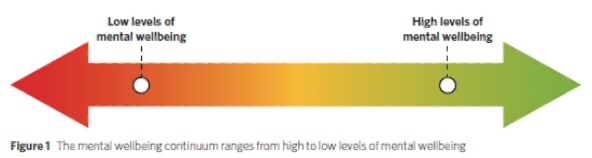
Mental wellbeing continuum:
a tool used to track fluctuating mental wellbeing. Mental wellbeing is dynamic (changes over time with life experiences). Placed on a mental wellbeing continuum, position that shifts over time.
Internal factors and External factors:
I- Factors that arise from within the individual
E- Factors that arise from an individual’s environment
Stress:
a psychological and physiological experience that occurs when an individual encounters something of significance that demands their attention and/or efforts to cope.
Not necessarily a sign of low levels of mental wellbeing, normal. Stress usually in response to known cause (different from anxiety). Eustress is positive stress.
Distress = does not feel as though they have adequate resources to cope with a stressor. It can lower an individual’s level of mental wellbeing.
Anxiety:
a psychological and physiological response that involves feelings of worry and apprehension about a perceived threat.
While stress can involve both positive (eustress) and negative (distress) feelings, anxiety typically only involves negative feelings (distress). Anxiety is broader than stress and may be due to an unknown stimulus. Usually future-oriented, meaning that it involves worrying about events that may happen in the future.
Specific phobia
a persistent, intense, irrational fear of a specific object or event, often leading to avoidance behaviour.
There are many different anxiety disorders, specific phobia being one of the most common. For a diagnosis of specific phobia, symptoms must be present for six months or longer and disrupt the person’s life, especially work and social relationships, or cause serious distress.
Phobias can generally be placed in four categories that relate to: natural environment (water, storms), animals (snakes, spiders, dog), potential bodily pain or injury (needles, dental and medical procedures, sight of blood), situations (heights, confined or open spaces, aeroplanes, tunnels).
Biopsychosocial approach:
a holistic (considers the whole person, including their mental, physical, spiritual, and social needs), interdisciplinary framework for understanding the human experience in terms of influence of biological, psychological, and social factors.
Suggests that biological, psychological, and social influences interact with each other, are equally effective, best used together. Therefore, to maintain mental wellbeing, a combination of biopsychosocial protective factors is likely to be most effective.
Protective factors:
influences that enable an individual to promote and maintain high levels of mental wellbeing. Utilised by individuals as tools in their day-to-day lives. Protective factors can work in two ways by:
• reducing risk of low levels of mental wellbeing / developing a mental health disorder
• increasing likelihood of high levels of mental wellbeing.
Do not guarantee high levels of mental wellbeing but may help to improve an individual’s mental wellbeing. Recognise that individual protective factors are not always a solution to managing low levels of mental wellbeing, further interventions and treatments may be required.

Biological protective factors: (Adequate nutritional intake and hydration, sleep):
(in relation to mental wellbeing) influences that stem from an individual’s brain and/or body that can maintain or promote mental wellbeing.
Adequate nutritional intake and hydration:
Sleep: a regular and naturally occurring altered state of consciousness that involves a loss of awareness and disengagement with internal and external stimuli.
Psychological protective factors: (Cognitive behavioural strategies, Mindfulness meditation):
(in relation to mental wellbeing) influences that relate to mental processes that can maintain and promote mental wellbeing.
Cognitive behavioural strategies
Mindfulness meditation
Social protective factors (Support):
(in relation to mental wellbeing) influences that exist in an individual’s social environment that can maintain and promote mental wellbeing.
Support: support from family, friend and community that is authentic and energising.
Determinants of wellbeing
factors that influence wellbeing on individual and community levels
Culture
a strong sense of identity, values, tradition, and connection between the past, present and future that drives behaviour and beliefs
Cultural continuity
the passing down and active practice of cultural knowledge, traditions, and values from generation to generation
Self-determination
the rights of all peoples to pursue freely their economic, social, and cultural development without outside interference.
Biological factors and Psychological factors and Social factors
b- internal, genetic, and/or physiologically based factors
p- internal factors relating to an individual’s mental processes, including their cognition, affect, thoughts, beliefs, and attitudes
s- external factors relating to an individual’s interactions with others and their external
environment, including their relationships and community involvement.
GABA (Gamma-amino butyric acid) and GABA dysfunction:
GABA: the main inhibitory neurotransmitter in the nervous system. When GABA activates its receptors, it makes post-synaptic neurons less likely to fire an action potential, produce a calming effect, reduces feelings of anxiety, stress and fear.
GABA dysfunction: insufficient neural transmission or reception of GABA in the body.
Long-term potentiation
the long-lasting and experience-dependent strengthening of synaptic connections that are regularly coactivated, during learning process
Precipitating factors (in relation to specific phobia)
factors that increase the susceptibility to and contribute to the occurrence of developing a specific phobia
Perpetuating factors (in relation to specific phobia)
factors that inhibit a person’s ability to recover from a specific phobia
Cognitive models
describe how people’s perceptions of situations influence their emotional and behavioural reactions. Key assumption = people with phobias hold 1 or more cognitive biases.
Cognitive bias
a predisposition to think about and process information in a certain way
tendency to think in a way that involves errors of judgment and faulty decision-making (mistaken thinking). Can cause a specific phobia including memory bias and catastrophic thinking. Aims to explain how people think (why they have unreasonable or excessive fear).
Type of cognitive bias: Memory bias and Catastrophic thinking
M: (remember something exaggerated): enhances/impairs recall of a memory or that alters its content. For specific phobia, completely distorts and exaggerates fears relating to phobias by focusing more on the fearful/negative experiences. Result in a tendency for memory recall of a phobic stimulus to focus on negative/threatening info than for positive/neutral information.
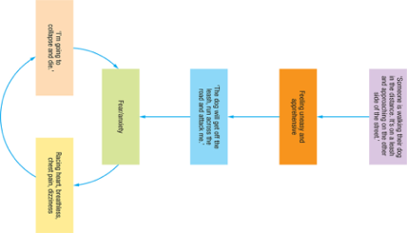
C: a type of cognitive bias in which a stimulus or event is predicted to be far worse than it actually is (thinking something irrational in future): a cognitive bias that involves overestimating and exaggerating the worst possible outcomes to situations, unlikely to occur, when thinking about an encounter with a phobic stimulus. Person generally feels heightened levels of anxiety and distress and underestimates their ability to cope with situation or their symptoms of anxiety. This in turn perpetuates the fear of situation. (think they would die if exposed to phobic stimulus).
Specific environmental triggers
stimuli or experiences in a person’s environment that evoke an extreme stress response, leading to the development of a phobia

Stigma
the feeling of shame or disgrace experienced by an individual for a characteristic that differentiates them from others. negative stereotypes associated with a trait, may also lead to discrimination. Someone with a phobia can be subject to ridicule, belittling comments / disbelief because some phobic stimuli (balloons/ buttons are typically harmless)
Benzodiazepines
a type of medication that depresses central nervous system activity and is often used as a short-acting anti- anxiety medication. class of sedatives. Depresses CNS activity and is often used as a short acting anti-anxiety medication.
Side effects: Generally safe to take but may reduce alertness, coordination and reaction time which increases risk of accidents. Lower inhibitions, particularly if mixed with alcohol or other drugs, so more impulsive. For short-term use, can be addictive if taken for a long time. If a person suddenly stops taking them, the person’s symptoms of anxiety, agitation and insomnia may return, and the person may also show sensory disturbances and even have seizures. Long term side effects – reduce alertness, lower inhibitions.
Agonists
a type of drug that imitates neurotransmitters and works to initiate a neural response (excitatory or inhibitory) when it binds to the receptor sites of a neuron
Breathing retraining
a method used to teach breathing control techniques that may reduce physiological arousal. Anxiety management technique that involves teaching someone how to control their breathing in presence of their phobic stimulus. can be taught with a therapist and then used in a public, not drawing attention.
Biological interventions
target physiological mechanisms believed to contribute to a phobia, and may focus on eliminating or alleviating symptoms of disorders rather than dealing with the underlying causes.
Psychotherapeutic treatments
collaborative treatment processes where a trained mental health professional uses psychological methods to help individuals address emotional, behavioral, and mental health issues
using psychotherapy aim to ‘unlearn’ the phobia response. methods are as effective as (or more effective than) biological interventions. Consequently, psychotherapy and biological interventions are often used together.
Systematic desensitisation
a therapeutic technique used to overcome phobias that involves a patient being exposed incrementally to increasingly anxiety- inducing stimuli, combined with the use of relaxation techniques Technique applies classically conditioning principles (unlearning the connection between anxiety and a specific object or situation and associating feelings of relaxation). Involves gradual exposure.
Psychoeducation
teaching families and supporters of individuals with mental health disorders how to better understand, deal with, and treat their disorder
Psychological interventions
using psychotherapy aim to ‘unlearn’ the phobia response. methods are as effective as (or more effective than) biological interventions. Consequently, psychotherapy and biological interventions are often used together.
Two psychological evidence-based interventions are: cognitive behavioural therapy (CBT), systematic desensitisation.
Social interventions
Used to complement one or more biological and psychological interventions because sufferers often experience their phobia every day, but only see their therapist every one or two weeks. So they need the support of family and friends to help manage their phobia.