PSYC 3400 Exam 1 Study Guide Clemson Grandits
 Call Kai
 Learn
Learn Practice Test
 Spaced Repetition
 Match
Match Flashcards
 Knowt Play
1/131

There's no tags or description
Looks like no tags are added yet.
Name | Mastery | Learn | Test | Matching | Spaced | Call with Kai | Chat |
|---|
No analytics yet
Send a link to your students to track their progress
132 Terms
What is development?
the act or process of change overtime
what is lifespan developmental psychology?
Study of the change over time of the body and mind
What is another term for a researcher who studies the human lifespan?
developmentalist
What skills are needed to be a developmentalist
Planning skills
logical thinking
critical thinking
statistical skills
writing skills
What is chronological age?
Actual age
What is mental age?
Age based on the function of your brain
What is biological age?
Age based on body's function and health
How can change over time be considered a continuous process?
If the subject is growing and developing overtime in the same state, baby to adult; growth of size visibly
ex: tree growth
How can change over time be considered a discontinuous process?
If the subject changes and develops in different satges; infant-toddler-child-preteeen...
ex: caterpillar to butterfly
What is preformationism?
The view that in some sense an organism is prefromed from origination.
Development is mere growth and solidifying what the organism already formed.
What are the two approaches to preformationism?
Spermists: one who believed that the complete human was contained in the sperm
Ovists: one who believed that the complete human was contained in the ovum
What is epigenesis?
Aristotle rejected preformationism and favored epigenesis:
A process where larger entities, patterns, and regularities arise through interactions among smaller or simpler entities and that organisms themselves do not exhibit such properties.
Why do we study lifespan development?
Raising children
Understanding human nature
Choosing social policies
What does it mean to say lifespan development os multidisciplinary?
The fact that it pulls theories/ideas from a multitude of different subdivisions of psychology such as cognitive, biological, sociocultural, and clinical psychology.
What does it mean to say that lifespan development explores milestones?
Lifespan development explores the predictable milestones on our human journey
walking, puberty, menopause, etc
What does it mean to say that lifespan development examines normative life transitions?
looks at the expected action as life continues
such as graduating from school, getting married, having children, or retiring.
What does it mean to say that lifespan development examines non-normative life transitions?
looking at life events are those that occur unexpectedly,
such as natural disasters, loss of a family member and war.
What does it mean to say that lifespan development is multidirectional?
Refers to the fact that not all change is positive. In each stage of one's life, one can experience growth (improvement) or regression (decline).
What does it mean to say that lifespan development includes stability and plasticity?
looking at the ability to adapt (plasticity) and traits stay the same (stability)
What does it mean to say that lifespan development focuses on individual differences?
field of study recognizes and examines how people develop at varying rates and in unique ways throughout their lives
What does it mean to say that lifespan development is multidimensional?
it involves the dynamic interaction of factors like physical, emotional, and psychosocial development
nature/nurture debate?
nature: traits your born with and inherit genetically from parents
nurture: traits and development affected by environmental factors, things after conception
Debate: asks how much not which one (answer = combo w context too)
context: family beliefs communities etc
How does Plato's allegory of the cave relate to the nature/nurture debate?
Suggest our perceptions of reality (shadows on a cave wall) are determined by nurture (our environment) while our ability to discover whats outside the cave is within us (nurture)
Provide examples of ways in which context influences development.
peer relationships and interactions, young children learn and reinforce notions of reciprocal interactions. For example, young children learn how to share, take turns, and give and receive from interactions with other young children.
What are some of the contexts of development?
Cohort
Socioeconomics
Culture and Ethnicity
Gender
What is Cohort
The age group with whom we travel life together
Why boomers and Gen Z have different approaches to things
What are history-graded influences?
significant events or societal trends that occur within a specific historical period, impacting the development and experiences of a generation of people born around that time
ex: covid
What is SES and how can it shape development?
Socioeconomic status
access to education and money can affect development
How can culture/ethnicity shape development?
Attitude ideas and traditions shared by a large group of people and transmitted from one gen to the next
America = freedom and entrepreneurship while other, Asia= grades and self worth defined
Be able to provide examples of differences in child rearing across cultures.
differences in emphasis on independence vs interdependence, sleep arrangements, discipline methods, feeding practices, and the age at which children are given responsibilities
How can gender shape development?
Identifying as either male or female
Females more depressed at puberty than males etc
What are two ways that lifespan developmental psychology is divided for studying?
developmental domains and life stages
What are the three domains of Lifespan Development that were discussed in class?
Physical - body size
Cognitive - intellectual abilities
Emotional & Social - emotional communication, self understanding
What are the steps of the scientific method (in order)?
Ask q, background info, hyp, test exp, is it working, analyze data, results, share
What is a variable?
attitudes or characteristics that vary from person to person
independent and dependent variables?
independent: the thing that causes the effect
dependent: thing that is being affected
What are differences between correlational and experimental research designs?
Correlation: explores relationship between to variables
Experimental: only type of experiment you can draw cause and affect from
What is random assignment?
assigning participants to experimental and control groups by chance
What is a control group?
The group that does not receive the experimental treatment in an experiment.
What are differences between longitudinal and cross-sectional research designs?
longitudinal: observes one group of individuals at serval time periods, large time comit and expensive, able to exam continuity
Cross Sectional: observes a group of different ages at 1 time. Time effective, less expensive but cant observe continuity
What are similarities between longitudinal and cross-sectional research designs?
both attempt to observe development over time
What is a major limitation of both longitudinal and cross-sectional research designs?
loss of participants over time throughout the study
What is a sequential research design?
Combination of longitudinal and cross sectional design
aims to identify cohort differences
Define and identify naturalistic observation.
Observing what happens naturally in a normal setting
ex: going to a playground and observing kids play
Define and identify structured observation.
Observing what occurs in an environment you've created
Define and identify unstructured interviews
interview with follow up questions based on participants response to previous question
Define and identify structured interviews.
interview in which interviewer has a predetermined set of questions
Define and identify case studies.
in depth examination of participants
Define and identify ethnographies.
studying people in their natural environment to understand their cultural and social systems
What are the limitations of self-report?
Have validity issues, subjects an exaggerate response or under report severity/ frequency in attempt to cater toward what is being asked
What are the limitations of expert observation?
validity issues as patient may not be exhibiting typical behavior during observation period
if patient knows they are being observed they might have social desirability take over
What are aspects of a good theory?
Should describe/ explain/ predict behavior
Be logically sound
Be empirically sound
Be testable
Be parsimonious - simple
Integrate previous research
Guide for further research
What does it mean to stay that a good theory is logically sound?
if it is both valid, and all of its premises are actually true.
What does it mean to say that a good theory is empirically sound?
capable of being verified or disproved by observation or experiment.
What does it mean to say that a good theory is testable?
able to be tested
What does it mean to say that a good theory is parsimonious?
it is the simplest explanation possible, using the fewest assumptions
Be able to identify three general behaviorists.
Ivan Pavlov
BF Skinner
John Watson
Which theorist discussed in class was an evolutionary theorist?
Konrad Lorenz
Which social learning theorists were discussed in class?
Albert Bandura
Andrew Meltzoff
Lev Vygotsky
What is classical conditioning?
The learning processes by which a meaningful stimulus is connected with a neutral stimulus that had no special meaning before conditioning
if you didn't know a lion was bad if it was out of cage you wouldn't be scared but due to reppetitive natural stimuli you learn to be scared.
What is an unconditioned stimulus?
a stimulus that automatically triggers a response without any prior learning or conditioning
what is an unconditioned response?
a natural, automatic reaction to a stimulus that occurs without prior learning or conditioning
What is a conditioned stimulus?
a neutral stimulus that, after being paired with a biologically relevant stimulus, can trigger a response
What is a conditioned response?
a learned reaction to a stimulus that was previously neutral
What is operant conditioning?
The learning process by which a particular action is followed by something desired or by something unwanted in order to promote or prevent an action
What is reinforcement (in operant conditioning)?
increasing behavior by following it with
something desired
What is punishment (in operant conditioning)?
decrease behavior by adding something unwanted
positive reinforcement
Add pos stim when behavior is correct
treat when dog sits
negative reinforcement
removing stimuli following correct behavior
when you wake up you turn alarm clock off
positive punishment
add noxious stimuli following behavior
spanking child for cursing
negative punishment.
removing pos stim following behavior
phone taken away after fighting with sibling
What is evolutionary theory?
Stresses that behavior is strongly influenced by biology, is tied to
evolution, and is characterized by critical or sensitive periods.
What researcher in class was associated with evolutionary theory?
Konrad Lorenz
How does evolutionary theory explain behavior?
Suggest that most of human behavior is the result of evolutionary adaptions over time
How can imprinting tell us about critical or sensitive periods?
imprinting is the exposure to an object during a specific period that is ireiversable.
Duck will follow first moving thing when it sees when hatches
What is behavioral genetics and how is it different from evolutionary developmental
psychology?
Research strategies devoted
to examining the genetic
contribution to the
differences we see between
What are three types of heritability studies that were discussed in class?
Adoptive studies: looks at behavior in relation to genetic and adoptive parents
Twin studies: study mono and zygotic twin differences to understand genetic and behavioral differences
Adoptive twin studies: twins adoptive by different sets of parents and all 3 compared to children's development
Which type of heritability study is considered the gold standard?
Twin studies
What are limitations of heritability studies?
They apply only to pops not individuals
They apply only to a particular group living in a particular time
They underestimate the role of the environment
Higher heritability does not imply immutability
What is social learning theory?
Observing behavior when an individual observes and
replicates another's behavior.
What is imitation and how is it related to social learning theory?
imitation is the action of replication demonstrated behavior, learning by doing
What are mirror neurons and how are they related to imitation?
A neuron that fires both when an animal acts and when the animal
observes the same action performed by another
when you see someone smile you smile associating that feeling with the cation of smiling
What were Freud's three components of personality?
id: instinctual part of the mind (want now)
ego: realistic part (lets figure this out together)
super ego: moral conscious (good people don't think those things)
What is psychic energy?
The driving force behind all mental activity, originating from the "id" part of the mind
Freud's psychosexual stages.
0-1 Oral: focus is mouth, breastfeeding
1-3 Anal: focus is anus, toilet training
3-6 Phallic: focus is genitals, stimulation
6-11: Latency: focus in convention activities ex academics
Adolescence + Genital: focus on genitals again, seeking sexual stim
What is the Oedipus Complex and which of Freud's stages is it related to?
The unconscious attachment of the child to the parent of the opposite sex, accompanied by envious and aggressive feelings toward the parent of the same sex
How is the Oedipus Complex related to infant amnesia?
The aggression felt towards the same sex parent is so scaring that we block out/ forget that time of life.
Erikson's psychosocial stages.
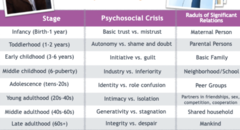
Piaget's Cognitive stages.
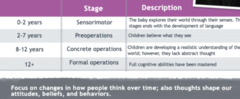
What is the Zone of Proximal Development?
the space between what a learner can do without assistance and what a learner can do with guidance
What is scaffolding?
how a more knowledgeable person helps a child learn within their zone of proximal development
knowledgeable person = temporary support aka scaffolding
How are thought and language related over time for Vygotsky?
though that they were initially separate systems but then they merge around 3
Be able to identify, characterize, and order each of Kohlberg's major Stages of Moral Judgment

Be able to characterize Bronfenbrenner's bioecological model.
a person has many layers of context
Microsystem - direct relationships
exosystem -indirect relationships (school system, parental job loss)
macrosystem - social and cultural ideology (laws, religion)
Chronosystem - changes over time
Mesosystem- interactions between the microsystem or different systems
characterize and identify dynamic-systems theory.
a view of human development as an ongoing ever changing interaction bw the physical and emotional being and bw the person and every aspect of their environment
how do ppl interact with other people and do so continuously over time
What is probabilistic epigenesis?
development is viewed as a constant, complex, fluid, emergent or nonlinear, and multi determined.
considers environment, behavior, neural and genetic activity
What does it mean to say that development is emergent and multidetermined?
affected by many factors and not linear
What is self-organization in dynamic-systems theory?
bringing together and integrating components as needed to adapt to a continuously changing environment
What is an attractor state in dynamic-systems theory?
unique sets of components we feel comfortable with and lean towards
What is soft assembly in dynamic-systems theory?
using what we have in the moment to adapt