Glycerol Phosphate Shuttle & Aspartate - Malate Shuttle
 Call Kai
 Learn
Learn Practice Test
 Spaced Repetition
 Match
Match Flashcards
 Knowt Play
1/6

There's no tags or description
Looks like no tags are added yet.
Name | Mastery | Learn | Test | Matching | Spaced | Call with Kai | Chat |
|---|
No analytics yet
Send a link to your students to track their progress
7 Terms
Glycerol Phosphate Shuttle & Aspartate - Malate Shuttle
The names Glycerol Phosphate Shuttle and Aspartate–Malate Shuttle describe how electrons from cytosolic NADH are transported into the mitochondria. Understanding the meaning of each word makes the mechanism easier.
1. Glycerol Phosphate Shuttle Word-by-word meaning
Glycerol
from Greek glykys (γλυκύς) = sweet
glycerol is a 3-carbon alcohol backbone found in fats and phospholipids.
Phosphate
from Greek phōs (φῶς) = light
phoros = bearer
Originally referring to phosphorus compounds that glow.
In biochemistry it means a PO₄³⁻ group attached to a molecule.
Shuttle
English word meaning something that moves back and forth carrying something (like a weaving shuttle).
Meaning of the whole term
Glycerol-phosphate shuttle
= a transport system that uses glycerol-3-phosphate to carry electrons into the mitochondria.
Simple idea:
Cytosolic NADH
      ↓
glycerol-3-phosphate carries electrons
      ↓
mitochondria
      ↓
electron transport chain
It is common in:
brain
skeletal muscle
2. Malate–Aspartate Shuttle Word-by-word meaning
Malate
from Latin malum = apple
Malic acid was first isolated from apples.
Aspartate
derived from asparagine, which was first isolated from asparagus.
Shuttle
again means a carrier moving molecules back and forth.
Meaning of the whole term
Malate–Aspartate shuttle
= a transport system that uses malate and aspartate to transfer electrons from NADH into mitochondria.
Simple idea:
Cytosolic NADH
      ↓
oxaloacetate → malate
      ↓
malate enters mitochondria
      ↓
electrons transferred to mitochondrial NADH
This shuttle is common in:
liver
heart
kidney
3. Why these shuttles exist
The inner mitochondrial membrane cannot transport NADH directly
So cells move the electrons, not the NADH molecule.
Cytosolic NADH
      ↓
Shuttle system
      ↓
Mitochondrial NADH
      ↓
Electron transport chain
      ↓
ATP production
4. Key difference
Shuttle | Molecules used | ATP yield |
|---|---|---|
Glycerol-phosphate shuttle | glycerol-3-phosphate | less ATP |
Malate-aspartate shuttle | malate & aspartate | more ATP |
✅ Simple summary
Glycerol-phosphate shuttle: uses glycerol-3-phosphate to carry electrons into mitochondria.
Malate-aspartate shuttle: uses malate and aspartate to carry electrons into mitochondria.
Both are electron transport systems that allow glycolysis NADH to contribute to ATP production
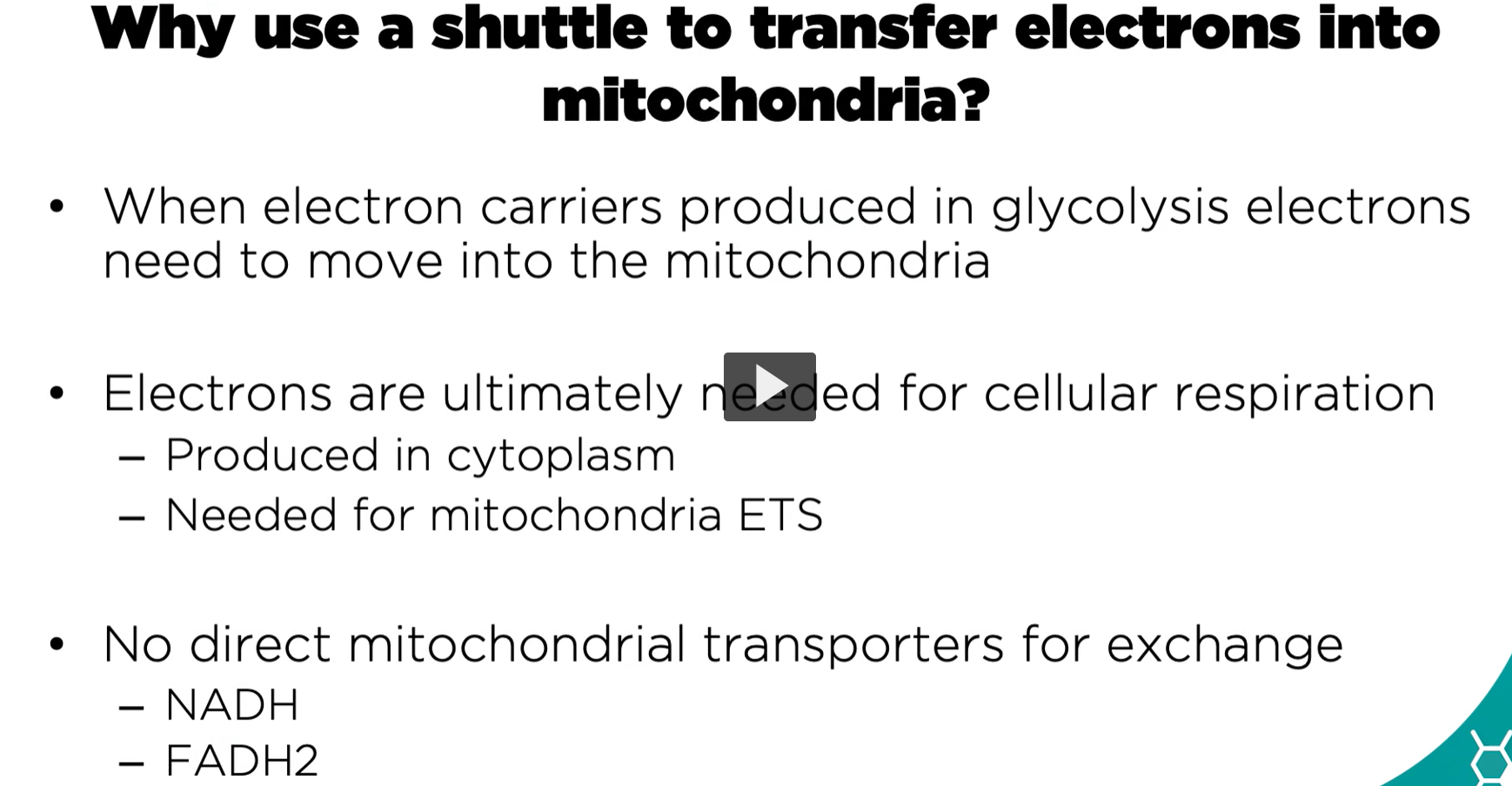
why use the shuttle to transfer electrons? Here, we will explain how the nictotinamides in the reduced form or NADH that is formed during glycolysis needs to circumvent the transfer of electrons from the cytoplasm into the mitochondria.
when electron carriers are produced in the glycolysis, the reduced form of those electron carriers need to move the electrons now into the mitochondria.
An important concept is that NADH that is produced in the cytoplasm CANNOT be transported directly into the mitochondria.
This is different and in contrast with the NADH produced in the krebs cycle, which happens in the mitochondrial matrix.
-NADH from glycolysis cannot be transported directly into the mitochondria, but NADPH produced in the kreb’s cycle is already in the mitochondrial matrix.
Electrons are ultimately needed for cellular respiration, but produced in the cytoplasm, yet needed for mitochondrial electron transport chain system.
Therefore, those electrons cannot reach directly and use for the electron transport chain system.
There is no direct mitochondrial transporters for the exchange, especially for the NADH or the FADH two production
ATP from Cytosolic NADH
production of NADH in the kreb cycle happens in the mitochondria, becoming available for cellular respiration.
When it’s produced in the mitochondria, both NADH and FADH2 are readily available for the oxidative phosphorylation.
However, if the NADH is producing the cytoplasm, there needs to be a system that moves those electrons into the mitochondria.
Therefore, the way to circumvent this is by using one of the two shunts. This is where we’re going to contrast the fate of the mechanisms by which electrons from NADH have been produced via glycolysis are moved into the mitochondria for ATP production.
bottom line
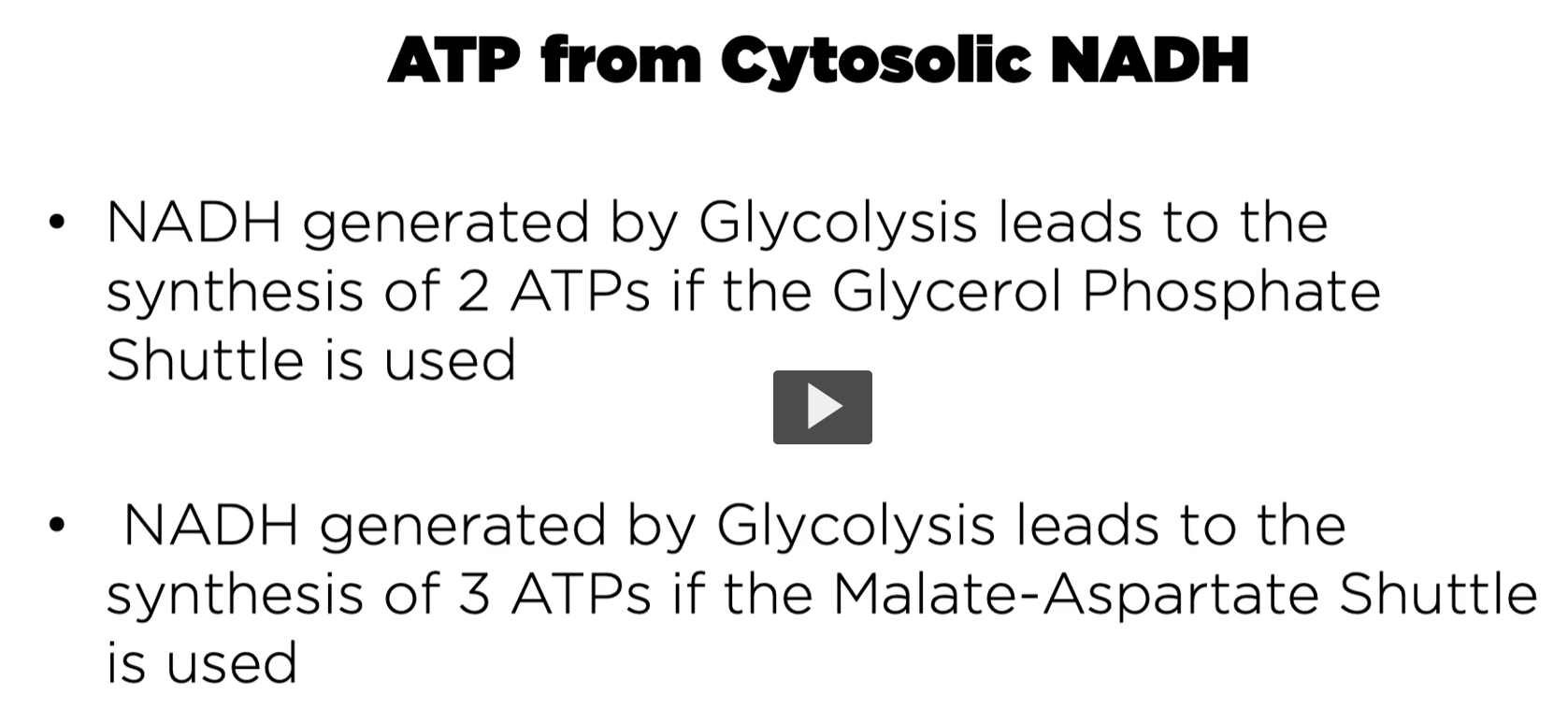
NADH generated by the glycolysis leads to synthesis of 2 ATPs if the glycerol phosphate shuttle is used
NADH generated by Glycolysis leads to the synthesis of 3 ATPs if the Malate Aspartate Shuttle is used.
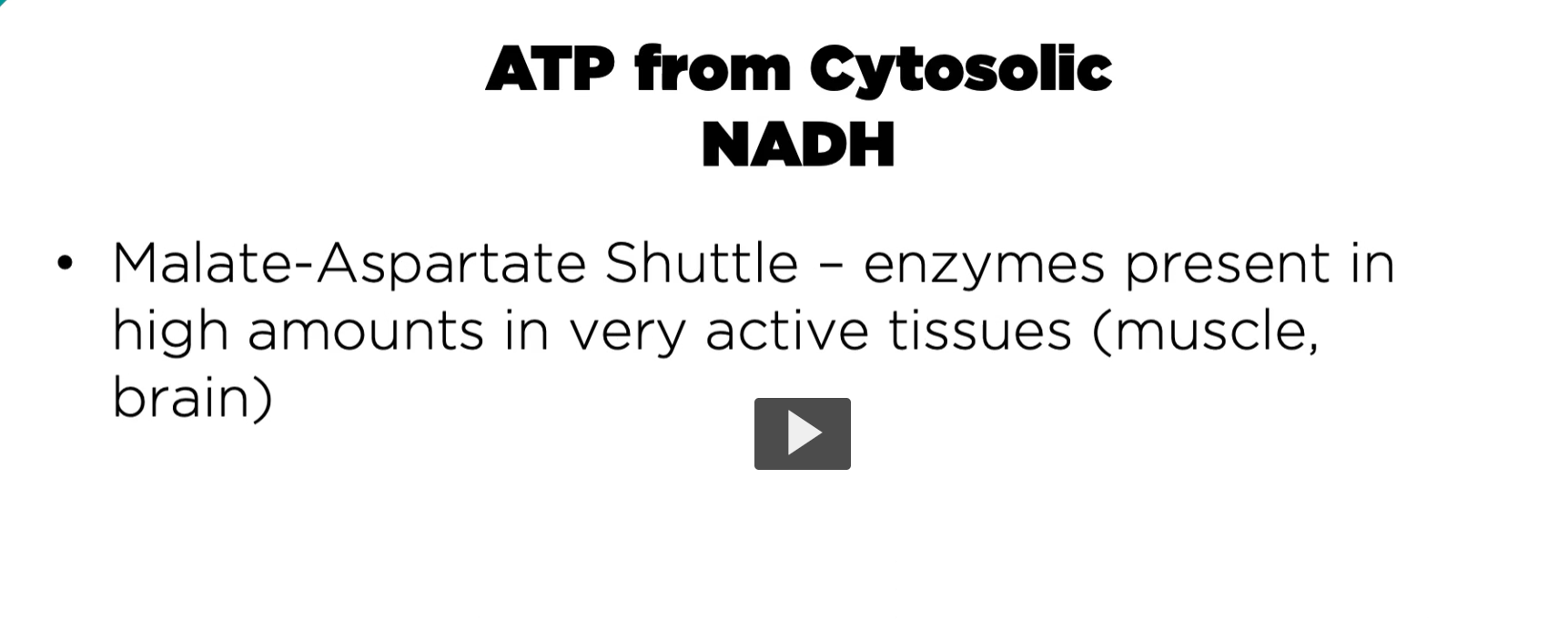
cells from different tissue types use one shunt, or the other, but not both. For example, malate aspartate shuttle is used in highly active tissues, including the muscle and the brain.
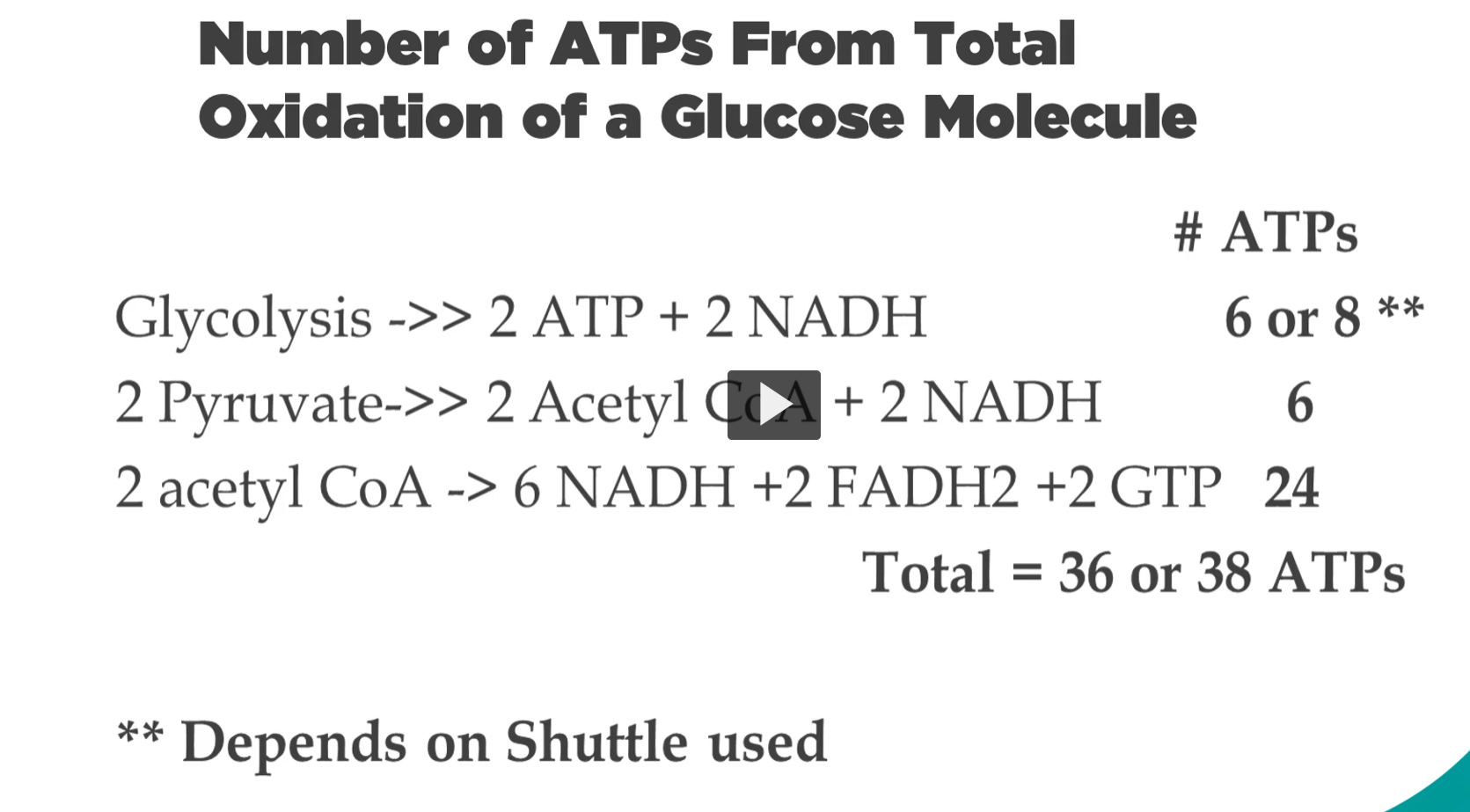
number of ATPs from total oxidation of a glucose molecule
the total yield for ATP production will depend on which shunt is used.
1. Starting from glycolysis, you can generate two ATPs directly. This is a fixed amount, but the two NADH that are produced will vary in the yield.
This yield will range 2-3 ATPs per NADH for a total of 4 to 6 ATPs. this is why you notice the two asterisk.
Following this breakdown, you have two pyruvates form two acetyl-CoAs and two NADH form six ATPs.
Now in the Kreb cycle, 2 acetyl-CoA → 6 NADH + 2 FADH2 + 2 GTP= 24 ATP
summed together, all of this will give a yield of 36 to 38 ATPs per glucose molecule.
depends on shuttle used
This slide is explaining why the total ATP yield from one glucose molecule can be either 36 or 38 ATP. The difference comes from which shuttle system transfers electrons from glycolysis into the mitochondria.
Let’s build the puzzle step-by-step.
1. Glycolysis (cytosol)
From 1 glucose → 2 pyruvate
Products:
2 ATP (directly made)
2 NADH
The ATP is fixed:
✔ always 2 ATP
But the NADH is produced in the cytosol, and NADH cannot cross the inner mitochondrial membrane.
So the electrons must be transported using a shuttle system.
2. Why the shuttle matters
The electrons from cytosolic NADH can enter the mitochondria using:
Malate–Aspartate Shuttle
Electrons enter the ETC as NADH
Yield:
1 NADH → ~3 ATP (older calculation)
So:
2 NADH × 3 ATP = 6 ATP
Glycerol-3-phosphate Shuttle
Electrons enter the ETC as FADH₂
Yield:
1 NADH equivalent → ~2 ATP
So:
2 NADH × 2 ATP = 4 ATP
Therefore glycolysis yields
Component | ATP |
|---|---|
Direct ATP | 2 |
NADH via malate shuttle | 6 |
NADH via glycerol shuttle | 4 |
Total glycolysis ATP:
6–8 ATP
That is why the slide shows:
6 or 8 ATP
3. Pyruvate → Acetyl-CoA (Pyruvate Dehydrogenase)
Each pyruvate produces:
1 NADH
Since glucose produces 2 pyruvate:
2 NADH → 6 ATP
4. Krebs Cycle (TCA cycle)
From 2 acetyl-CoA
Products:
6 NADH
2 FADH₂
2 GTP (ATP equivalent)
ATP equivalents:
Molecule | ATP produced |
|---|---|
6 NADH | 18 ATP |
2 FADH₂ | 4 ATP |
2 GTP | 2 ATP |
Total:
24 ATP
5. Total ATP yield If Malate–Aspartate shuttle is used
Glycolysis → 8 ATP
Pyruvate → 6 ATP
TCA cycle → 24 ATP
Total:
38 ATP
If Glycerol-3-phosphate shuttle is used
Glycolysis → 6 ATP
Pyruvate → 6 ATP
TCA cycle → 24 ATP
Total:
36 ATP
Final idea
The difference (36 vs 38 ATP) happens because:
Cytosolic NADH from glycolysis
↓
Must enter mitochondria
↓
Uses a shuttle
↓
Different shuttle = different ATP yield
Shuttle | ATP produced from glycolysis NADH |
|---|---|
Malate–Aspartate | more ATP |
Glycerol-phosphate | less ATP |
✅ Simple summary
The total ATP from glucose is 36–38 ATP because the two NADH produced in glycolysis must enter the mitochondria through a shuttle, and the type of shuttle determines how much ATP those electrons produce.
If you want, I can also show you the modern calculation (30–32 ATP) that most medical schools use today, which fixes a lot of the confusing numbers in this slide.
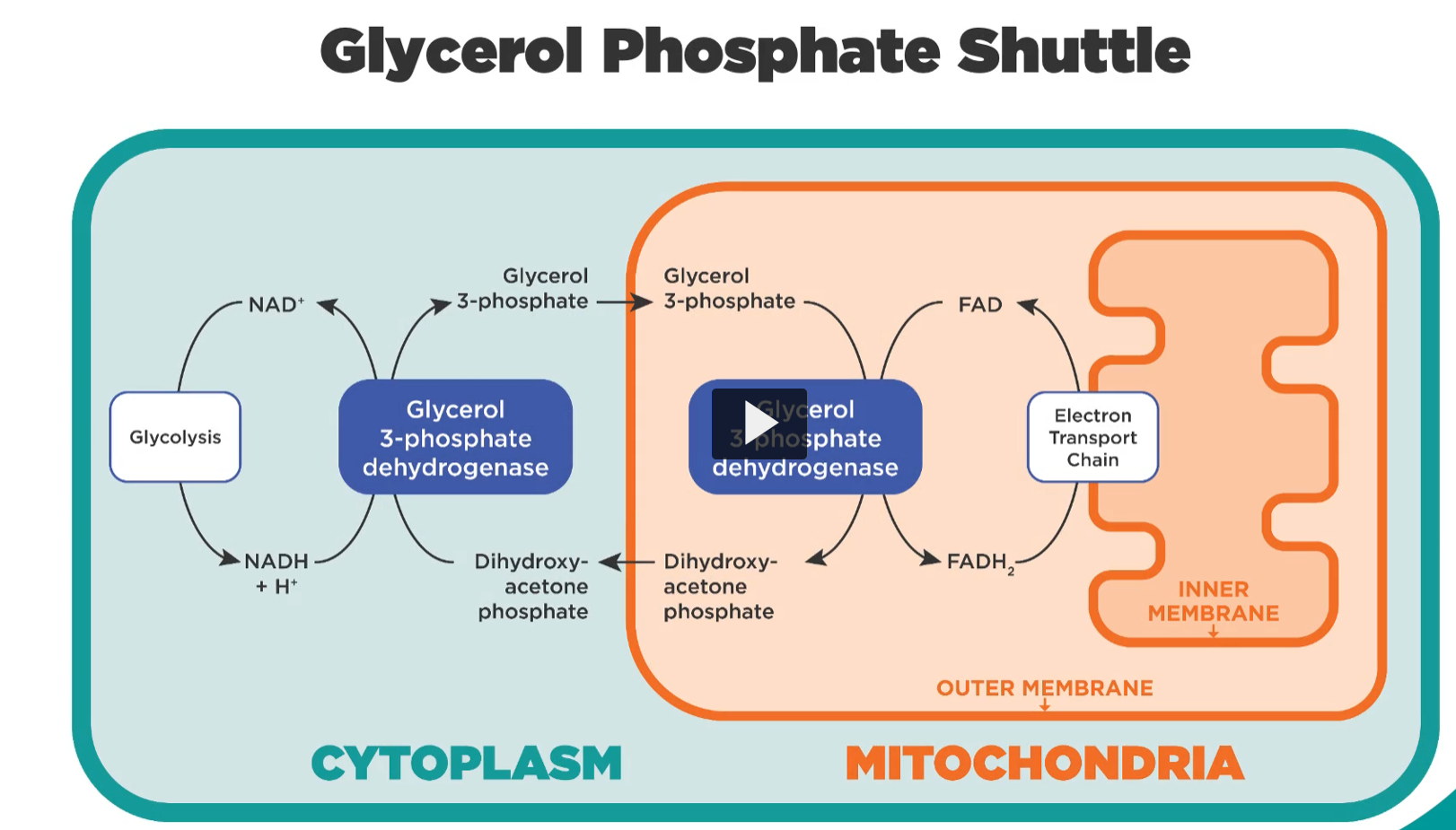
as an overview of the glycerol phosphate shuttle, when we start to look at the cytoplasm and compare that to the mitochondria. we start from the left and look at glycolysis producing that NADH at the bottom.
That NADH will serve as the coenzyme for an enzyme known as the glycerol triphosphate dehydrogenase .
in short, the glycerol-3-phosphate dehydrogenase reduces dihydroxyacetone phosphate (a glycotic intermediate), and converts it to glycerol three phosphate.
now that glycerol 3 phosphate has the ability to translocate to the mitochondria, when it’s converted back to the hydrocetone phosphate. This hydrocetone phosphate returns then to the cytoplasm.
Notice that in the mitochondria, the glycerol-3-phosphate dehydrogenase, opposes the direction of the reaction seen in the cytoplasm. what’s important here is that for the mitochondrial glycerol-3-phosphate dehydrogenase, the coenzyme is not another NADH molecule but rather a flaming adenine dinucleotype or FAD. This is the oxidized form, this is the substrate that is uses and forms FADH2, which is the reduced form. The fadh2 subsequently enters the electron transport chain system, transferring the electrons, and reconverting to FAD.
This shuttle is confusing at first, but the idea behind it is actually simple. Think of it as a delivery system for electrons from the cytoplasm into the mitochondria.
I’ll walk through it step-by-step in plain language.
Big Idea (One Sentence)
The glycerol phosphate shuttle moves the electrons from NADH (made in glycolysis) into the mitochondria so they can be used to make ATP.
Why is this needed?
➡ NADH cannot cross the mitochondrial membrane.
So the cell transfers the electrons instead of the molecule itself.
Step-by-Step Explanation 1. Glycolysis makes NADH in the cytoplasm
During glycolysis:
Glucose → Pyruvate
This produces:
2 NADH
These NADH molecules contain high-energy electrons that must go to the electron transport chain (ETC) to make ATP.
⚠ Problem:
NADH cannot enter the mitochondria.
So the cell needs a shuttle system.
2. Cytoplasmic enzyme transfers electrons to DHAP
The enzyme:
Cytosolic glycerol-3-phosphate dehydrogenase
uses the NADH electrons.
Reaction:
DHAP + NADH → Glycerol-3-phosphate + NAD⁺
What happens here?
NADH gives its electrons
DHAP accepts them
Result:
DHAP becomes glycerol-3-phosphate
This regenerates NAD⁺, which glycolysis needs to continue.
3. Glycerol-3-phosphate moves to the mitochondria
Now:
Glycerol-3-phosphate travels to the outer surface of the inner mitochondrial membrane.
There is another enzyme there.
4. Mitochondrial enzyme removes the electrons
Enzyme:
Mitochondrial glycerol-3-phosphate dehydrogenase
This enzyme uses FAD instead of NAD⁺.
Reaction:
Glycerol-3-phosphate + FAD → DHAP + FADH₂
So:
glycerol-3-phosphate loses electrons
FAD gains electrons
Result:
FADH₂
5. FADH₂ enters the electron transport chain
FADH₂ gives its electrons to the ETC.
But it enters at Complex II level.
Because of that:
less ATP is produced
Each NADH from glycolysis → ~1.5 ATP instead of 2.5 ATP
6. DHAP returns to the cytoplasm
The molecule becomes DHAP again.
DHAP goes back to the cytoplasm and the cycle repeats.
Visual Flow (Simplified)
Cytoplasm:
NADH
↓
gives electrons to DHAP
↓
DHAP → Glycerol-3-phosphate
⬇ moves to mitochondria ⬇
Mitochondria:
Glycerol-3-phosphate
↓
gives electrons to FAD
↓
FAD → FADH₂
↓
Electron Transport Chain → ATP
DHAP returns to cytoplasm.
Why This Shuttle Exists
Two main reasons:
1⃣ NADH cannot cross the mitochondrial membrane
2⃣ Glycolysis must regenerate NAD⁺
This shuttle solves both problems.
Why It Produces Less ATP
Because the electrons end up on:
FADH₂ instead of NADH
Electron entry point:
Molecule | ETC Entry | ATP |
|---|---|---|
NADH | Complex I | ~2.5 ATP |
FADH₂ | Complex II | ~1.5 ATP |
So this shuttle costs about 1 ATP per NADH.
Where This Shuttle Is Used
Common in:
Brain
Skeletal muscle
Other tissues (heart, liver) prefer the malate-aspartate shuttle.
Simple Analogy
Think of this like a bucket brigade passing water.
You cannot move the bucket (NADH) across the wall,
so you pour the water (electrons) into another bucket.
That bucket carries the electrons across.
✅ One-line summary
The glycerol phosphate shuttle moves electrons from cytoplasmic NADH to mitochondrial FAD so the electrons can enter the electron transport chain and produce ATP.
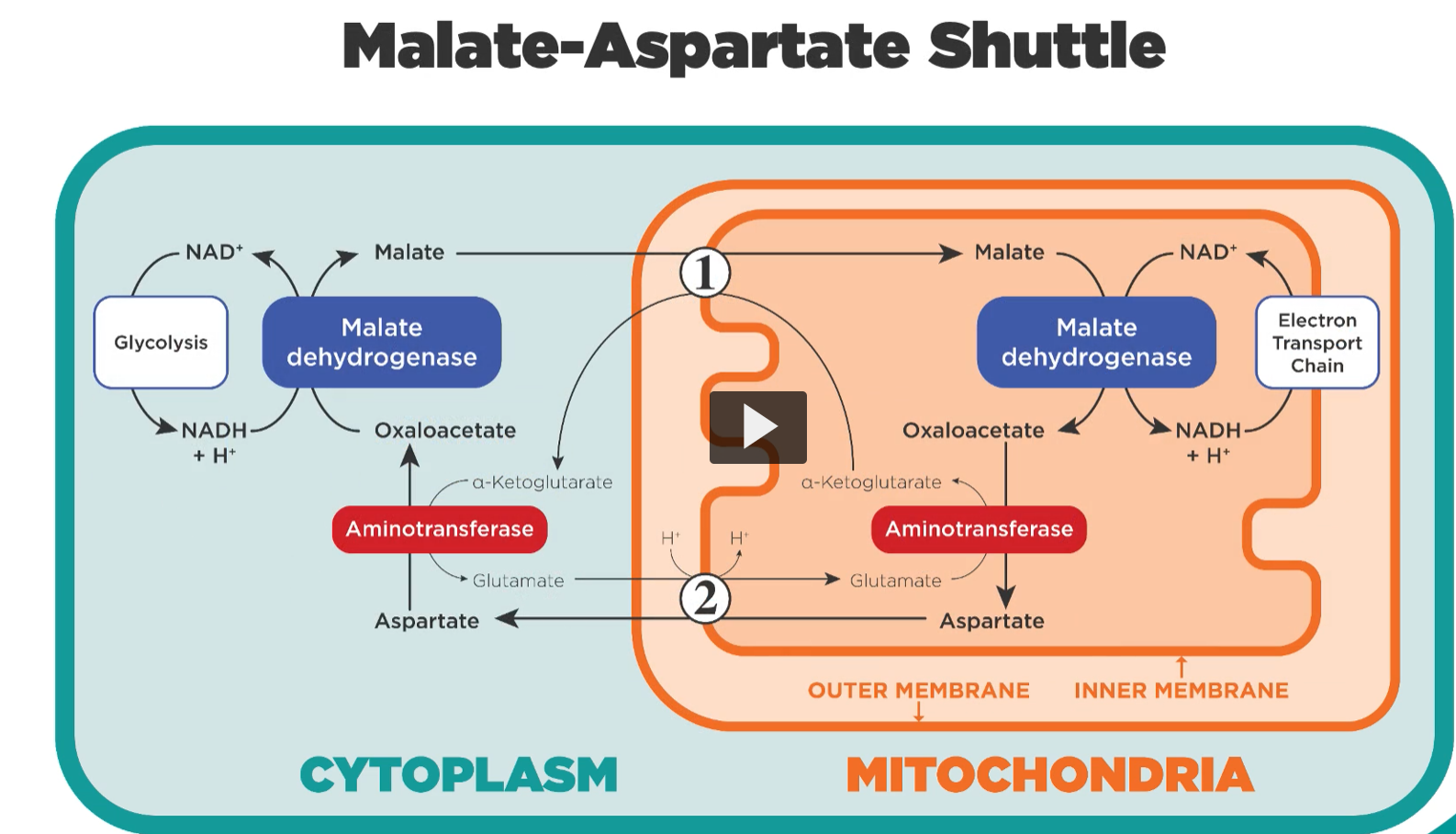
to overview the malate aspartate shuttle, we will do the same approach, when we are going to start focusing on glycolysis.
at the left, glycolysis produces the NADH that will then be used as a Coenzyme for a cytoplasmic enzyme known as malate dehydrogenase. Malate dehydrogenase produces malate. Malate has the ability to get into the mitochondria where it is converted to oxaloacetate by the mitochondrial version of the same enzyme.
Note that the coenzyme converts malate to oxaloacetate is the oxidized form of the nicotineamide adenine dinucleotide, that is found in the mitochondria.
This becomes a reduced NADH as a byproduct.
The NADH now has the ability to enter the electron transport chain. The fate of the oxaloacetate that is produced in the mitochondria will either serve the Krebs cycle or will serve to become aspartate.
Aspartate is formed by an amino transferase from oxaloacetate, which is then moved out of the mitochondria. Now the cytoplasmic aspartate is deaminated, meaning the amino group is removed to form a keto acid. In this case the ketoacid is oxaloacetate, now oxaloacetate in the cytoplasm will be the precursor for the malate that formed in the cytoplasm.
The cycle goes on and on with the production of certain amino acids along the way, you can see that in the cytoplasm, you have alpha ketoglutarate forming glutamate. This glutamate helps in the exchange of aspartate from the mitochondria out of the cytoplasm. then glutamate then donates the amino group to the oxaloacetate to form alpha ketoglutarate.
then mitochondria alpha ketoglutarate then helps the antiport malate into the mitochondria.
The malate–aspartate shuttle looks complicated in diagrams, but the main goal is actually the same as the glycerol phosphate shuttle:
👉 Move the electrons from cytoplasmic NADH (from glycolysis) into the mitochondria so ATP can be made.
The difference is how the electrons are transported.
The Big Idea (one sentence)
The malate–aspartate shuttle transfers electrons from cytoplasmic NADH into the mitochondria by temporarily storing them in malate.
Unlike the glycerol shuttle, this one preserves NADH, so it produces more ATP.
Step-by-Step Simple Explanation 1. Glycolysis produces NADH in the cytoplasm
During glycolysis:
Glucose → Pyruvate
This produces:
2 NADH
These electrons must reach the mitochondrial electron transport chain.
⚠ Problem:
NADH cannot cross the mitochondrial membrane.
So the cell transfers the electrons indirectly.
2. Oxaloacetate accepts the electrons
In the cytoplasm:
Enzyme: malate dehydrogenase
Reaction:
Oxaloacetate + NADH → Malate + NAD⁺
What happens:
NADH donates electrons
Oxaloacetate accepts electrons
Result:
Malate is formed.
Malate can cross the mitochondrial membrane.
3. Malate enters the mitochondria
Malate is transported into the mitochondria through a malate–α-ketoglutarate transporter.
4. Malate becomes oxaloacetate again
Inside the mitochondria:
Enzyme: mitochondrial malate dehydrogenase
Reaction:
Malate + NAD⁺ → Oxaloacetate + NADH
So:
Malate loses electrons
NAD⁺ gains electrons
Result:
Mitochondrial NADH
This NADH directly enters the electron transport chain at Complex I.
5. Oxaloacetate cannot leave the mitochondria
Another problem appears:
Oxaloacetate cannot cross the mitochondrial membrane.
So the cell converts it to something that can leave.
6. Oxaloacetate becomes aspartate
Enzyme:
Aminotransferase (AST)
Reaction:
Oxaloacetate + Glutamate → Aspartate + α-ketoglutarate
So:
Oxaloacetate gains an amino group
It becomes aspartate
Aspartate can cross the membrane.
7. Aspartate leaves the mitochondria
Aspartate moves back to the cytoplasm.
In the cytoplasm:
Aspartate → Oxaloacetate again.
Now the cycle is reset.
Visual Flow (Simplified) Cytoplasm
NADH
↓
Oxaloacetate → Malate
⬇ enters mitochondria ⬇
Mitochondria
Malate → Oxaloacetate
↓
NAD⁺ → NADH
NADH → Electron Transport Chain
Oxaloacetate → Aspartate
↓
Aspartate returns to cytoplasm
Cycle repeats.
Why This Shuttle Is Better for ATP
The electrons end up as mitochondrial NADH.
Shuttle | Electron carrier | ATP per NADH |
|---|---|---|
Glycerol phosphate | FADH₂ | ~1.5 ATP |
Malate–aspartate | NADH | ~2.5 ATP |
So this shuttle produces more ATP.
Where It Is Used
Mostly in high-energy organs:
Heart
Liver
Kidney
Simple Analogy
Imagine you need to move electricity through a wall.
You cannot pass the wire (NADH) through the wall.
So you:
1⃣ store the electricity in malate
2⃣ carry malate through the wall
3⃣ convert it back into NADH inside the mitochondria.
One-Line Summary
The malate–aspartate shuttle transfers electrons from cytoplasmic NADH into the mitochondria using malate and aspartate, producing mitochondrial NADH for ATP generation.
✅ Since you're studying metabolism at a medical-school level, the real key exam trick is understanding why the two shuttles produce different ATP yields.
Now let’s go directly into the explanation of the two main pathways, let’s review the steps and the enzymes involved the glycerol phosphate shunt. How you will tell part one shunt over the other is the enzyme and the substrate at play. Glycerol-3-phoshpate dehydrogenase is found in the cytoplasm and in the mitochondria too, but depending on where you are looking, the direction of the reaction will be the opposite to the other.
the most crucial detail of the glycerol phosphate shunt is the electron carrier using the mitochondria is FAD+ to form FADH2. that’s why you produce 2 less ATP, since FADH2 yields up to two ATPs.
Let’s simplify what your slide is trying to say. The key point is how the glycerol-phosphate shuttle moves electrons from glycolysis into the mitochondria and why it produces less ATP.
The Main Idea
During glycolysis, NADH is produced in the cytoplasm.
However:
❗ NADH cannot cross the mitochondrial membrane.
So the cell uses a shuttle system to move the electrons instead of the NADH molecule.
One of these systems is the glycerol-phosphate shuttle.
Step-by-Step Simple Explanation 1. Glycolysis produces NADH
In the cytoplasm:
Glucose → Pyruvate
This produces:
2 NADH
These NADH molecules contain high-energy electrons that must reach the mitochondria.
2. Cytoplasmic glycerol-3-phosphate dehydrogenase uses NADH
Enzyme:
Glycerol-3-phosphate dehydrogenase (cytoplasmic)
Reaction:
DHAP + NADH → Glycerol-3-phosphate + NAD⁺
What happens:
NADH donates electrons
DHAP accepts electrons
This produces glycerol-3-phosphate.
This step also regenerates NAD⁺, which glycolysis needs to continue.
3. Glycerol-3-phosphate moves to the mitochondria
Glycerol-3-phosphate travels to the outer surface of the inner mitochondrial membrane.
Here there is another glycerol-3-phosphate dehydrogenase, but this one is mitochondrial.
Important detail:
⚠ The reaction goes in the opposite direction here.
4. Mitochondrial enzyme transfers electrons to FAD
Reaction:
Glycerol-3-phosphate + FAD → DHAP + FADH₂
What happens:
Glycerol-3-phosphate loses electrons
FAD accepts the electrons
Result:
FADH₂
5. FADH₂ sends electrons into the Electron Transport Chain
FADH₂ transfers its electrons to the electron transport chain (ETC).
But it enters at Complex II instead of Complex I.
Because of this:
Less proton pumping occurs
Less ATP is produced
Why the Shuttle Produces Less ATP
Electrons from glycolysis normally produce NADH ATP yield.
But in this shuttle they become FADH₂ instead.
Electron carrier | Entry point in ETC | ATP produced |
|---|---|---|
NADH | Complex I | ~2.5 ATP |
FADH₂ | Complex II | ~1.5 ATP |
So:
Each cytoplasmic NADH produces about 1 ATP less.
Since glycolysis makes 2 NADH, the total is about 2 ATP less overall.
That is why older textbooks say:
38 ATP with malate-aspartate shuttle
36 ATP with glycerol phosphate shuttle
Key Point From Your Slide
You identify the glycerol phosphate shuttle by two clues:
1⃣ The enzyme glycerol-3-phosphate dehydrogenase
2⃣ The mitochondrial electron carrier FAD → FADH₂
Those features distinguish it from the malate-aspartate shuttle.
One-Sentence Summary
The glycerol phosphate shuttle transfers electrons from cytoplasmic NADH to mitochondrial FAD, producing FADH₂, which enters the electron transport chain and generates less ATP than NADH.