BIOD 152: Module 4 - Problem Set
 Call Kai
 Learn
Learn Practice Test
 Spaced Repetition
 Match
Match Flashcards
 Knowt Play
1/72

There's no tags or description
Looks like no tags are added yet.
Name | Mastery | Learn | Test | Matching | Spaced | Call with Kai | Chat |
|---|
No analytics yet
Send a link to your students to track their progress
73 Terms
T or F: The cardiovascular system is the study of the organs of the body.
False
The cardiovascular system is the study of the heart, blood, and vessels.
T or F: The tough, thick sac that encloses the heart and anchors it to the diaphragm is the pericardium.
True
T or F: The abdominal cavity contains the heart.
False
The pericardial cavity inside of the thoracic cavity contains the heart.
Which layer of the heart is continuous with the blood vessels linings?
Endocardium
T or F: The left ventricle faces anteriorly, towards the sternum.
False
The right ventricle faces anteriorly closest to the sternum.
Describe the location of the heart to the diaphragm.
The heart is located superior to the diaphragm.
The two upper chambers of the heart are called_____________.
Atria
The two lower chambers of the heart are called _______________.
Ventricles
What is the purpose of the fossa ovalis in a fetus?
It allows fetal blood to move directly from RIGHT TO LEFT atrium, bypassing the undeveloped lungs. The fossa ovalis closes during birth so that the lungs can receive oxygen once the baby is born.
Label all heart chambers and valves.
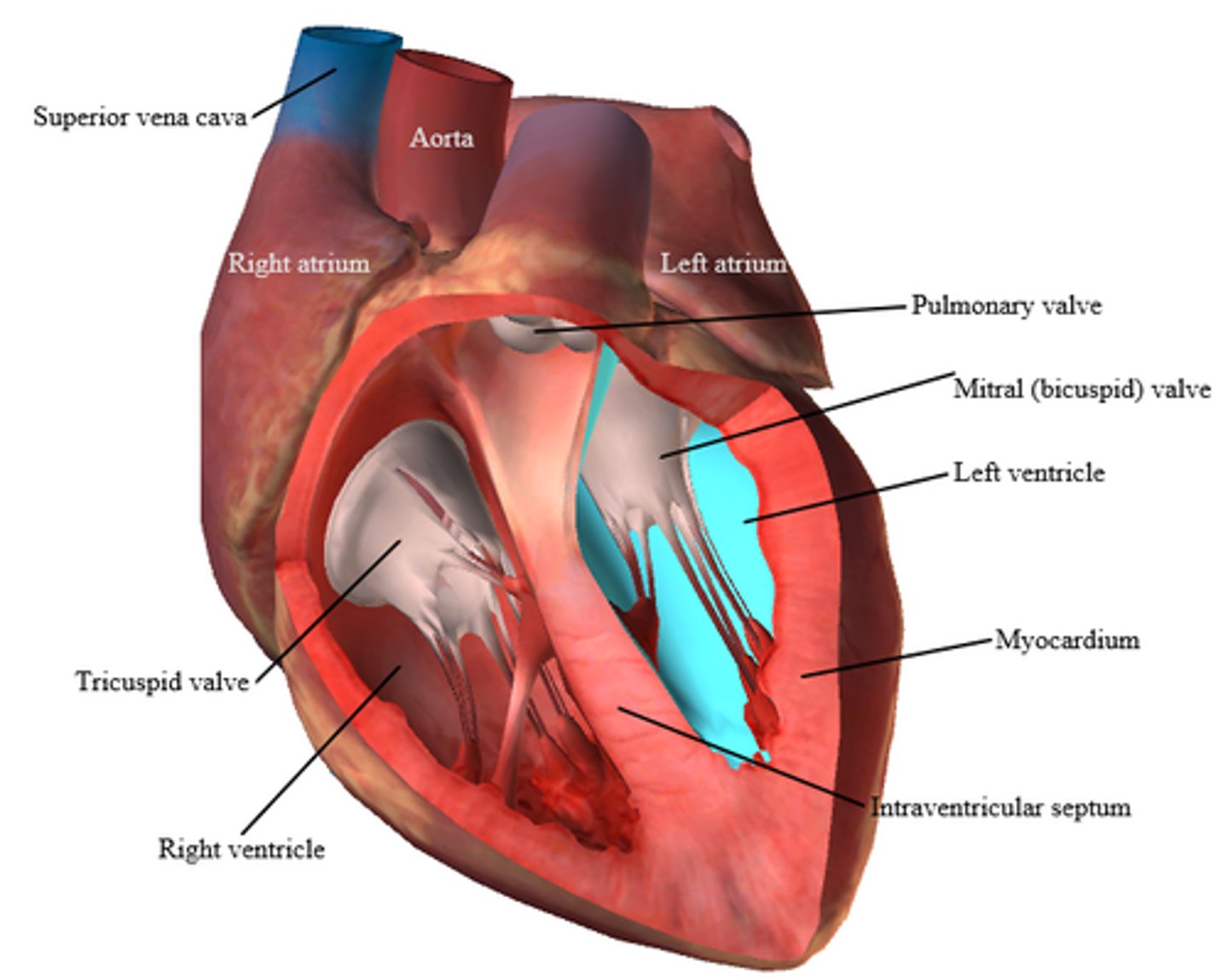
What is the purpose of the mitral valve?
The mitral valve (bicuspid) controls the flow of blood from the left atrium into the left ventricle.
What is the purpose of veins?
Veins carry blood back to the heart.
T or F: Veins are primarily responsible for the vessel's ability to control peripheral resistance.
False
The arterioles are primarily responsible for the vessel's ability to control peripheral resistance (varying blood pressure) to blood flow depending on the external and internal conditions affecting the body.
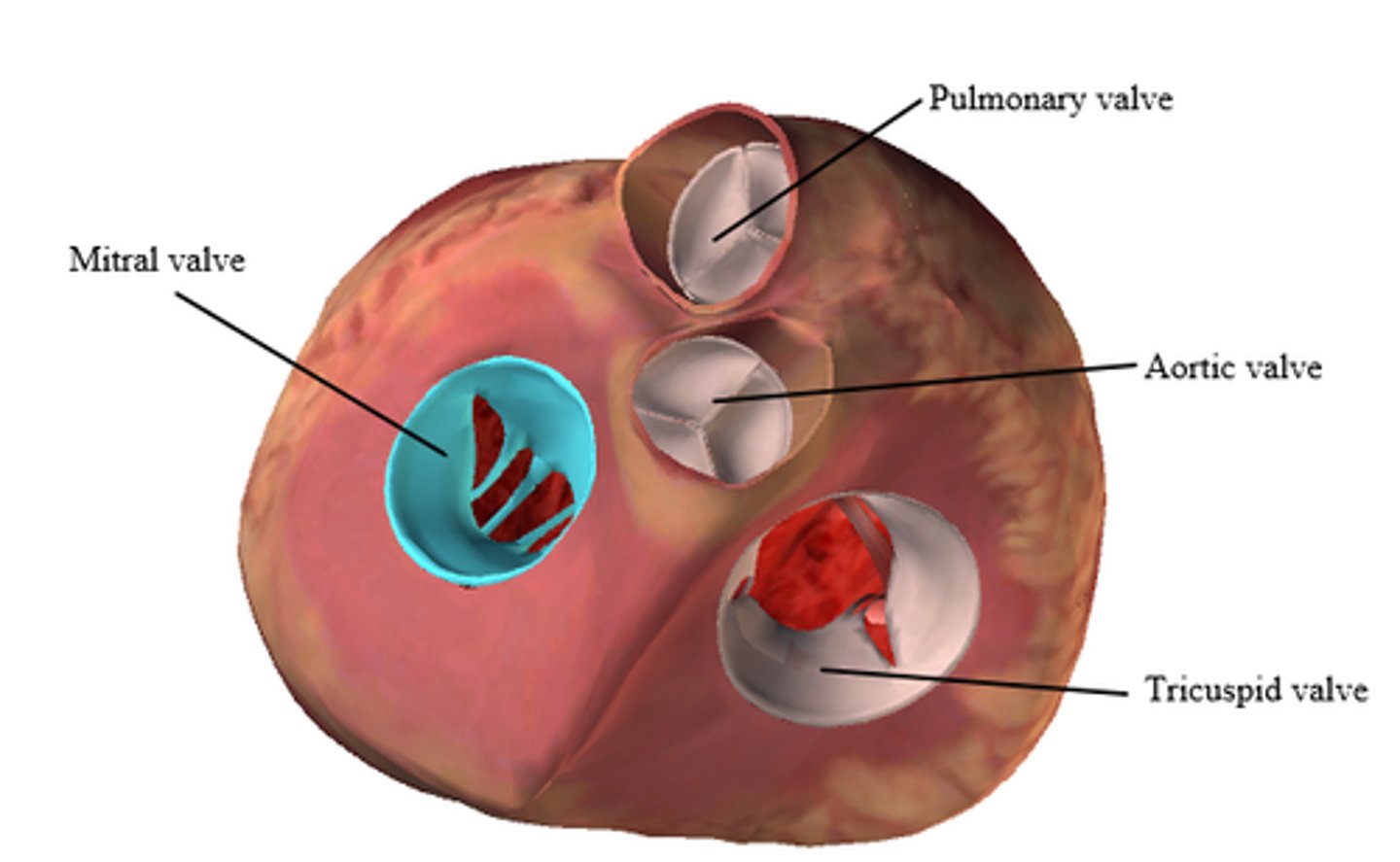
Label all heart valves (superior view).
How does the contraction and relaxation of the arterioles help to control blood pressure?
Contraction of the arterioles increases the blood pressure through decreasing the available volume. Relaxation of the arterioles decreases blood pressure as the volume increases.
What does compliance mean? In regards to veins?
Stretch with little recoil
(Characteristic of veins)
What are the three layers of a vessel?
Tunica externa (superficial), tunica media, tunica intima (closest to the lumen)
T or F: Only arteries contain a tunica media.
False - all vessels contain three layers but in differing proportions.
Capillaries are interconnected to form _____________.
Capillary beds
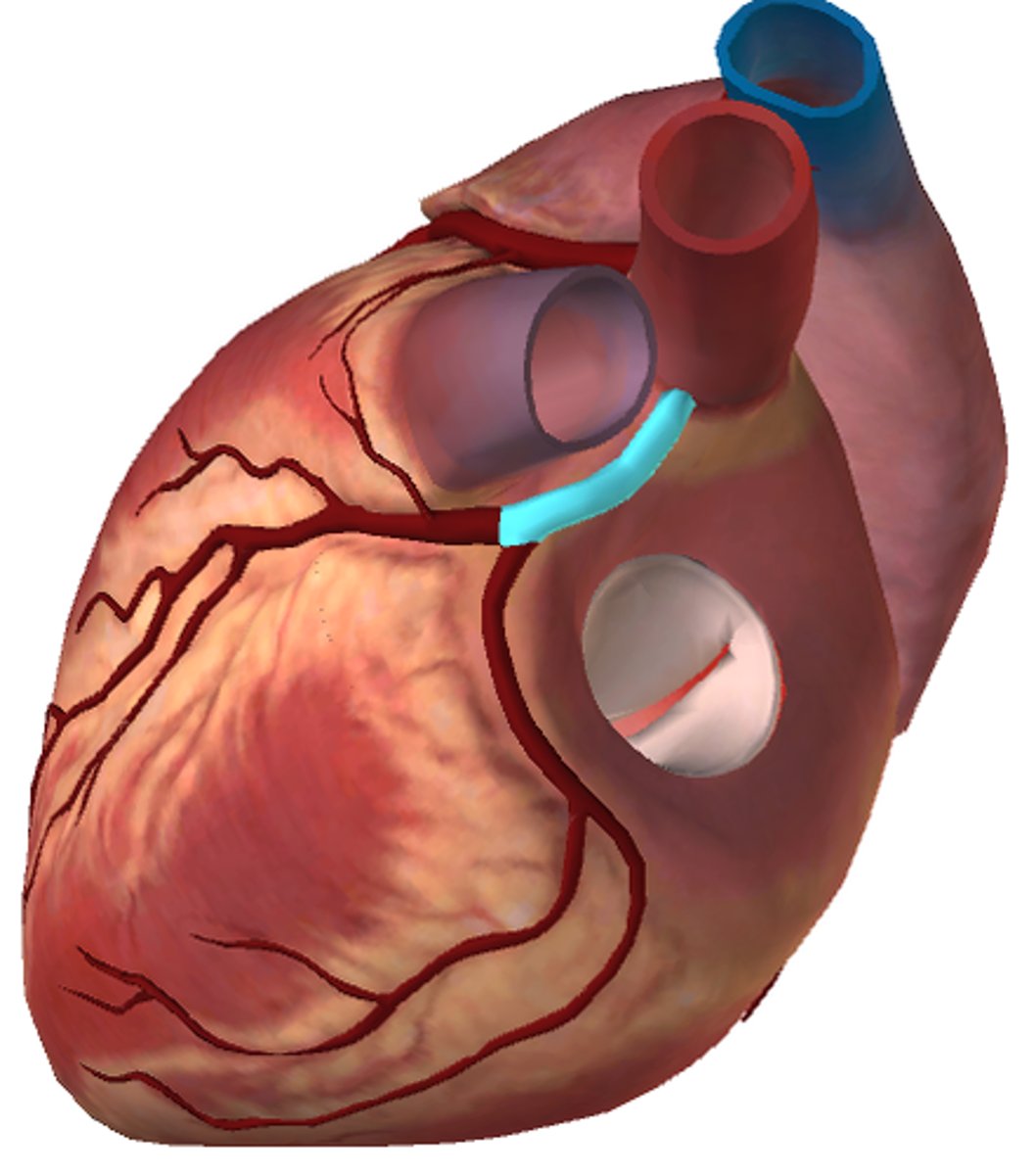
Label all the blood vessels which supply blood to the heart. It is required for you to recognize the orientation of the heart in the picture. For example, what is the artery highlighted in blue in the figure below?
Left coronary artery
The aortic arch becomes the __________as it moves inferiorly.
Descending aorta
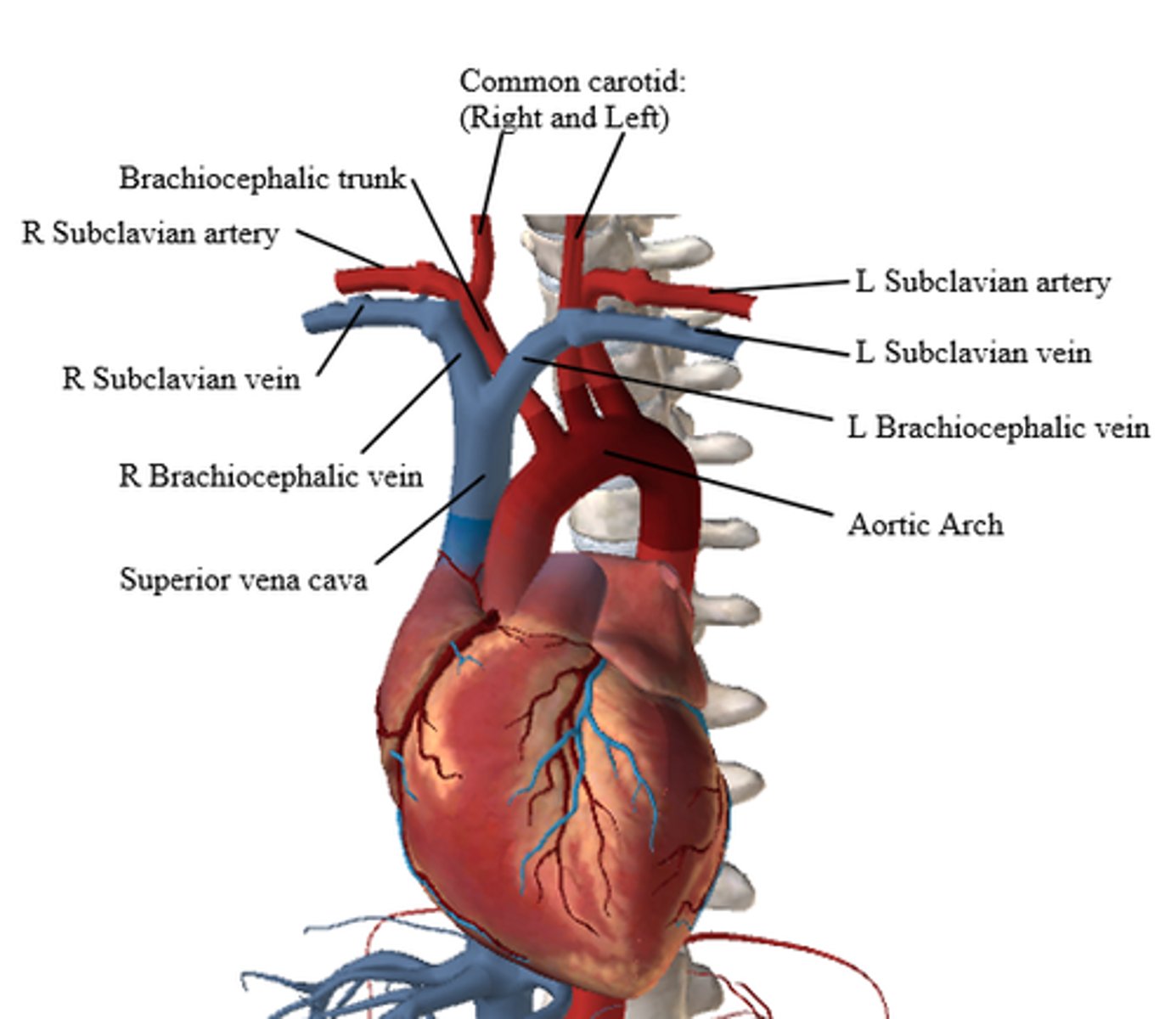
What are the three branches off the aortic arch?
Brachiocephalic trunk (right), left common carotid, left subclavian
(ABC's)
Label all major branches to/from the heart.
What is unique about the Circle of Willis?
The Circle of Willis has a unique feature of providing alternate circulation in case one of the arteries becomes blocked.
Know general location of Circle of Willis in relation to its position in the brain.
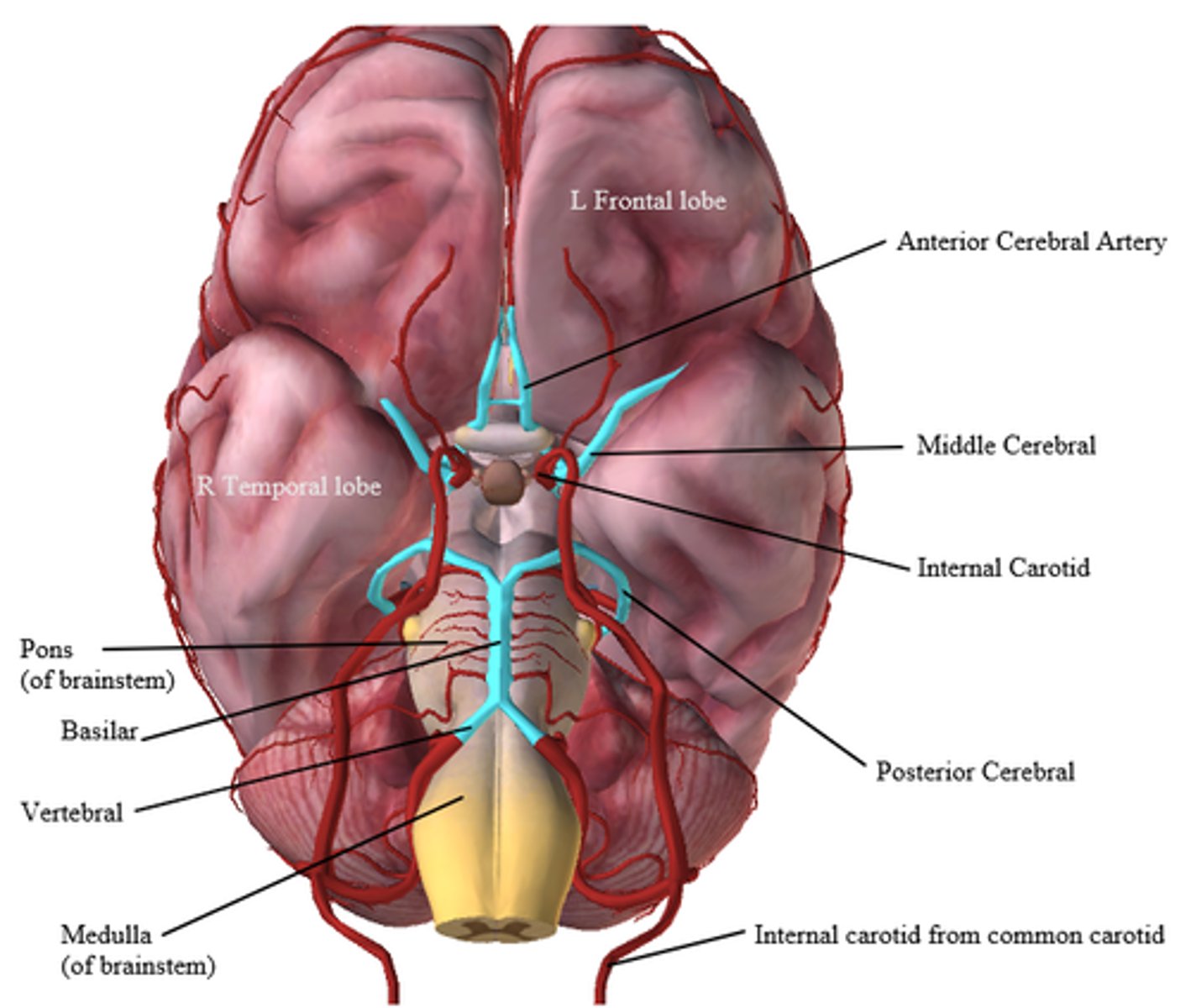
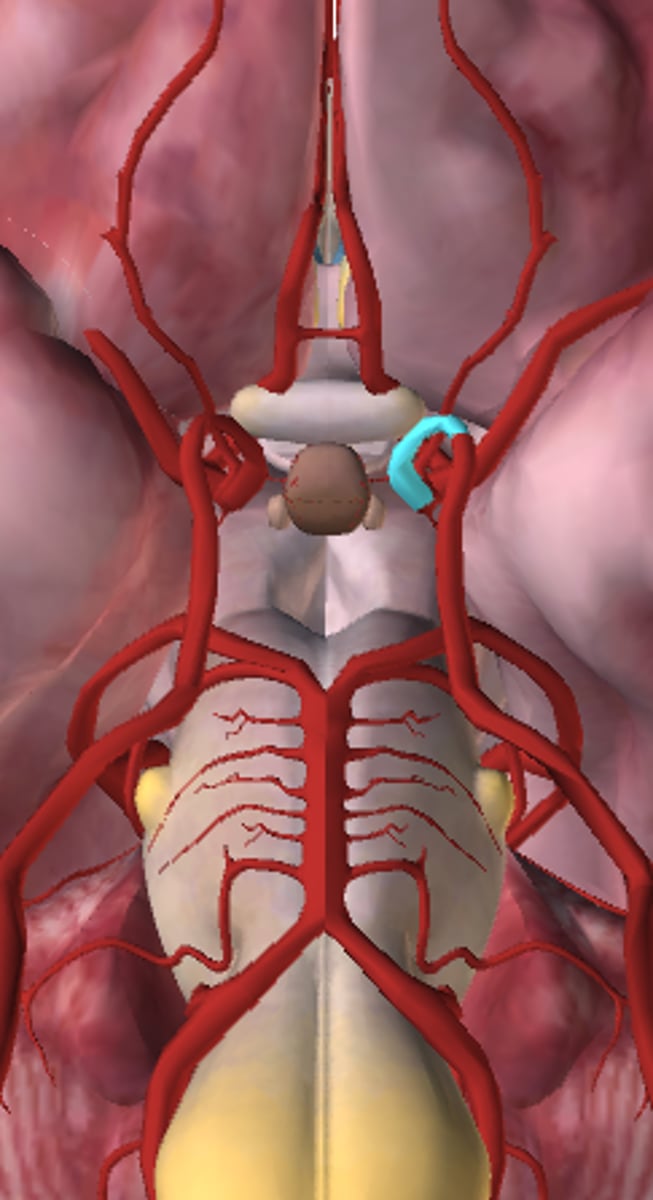
Label all vessels of the Circle of Willis circulation. For example, what vessel is highlighted in blue below?
Internal carotid (left)
True or False: Blood is classified as epithelial tissue.
False - connective tissue.
What is the cell portion of blood called?
Formed elements
How is serum made?
Letting blood sit in a tube until it clots and then centrifuging the sample to separate the solid and liquid portions of the blood.
T or F: Osmotic pressure pushes fluid into the tissues.
False - pushes fluid into the circulatory system.
(Hydrostatic pressure pushes fluid into the tissues)
What is the average pH of blood?
7.4
What is the shape of red blood cells?
Biconcave disks
What is the purpose of hemoglobin?
To carry oxygen, which loosely combines with iron inside the hemoglobin.
What is average life span of a red blood cell?
120 days
T or F: Once it dies, all portions of the red blood cell is destroyed and excreted.
False - the iron can be recycled and returned to the red bone marrow.
T or F: White blood cells are smaller than red blood cells.
False
What are the contents of pus?
The thick, yellowish fluid called pus contains a large proportion of dead white blood cells that have fought the infection and then undergone cell death.
What are the three main types of white blood cells?
Granulocytes, agranulocytes, and lymphocytes.
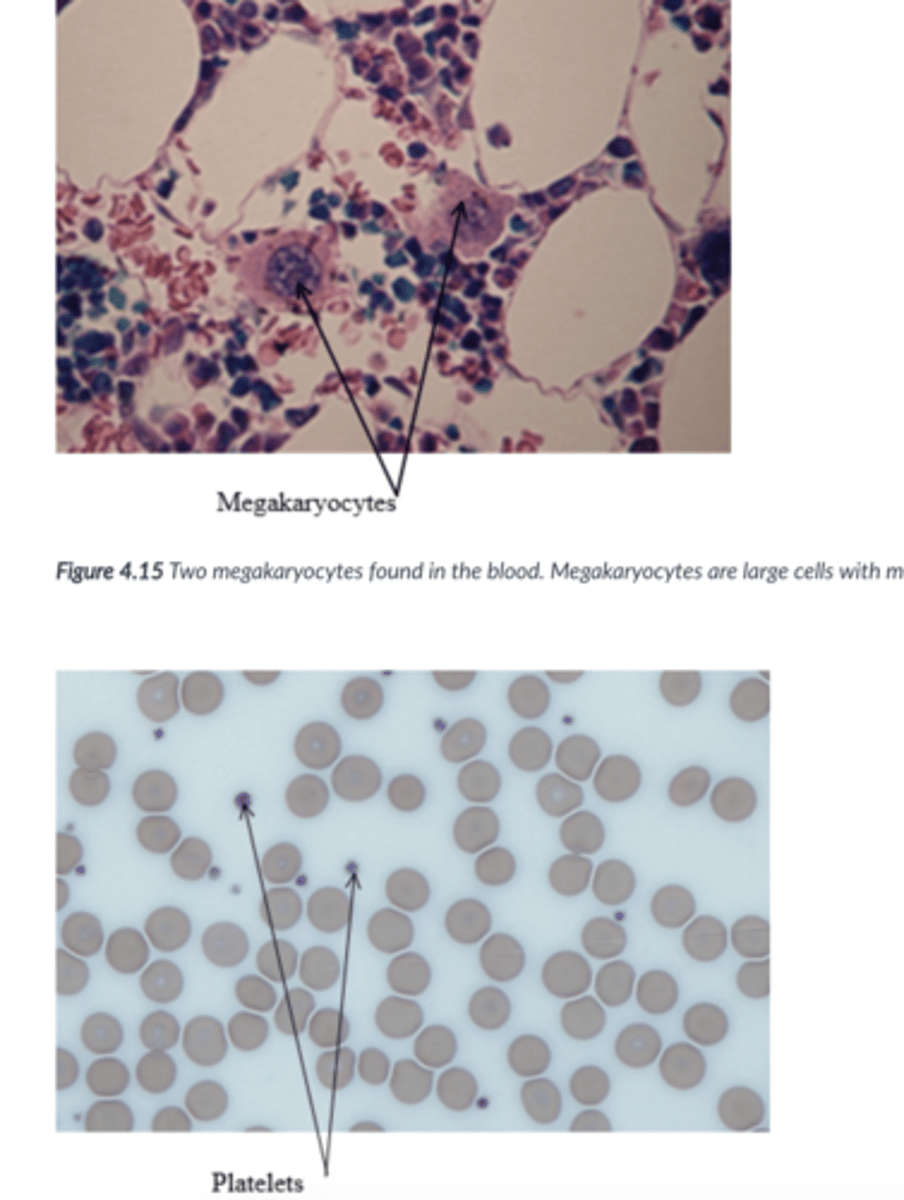
What are platelets?
Platelets (thrombocytes) are involved in the process of blood clotting, or coagulation. Platelets are not true "cells", but instead are fragments of a large bone marrow predecessor called a megakaryocyte.
What is the coagulation cascade?
A series of events to start the blood clotting mechanism.
What converts prothrombin to thrombin?
Prothrombin activator
What is the purpose of fibrin?
Fibrin threads wind around the platelet plug in the damaged area of the blood vessel and provide the framework for the clot.
What is plasmin?
As soon as blood vessel repair is initiated, an ENZYME called plasmin destroys the fibrin network and restores the fluidity of plasma.
Identify histological pictures of blood cells in the module.
What are the pulmonary and system circuits?
The RIGHT circuit is called the pulmonary circuit, sending deoxygenated blood to the lungs to be oxygenated. The LEFT circuit is called the systemic circuit, sending the oxygenated blood to the cells.
What are the inferior and superior vena cavae?
They return deoxygenated blood to the right atrium.
The __________ are the only arteries in the body carrying deoxygenated blood away from the heart.
Pulmonary arteries
The pulmonary veins return blood to the ______.
Left Atrium
Diastole refers to ______.
Relaxation
Systole refers to ______ .
Contraction
T or F: each heartbeat typically lasts longer than 2 seconds.
False (less than 1)
T or F: the atria contraction time is much longer than the ventricles.
False
T or F: the heart sounds are of the valves opening.
False (closing)
How does the nervous system and endocrine system interact with the heart?
The heart rate is regulated by the nervous system and endocrine system which can increase or decrease the rate of the heartbeat and blood pressure.
Label the parts of a sphygmomanometer.
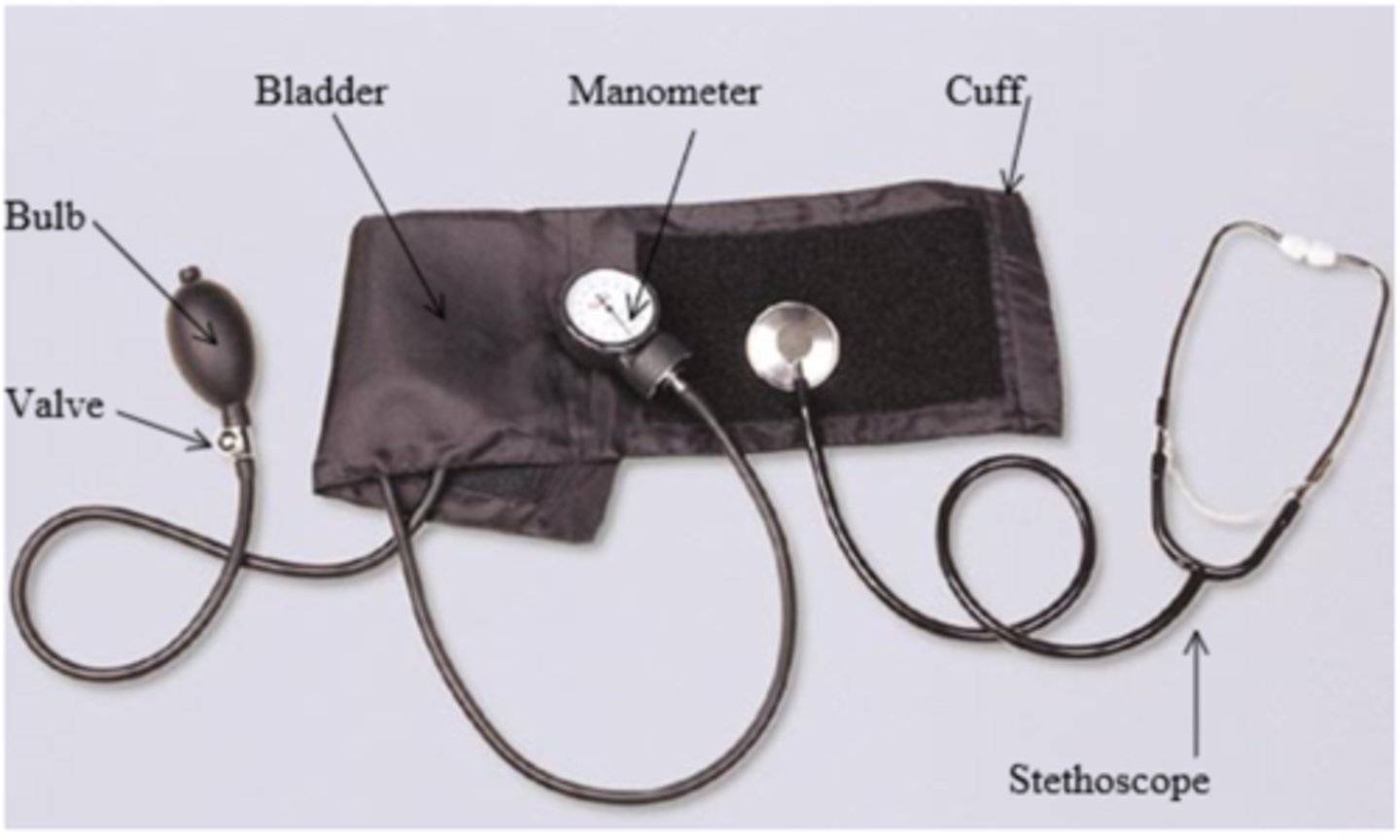
What is the purpose of the bulb?
The bulb portion is squeezed to inflate the bladder with air.
What is the purpose of valves inside the veins?
Prevents the backward flow of blood.
What portion is the pacemaker of the heart?
SA node (in the right atrium)
Following the bundle of His, where does the electrical impulse travel next?
Purkinje fibers
(SA node - AV node, bundle of his, Purkinje fibers)
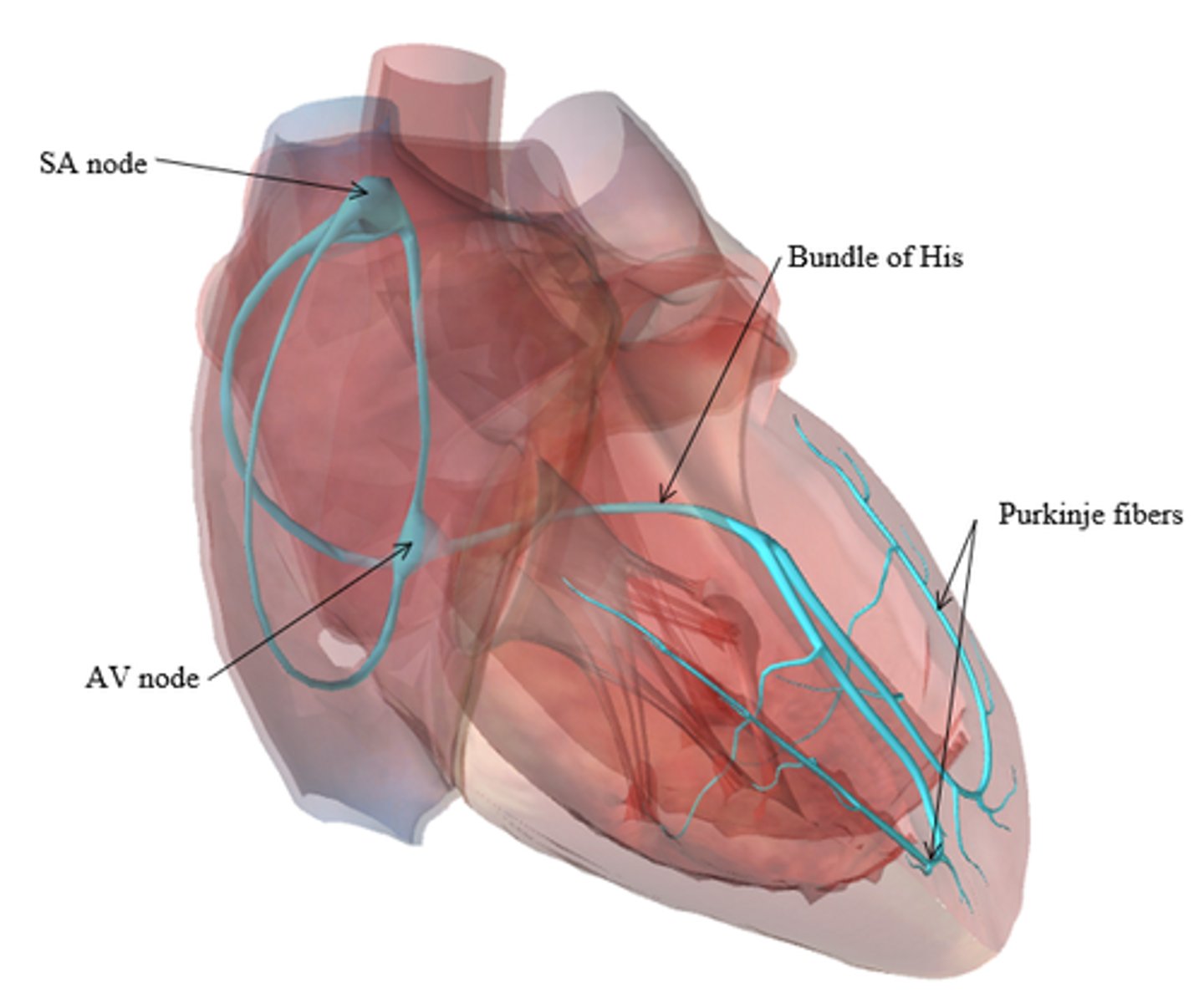
The impulse of the SA node causes contraction of the ______.
Atria
What is an EKG?
A device used to measure electrical impulses in the heart.
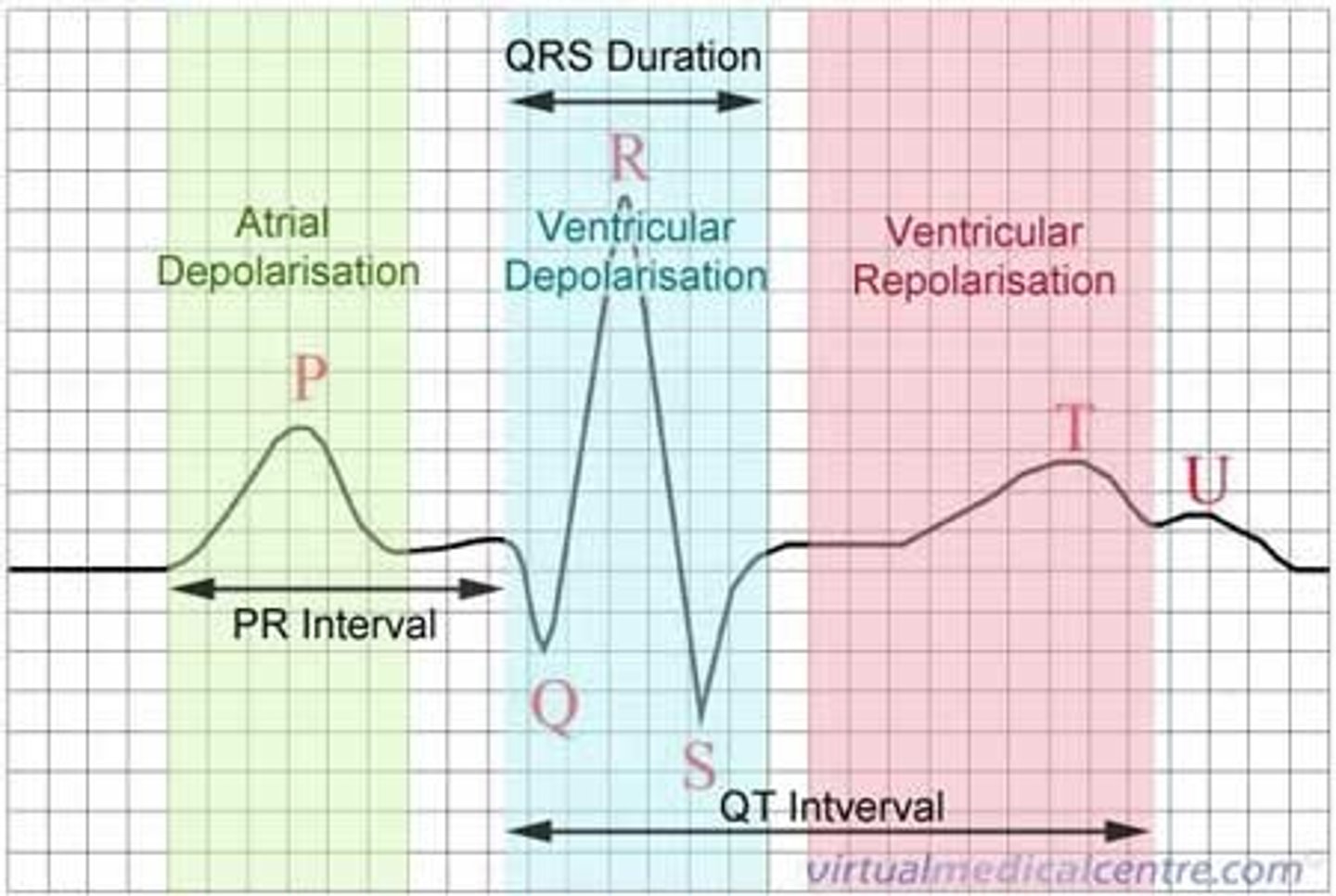
What is the P-wave?
Atrial depolarization and atrial systole.
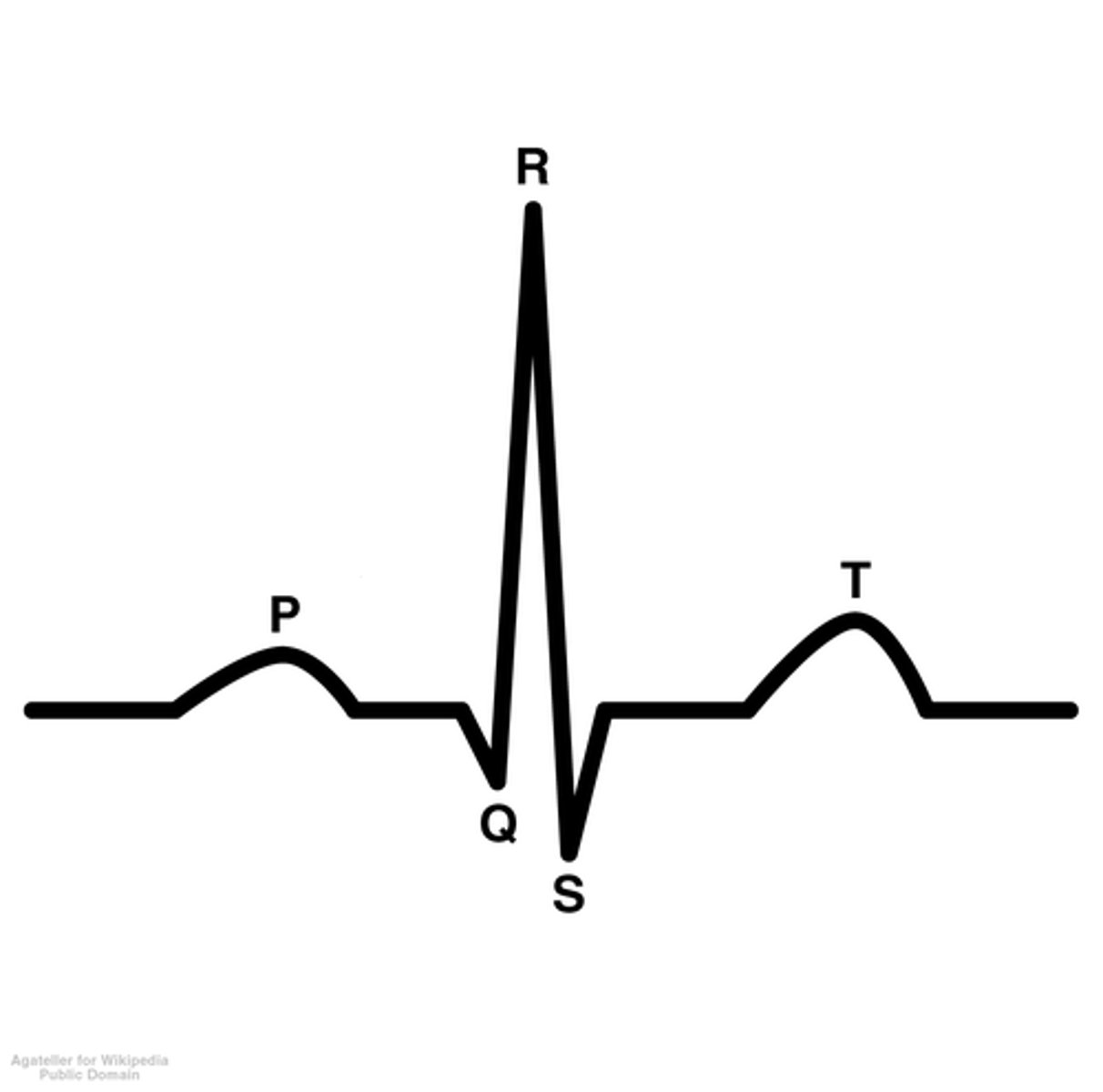
What is edema?
Fluid accumulation
What is pulmonary edema?
Fluid in the lungs
Hypertension is blood pressure significantly higher than:
120/80
What is atherosclerosis?
Accumulation of soft masses of fatty materials inside the arteries.
What is the difference between a thrombus and an embolus?
A stationary blood clot is called a thrombus. If a blood clot dislodges and moves along with blood, it is called an embolus.
PE is an abbreviation for:
Pulmonary embolism
What is the medical term for a heart attack?
Myocardial infarction
What is angina pectoris?
Chest pain (in a heart attack, pain often radiates down the left arm)
Name at least one other heart attack symptom:
Shortness of breath, upset stomach, extreme fatigue, pain or pressure in the chest
Streptokinase is a drug given to______.
Dissolve a blood clot.
Name two surgical procedures available to clear clogged arteries.
Angioplasty, coronary artery bypass surgery CABG