Biochem Oct. 1st
 View linked note
 Call Kai
 Learn
Learn Practice Test
 Spaced Repetition
 Match
Match Flashcards
 Knowt Play
1/6

Earn XP
Description and Tags
Topic 7
Name | Mastery | Learn | Test | Matching | Spaced | Call with Kai | Chat |
|---|
No analytics yet
Send a link to your students to track their progress
7 Terms
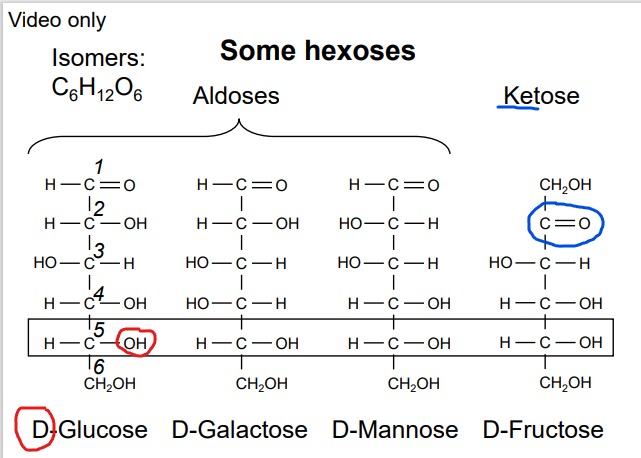
How can monosaccharides be described?
Can be characterized by their chemical structure
Pentose: 5 carbon atoms
Hexose: 6 carbon atoms
D and L Isomers
Stereochemistry based on the position of the hydroxyl group on the highest-numbered chiral carbon
D-sugar: Hydroxyl group on the right.
L-sugar: Hydroxyl group on the left.
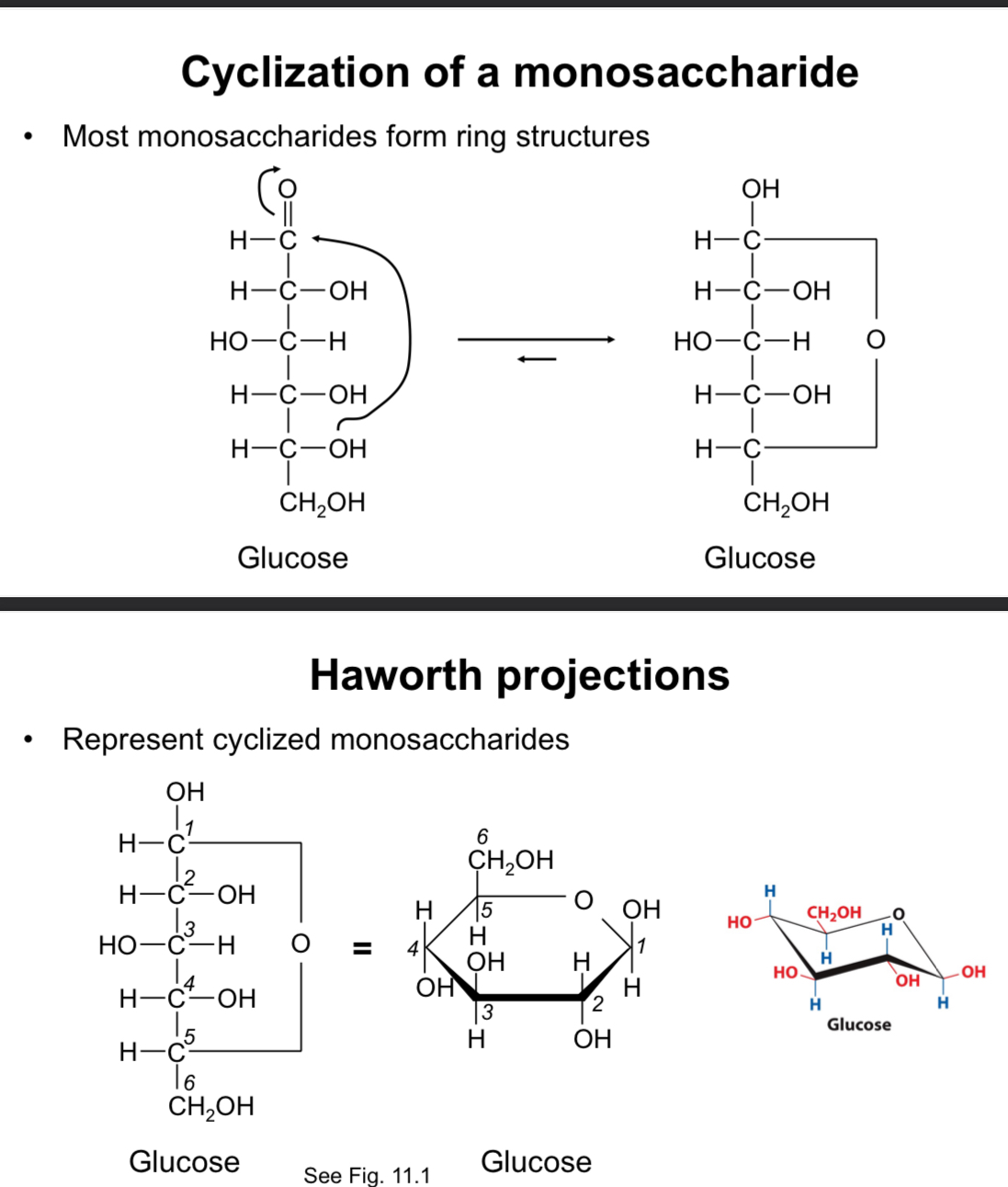
How do Sugars (Carbohydrates) cyclize?
Sugars like glucose tend to cyclize due to nucleophilic attack (O from 5th carbon attacks carbonyl)
Results in a stable ring structure typically containing 5 or 6 members (favorably cyclized form)
the C=O becomes OH once the hydroxyl group from the 5th carbon bonds to it
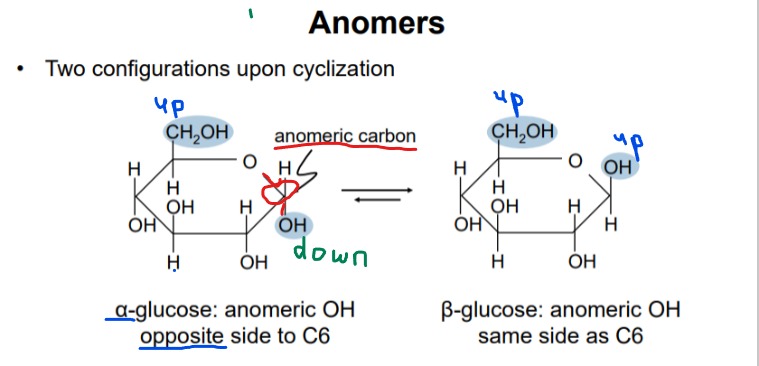
What are anomeric carbons and how do we identify them?
Identification of the anomeric carbon (carbon with two bonds to oxygen) is crucial for defining alpha (a) and beta (b) forms of sugars
Alpha glucose
Hydroxyl on the opposite side of the anomeric carbon
Vowels (alpha/opposite)
Beta glucose
Hydroxyl on the same side as the anomeric carbon
Consonants (beta/same)
(Doesn’t always have to be the farthest from the carbonyl group)
(IS SOMETIMES CHIRAL OR ACHIRAL)
How do Disaccharides form?
Formed when two monosaccharides bond through a glycosidic bond via a condensation reaction
Occurs when the hydroxyl group (-OH) on the anomeric carbon of one sugar reacts with an -OH group of another molecule (a water molecules is released)
(An O-glycosidic bond)
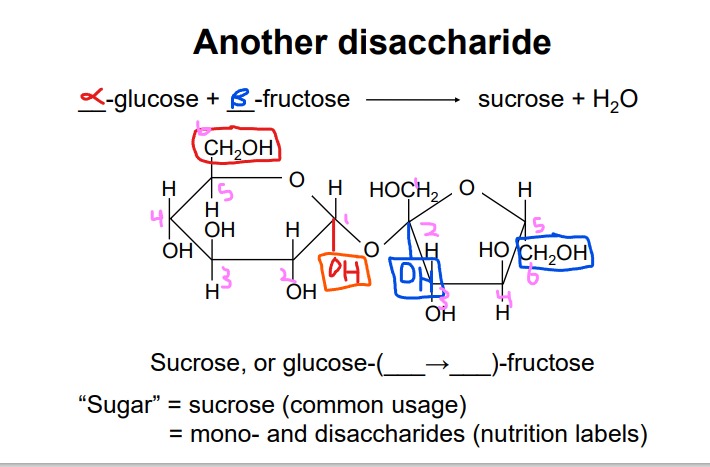
the anomeric carbon that’s forming the glycosidic bond can’t switch between alpha and beta but the other anomeric carbon can
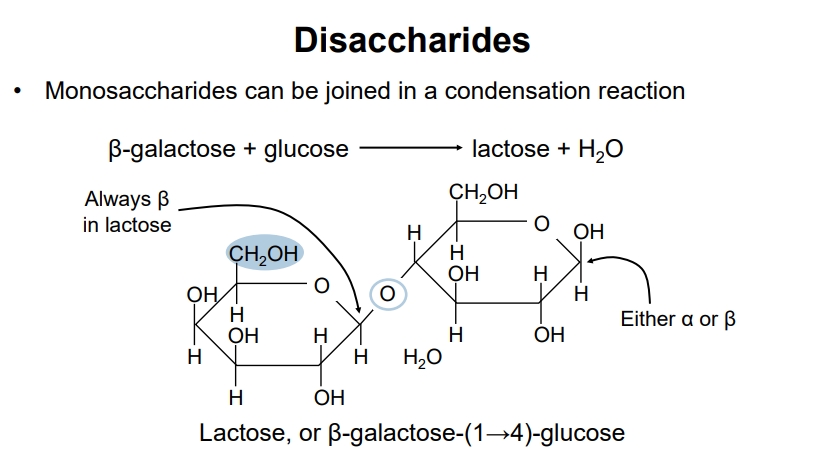
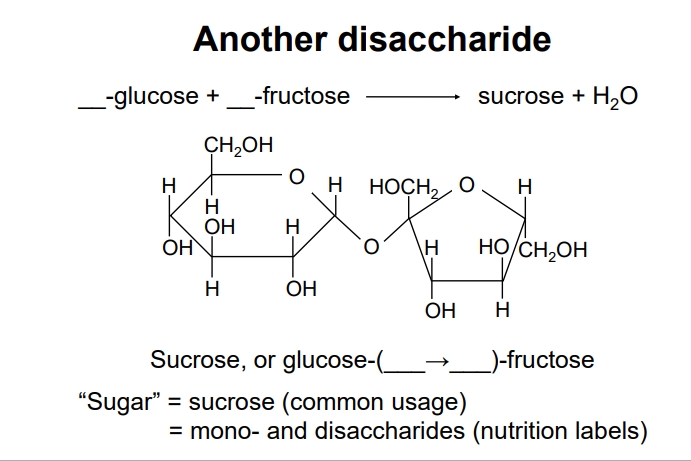
Ex. which is alpha and which is beta?
To determine which form is alpha or beta, identify the anomeric carbon and observe the position of the hydroxyl group; if it is on the opposite side of the anomeric carbon, it is alpha, while if it is on the same side, it is beta
(fructose also always makes 5 membered rings)
What are polysaccharides?
Polysaccharides are complex carbohydrates formed by the linkage of multiple monosaccharides through glycosidic bonds, serving various structural and energy storage roles in organisms
Polysaccharides as energy storage
Stored as glycogen in animals and starch in plants, providing a readily available source of energy
Glycogen
Represented by a structure with glycogenin as a central protein primer molecule, around which glycogen chains are synthesized
Polysaccharides as structural molecules
Cellulose in plant cell walls
Pectin for cell wall in fruits
Dietary fibers that humans can’t efficiently digest
cellulose, chitin
What are Oligosaccharides?
Protect cells, make them slippery
These surface carbohydrates influence cell-cell recognition, adhesion and provide physical protection