EXAM 6 ANS + endocrine
 Call Kai
 Learn
Learn Practice Test
 Spaced Repetition
 Match
Match Flashcards
 Knowt Play
1/60

There's no tags or description
Looks like no tags are added yet.
Name | Mastery | Learn | Test | Matching | Spaced | Call with Kai | Chat |
|---|
No analytics yet
Send a link to your students to track their progress
61 Terms
endocrine system…
is closest system working with ner sys
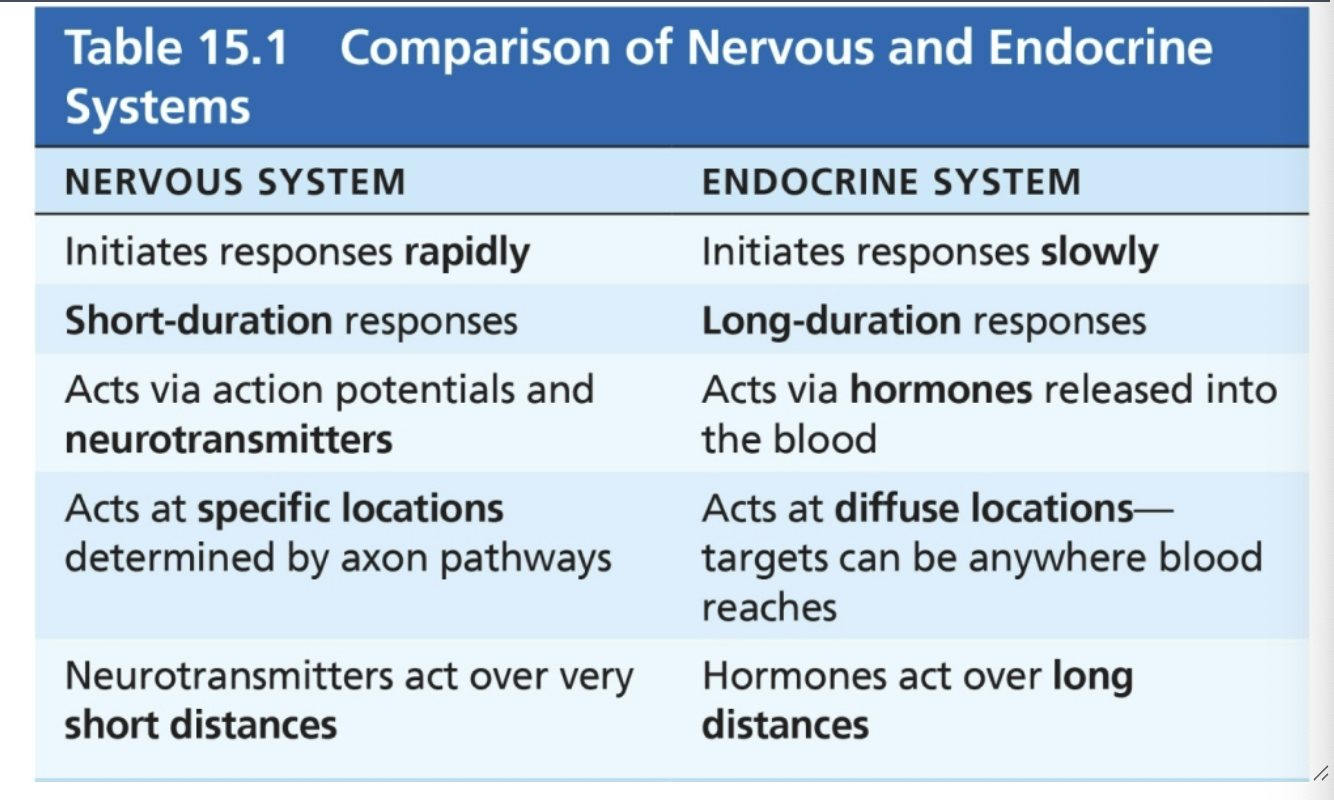
nerv sys vs endocrine sys table write out (5)
** NER SYS USES ACTION POTENTIALS AND NEUROTRANSMITTERS
** ENDO SYS USES HOROMONES RELEASED INTO BLOOD!
**ner sys has axons releases neurotransmitters
**endocrine sys releases hormones in blood cuz blood present in every part of body, responses are more specific + far effect
** endocrine response slower but longer lasting than nervous system
endocrinology
Study of hormones and
endocrine organs
FUNC OF ENDOCRINE SYS**
Reproduction
• Growth and development
• Maintenance of
electrolyte (ions w/ pos + neg charge) , water, and
nutrient balance of blood
• maintains cellular
metabolism and energy
balance
• may help Mobilization of body
defenses
hormones
long distance chemicals typically released by endocrine sys and travel in blood
typically released in blood from endocrine orders - responses spread everywhere!
Exocrine glands
group of cells that release secretions outside
endocrine glands
release secretions inside the body in the blood
horomones can be made up of what
amino acid /prots - (amino acid based hormones
lipids - steroids
target cells
specific cells targeted by a specific hormones. target cells are affected by specific hormone(s).
hormones do not act on all body cells, they only act on cells that are targeted for those specific hormones
(when hormones act on target cells they may change the plasma memb permeability of the target cell, cause action potents to occur, cause repolarisaition , may stim produ of specific prots/enzymes, may activate/deactive prots, may induce secretory act, may stim mitosis
cuz hormones enter the blood supply, will they affect all the cells of the body?
no - they will only affect cellls that are targeted by specific hormones
antagonists **
one or more hormones oppose(s) action of
another hormone
Example: insulin and glucagon
major endocrine organs **
Pituitary gland (big)
• Thyroid gland (big)
• Parathyroid glands (big)
• Adrenal glands (big) - AKA SUPRARENALS ***
• Pineal gland - IN EPITHALMUS
• Thymus gland
• Pancreas
• Gonads (ovaries and testes)
• Hypothalamus
hypothalamus **
part of diencephalon
pituitary gland (AKA HYPOPHYSIS) attached to hypothalamus thru a stalk called infundibulum
hypothalamus produces 2 hormones and they are stored + released by posterior pituits
2 specialised cells in hypothalamus that make each make a type of hormone and push towards posterior pituitary for store/release **
paraventricular cells(/neurons ) of hypothala - produce oxytocin that acts on uterus (smooth muscles)i and causes contractions of uterus Paraoxy
supraoptic cells(/neurons) of hypothala- produces ADH (antidiuretic hormone) that tells kidneys not to make pee (+maintain BP) SUPRAADH
- acts on kidney that makes pee + maintain BP + filter blood
ADH + OXYTOCIN ARE PROTS/AMINO ACIDS HORMONES
pituitary gland of hypothalamus **!!
pituitary gland AKA HYPOPHYSIS**
pituitary gland secretes/produces, releases, or stores 8 MAJOR HORMONES
- has 2 lobes:
anterior pituitary AKA ADENOHYPOPHYSIS **
anterior pituitary produces + RELEASES 6 HORMONES! +* (mostly peptides/AA)
Growth hormone (GH) - directly act on body cells when released
– Thyroid-stimulating hormone (TSH) (tropic) acts on thyroid gland
—>DO NOT DIRECTLY AFFECT BODY CELLS they first affect some glands that then produce effects
– Adrenocorticotropic hormone (ACTH) (tropic) - acts on adrenal gland DO NOT DIRECTLY AFFECT BODY CELLS they first affect some glands that then produce effects
– Follicle-stimulating hormone (FSH) (tropic) - DO NOT DIRECTLY AFFECT BODY CELLS they first affect some glands that then produce effects
→ act on ovaries + testes
– Luteinizing hormone (LH) (tropic) DO NOT DIRECTLY AFFECT BODY CELLS they first affect some glands that then produce effects
→ act on ovaries + testes
FSH + LH are gonadal hormones cuz act on gonads ( male testes + female ovaries )
– Prolactin (PRL) - directly act on body cells when released
posterior pituitary AKA NEUROHYPOPHYSIS **
POSTERIOR PITUIT PRODUCES 0/NO HORMONES!
ONLY STORES + RELEASES 2 HORMONES - ADH + OXYTOCIN -ACTUALLY MADE BY HYPOTHALAMUS!
hypothalamus produces 2 hormones and they are stored + released by posterior pituits
ANTERIOR + POSTERIOR PITUIT ARE UNDER CONTROL OF HYPOTHALAMUS! - when hypothalamus tells ant pituit/post pituit to stop release/ start release hormones, they stop!
diabetes insipidus **
disease/deficiency in which ADH IS NOT PRODUCED DUE TO CANCER OF HYPOTHALA/ cancer of post pituit
MAKES U KEEP PEEING - SO YOU LOSE WATER + ELECTROLYTES SO BP CAN DROP!
tropic
don’t directly affect body cells!
growth hormone *GH)
AKA SOMATOTROPIN HORMONE***
causes growth
when released, acts on skeletal muscle cells + bones - cause em to enlarge + growth
- directly act on body cells when released
produced by anterior pituit
gigantism **
hypersecretion of growth hormones during childhood that causes kids to be giant
acromegaly **
hypersecretion of growth hormone/somatotropin in adults that causes enlargement of hands + feet (+face)
dwarfism **
hyposecretion of GH in childhood causes height to be rlly short
(hyposecretion of GH in adults usually no issue)
thyroid stimulating hormone (TSH)
produced by anterior pituit
acts on thyroid gland, which then produces its own hormones
adrenocorticotropic hormone (ACTH)
produced by anterior pituit
acts on adrenal gland and then adrenal gland will produce its hormones
gonadal / gonadotropin hormones **
FSH (follicle stimulating hor) + LH (luteinizing hormone)
-produced by anterior pituit + act on female ovaries + male testes
FSH - follicle stim hor
when FSH released in females it acts on female ovaries it causes development /production of eggs/ ova
when FSH released in males it acts on male testes it causes development /production of sperm
luteinizing hor
when release acts on testes + causes release of testosterone
when release acts on female ovaries + causes release of estrogen + progesterone
prolactin
produce by ant pituit
**directly affects breasts in females after childbirth + causes release of milk
in males, func not known
thyroid gland **
is in neck
has right + left lobes, connected by isthmus
PRODUCE 2 IMP HORS:
#- THYROID HORMONE
- cells of thyroid gland that produce thyroid hor are called follicular cells!
thyfoll
# CALCITONIN
paracalc
cells of thyroid gland that produce calcitonin called parafollicular cells!
**func: calcitonin reduce / decs blood calcium levels BY ACT ON OSTEOBLASTS - tells osteob to build new bones, when new bones built, the extra calc from. blood stored in bones to reducre blood calc lvls
calcitdeccalc
parathyroid glands **
on back of thyroid glands
produce PTH (parathyroid hor)
func of PTH: increases blood calcium levels! (hypercalcemic)
PTH acts on osteoCLASTS to increase blood calcium levels
when PTH acts on osteoclasts, osteroclasts break bones + release calcium from the bones, which raise blood calc
pthinccalc
thyroid hormone (TH)
func: thyroid hor works closely tgt w/ growth hor work tgt to CAUSE YOUR GROWTH! - if deficient in either one, your growth can be retarded!
help maintain body weight, maintain/ BMR, keep an eye on caloric intake of body , maintain heat produ, calorigenic effect: maintain most acts of cell, BP maintain
—> you need both thyr + growth hor for good growth cuz they work closely tgt
need enough iodine in diet to make thyroid hormones; if not enough iodine in diet, thyroid gland will not produce thyr hors!
2 forms of TH (both are amino acid / prot hors)
T4 (thyroxine) - is active form of thyroid hor made of 2 tyrosine AA’s + 4 iodine!
T3 (triiodothyronine) - 2 tyrosine + 3 iodines!
goiter
inflam of thyroid gland due to lack of iodine in diet
cretinism **
disease Caused by hyposecretion of thyroxine in cgildgood
• Results in dwarfism during childhood
myxedema
Caused by hypothyroidism (decreased produce of TH) in adults
• Results in physical and mental sluggishness
Graves’ disease ** AKA HYPERTHYROIDISM
disease caused by hyperthyroidism/ Hypersecretion of TH
• Results in increased metabolism, heat intolerance, rapid
heartbeat, weight loss, and exophthalmos (bulging of eye cuz lose face fat), tremors, BP low
calcitonin + Pth are
antagonists
adrenal glands
AKA adrenals or suprarenals
adrenocorticotropic (ACTH) hor acts on adrenal gland then adrenal gland produces hors
sit on top of kidney
have 2 regions:
outer region = adrenal cortex
inner region = adrenal medulla
in adrenal cortex, we have 3 subregions/zones that each produce different hors
outer to inner:
zona glomerulosa produce hors that control minerals/electrolytes - mineralocorticoids (collective name) , most imp is aldosterone
zona fasciculata - produce collective hors known as glucocorticoids - most imp is cortisol/cortisone
zona reticularis - produce sex hormones
mineralocorticoids
most imp is aldosterone
produ by zona glomerulosa
acts on kidneys + does same func as ADH - stops water + electrolytes going out to maintain BP
cortisol/cortisone which are glucocorticoids
produced by zona fasciculata
these hors are anti- inflam
they inc blood sugar lvls
aka stress hormones
sex hors
produced by zona reticularis of adrenal cortex
they act on testes + ovaries
adrenal medulla
PRODUCE CATECHOLAMINES (collective name of these 2 AA hors):
epinephrine (adrenaline)
norepinephrine (noradrenaline)
they are fight or flight hors that released when sympathethic ner sys activated
func: inc BP, HR inc, pupils dilate, resp passages open
parasympathetic ner sys has what effect on dig sys
dig sys activity goes up
adrenal gland disorders
addisons disease **
Hyperaldosteronism
Cushing’s syndrome
Masculinization
addisons disease **
due to hyposecretion of all 3 hors produ by adrenal cortex (glucocorticoid, mineralcorticoids, sex hors)
golden bronzy skin, muscle weakness, tired/burnout, more prone to infection cuz cortisol anti-inflam - if not produced, more prone to infect
Hyperaldosteronism
due to overproduction of aldosterone in zona glomerulosa
too much aldosterone, wont pee, will hold water + electrolytes, BP goes up, swelling cuz lot of water
Cushing’s syndrome
due to cancer of zona fasciculata that produce cortisol/cortisone that are anti-inflam
parient produce lots of gluc, swell face - moon face, bufallo hump, high BP, increased sugar lvls, depression
pineal gland
small gland in epithalamus that produce melatonin
controls sleep/wake cycle
PANCREAS **
are triangular gland behind stomach
act as endocrine + exocrine glands - produce hors + other enzymes
cells of pancreas that produce (endocrine) hors are pancreatic islets/islets of langerhans
—>2 cells of pancreatic islets each produce hors:
—> alpha cells produce glucagon hor that is hyperglycemic - inc blood sugar
alphagluc
—→ beta cells produce insulin that lowers blood sugar - it is hypoglycemic
betin
diabetes mellitus **
imbalance associated with sugars
2 types:
Hyposecretion of insulin: Type 1 (juvenile / childhood diab) - insulin not produced by beta cells so need to take insulin
– Hypoactivity of insulin: Type 2 - insulin there but does not affect body cells
3 signs of diabetes mellitus 3P’s ! **
polyuria: excessive urination
polydipsia: excessive thirst so drink a lot
polyphagia - excessive eating
FSH
act on ovaries + cause egg production
act on testes + cause sperm production
luteinizing hor
act on male testes + cause produ of testosterone
testosterone cause puberty, develop male sexual hair, changes voice, develop beard
act on female ovaries + cause produ of estrogen + progesterone
estrogen + progesterone control ovulation, menstruation, develop of human breasts!
AUTONOMIC NER SYS
AKA VISCERAL MOTOR NER SYS AKA involuntary, automatic
part of ner sys that is inc or dec activities of smooth muscles, cardiac muscle, glands , visceras , dig sys
can only inc or dec these things cuz those things dont need brain signals - they automatic!
2 parts:
sympathetic AKA - incs activitiy of these organs
parasympathetic AKA - decs activity of these organs
supplies automatic organs
neurons that make up autonomic ner sys called
automatic/autonomic neurons!
2 neurons in autonomic ner sys
all other ner sys have 1!
1st neuron = pre ganglionic neuron + 2nd neuron = post ganglionic neuron
round circle = ganglion
cell body + dendrites of 1st (preganglionic) neuron is in brain or spinal cord
axon of 1st neuron stops in ganglia
cell body + dendrites of 2nd neuron (postganglionic) is in ganglia
in between 1st (preganglionic) + 2nd (postganglionic) neurons is a ganglia
1st neuron leaves brain + spinal cord + its axons release neurotransmitter on the cell body of 2nd neuron + neurotransmit moves on to next!
we call it ganglia cuz it has cell bodies of 2nd neuron, (which is in PNS)
how info conveyed in ANS
preganglionic will have all info from brain + spinal cord, so will convey it into ganglia, from ganglia, postganglionic neuron will take info that will go to organs
func preganglionic neuron
has the info from brain + spinal cord
func post ganglionic neuron
neuron that will convey info to organs/visceras
neurons communicate through
release neurotransmitters
ganglion / ganglia
cell bodies + dendrites in PNS (outside brain + spinal cord)
neurons of ANS come out from where
from the brain / spinal cord
parasympathetic NS **
AKA functional name : rest and digest NS AKA origin/locational name : CRANIOSACRAL NS! ***
slows down activities of involunt organs
IN PARASYMP NS THE cell bodies of the 1ST / PREGANGLIONIC NEURON COMES OUT FROM BRAIN/cranium OR FROM THE sacral PART OF SPINAL CORD **
ganglia is closer to organs
so preganglionic neuron will be long
→ postganglionic neuron will be short
parasympathetic ns + neurons releases acetylcholine - an inhibitory neurotransmitter - slowing down activities!
func: slow down activities of body, dig sys activitiy, HR, BP etc.
how many autonomic ns active at one time
either parasympath or sympath
only 1 NS active at one time!
sympathetic NS
FUNC NAME: fight or flight NS locational /origin name : thoracolumbar NS!
1st neurons (preganglionic) arise from / have their cell bodies in the thoracic or lumbar part of spinal cord
ganglia is closer to spinal cord
PREGANGLIONIC NEURON IS SHORT
POSTGANGLIONIC NEURON IS LONG!
name of neurotransmitter released by neurons here is epinephrine/adrenaline/norepinephrine
these neurotransmitters increase the activity of involunt organs HR inc, resp inc etc.