gut secretions
 Call Kai
 Learn
Learn Practice Test
 Spaced Repetition
 Match
Match Flashcards
 Knowt Play
1/23

There's no tags or description
Looks like no tags are added yet.
Name | Mastery | Learn | Test | Matching | Spaced | Call with Kai | Chat |
|---|
No analytics yet
Send a link to your students to track their progress
24 Terms
what cells secrete saliva
acinar cells
describe how primary saliva is made? what is the end result of the saliva?
sodium is pumped out of the lumen which creates a concentration gradient, so sodium moves down the concentration gradient bringing water with it . this results in an isotonic secretion of saliva.
what happens to saliva as it is modified?
some sodium and chlorine is reabsorbed, whilst potassium and hco3- is added resulting in a hypotonic secretion
what are the functions of saliva?
lubricating food, initiating digestion of some starch from amylase, ca2+ and phosphate ion aid mineralizing of teeth, balance pH
what happens during the cephalic phase of digestion?
the thought/sight smell and taste of food promote saliva and gastric secretion
what is the function of the parietal cells in the stomach?
secrete HCl and intrinsic factor
what is the function of the cheif cells in the stomach?
secrete pepsinogen
describe the mechanism of acid production from the parietal cells?draw
co2 joins with h2o via carbonic anhydrase to form h2co3 which dissociates into H+ and hco3-.
proton pump actively pump moves hydrogen ions into the lumen of the walls via ATP, and hco3- moves into the capillary.
HCO3- is exchanged for a chloride which combine with the hydrogen to form HCl
what is the role of gastrin and when is is secrted?
gastrin is released in response to unbroken down proteins and is released from the g cells in the stomach. This acts on the parietal cell and the chief cells to release HCl and pepsinogen. and also increase motility.
what hormone inhibits gastric secretions and how and when does it work?
somatostatin is released from d cells in response to an increase in h+. it works by inhibiting the g cells from producing gastrin as well as inhibiting ECL cells from releasing histamines.
what hormones can simulate the parietal cells to produce acid?
gastrin, histamine and acetylcholine from the parasympathetic system
what cell releases histamines?
ECL cell
what is the role of the sphincter of odi?
when this relaxes it allows the release of bile from the gall bladder and enzyme from the pancreas to enter into the duodenum.
what hormone relaxes the sphincter of odi?
CCK hormone
what are the two main exocrine function of the pancreas?
produce alkaline fluid rich in hco3- ions and to produce digestive enzymes
what simulates the release of secretin and what cells produce it?
acidic chyme from the pyloric antrum and is produced by the s cells in the duodenum
what stimulates the release of CCK?
fats
what three hormones produced in the duodenum inhibit gastric motility and secretion?
CCK, secretin and GIP/GLP-1
what is the function of secretin?
inhibits gastric secretion, stimulates bile synthesis, stimulates bicarbonate secretions, and enzymatic secretion from the pancreas
what is the function of the CCK hormone?
allows the relaxation of the sphincter of odi and contraction of the gall bladder which allows the the release of bile and digestive enzymes into the small intestines
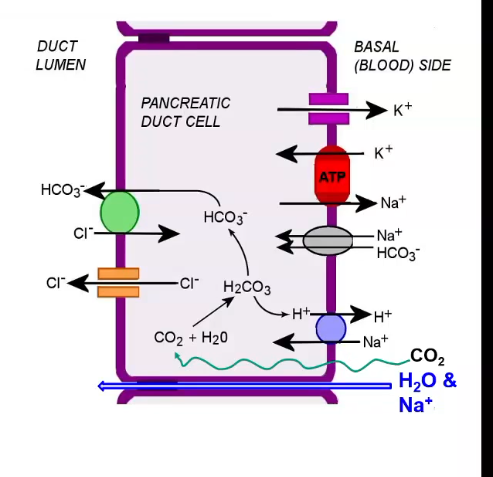
what is the mechanism of alkaline fluid secretion by pancreatic duct cells. draw
h2co3 produced by carbonic anhydrase. this dissociates into h+ and hco3-, and the hco3- moves out via the cl- exchanger. this is driven by the sodium potassium exhanger.
what is the function of GIP/GLP?
stimulates insulin release and inhibit glucagon release
what stimulates the release of GIP/GLP-1?
fats and polysaccharide in the chyme.
what does the colon secrete?
mucus, potassium and hcos