Network+ #2 -- OSI Model
 Call Kai
 Learn
Learn Practice Test
 Spaced Repetition
 Match
Match Flashcards
 Knowt Play
1/76

There's no tags or description
Looks like no tags are added yet.
Name | Mastery | Learn | Test | Matching | Spaced | Call with Kai | Chat |
|---|
No analytics yet
Send a link to your students to track their progress
77 Terms
OSI model was developed in _____
1977 by the International Organization of Standarization
OSI model is not a _____
applied model, just a reference one
OSI model is useful for _____
categorizing networking funtions and troubleshooting
Under which model networks operate as of today
TCP/IP Model
List OSI layers
Physical, Data Link, Network, Transport, Session, Presentation, Application
Name data representation at each layer
Physical: Bits
Data Link: Frames
Network: Packets
Transport: Segments
Session, Presentation and Application: Data
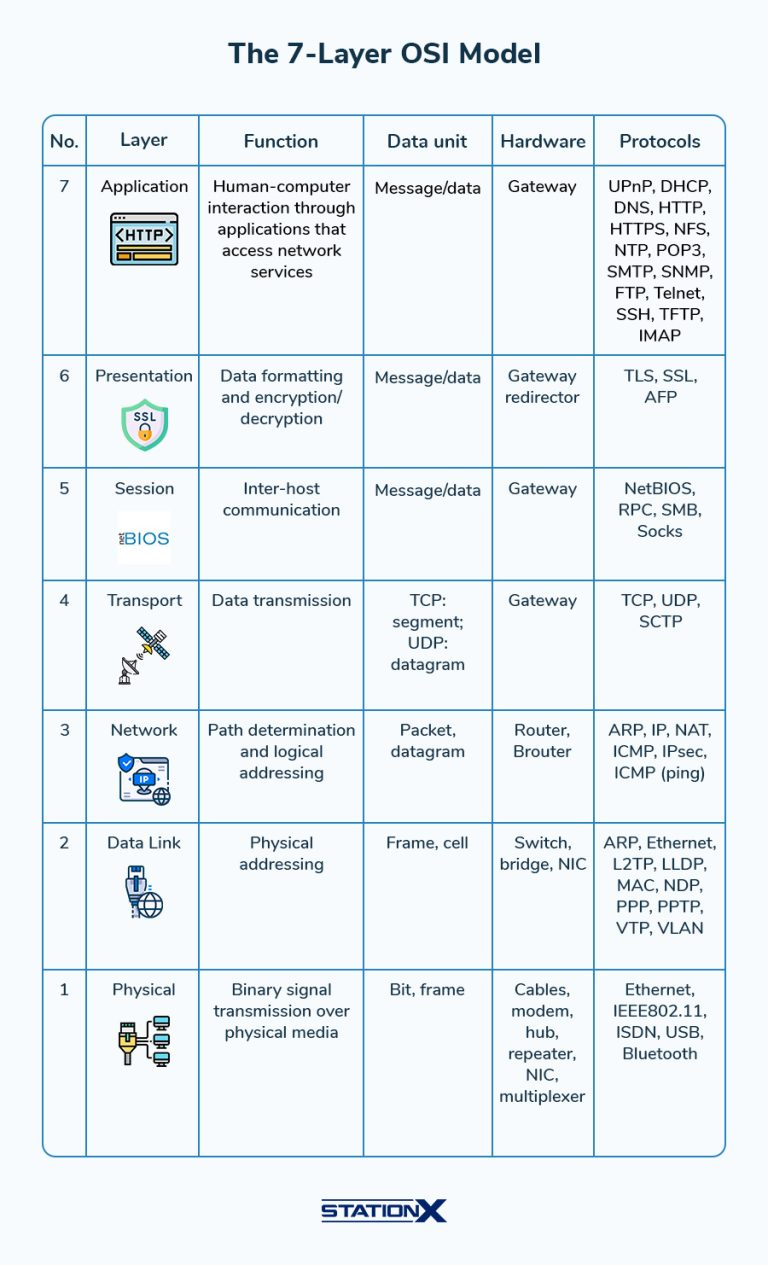
State the 7 layer mnemonic
Please Do Not Throw Sausage Pizza Away
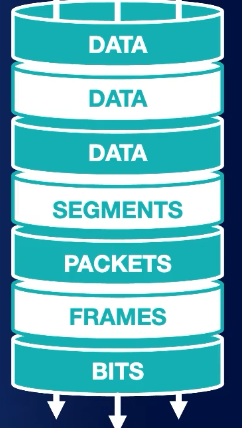
State data traversal mnenonic
Do Some People Fear Birthdays
Data type at the Physical Layer
Binary bits
which characteristics does the physical layer has
physical and electrical network characteristics
Transition Modulation
Switching between levels to represent 1 or 0
Transition Modulation on Copper cable
voltage at 0V for 0, and + or -5V for 1
Transition Modulation on fiber optioc
Light: On for 1 and Off for 0
Cables are part of the ____ layer
physical
RJ-45, or _____ which is used for ___
Registered Jack, Ethernet
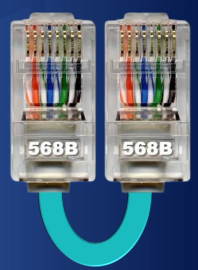
TIA/EIA-568B on both ends is the standard for
Straight-Through Cables
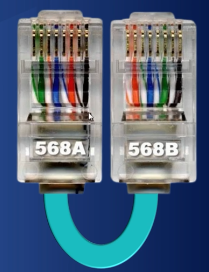
TIA/EIA-568A on one end and TIA/EIA-568B on the other is the standard for
Crossover Cables
how do Physical layer devices view networks from a phyisical topology perspective
based on how cables are connected
Asynchronous Communication
Two parties exchange information without requiring them to be activeliy on sync at the same time
Async Communication functioning
Start and Stop bits to indicate when transmission occur from sender to the receiver
Async comms examples
voice mail, messaging
Synchronous Communication
Real-Time communication using a common time source
Sync Comms functioning
Reference clock to coordinate transmission by both sender/receiver
Sync Comms examples
Call
Bandwidth Utilization
percentaje of available network capacity that is actually being used over a period of time
Broadband bandwitdh utilization
Dividides bandwitdh into separate channels
Broadband examples
Tv service: single cable with multiple channels
Baseband bandwidth utilization
Uses all frequency of the cable
Baseband examples
telephone, one call at a time
Baseband reference clock
clock signal used by sender/receiver as the timing reference for baseband functions
Multiplexing
process of combining multiple singals/steams into one shared transmission channel and separating them again at the receiver
Multiplexing benefits
Increased efficiency (one cable/freq/link), low cost, low complexity, concurrency
Time-Division Multiplexing
dedicated time-slots, each session takes a turn on the slot to share medium between all users
TDM analogy
Shared singular tv on a household, each person gets asigned a turn (timeslot) to use and watch said tv
Statistical Time-Division Multiplexing
Dynamically allocates timeslots on as-needed basis
Stat TDM analogy
follows household tv example, as long as nobody is using the TV (slot) anyone can use it
Frequency-Division Multiplexing
Divides medium into channels based on frequencies and each session is transmitted over a different channel
Multiplexing Main objective
optimizing a limited amount on resources for more efficient utilization
Multiplexing Golden Exam Rule
Multiplexing enables simultaneous usage of a baseband connection by multiple users
Physical layer media —> Cables
Fiber Optic, Ethernet, Coaxial
Physical Layer media —> Wireless
BT, WiFi, Near Field Communication
Physical layer devices
Hubs, Access Points, Media Converters
Physical Layer devices main purpose
to simply pass along whatever is received
Data link Layer purpose
to package data into frames and transmit them on the network
Media Access Control
physical hexadecimal addressing system of a device which operates on a logical topology
MAC Address bit count
48bits
MAC Address first 24 bits —>
Manufacturer identifier
MAC Address last 24 bits —>
Device identifier
MAC Address importance
crucial for physical topology and device id on the network (such as NICs)
Logical Link Control
provices connection services and allows acknowledgement of receipt of messages
LLC Example
Hand raise System of elect whom may speak on a classroom setting
LLC is the basic form of ____
flow control
flow control
limit on data sent to prevent the receiver to be overwhelmed
LLC basic error control functions
receivers may notify if the received data frames are corrupted or correctly received utilizing a checksum
LLC Checksum
small value added to the data frame so the receiver can check wheter the data was corrupted/changed while traversing the network
Isonchronous method at Data link layer
devices use a common reference clock and create time slots for transmission
synchronous method at Data link layer
device use same clock with beggining/ending frames and control characters
Asynchronous method at Data link layer
devices reference internal clock and use start/stop bits for sync with no strict control over comm timing
Data Link devices
NICs, Bridges, Switches
Network layer
all about routing and forwarding traffic using logical addresses
Logical Addressing — IPv4
dotted octet notation composed of four sets of numbers separated by dots
since Routing is a Network layer term, what its another equivalent
Switching
Packet switching
data divided in packages and then forwarded based on its IP address
What other protocols has IP replaced
AppleTalk and IPX
Circuit Switching
Dedicated and constant comm link established between two devices maintained for the duration of the conversation
Message switching
Data is divided into messages which may be stored and then forwarded
Most common type of switching
Packet switching
Switching
moving data from an input to the correct output
Route discovery and selection
manually configured as a static route or dynamically through a routing protocol
Routing protocols purpose
to help us decide how data is going to flow across the network and how routers communicate it
Connection services at network layer
augment layer 2 connection services to improve reliability
Packet reordering at connection services in network layer
ensures data packets arrive and are reassembled in the correct order
Internet Control Message Protocol
sends error messages and operational information to an IP destination
ICMP Ping protocol
used to troubleshoot network issues by testing connectivity and response times
ICMP Traceroute protocol
traces the route of a package through the network (list router addresses)
Network Layer devices
Routers and multilayer s