NSG 170 - Thermoregulation
 Call Kai
 Learn
Learn Practice Test
 Spaced Repetition
 Match
Match Flashcards
 Knowt Play
1/134

There's no tags or description
Looks like no tags are added yet.
Name | Mastery | Learn | Test | Matching | Spaced | Call with Kai | Chat |
|---|
No analytics yet
Send a link to your students to track their progress
135 Terms
What is thermoregulation?
the process of maintaining the core body temperature at a nearly constant value
Normal body temperature range
The range is from 36.2°C to 37.6°C (97°F to 100°F)
The average temperature is 98.6°F (37°C).

Normothermia
The state in which body temperature is within the "normal" range
Hypothermia
refers to a body temperature below normal range (

Signs of hypothermia
decreased body temperature and respirations, pale and cool skin, hypotension (decreased blood pressure) decreased muscle coordination and urinary output, disorientation, and drowsiness progressing to coma.

Mild Hypothermia
(34-36 C); pt is usually alert and shivering in an attempt to generate heat; pulse rate and resp. are usually rapid; skin may be flushed (red) but may turn to pale due to bodies constriction of blood vessels at the skin to retain heat, than cyanotic; may have blue lips or fingertips
Moderate Hypothermia
(30-34 C). Lethargy, sleepy, slow pulse. Loss of dexterity, may not be able to ambulate. pale or blue extremities. May no longer shiver.
Severe Hypothermia
(less than 30 C); shivering stops and muscular activity decreases; pt becomes lethargic; LOC decreases; BP drops; poor condition and memory loss; reduced or complete loss of sensation of touch, mood changes, and impaired judgment; resp slow; @ 80 degrees or less, all cardiovascular activity may cease; pupil reaction is slow
What is a major sign of hypothermia?
Sleepiness
Hyperthermia
refers to a body temperature above normal range (>37.6°C)

Signs of hyperthermia
a. Vasodilation occurs, causing the skin to appear flushed and warm or hot to touch
b. Diaphoresis
c. Dry skin and membranes
d. Decreased urinary output (and other signs of dehydration)
e. Seizures
f. Cognitive changes: slightly confused or delirious to coma.

Hyperpyrexia
extremely high body temperature or fever

____ establishes a set point for core body temp
Hypothalamus
Heat is produced through _____ in the cells.
Metabolic activity (chemical reactions)
Metabolic activity involves the ingestion and metabolism of food and the basal metabolic rate
The greatest amount of heat is produced by the ____ and through metabolic activity in the ____
Muscles; Liver
The basal metabolic rate changes with ___
Age
The contraction of muscles produces heat through _____ and _____.
Muscle Tone; Shivering
____ consumption, ____ activity, and _____ levels affect the amount of heat produced.
Food; Physical; Hormone
Chemical thermogenesis occurs as a result of ____ release, which increases metabolic rate
Epinephrine
The body conserves heat through ____
peripheral vasoconstriction
The process shunts warm blood away from the superficial body tissues and skin surfaces and increases muscle activity to minimize heat loss.
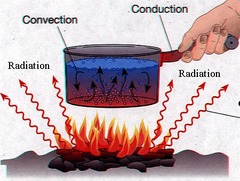
____ occurs as a result of multiple mechanisms, including radiation, conduction, convection, vasodilation, evaporation, reduced muscle activity, and increased respiration
Heat Loss
Radiation occurs through a process of ____ that emit heat from skin surfaces to the air.
Electromagnetic waves
The degree of heat loss through radiation is directly related to the difference between ambient air temperature, skin temperature, and exposure.
Evaporation
The change of state from a liquid to a gas

Conduction
transfer of heat through direct contact of one surface to another

___ surfaces lose heat to ___ surfaces.
Warmer; Cooler
Convection
loss of heat by air currents (caused by wind or a fan) moving across the body surface
Heat loss can be increased through ____, which brings greater vol. of blood to body surface.
Peripheral vasodilation
Perspiration
sweat
evaporation of moisture from the skin surface

Sweat normally accounts for ___ mL of water loss per day
600
In extreme heat, an individual can lose as much as ___ L of fluids in an hour.
4
Replacing fluids and electrolytes are is essential to preventing ____
Dehydration

During respiration, cool ambient air is inhaled and ___ in the respiratory tract and by the microcirculation within the ____.
Warmed; Alveoli
Warmed air is then exhaled
Elevated respiratory rates are seen among individuals with ___, and lower respiratory rates are seen in individuals with ___.
Elevated temperature; Hypothermia
Peripheral thermoreceptors are located in the _____
Skin
Central thermoreceptors are located in the _____
spinal cord, abdominal organs, and hypothalamus
The hypothalamus also stimulates the ____ system, which triggers the adrenal cortex to increase muscle tone and initiate a shivering and vasoconstriction response.
Sympathetic nervous
____ do NOT have heat-conserving capacity.
Newborns
A newborn infant has a unique source of heat from ____.
Brown Adipose Tissue (BAT)
Blood passes through BAT warmed by metabolism and carries heat to the rest of the body
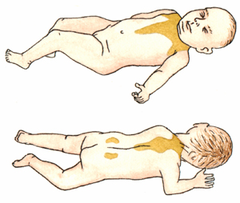
TRUE or FALSE: Newborn infants generally do not shiver
TRUE
Nonshivering Thermogenesis (NST)
Elevation of heat production for thermoregulation by means other than shivering.
Involves increased metabolism and oxygen consumption to offset heat loss.
How do newborns lose heat quickly at birth?
radiation, convection, conduction, evaporation
Newborn Characteristics that lead to Heat Loss
thin skin, blood vessels closer to surface, little subQ white fat to insulate, 3X more surface area to body mass than adults
Infants have a propensity for heat loss due to a greater ____ to weight ratio
Body surface area
Flexed posture moderates heat loss by reducing surface area exposure
When infant flexes, vasoconstriction occurs to decrease heat loss and may cause ____, or blue hands and feet.
Acrocyanosis

Sick or preterm infants have weaker muscle tone and are unable to maintain flexed position, ____ heat loss
Increasing
Infants have limited insulation due to a thin layer of ___ and their blood vessels are ___ to the skin, increasing heat loss
Subcutaneous fat; Closer
Older adults have ___ circulation and ____ vasoconstrictor and shivering response.
Slower; Decreased
Sweating in older adults is _____.
Decreased or Absent
Due to slower metabolism and and less physical activity, older adults have ____ heat production.
Reduced
Older adults also have a reduced perception to environmental temp.
Fever is caused by
pyrogens (fever-producing agents)
Pyrogens trigger the hypothalamus in the brain to do what?
Adjust heat production, heat conservation, and heat loss mechanisms to maintain a higher core temperature. Representing an increased hypothalamic set point.
Exogenous pyrogens are:
Products of infectious agents:
bacterial endotoxins, viruses, antigen-antibody complexes, etc.

Endogenous pyrogens or interleukin-1 (IL-1)
produced by phagocytic white blood cells as part of the immune response
When exogenous pyrogens invade the body, endogenous pyrogens are released that trigger the production of ____.
prostaglandin E2
Three mechanisms that lead to hyperthermia:
1. excessive heat production
2. inadequate ability to cool
3. hypothalamic regulator dysfunction
Hyperthermia occurs as a result of:
1. Environmental: temperature, humidity, and lack of air movement
2. excessive physical exertion (particularly in hot, humid environments without sufficient water replacement)
3. genetic abnormality
4. metabolic diseases
5. injury to the hypothalamus
6. as a result of pharmacologic agents
Sustained high core body temperature coupled with reduced perfusion leads to _____, _____, and _____.
Cerebral edema, central nervous system degeneration, and renal necrosis.
Three factors that lead to hypothermia:
1. excessive heat loss
2. insufficient production of heat,
3. dysfunction of hypothalamic regulatory mechanisms
Accidental Hypothermia
results from environmental exposure (including staying out in the cold too long, wearing insufficient clothing for weather conditions, wet clothing, and cold water submersion) or as a complication from serious systemic disorders.
Therapeutic Hypothermia
intentionally induced to reduce metabolism and thereby preserve tissue by preventing tissue ischemia
As core body temperature decreases, compensatory mechanisms including ____ and ____ occur.
shivering (muscle contraction to simulate warmth); vasoconstriction (to reduce heat loss)
To prevent peripheral tissue ischemia, intermittent ___ of tissue occurs.
Reperfusion
Prolonged hypothermia leads to reduced perfusion in the microcirculation attributable to increased ____ of the blood and reduced blood flow and ____.
Viscosity; Coagulation
Patients have been known to remove clothing due to a combination of reduced cognition and the false ____ of vasodilation.
Warming sensation
The risk for heat and cold related deaths are twice as high for ___.
Males
Higher rates of heat and cold related deaths are higher in this ethnic group ____
African-Americans
The ___ population is particularly at high risk for hyper- and hypothermia.
Homeless
Individuals living in very hot or very cold areas are at risk for poor thermoregulation due to their ___.
Geographical Location
Those with ____ are at risk for imbalanced temperature because of the potential inability to recognize dangerous environmental exposures or the inability to react appropriately
Impaired Cognition
Persons under the influence of ___ or ___ are at risk because sensory alterations affect judgment
Drugs or alcohol
Alcohol also acts as vasodilator (dilation of surface blood vessels = loss of body heat)
Health conditions that lead to poor thermoregulation:
1. Autoimmune conditions- hyperthermia
2. Burns
3. Chronic medical conditions (such as congestive heart failure, diabetes, or gait disturbance - risk for hyperthermia)
4. Hypothalamic injury
5. Traumatic brain injury
6. Stroke
7. Brain neoplasm
8. Infection - hyperthermia
9. Inflammation - hyperthermia
10. Long surgical procedures -risk for hypothermia
11. Metabolic conditions
12. Hyperthyroidism
13. Hypothyroidism
14. Prematurity/preterm birth
15. Protein calorie malnutrition - hypothermia
16. Traumatic injury - hyperthermia
During assessment, note symptoms such as:
"feeling feverish" or "feeling hot," chills, general malaise, lethargy, weakness, dizziness, loss of appetite, or muscle cramps. Primary symptom of hypothermia is feeling cold
When an individual has hyperthermia or hypothermia, the most reliable means available for assessing core temperature is a ___ temperature
Rectal
Primary prevention
When it is cold, physical activity helps to increase body temp
Resting, adequate hydration, wearing appropriate clothing and seeking shelter reduces risk of hyperthermia
Secondary Prevention
Screening individuals with a family hx of Malignant Hyperthermia
Caring for a patient with hypothermia:
1. Remove the individual from the cold
2. Passive measures include dry and warm clothing, warm drinks, and exercise
3. active rewarming measures may be necessary and include providing warm blankets or heating pads, drawing a warm water bath, and placing the patient in a heated environment
4. When core body temperature falls below 30°C, active core rewarming measures are indicated
a. should be done slowly and carefully to minimize the risk of triggering dysrhythmias
b. continuous cardiac monitoring and core body temperature observation are necessary
c. include infusion of warm intravenous solutions, gastric lavage with warm fluid, peritoneal lavage with warm fluid, and inhalation of warmed oxygen
5. If severe, cardiopulmonary bypass or arteriovenous rewarming may be indicated.
Passive Rewarming
dry and warm clothing, warm drinks, and exercise
Active Rewarming
providing warm blankets or heating pads, drawing a warm water bath, and placing the patient in a heated environment
Core rewarming must be done SLOWLY to avoid risk of ___
Dysrhythmias
The most common environmental factors causing heat-related illnesses are ___ and ____.
high environmental temperature (above 95° F [35° C]); high humidity (above 80%)
Heat Exhaustion
a syndrome resulting primarily from dehydration. It is caused by heavy perspiration and inadequate fluid and electrolyte intake during heat exposure over hours to days.
i. Profuse diaphoresis can lead to profound, even fatal, dehydration and hyponatremia caused by excessive sodium lost in perspiration.

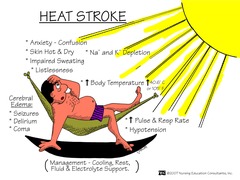
Heat Stroke
a true medical emergency in which body temperature may exceed 104° F (40° C).
Has a high mortality rate if not treated in a timely manner.
Prescribed drugs that can increase the risk for heat-related illnesses:
lithium, neuroleptics, beta-adrenergic blockers, anticholinergics, angiotensin-converting enzyme (ACE) inhibitors, and diuretics
ii. If untreated, heat exhaustion can lead to ___, which is a true emergency condition that has a very high mortality rate
Heat stroke
Signs & Symptoms of Heat Exhaustion
1. Flu-like symptoms: headache, weakness, nausea, vomiting
2. Body temp may not be significantly elevated
3. Patient may continue to perspire, although dehydrated
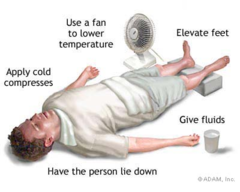
Exertional Heat Stroke
has a sudden onset and is often the result of strenuous physical activity (especially when wearing too heavy clothing) in hot, humid conditions.
Classic Heat Stroke
(nonexertional heat stroke) occurs over a period of time as a result of chronic exposure to a hot, humid environment such as living in a home without air conditioning
Malignant Hyperthermia
A hereditary condition of uncontrolled heat production that occurs when susceptible people receive certain anesthetic drugs.
Treatment for Hypothermia
i. sheltered from the cold environment, have all wet clothing removed, and undergo passive or active external rewarming.
ii. Passive warming: warm clothing and blankets
iii. Active warming methods: heating blankets, warm packs, and convective air heaters or warmers to speed rewarming
iv. Heating blanket: monitor patient's skins every 15-30 minutes to reduce risk of burn
v. Have patient drink war, high carb liquids (no alcohol or caffeine)

Frostbite
occurs when body tissue freezes and causes damage to the body tissue.

For a patient with frostbite, give ___ for pain (with PCA).
Opioid
Frost Nip
red or unusually pink color to skin or numbness, itching, and tingling in the area
a type of superficial cold injury

Rectal temperature
temperature taken in the rectum
The most reliable site for core temperature is the ____
Rectum
temporal temperature measurement
-across the forehead
-can be used on any patient
-almost as accurate as rectal
-normal temp 100.4

tympanic temperature
The temperature reading obtained by placing an aural (ear) thermometer in the patient's ear

Axillary temperature
Common site for measuring temperature in infants and children; however, it is an infrequently used site for temperature measurement in adults.
Because it is not close to any major blood vessels and because the thermometer is placed between skin surfaces, the axillary site is thought to poorly reflect core body temperature.

Neutral thermal environment (NTE)
An environment that maintains body temperature with minimal metabolic changes and /or oxygen consumption.
Thermoneutral Zone (TNZ)
The range of temperatures over which an endotherm does not have to expend extra energy to thermoregulate.

Nonshivering Thermosis (NST)
primary method of heat production; the metabolism of brown fat to produce heat.