Synapses + Neurotransmitters
 Call Kai
 Learn
Learn Practice Test
 Spaced Repetition
 Match
Match Flashcards
 Knowt Play
1/23

There's no tags or description
Looks like no tags are added yet.
Name | Mastery | Learn | Test | Matching | Spaced | Call with Kai | Chat |
|---|
No analytics yet
Send a link to your students to track their progress
24 Terms
Synapse
Junction that mediates information transfer from one neuron to
another neuron or effector cell (muscle or gland - Neuromuscular junction = NMJ = neuron to muscle)
Signal conversion of synapse
electrical (of neuron 1’s action potential) → chemical (neurotransmitter) → electrical (graded potential at neuron 2)
What are the two major parts of chemical synapse
Presynaptic and post synaptic neuron
Presynaptic neuron
neuron that releases the neurotransmitter through axon terminal
Postsynaptic neuron
the neuron that receives the neurotransmitter through receptors
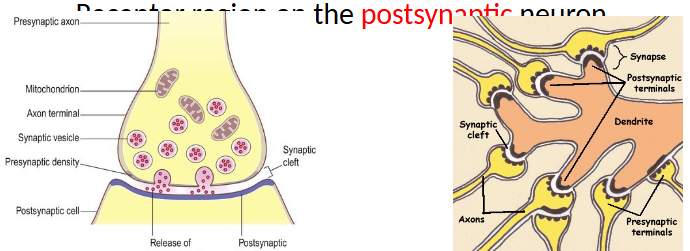
Synaptic cleft
Space between the presynaptic and postsynaptic neuron where neurotransmitters diffuse
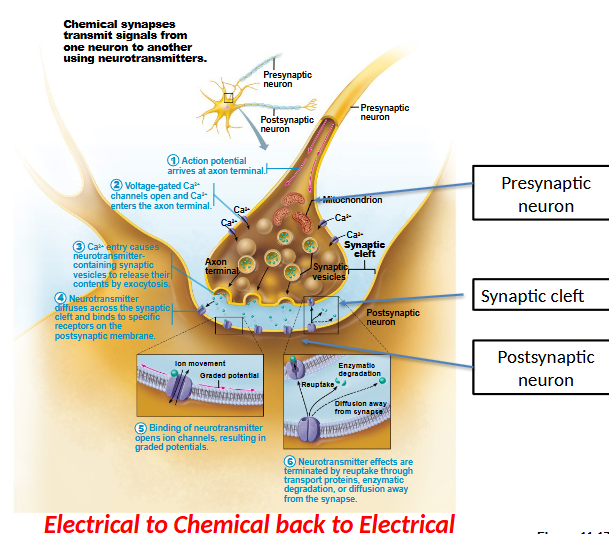
Steps of Chemical Synaptic Transmission (8)
action potential arrive at axon terminal
voltage gated Ca 2+ channels open
Ca 2+ enters axon terminal (the trigger)
Ca 2+ causes synaptic vesicles to release neurotransmitters by exocytosis
Neurotransmitter diffuse across synaptic cleft
Neurotransmitter binds to receptors
Ion channels open
graded potential forms in postsynaptic neuron (IPSP or EPSP)
How is the neurotransmitter terminated / removed
3 ways
Enzymes degrade the neurotransmitters
reuptake by astrocytes or axon terminal (transport proteins move neurotransmitters there)
Diffusion away from synaptic cleft
Post synaptic potentials
Graded potentials
EPSP (excitatory postsynaptic potential)
IPSP (inhibitory postsynaptic potential)
What is post synaptic graded potential’s strength determined by
Amount of neurotransmitters released and time neurotransmitter stays in area
EPSP
Excitatory post synaptic potential
causes depolarization → membrane potential closer to threshold → likely to fire another action potential
IPSP
inhibitory postsynaptic potential
causes hyperpolarization → membrane potential moves away from threshold → unlikely to fire another action potential
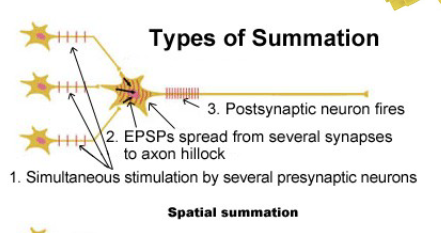
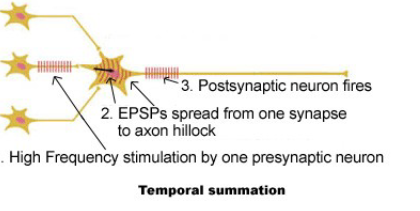
Why does summation happen and what are the two types
Because one graded potential isn’t enough so they combine
Spatial and temporal
Spatial summation
several neurons firing all at once
many action potential from different neurons → summed up graded potential
Temporal summation
One neuron fires many times
Neurotransmitters = “___”
Most neurons can make ______ neurotransmitters
Language of the nervous system
2 or more
Acetylcholine (ACh)
released at neuromuscular junctions (NMJ) and some autonomic nervous system (ANS)
Major neurotransmitter that controls muscle action
Catecholamines (3)
Dopamine, norepinephrine (NE), and epinephrine
Dopamine
Catecholamines
reward and pleasure for when we engage with something necessary for survival (food/reproduction)
norepinephrine (NE)
Catecholamines
alertness as stress response
Epinephrine
Catecholamines
fight or flight response
Indolamines (2)
Serotonin and histamine
Serotonin
Indolamines
mood/ sleep/ apetite
Histamine
Indolamines
wakefulness and arousal