lecture 4: serine and threonine proteases
 Call Kai
 Learn
Learn Practice Test
 Spaced Repetition
 Match
Match Flashcards
 Knowt Play
1/15

There's no tags or description
Looks like no tags are added yet.
Name | Mastery | Learn | Test | Matching | Spaced | Call with Kai | Chat |
|---|
No analytics yet
Send a link to your students to track their progress
16 Terms
what do chymotrypsin, trypsin and elastase all have in common?
all serine proteases with a similar amino acid sequence
binds to the side chain of amino acids in the specificity pocket
recognises the main chain to confirm the polypeptide and help orientate it for cleavage
difference between chymotrypsin, trypsin and elastase
different specificities:
chymotrypsin cuts after large aromatic residues
trypsin cuts after positively charged amino acids
elastase cuts after small hydrophobic amino acids
enzyme activation by proteolysis
the enzymes start out as inactive zymogens
proteolytic cleavage of the zymogens to activate them
proteolytic activation is not reversible so it requires close control (e.g. use of inhibitor proteins)
chymotrypsinogen → chymotrypsin
chymotrypsinogen → trypsin cleaves chymotrypsin between arg25 and ile16 (the 2 pieces remain attached via disulfide bonds)
π-chymotrypsin → autolysis to clip out 2 specific dipeptides (ser14 and arg15, thr147 and asn148)
α-chymotrypsin
formation of the oxyanion hole from chymotrypsinogen to chymotrypsin
on cleavage by trypsin, the new NH3 on the ile16 pairs up with the side chain on asp194, altering the conformation of the main chain between residues 193 and 195. this changes the position of ser195 side chain, forming the correct geometry for the catalytic triad and orients the main chain amides of residues 193 and 195 to form the oxyanion hole
blood clotting activation cascade
intrinsic pathway → triggered when blood comes into contact with a damaged surface
extrinsic pathway → triggered by external trauma that releases tissue factor into the blood
this leads to the activation of factor x, causing serine proteases to cleave the arg-gly bind in soluble protein fibrinogen
how is hemophilia passed down
inherited from the father
what are proteasomes
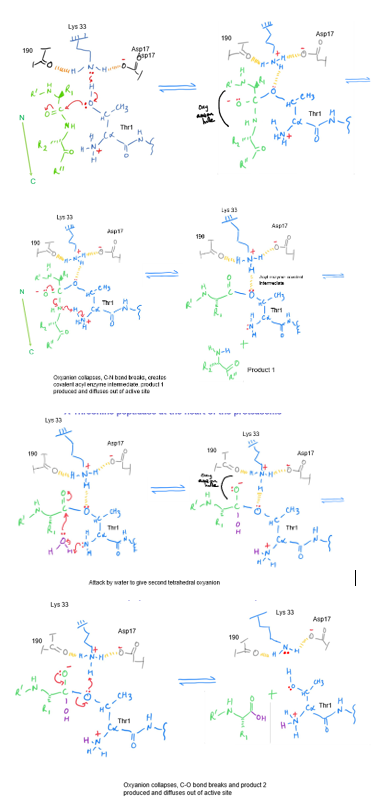
intracellular, multi-subunit, cylinder-shaped complexes with an interior cave containing proteolytically active sites that belong to the N-terminal of threonine hydrolases
threonine peptidase at the heart of the proteasome mechanism
why are ubiquitin-proteasome pathways useful
they play a role in cytoplasmic turnover
what did proteasome inhibitors do?
exhibit apoptosis in some tumour derived cell lines
why does lys33 have a reduced pKa in a threonine peptidase
due to its hydrophobic environment, which allows it to be deprotonated and acts as a base
dipeptide boronic acid (boetezomib) as a proteasome inhibitor
boron is an electron deficient atom, the inhibitor works by reacting with the active site nucleophile to create a covalent bond. this gives a tetrahedral shape that mimics the transition state that occurs during protein breakdown
what is bortezomib used as a treatment for
multiple myeloma
positive feedback of the blood clotting cascade
thrombin actually goes back and activates earlier factors to accelerate and finish the clot
negative feedback of the blood clotting cascade
antithrombrin and TFPI neutralises the proteases so the clot does not grow indefinitely