Week 3
 Call Kai
 Learn
Learn Practice Test
 Spaced Repetition
 Match
Match Flashcards
 Knowt Play
1/35

There's no tags or description
Looks like no tags are added yet.
Name | Mastery | Learn | Test | Matching | Spaced | Call with Kai | Chat |
|---|
No analytics yet
Send a link to your students to track their progress
36 Terms
What is metabolism?
Totality of an organism’s chemical reactions
What are metabolic pathways? What are the types
Convert the starting substance to the final product by going throght a serires of chemical reactions.
Catabolic and anabolic
What is a catabolic pathway?
Purpose to breakdown a compound to release energy
What is a anabolic pathway?
Involved in building a new molecule.
What are the different forms of energy?
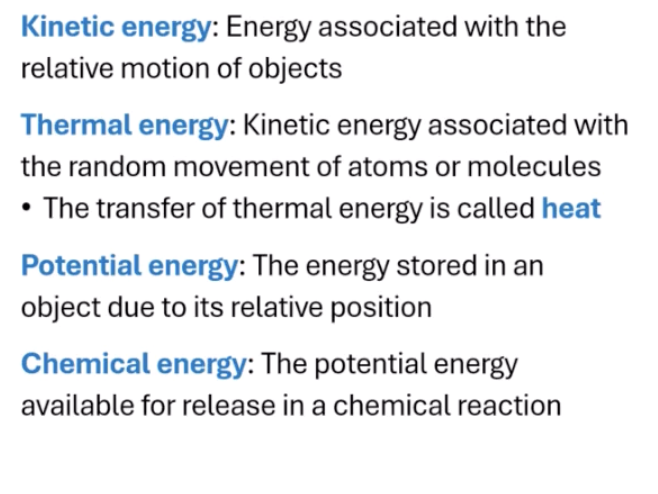
What is the thermodynamic study? What are the laws?
A system refers to the matter under study; everything else is the surroundings
First law: Energy can be transferred and transformed, but it cannot be created or destroyed
Second law: Every energy transfer or transformation increases the entropy (disorder) of the universe.
What is Gibbs free energy (G)
The portion of a system’s energy that can perform work
Change in free energy calculated as:
∆G = ∆H - T∆S
∆ (change)
G (Gibbs free energy)
H (enthalpy [total energy])
T (absolute temperature)
S (entropy)
Change in free energy can also be represented as: ∆G = Gfinal - Ginitial
What are the different types of Gibbs free energy?
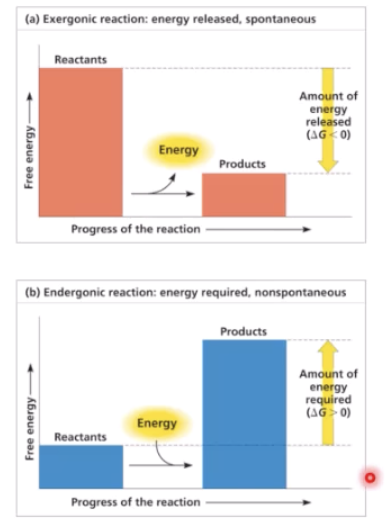
Exergonic reaction (G is negative): energy released, spontaneous
Endergonic reaction (G is positive): energy required, non spontaneous
What is activation energy?
Energy that is required to start a chemical reaction ( for the reactans to reach the transition state) , Determines rate of reaction ( fast or slow)
What is the transition state?
Molecules in an unstable condition, resulting from having absorbed enough energy for the bonds to break

How does activation energy have an impact on endothermic reactions and exothermic reactions?
The amount of activation energy required is what determine the rate of the chemical reaction
more activation energy = slow reaction
How do enzymes affect activation energy?
Catalysts- molecules that speed up a chemical reation, but are not consumed in the reaction, by decreasing activation energy without impacting ∆G. (basically make the hill smaller)

What is a substrate?
The reactant(s) on which an enzyme acts.
The substate specificity is determined by the enzyme’s shape. Enzymes interacted with the substate with their active site which is a complementary size and charge to the substrate.
How can enzymes lower activation energy?
Correctly orienting substrates:
So they can properly react
Distorting the substrate bonds
Reducing the amount of energy needed to break them
Provide an appropriate microenvironment
for the reaction to occur
Directly participate in reaction
Following the reaction the original state of the enzyme is restored
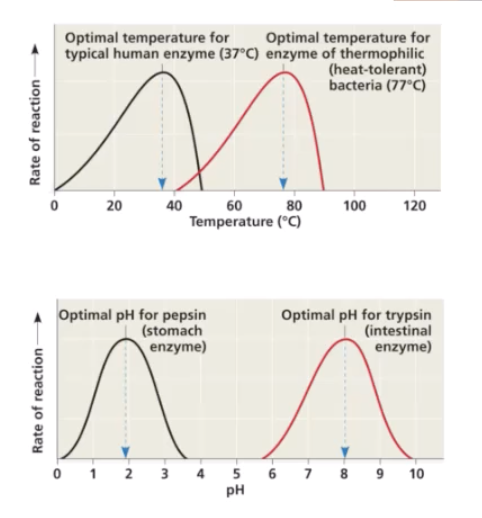
What influences enzyme activity?
Temperature
pH
Also some enzymes can’t work alone they need:
Non protein cofactors
coenzymes
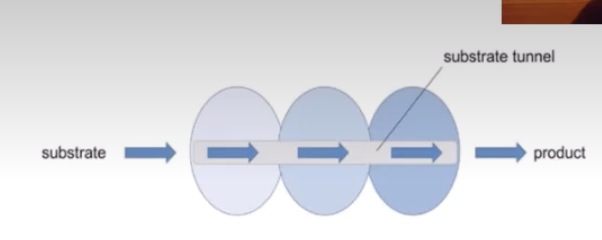
How can enzymes be organized
Localized within the cell
found within specific organelles
Form multi-enzyme complexes ( improves efficentness for reactions)
What are enzyme inhibitors? What are the types?
Somme chemicals selectively inhibit the activity of certain enzymes through reversible or non-reversible mechanisms
Competitive: blocks active site ( preventing the substrate from entering)
Noncompetitive inhibitors: Interacts with enzyme away from the active site

What is allosteric regulation? Give an example
The binding of a regulatory molecule to protein at one site that affects function at different site
Can activate or inhibit an enzyme
Feedback inhabitation: A form of allosteric regulation where the regulatory molecule is an end product of the same metabolic pathway
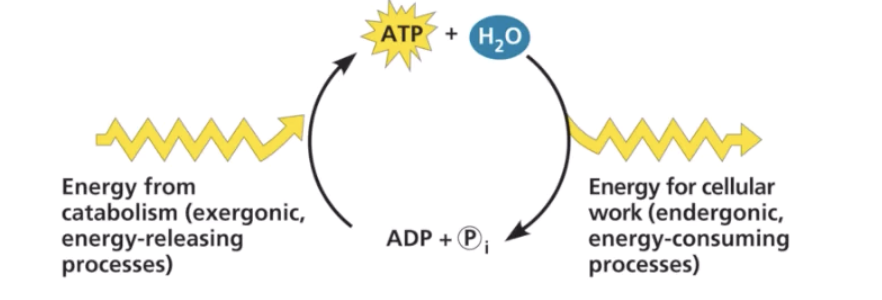
What is energy coupling?
Cells do 3 kinds of work: chemical, transport, and mechanical
This is accomplished through energy coupling- the coupling of an exergonic process to an endergonic process
Breaking the bond needs energy
Forming the bond releases energy
What is cellular respiration? What are the types?
The catabolic pathways that breakdown organic compounds into waste products and energy
Aerobic respiration: consumes oxygen as a reactant
Anaerobic respiration: replaces oxygen with another inorganic molecule
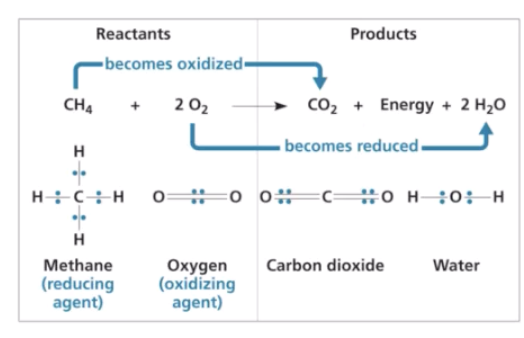
What is oxidation-reduction reactions (redox)
Chemical reactions involving the transfer of electrons, which from the basis of extracting energy from organic compounds
Can involve partial electron transfer
Oxidation is the loss of electrons (reducing agent- electron donor)
Reduction is the gain of electrons (oxidizing agent- electron acceptor)
What is nicotinamide adenine dinucleotide NAD+ and NADH?
Coenzymes that are electron carriers
Oxidize version is NAD+ (no electron)
Reduced form is NADH (with electron)
What is dehydrogenases?
Redox reactions that form NADH= dehydrogenases reactions they are catilized by dehydrogenase enzymes
Enzymes that transfer 2 electrons and proton from an organic comound to NAD+, producing NADH

Explain what is going on in the photo

What is glycolysis? What are the 2 pathways?
The breakdown of glucose into 2 molecules of pyruvate
The Embden-Meyerhoff-Parnas (EMP) pathway
Entner-Doudoroff (ED) pathway
What is the reaction of glycolysis?

What is pyruvate oxidation? And what is there reactions?
Occurs in the mitochondria (eukaryotes) or the cytosol (prokaryotes) and connects glycolysis to the critic acid cycle

What is the citric acid cycle? What is it’s reaction?
Considered a cycle as it starts and ends with oxaloacetate

What is oxidative phosphorylation? What are the stages?
The synthesis of ATP through the energy released by the transder of electrons from NADH and FADH2 to O2
1. The electron transport chain
2. Chemiosmosis
What is the electron transport chain?
The transfer of electrons to O2 (pulls all the electron through because of its electronegativity) through a series of redox reactions involving multiprotein complexes tightly bound to non-protein prosthetic groups
Some redos reactions are coupled to the export of protons, establishing a proton-motive force

What is chemiosmosis?
An energy-coupling mechanism that uses energy stored in the form of an H+ gradient across a membrane (the proton-motive force) to drive cellular work
protons come back down after being pumped out and when they come down they make ATP synthase which creates ATP.

What is the maximun of ATP? Where are they distributed?
30 to 32

What is regulation of cellular respiration?
A key step of regulation is the enzyme phosphfructokinase of glycolusis, allosterically regulated by ATP, AMP, and citrate
What is anaerobic respiration?
like aerobic respiration but O2 is replaced by other molecules like sulphate, methane, or nitrate
It is less efficient because these molecules are waker at oxidizing
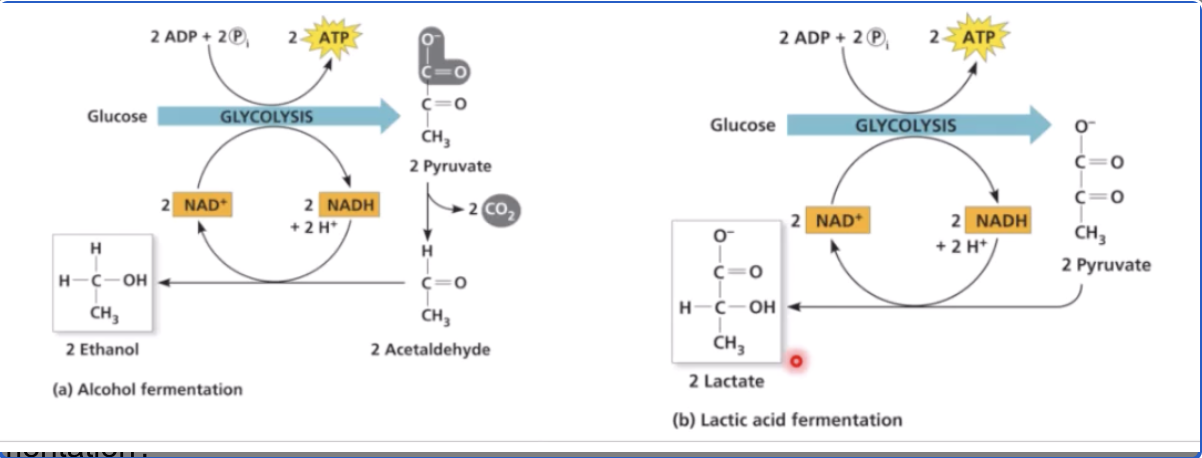
What is fermentation?
Does not require oxygen
Skips the electron transport chain, relying solely on substrate-level phosphorylation
Recycles NADH to NAD+ via electron transfer to pyruvate
What are examples of fermentation?
Alcohol fermentation
Lactic acid fermentation
