PSYC 494 Exam Study Guide
 Call Kai
 Learn
Learn Practice Test
 Spaced Repetition
 Match
Match Flashcards
 Knowt Play
1/58

There's no tags or description
Looks like no tags are added yet.
Name | Mastery | Learn | Test | Matching | Spaced | Call with Kai | Chat |
|---|
No analytics yet
Send a link to your students to track their progress
59 Terms
Telemental health (TMH)
providing behavioral health services with telecommunications technologies (including telephones - we had tmh before the internet)
eHealth
using the internet to provide services (e.g., videoconferencing, mobile apps, interactive websites, text messaging, email, etc.
What were the results of the 2021 general population study? (Fischer et al.,
2021)
53.6% of patients receiving behavioral health services used telehealth
Lower utilization by
Females
Those 60+
Non-Hispanic Whites (relative to non-Hispanic Blacks)
Those with less than a high school education (relative to college degree)
What were the results of the 2021 Veterans Affairs study? (Connolly et al.,
2021)
Number of patients using telemental health via videoconferencing (TMH-V) increased 556% from March to April 2020
77.5% of patients were first-time TMH-V users
What were the results of the National Center for Health Statistics study?
(NCHS, 2022)
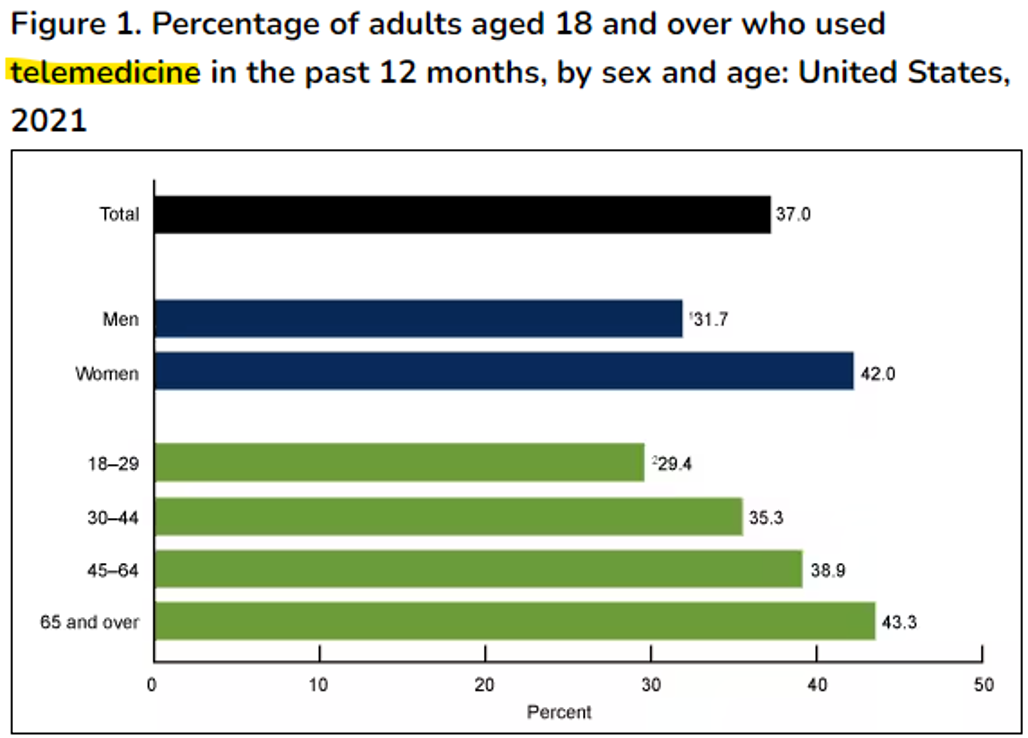
In 2021, 37.0% of adults used telemedicine in the past 12 months.
Telemedicine use increased with age, and was higher among women (42.0%) compared with men (31.7%).
Non-Hispanic White (39.2%) and non-Hispanic American Indian or Alaska Native (40.6%) adults were more likely to use telemedicine compared with Hispanic (32.8%), non-Hispanic Black (33.1%), and non-Hispanic Asian (33.0%) adults.
The percentage of adults who used telemedicine increased with education level and varied by family income.
The percentage of adults who used telemedicine varied by region and decreased with decreasing urbanization level.
How large is telehealth predicted to grow by 2031? (Maheu, 2022)
Telehealth is predicted to grow to a quarter-trillion-dollar industry by 2031 (Maheu, 2022)
What did the Missouri S&T
researchers do to assess levels of depression, anxiety, and internet addiction in
students?
Monitor school internet uses of students to predict anxiety and depression. Found that high shifting between file, music, movie, email for a low duration was predictive of depression. they didn’t track the content but the data
Remote patient monitoring (RPM)
monitoring vital signs and other medical metrics across geographic distance
Remote therapeutic monitoring (RTM)
transmission of behavioral metrics across distances (e.g., exercise schedules, sleep programs, self-rating scales)
Mobile health (mHealth)
health content or services provided on mobile devices (e.g., smartphones, tablets)
Originating site
The site of care delivery where the client or patient is located. May be a remote clinic, community center, or residence
Distant site
The clinician’s location.
Spoke
The client’s or patient’s location
Hub
The clinician’s location
Clinically supervised
Locations with on-site clinical staff, such as clinics, mental health centers,
and other health care locations. Private room like VA, for session, monitored
Unsupervised
The home of the health care consumer or other locations that may not have clinical staff on-site.
What are benefits of telemental health we discussed?
clinical interviews, psych testing, treatment, transmission of health data / assessment data, clinical supervision, clinical consultation and /or case management
What are the potential drawbacks of telemental health we discussed?
lack of privacy, wifi issues, less connection, lack of body language
Improved access
u80 million Americans live in health professional shortage area
uTypically rural —> less access to mental health insurance, limited transportation options
u55% of US counties have no practicing psychologists, psychiatrists, or social workers (Valentino, 2016)
uVC approaches have been successful in urban areas for
uUnder-resourced populations who are not familiar with mental health services
uThose who find it difficult to navigate complicated city transit systems
uThose who feel intimidated by large medical centers
uHomeless individuals
uTMH increases access to specialty areas (e.g., neuropsychology) and clinicians from particular cultural groups (e.g., military, older adults)
Decreased stigma
uIssues of confidentiality in small communities (Cowan et al., 2019; Larson & Corrigan, 2010)
Clinical benefits
uPatients feel less inhibited and more comfortable in their own homes —-> improves participation in treatment (Pruitt et al., 2014)
uAdolescents prefer control of their environment through technology (Myers et al., 2017)
uComfort of “being at home” (e.g., in dorm) for college students; comfort with interacting with world via technology for millennials and later generations (Misner, 2014; Nelson & Bui, 2010)
uEasier to involve support system (e.g., spouse, roommate) in patient’s treatment
Convenience
uPatient-centered care
uExtended hours of service
uEasier follow-up with patients (e.g., between appointments)
uIncreased continuity of care
uCould facilitate integrated care consistent with patient-centered medical home concept
uPractitioners: access to other professionals for consultation
Economic benefits for patients
uLower cost of service
uLower/eliminated travel, childcare costs
patient-centered medical home concept
one shared electronic record
Economic benefits for clinicians
uReduced overhead (office space)
Types of communications
synchronous, asynchronous, hybrid
Potential drawbacks for patients
uUnfamiliarity with required technologies
uDiscomfort with “artificial” interaction through technology
uSafety planningPoten
Potential drawbacks for clinicans
uUnfamiliarity with required technologies
uDifficulty reading nonverbals (for non-VC)
uSafety planning
Synchronous
Life, real-time interactive two-way communication
Asynchronous
Also, store and forward —> information or data are collected and later sent to another location via electronic communication. Not interacting in real-time
Hybrid
Combine synchronous, asynchronous, and/or in-person
Advantages for videoconferencing
uCloser to natural in-person social experience
uHelps practitioner verify identity
uOften reimbursable via insurance
Tech used for videoconferencing
camera, microphone, video, monitor, broadband internet
Possible VC features
file sharing, electronic whiteboard, instant messaging, integrated calendar system, integration with EHRs
Drawbacks to telephone use?
Can’t read body language
VoIP
voice over internet protocol, landline from internet provider
What are web-based applications?
uSelf-directed, can be paired with coaching or therapist support
uPairing web modules with therapist support increases adherence and outcomes (Morh et al., 2013)
uMay include psychoeducational or intervention content via interactive platforms
uAI advances allow machine-learning to tailor content to the user
uCan be used to administer and score assessments
What should they be paired with to increase adherence and outcomes?
coaching or human support, in
tandem with online content
What suicide prevention apps were discussed
iBobbly, Virtual Hope Box, Therapeutic Evaluative Conditioning, BlueIce
What were the outcomes? (Did they help?)
Primary outcomes: SI, non-suicidal, self-injury, suicidal behavior, intent. SI: 0/4 all apps except Virtual Hope Box covered all primary outcomes. Secondary outcomes: anxiety, depression symptoms: 4/4
How do mobile devices contribute to the quantified self concept?
a movement supported by an ever-increasing array of smart device apps that allow the user to acquire a broad range of data pieces about themselves (e.g., mood, sleep, activity, food intake) by self-tracking and auto-analytics, whereby the user is empowered by mobile technology to quantify their biometrics and compare them with the biometrics of millions of other people (Lupton, 2013).
Internet of things (definition)
allowing users to interconnect mobile and computerized devices (e.g., sensors) that can communicate with each other via the internet. “smart devices”
How should telehealth equipment and settings be optimized?
consider placement of patient and clinician camera (what is shown in the background). camera control (angle, zoom in/out) The use of multiple monitors. uHow much is too much to share with patient about tech specs? Potential impact of over-sharing. not 100% secure protection. screen size. Microphone quality. Will a smartphone video screen be adequate for clinical purposes in emergencies? What will be adequate in the long term for psychotherapy? How do ergonomic factors play into such technology use.
What should be considered when creating a backup plan for disruptions to a
telemental health session?
what if internet stops working? telephone or voip. what backups to use? what subtests to use in place of ruined subtest. emergency plan. bandwidth specs. hipaa requirements
What are special ethical and legal considerations for telepsychology?
uGeographical distance between patient and practitioner
uUse of technology as the medium of service provision
Where can clinicians practice telemental health?
uCheck state laws, licensing requirements
u Majority of states have telehealth laws (APA, 2013)
uIn general, legal and regulatory requirements are based on where the patient is located (but can also include clinician location, too)
u However, this is changing
uMany states have parity between in-person and TMH
What is parity?
mental health in person and remote reimbursment
Ethical/legal perspective on “life coaches” and “consultants”
bad. must have a license to practice clinical
What is PSYPACT?
membership where you can practice telemental health in certain states other than your own. medium blue color states on the map
Currently, how many states have enacted PSYPACT legislation?
46 enacted and 43 effective PSYPACT participating states
Duty to report
mandated report. report harm or suspected elder/vulnerable person or child abuse.
Duty to warn/protect
client has potential victim, warn potential victim via police. e.g. Tarasoff case. mental wellness check, protect from self
Civil Commitment
Threat to themself, temporary hospitalization, can’t take care of themself
What federal legislation includes rules for healthcare data privacy,
encryption, etc.
HIPAA
What room-related privacy issues should be addressed?
Incidental disclosure, informed consent
Business associates agreement (definition)
HIPAA contract with outside agency (billing, etc) to promise to protect and encrypt PHI and ePHI from risk of breach.
What is informed consent?
process whereby the recipient of care is given adequate information to make an informed choice about the care to be received
What guidelines should be referenced when creating an informed consent for
telemental health?
Guidelines for the Practice of Telepsychology (APA, 2013)
What special topics/information should be included in informed consent for
telemental health?
u Limits of confidentiality when using electronic communications
u Emergency plan with contact info for local resources
u How documenting/storing information
u Possibility of technical failure
u Protocol for contact between sessions
u Times of availability
u Referrals
u Areas where client can take calls/sessions
u When TMH may be terminated and face-to-face care recommended