12: Socioemotional Development in Adolescence
 Call Kai
 Learn
Learn Practice Test
 Spaced Repetition
 Match
Match Flashcards
 Knowt Play
1/54

There's no tags or description
Looks like no tags are added yet.
Name | Mastery | Learn | Test | Matching | Spaced | Call with Kai | Chat |
|---|
No analytics yet
Send a link to your students to track their progress
55 Terms
self-esteem
the self-esteem of girls declines more during adolescence
Self-esteem reflects perceptions that do not always match reality
For example, one’s perception of one’s own intelligence or attractiveness
Thus, high self-esteem may refer to accurate, justified perceptions—but it can also indicate an unwarranted sense of superiority
Narcissism
a self-centered and self-concerned approach toward others
Self-regulation is important to many aspects of adolescents’ lives.
Academic achievement
Good health habitsAvoiding risky behavior
a key component is effortful control, which involves
inhibiting impulses
not engaging in destructive behavior
focusing and maintaining attention despite distractions
initiating and completing tasks that have long-term value, even if they may seem unpleasant
identity is a self-portrait composed of many pieces and domains
vocational/career identity
political identity
religious identity
relationship identity
achievement, intellectual indentity
sexual identity
cultural/ethnic identity
interests
personality
physical identity
Erikson’s view
the 5th developmental stage, experienced in adolescence: identity vs. identity confusion
the search for identity is aided by a psychosocial moratorium— the gap between childhood security and adult autonomy
Adolescents experiment with different roles and personalities
Adolescents who cope with conflicting identities emerge with a new sense of self
Adolescents who do not successfully resolve the identity crisis suffer identity confusion
Developmental changes:
the individual can now sort through and synthesize childhood identities to construct a path toward maturity
James Marcia classifies individuals at this stage based on the existence or extent of their crisis or commitment
Crisis: a period of identity development during which the adolescent is exploring alternatives
Commitment: a personal investment in identity
Marcia’s four statuses of identity
identity diffusion
identity foreclosure
identity moratorium
identity achievement
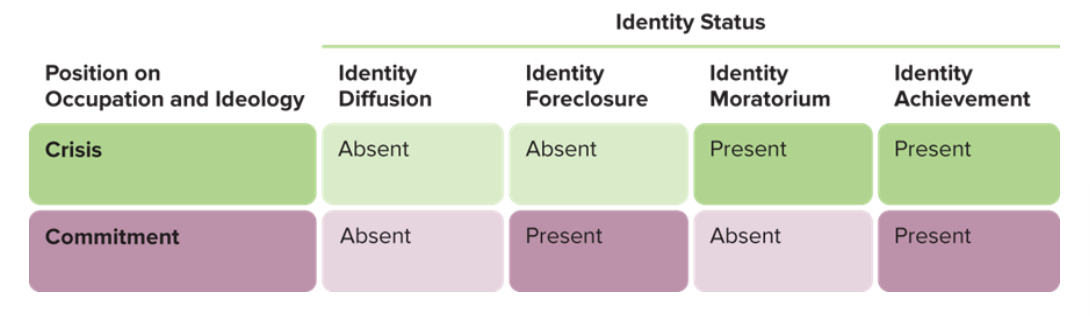
identity diffusion
individuals who have not yet experienced a crisis (explored meaningful alternatives) or made any commitments
identity foreclosure
those who have made a commitment but have not experienced a crisis
identity moratorium
those who are in the midst of crisis, but their commitments are either absent or vaguely defined
identity achievement
those who have undergone a crisis and have made a committment
Emerging adulthood and beyond:
Key changes in identity are more likely to take place in emerging adulthood—or later—than in adolescence.
College can have significant effects, including increased complexity in reasoning and a wide range of new experiences
Note that identity does not remain stable throughout life
Many follow “MAMA” cycles: from moratorium to achievement to moratorium to achievement
the first identity should not be expected to be the final product
Ethnic identity
an enduring aspect of the self that includes a sense of membership in an ethnic group and the attitudes and feelings related to that membership
many adolescents develop a bicultural identity, based on both their ethnic group and the majority culture.
Pride in one’s ethnic identity group and a strong ethnic identity and connection has positive outcomes
Influenced by positive and diverse friendships
Although important to many, religious interest among adolescents has declined in the twenty-first century
Assessed in terms of frequency of prayer, discussion of teachings, and deciding moral actions for religious reasons, along with the overall importance of religion in everyday life.
Adolescent girls are more religious than are adolescent boys
Emerging adults in less developed countries are more likely to be religious than their counterparts in more developed countries
Cognitive development and religion in adolescence:
More so than in childhood, adolescents think abstractly, idealistically, and logically
The increase in abstract thinking lets adolescents consider various ideas about religious and spiritual concepts
Increased idealistic thinking provides a foundation for considering religion’s role in a better world
An increased capacity for logical reasoning enables them to develop hypotheses and sort through answers to spiritual questions.
The positive role of religion in adolescents’ lives
Religion plays a role in adolescents’ health and has an influence on whether they engage in problem behaviors
Research links religiosity or spirituality to a decreased likelihood of engaging in substance use and to positive health outcomes
In one study, spirituality but not religiosity was linked to higher life satisfaction.
Many religious adolescents adopt their religion’s message about caring and concern for people
Increased likelihood of engaging in community service.
A key aspect of the managerial role of parenting is effective monitoring
Supervising adolescents’ choice of social settings, activities, and friends
Supervising academic efforts
Higher levels of monitoring and rule enforcement are linked to
Engaging later in sex and using condoms
Getting more sleep
Better health behavior in adolescence and college.
A current interest focuses on adolescents’ management of their parents’ access to information
Disclosing or concealing information about their activities.
When parents engage in positive parenting practices, adolescents are more likely to disclose information.
This disclosure is linked to positive adolescent adjustment.
Adolescents who engage in problem behaviors are more secretive and disclose less to parents
Adolescents often have a strong desire to make their own decisions—and to spend time with friends
Adolescents’ ability to attain autonomy is acquired through appropriate adult reactions to their desire for control
When given autonomy, teens feel they have more independence and a better parental relationship
Boys are typically given more independence
Cultural diversity in timing and roles must also be considered
The role of attachment
Securely attached adolescents are less likely to have emotional difficulties and to engage in problem behaviors, juvenile delinquency, and drug abuse
Balancing freedom and control
Adolescents still need to stay connected with their family
For example, those who do not eat with a parent on most days have higher rates of substance use.
A high monitoring, high autonomy support parenting profile is positively linked to adolescent adjustment.
Developmental advantages occur when friends are:
Socially skilled
Supportive
Oriented toward academic achievement
Developmental disadvantages are more likely with friends who:
Coercive friends who encourage drinking
Conflict-ridden, poor-quality friendships
Five ways social media use transforms adolescent peer relationships
Changing the frequency or immediacy of their experiences
Amplifying their experiences and demands
Altering the qualitative aspects of their interactions
Facilitating new opportunities for their compensatory behaviors
Creating completely novel behaviors
Young adolescents conform more to peer standards than children
Boys are more influenced by peer pressure involving sexual behavior than girls
Adolescents with low self-esteem and high social anxiety are most likely to conform to peers and during transitions (for example, a new school).
Clique
a small group of about five or six individuals that may form among adolescents who engage in similar activities
May also form because of friendship.
Crowd
a larger group structure that is usually based on reputation
Members may or may not spend much time together
Most are defined by the activities adolescents engage in— that is, “jocks” and “druggies.”
Peer Groups
The appearance of the Coronavirus (COVID-19) in 2020 quickly affected the ways friendship and peer relations take place
Social distancing—maintaining a distance of 6 feet or more from others—may for some increase feelings of social isolation
In this respect, the dramatic increase in social media use may prove to be of great value, allowing adolescents to stay connected with friends and peers online.
Three stages characterize the development of romantic relationships in adolescence
Entry into romantic attractions and affiliations at about 11 to 13 years of age
Exploring romantic relationships at approximately 14 to 16 years of age, often through casual dating and dating in groups
Consolidating dyadic romantic bonds at about 17 to 19 years of age
Two variations are considered early bloomers and late bloomers
Dating in gay and lesbian youth
Many date other-sex peers, which can help clarify their sexual orientation or disguise it from others
Most gay and lesbian youth have had some same-sex experience, often with peers who are “experimenting.”
Sociocultural contexts and dating
Cultures, values, beliefs, and traditions often dictate the age at which dating begins, how much freedom is allowed, whether dates must be chaperoned, and the roles of males and females
Dating can be a source of conflict in families, especially if parents grew up in a culture where little freedom is allowed
Dating and adjustment
Experiencing romantic encounters can increase social acceptance, friendship competence, and romantic competence
Supportive romantic relationships can improve the likelihood of positive outcomes for adolescents experiencing conflict in other parts of their lives.
Having more romantic relationships can also have negative implications
Higher levels of substance use, delinquency, and sexual behavior
In girls, depression and pregnancy.
Health
Overall, fewer adolescents die from infectious diseases and malnutrition today; but health-compromising behaviors are increasing in frequency
Gender
The experiences of boys and girls continue to be quite different
In much of the world, males have far greater access to education, a variety of careers, and leisure activities
Far more restrictions are placed on the sexual activity of adolescent females than on that of males
Differences are narrowing over time, however.
Family
In some countries, families are close-knit and have extensive kin networks; but current trends of mobility and migration are bringing change
Countries like the United States are seeing greater numbers of divorced families and stepfamilies
Peers
In some regions, peer relations are restricted (especially for girls); in others, the peer network can serve as surrogate family
Activities
U.S. adolescents have far more discretionary time than adolescents in other industrialized countries
When given a choice, they typically engage in unchallenging activities such as hanging out and watching TV
rite of passage
signal the adolescent’s move to maturity and achievement of adult status
Jewish bar and bat mitzvah and the Catholic confirmation
School graduation may be the most culture-wide rite of passage in the United States
The following factors appear to improve academic achievement for children living in poverty
greater academic commitment
emotional control
family involvement
a supportive school climate
Immigration
Immigrants often experience stressors uncommon to or less prominent among long-time residents
Language barriers
Dislocations and separations from support networks
The dual struggle to preserve identity and to acculturate
Changes in socioeconomic status.
Many individuals in immigrant families are also dealing with the problem of being undocumented
The ways ethnic minority families deal with stress depend on many different factors
Ethnicity and socioeconomic status:
Ethnicity and SES can interact in ways that exaggerate the influence of ethnicity, because ethnic minorities are overrepresented in the lower-SES levels of American society.
Thus, many ethnic minority adolescents experience a double disadvantage:
prejudice, discrimination, and bias because of their ethnic minority status
Stressful effects of poverty
Economic advantage among middle-income ethnic minority youth does not mean they escape prejudice, discrimination, and bias.
Screen time includes how much time individuals spend watching TV or DVDs, playing video games, and using computers or mobile media devices
Nighttime mobile phone use and poor sleep behavior increases from 13 to 16 years of age
Among both girls and boys, heavy users of digital media are twice as likely to have low psychological well-being.
The more screen time adolescents have, the more their academic achievement suffers
One major trend is the dramatic increase in media multitasking, which at a general level is distracting and impairs performance on many tasks.
A national survey also revealed dramatic increases in adolescents’ use of social media and text messaging
In 2019, 15- to 17-year-olds spent an average of three hours and four minutes each day engaging in screen time (Livingston, 2019)
Less screen time has been linked to better health-related quality of life among adolescents.
Text messaging is the preferred method of contact with friends, while voice mail is used to connect with parents
Juvenile delinquent
an adolescent who breaks the law or engages in behavior that is considered illegal.
Delinquency rates
Males are more likely to engage in delinquency than females
Rates among minority groups and lower-SES youth are especially high
Causes of delinquency
Lower-SES culture
Parents less skilled in discouraging antisocial behavior
Siblings and delinquent peers.
Factors contributing to depression
Genes
Certain family factors
Poor peer relationships
Treatment of depression
Drug therapy using serotonin reuptake inhibitors
Cognitive behavioral therapy
Interpersonal therapy
In the United States, suicide is now the third-leading cause of death in 10- to 19-year-olds
Adolescents contemplate or attempt it unsuccessfully more often than they actually commit it.
Females are more likely to attempt suicide, but males are more likely to succeed.
Risk factors for suicide
History of family instability and unhappiness
Lack of supportive friendships
Cultural contexts and genetic factors
Depressive symptoms
The four problems that affect the most adolescents are
Drug abuse.
Juvenile delinquency
Sexual problems
School-related problems.
A review of the programs that have been successful in preventing or reducing adolescent problems found these common components
Intensive individualized attention
Community-wide multiagency collaborative approaches
Early identification and intervention.