Energy Flashcards
 Call Kai
 Learn
Learn Practice Test
 Spaced Repetition
 Match
Match Flashcards
 Knowt Play
1/77

There's no tags or description
Looks like no tags are added yet.
Name | Mastery | Learn | Test | Matching | Spaced | Call with Kai | Chat |
|---|
No analytics yet
Send a link to your students to track their progress
78 Terms
Put the three states of matter in order of increasing internal energy.
Solid, liquid, gas
Define internal energy.
The total amount of kinetic energy and potential energy of all the particles in a system.
Describe the effect of heating on the internal energy of a system.
The internal energy increases.
State the SI unit of energy.
Joules (J)
Energy stores list
Kinetic store
Gravitational potential store
Elastic potential store
Chemical potential store
Thermal store
Nuclear
Magnetic
Electrostatic
Heating a substance increases its internal energy.
When a substance is heated (when you add energy), the internal energy can change in two ways:
Kinetic energy (of the particles) increases, causing them to move faster: temperature rises
Potential energy increases: energy is used to weaken or break intermolecular bonds and the substance changes state. Temperature remains constant
Specific Heat Capacity definition
Specific heat capacity is the energy needed to raise the temperature of 1 kg of a substance by 1 ºC.
The temperature change of a material when it is heated depends on three things:
mass of the substance
the material it is made from
how much energy is transferred to it.
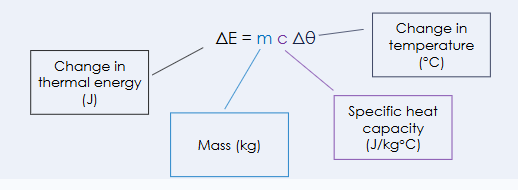
specific heat capacity equation (change in thermal energy = mass x specific heat capacity x change in temperature)
Specific Latent Heat definition
Specific latent heat of a material is the energy needed to change the state of 1 kg of the substance with no change in temperature.
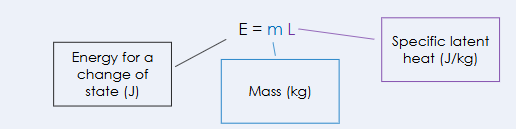
Specific latent heat equation (energy for a change of state = mass/ specific latent heat)
Specific latent heat of fusion refers to…
a change of state from solid to liquid. melting
Specific latent heat of vaporisation refers to
a change of state from liquid to vapour (gas).
State the different pathways by which energy can be transferred between stores.
Mechanically, electrically, by heating, or by radiation.
What is temperature?
A measure of the average kinetic energy of the particles.
Define density
The amount of mass in a given volume
Describe the movement of particles in a gas.
Particles can move freely, quickly, and randomly in all directions.
Thermal energy definition
Thermal energy is a measure of the total kinetic energy of the particles in a substance.
When there is a temperature difference between two object, energy is always transferred from the … object to the … object
hotter object to the cooler object
Conduction meaning
Conduction is thermal transfer by the vibration and collision of particles.
It is the way energy is transferred through heating by contact from something hot to something cooler.
Process of conduction, and why metals are good conductors
The particles near the heat source start to vibrate.
These vibrations are passed onto the atoms next to them, which passes the vibrations through the material.
Metals are especially good thermal conductors because they contain free/delocalised electrons. These electrons can move and collide with ions further away from the source of heat and so transfer their energy more quickly
Investigating the effectiveness of materials as thermal insulators practical
Place a small beaker into a larger beaker.
Fill the small beaker with hot water from a kettle.
Put a piece of cardboard over the beakers as a lid. The lid should have a hole suitable for a thermometer.
Place a thermometer into the smaller beaker through the hole.
Record the temperature of the water in the small beaker and start the stopwatch.
Record the temperature of the water every 2 minutes for 20 minutes.
Repeat steps 1-6, each time packing the space between the large beaker and small beaker with the chosen insulating material.
Why is a higher resolution thermometer good?
It can record to more decimal places: more accurate
Explain the difference between speed and velocity.
Speed is the distance covered per unit time whereas velocity is speed in a given direction.
Explain the difference between mass and weight.
Mass is the amount of matter in an object whereas weight is the effect of gravity on the mass.
Define kinetic energy
Kinetic energy is the energy store found in any moving object, not just the particles inside it.
State how much kinetic energy a stationary object has.
Stationary objects have no kinetic energy
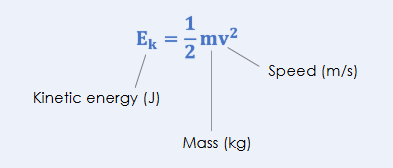
kinetic energy equation (kinetic energy = 0.5 x mass x (speed)2
Elastic potential energy definition
Elastic potential energy is the store of energy in objects that have been stretched or compressed.
When a spring is stretched or compressed…
work is done on the spring
its elastic potential energy store is filled
Extension measures
stretching and deformation
Extension is…
how much the spring is stretched
It is the difference between the stretched length and the original length of the spring.
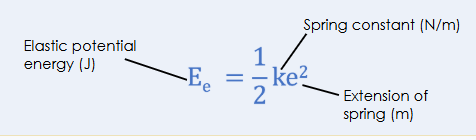
elastic potential energy equation (Ee = 0.5 x spring constant x extension of spring2)
Describe the energy transfer that takes place when an object is stretched or compressed.
Work is done when an object is stretched or compressed and energy is transferred to the elastic potential energy store
Describe the relationship between work done in stretching or compressing an object and its store of elastic potential energy.
State the condition needed for this relationship to apply.
The work done in stretching an object is equal to the store of elastic potential energy in it
It has to be stretched within the elastic limit (not elastically deformed(permanently bent))
When an object is elastically deformed, it can return to its original shape when…
the force is removed
how to find the extension
Measure the length of the spring before it is stretched
Apply a force and measure the length of the spring when it is stretched
The difference between the original length and the stretched length is the extension
Gravity definition
Gravity is an attractive non-contact force between all objects with mass.
Gravity pulls all things with mass towards each other.
On Earth, an object which is free to move falls towards the centre of the Earth.
All objects with a mass have a gravitational force.
What is the difference between mass and weight? & what are they measured in
The mass of an object is the amount of matter it contains.
It is measured in kilograms using a balance.
The mass of an object does not change unless material is added or taken away from the object.
Weight is the force of gravity acting on a mass.
Weight is measured in Newtons using a Newtonmeter.
gravitational field strength unit
N/kg
Gravitational potential energy definition
Gravitational potential energy is the store of energy in objects due to their position in a gravitational field.
When an object is lifted above the ground, its gravitational potential energy store is…
filled
State how much gravitational potential energy an object on the ground has.
0
gravitational field strength on earth
9.8N/kg
The Law of Conservation of Energy states that…
the total energy of a closed system remains constant. This means that energy cannot be created or destroyed, only transferred between different stores.
Energy can be transferred…
mechanically (by the action of a force), electrically (by an electric current), by radiation or by heating
friction / air resistance means…
not all energy is transferred to gravitational potential energy, some is transferred to the thermal store of surroundings etc.
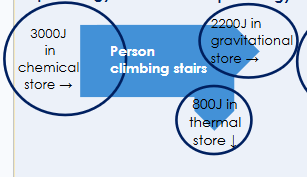
interpet this sankey diagram
3000J = input energy
other is output energy
What are Sankey diagrams used for?
Sankey diagrams are used to demonstrate the efficiency of energy transfers. They are easy to interpret diagrams.
What does it mean to be efficient?
If something transfers more of its energy in a useful way (or wastes less energy) we say it is more efficient.
In any system change where energy is transferred, some energy is…
Some of that … energy may be … into the surroundings, including by ...
wasted
wasted
dissipated
heating
what is friction, and how can it be reduced to increase efficiency?
In mechanical systems, where two surfaces rub together, energy is dissipated because of friction.
This friction can be reduced by adding a lubricant.
How can energy transfer be reduced?
How would this affect the efficiency?
Reduce friction by adding a lubricant
Thermal insulation e.g. in a house: roof & wall insulation, using curtains, double-glazed windows
The efficiency would increase because less energy would be wasted.
Why is energy transferred from a house to the outside?
There is a temperature difference between outside and inside the house, so energy is transferred from the warmer object (the house) to the colder object (outside).
Explain what efficiency is a measure of.
The proportion of energy that is transferred usefully.
Describe the energy transfer that takes place when a car starts moving.
Chemical energy is transferred (mechanically) to kinetic energy and thermal energy.
What do we need energy for?
heating
appliances
transport
factories
etc.
A renewable energy resource definition
A renewable energy resource is one that is being (or can be) replenished as it is used.
Examples of renewable resources
biofuels
wind
hydroelectricity
geothermal
tidal
solar power
waves.
Non-Renewable Energy Resources & how they work
Fossil fuels are non-renewable energy resources.
Examples of fossil fuels are coal, oil and natural gas.
Fossil fuels can be burned to heat water, which produces steam.
The steam turns a turbine, which powers a generator.
When fuels are burned, this reaction is called ...
combustion
fuel + oxygen 🡪
carbon dioxide + water
Burning fuels can result in some of the products below: (& what are they)
Carbon dioxide (CO2)
Carbon monoxide (CO)
Sulfur dioxide (SO2)
Oxides of nitrogen (NO and NO2)
Along with unburned fuel and solid particles, all of these substances are pollutants.
Nuclear fuels release energy through...
nuclear reactions, which can involve the breaking up of atomic nuclei
The energy released through the nuclear reactions is used to heat water to produce steam, similar to burning fossil fuels.
Examples of nuclear fuels
uranium and plutonium
What are the advantages and disadvantages of using nuclear energy?
Nuclear energy has an advantage over fossil fuels in that it does not produce carbon dioxide (or sulfur dioxide) in the reaction, meaning that it does not have the same contribution to global warming. However the use of nuclear energy comes with significant risks, with accidents at nuclear power stations being extremely dangerous both immediately and long term
If there is an accident, large amounts of radioactive material could be released into the environment and nuclear waste remains radioactive and harmful to health for thousands of years. It must be stored safely and disposed of safely, both of which are expensive to maintain.
Describe the advantages and disadvantages of using natural gas as an energy resource.
Natural gas is a non-renewable resource, so will eventually run out
Natural gas is burned to release energy
This releases carbon dioxide, which contributes to global warming
They release a large amount of energy, so they are reliable
They can also be used on demand
Describe the advantages and disadvantages of using nuclear power as an energy resource.
Nuclear power is a non-renewable resource as it cannot be replenished as it is used
It does not release carbon dioxide, so does not contribute to global warming
It releases a large amount of energy, so they are reliable can also be used on demand
However, accidents at nuclear power stations can be very dangerous, so radioactive material must be stored and disposed of carefully, which is expensive
Describe the advantages and disadvantages of burning coal as an energy resource.
Coal is a fossil fuel, so is a non-renewable resource and will eventually run out
Burning coal releases carbon dioxide, which contributes to global warming
It also produces other pollutants, such as sulfur dioxide and oxides of nitrogen
Burning coal releases a large amount of energy, so is reliable
what contributes to acid rain?
sulfur dioxide
compare ways that different energy resources are used
fossil fuels: electricity generation, transport fuels, heating, industrial processes: reliable, widely available, non-renewable, contribute to greenhouse gas emissions & air pollution
nuclear energy: electricity generation: low greenhouse gas emissions, risk of accidents & radioactive waste disposal challenges
solar energy: electricity generation: abundant, sustainable, produces no greenhouse gases during operation, intermittent & weather-dependent, production of panel requires energy-intensive processes
wind energy: electricity generation using wind turbines: renewable, abundant in suitable locations; location-dependent, variable output, potential visual & noise impacts
hydroelectric & tidal energy: electricity generation, renewable, low emissions; environmental impact on aquatic ecosystems, high initial infrastructure costs
geothermal: electricity generation from Earth’s internal heat: renewable, low emissions, reliable; location-specific
biomass: heating & electricity generation by urning organic material: renewable if managed sustainably, can reduce waste; can product greenhouse gases if not managed properly
Give an advantage of geothermal energy.
It is underground so there is minimal damage to the environment, and there are no carbon dioxide emissions
Give a disadvantage of geothermal energy.
It is very expensive
Give an advantage of hydroelectric energy.
Can be used to meet surges in demand, so it is very reliable
Give a disadvantage of hydroelectric energy.
Very expensive to build and can disrupt natural habitats
alters river ecosystems
blocks fish migration
releases methane from vegetation submerged in reservoirs decaying
Evaluate the advantages and disadvantages of wind power.
Wind power is a renewable resource so it will not run out
It does not release carbon dioxide emissions
However, wind power can be unreliable because it is not always windy
They can also be expensive to build and cause disruption to habitats
Overall, wind power is useful because it is a renewable resource but it does have significant disadvantages
Why does a wind turbine work better with more wind?
When there is more wind, the turbine spins faster. This means it has more kinetic energy.
The turbine generates electricity which is stored in a battery. This is stored as chemical energy.
how does hydroelectric power work
Water falls/moves from a higher point to a lower point
Gravitational potential energy transferred to…
Kinetic energy
Which turns a turbine to generate electricity