Plant discussion exam
 Call Kai
 Learn
Learn Practice Test
 Spaced Repetition
 Match
Match Flashcards
 Knowt Play
1/38

There's no tags or description
Looks like no tags are added yet.
Name | Mastery | Learn | Test | Matching | Spaced | Call with Kai | Chat |
|---|
No analytics yet
Send a link to your students to track their progress
39 Terms
primary growth
(height/lengthening of shoots and roots)
secondary growth
(thickening of stems/trunks).
Where do you see signs of primary growth?
At shoot tips and root tips: buds, young leaves, or elongating twigs at branch
ends. Example: New green, flexible shoots at the tip of a redwood or maple
branch
Where do you see evidence of secondary growth?
Thickening of stems and trunks: annual rings, bark, and wood expansion.
Example: The thick trunk of an oak or redwood shows secondary xylem (wood)
added each year.
Why are both types of growth important for tree survival?
Primary growth allows the tree to reach new light and resources by increasing
height and root length. Secondary growth provides support, stability, and
water/nutrient transport capacity for a tall, long-lived organism.
Both together ensure trees can grow tall and strong over time
Can you find an example of proleptic branching (branches arise from buds that
rested before elongating)?
oak (Quercus spp.) — lateral buds form one year and then grow the next spring.
Branches have distinct bud scars
Can you find an example of sylleptic branching (lateral branches can grow out
during current season’s growth phase)?
poplar or willow (Populus, Salix spp.) — side shoots emerge during the same
season’s growth. Young stems show actively elongating side branches with no
resting buds between flushes.
excurrent tree
(single trunk, conical; e.g.pine)
Example: Pine or redwood
Outline: narrow, triangular shape — strong central leader
Better light capture in dense forests (leaves spread vertically).
Greater wind and snow resistance due to streamlined shape.
decurrent tree
(spreading; e.g., oak)
Example: Valley oak (Quercus lobata) or maple (Acer spp.)
Outline: broad, dome-like crown.
Advantages:
1)Wider canopy for light capture in open environments.
2)Strong lateral branches provide stability and more space for reproduction
(acorns, flowers)
What environmental factors might have influenced this shape—broad (e.g., light, wind, snow load, competition, human pruning)
Example observation:
Tree: Coast live oak (Quercus agrifolia)
Crown shape: Broad and spreading.
Environmental influences:
1)Open sunlight promotes wide lateral branching.
2)Low wind pressure in sheltered areas allows a broad crown.
3)Human pruning near paths may modify shape.
Leaves in the shade
Shade leaves are larger, thinner, with a thinner cuticle, darker green (more chlorophyll per
unit mass), less lobed, with half to a quarter the density of stomata. This allows them to work
efficiently and maximize light capture at lower light intensities.
Shade leaves tend to be more horizontal to maximize light capture, while sun leaves tend to
be more vertical to reduce midday light exposure and prevent overheating.
Leaves in the sun
Sun leaves are more deeply lobed, which reduces the boundary layer, allowing for more
cooling to prevent overheating in the sun. Thicker leaves contain more mesophyll per unit
area to maximize light utilization in the sun
Sun branches often grow more densely, with shorter internodes. They often grow more
horizontally to reduce self-shading. Shade branches tend to be longer and thinner with fewer
but larger leaves, growing more upright or outward to reach available light.
embolism
The formation of air bubbles in the xylem's water transport system
Water transport can be disrupted when air enters the xylem, forming embolisms that block
flow and reduce conductivity.
xylem conductivity
The ability of a plant's xylem tissue to transport water, often measured as the rate of water flow per unit cross-sectional area of xylem for a given pressure gradient
Which species had the longest vessels? How might vessel length influence water
transport efficiency?
Oaks and Chinese tallow tree generally have longer vessels than redwood, maple, or
redbud.
Redwoods is conifers, actually have tracheids instead of vessels, which are much
shorter.
Short vessels: many end walls → more resistance → slower overall water movement
Long vessels: fewer end walls → less resistance → higher transport efficiency
Long vessels are more prone to cavitation (air bubbles) and embolism spread:
If an air bubble forms in a long vessel, it can spread through the entire length.
In short vessels, embolisms tend to stay isolated.
So plants in arid, drought-stressed environments often evolve shorter vessels for safety, even though they’re less efficient. (As soil dries, plants must pull harder on water columns.
The longer the water column inside a vessel, the more tension it experiences.)
After introducing embolisms, how did the flow of water change? Why?
When embolisms (air bubbles) form, they block water flow in the affected vessels.
The flow rate decreases because water must detour through fewer, narrower, or less
efficient pathways
What natural conditions (e.g., drought, freezing, strong heat) could cause
embolisms to form in plants?
Drought: Low soil moisture increases tension in water columns, pulling air into xylem.
Freezing temperature: Ice formation excludes air; when it thaws, bubbles remain and
block vessels
Examine the coast redwood trees and read the informational signs. Describe a few of the
characteristics of the redwood trees and explain how they help the redwoods survive in their
environment.
Redwoods are from a very different environment from Davis - moist, cool, and foggy with
occasional fire
Many characteristics that help them survive them in this environment (just a few highlighted
here):
Fire-resistant bark allows mature trees to survive intermittent fires
Leaves can absorb moisture from fog
Trees can resprout from their bases after fire (generally quite rare in conifers)
Think about how new redwoods would get established here. Do you see redwoods of
different ages? Can you see examples of both vegetative and sexual reproduction?
Redwoods have tiny seeds – what soil surface conditions do you think they need to get
started, and what might create those conditions
Vegetative - sprouting at bases of mature trees
Sexual - scattered smaller trees independent of a larger individual
Most of the youngest shoots are vegetative sprouting at the base of mature leaves. We see
evidence of some seedling recruitment as there are some younger trees scattered through
the grove but this is generally quite rare.
Redwood seeds need the litter on the forest floor to be cleared in order to effectively
germinate (the litter here is quite thick). In the wild this would be the result of fire or flooding.
Redwood leaves from the top of the tree and the
bottom of the tree. How are they different? Why do you think this is?
Similar to sun leaves vs. shade leaves exercise. “Leaves” (scale-like needles) closer to the
top of the tree in direct sun are smaller, spikier, and denser while “leaves” towards the
bottom of the tree are flatter, wider, and more planar
Describe the climate within the redwood grove (how do you think it might differ from the
outside climate in the summer). How do the Redwoods modify the environment?
The redwoods form a cooler, more moist microclimate in the shade of their branches.
Additionally, the dense branches provide protection to the understory against strong wind.
Look at the trees at the edge of the redwood grove (along the road). Describe any
difference you notice between those trees and those in the center of the grove. What
natural features and processes might create similar conditions to the grove edges you
observed?
The edges of the grove are exposed to direct sun and are in conditions that can get quite
harsh in the summer. The trees at the edges produce sun “leaves” throughout their height
while those sheltered in the middle of the grove produce mostly shade “leaves” except on
their highest branches. The trees at the edge are also generally less healthy, being battered
by the more extreme conditions while those in the middle are more lush.
Examine a tree growing in the understory of the redwood Grove. What characteristics
help it to survive in this environment? How is it different from the redwoods?
As opposed to the redwoods that grow really tall to access light, many trees growing in the
understory are shade adapted and have large, thin leaves to maximize sunlight capture in
the lower light conditions.
What is the overall goal of cultural burning?
To manage the land for production of cultural resources (food, medicine, basketry materials, etc.
Briefly explain the importance of the Mariposa gray leaf manzanita (Arctostaphylos
mariposa). How does fire use affect this plant
Many parts of the plants are useful - the bark can be used as a remedy for poison oak, the berries are edible and can be fermented for medicine. Smoke exposure encourages new growth and increases berry production
How does fire use impact water supply and quality?
Fire use encourages new growth that increases the capacity for roots to hold water, increasing
water levels in the soil.
What is the top priority objective for a prescribed burn?
To clear out potential fuel for larger wildfires
What is the history of fire suppression and how did it oppress Indigenous communities?
Settlers saw fire as dangerous and did not understand the importance of it to Indigenous
stewardship of the land. Fire suppression was implemented to maximize trees, which they
thought was beneficial to the landscape, which simultaneously acted as cultural suppression of
Indigenous communities
What are the outcomes of fire suppression?
Greater accumulation of fuel (dead leaves, branches) and higher density of trees that allows for
fires to rapidly get large
What are a few issues with the catastrophic large, high severity “super fires” we are seeing
today?
Many - they are strong enough to remove the entire seedbank, slowing down recovery
The super fires are also strong enough that they are extremely challenging to control once they
start, leading to major damage to the landscape and potentially to human infrastructure
Describe the complicated relationship between USFS and tribes in the context of fire
management.
The USFS was involved in fire suppression but there is greater acceptance for use of regular
prescribed burns to reduce fuel loads. The USFS now has strong interests in reducing massive
forest fires and has been working with tribes to conduct prescribed burns / cultural burns to
achieve the goals of both. Communication and collaboration between the two will be important
moving forward.
Epiphytes
Are plants that grow on other plants but are not parasitic. They obtain
nutrients and water from the air, rain, and debris that accumulates around them.
Epiphytes grow on larger plants, such as trees, but they do not harm their host plants.
Many orchids are epiphytic and have succulent growth forms to conserve water between rain as
their exposed positions in the canopies dry out between precipitation events
Additionally, they often have thickened roots that absorb moisture from the air and can
photosynthesize as they are exposed to light
Lianas
Are woody vines that grow in tropical rainforests. They begin as seedlings
on the forest floor but grow upward, using other trees or plants as support to reach the
sunlight in the canopy. Lianas are not parasitic, but they can be competitive and
sometimes affect the growth of their host trees.
Lianas have stems that are both strong and flexible, as they need to provide strong support from
the forest floor to the canopy but also have the flexibility to twist around their tree supports, ex: wisteria
Mutualism
Is a type of symbiotic relationship between two different species in
which both species benefit from the interaction. In the tropical plant conservatory, you
can observe various examples of mutualism between plants, animals, and other
organisms. These interactions are essential for maintaining the health and balance of
tropical ecosystems.
Acacia-Ant: The acacia tree benefits because the ants protect it from herbivores and
other pests. Ants will aggressively defend the tree by attacking and driving away
herbivores, such as grazing insects, and other threats. This helps the acacia maintain its
leaves and overall health.
Plant - lichen: provides a protective structure and retains moisture. Plant perform
photosynthesis, providing the lichen with organic nutrients.
Not all tropical plants grow in warm environments. Go to the cloud forest room and
write down some observations of plants there compared to in the warm tropical room.
The cloud forest room is cool and wet. Many of the plants grow in constantly damp conditions so
lack adaptations for water storage. Additionally, many grow in low light conditions so there are
lots of ferns, mosses, and clubmosses.
Go to the dry room. What do you notice about differences in leaf biomass and
morphology of plants in this room vs. in the wet forest rooms?
As opposed to the cloud forest and warm tropical rooms, much less allocation to leaf biomass is
present here - most of the leaves in this room are small to reduce evapotranspiration. Stems are
often huge an modified for water / nutrient storage as those are limiting in these environments.
Additionally, many plants are well-protected with spines / thorns as they invested a lot of
resources into growing the water storage organs
Think about how the facilities and equipment across the different rooms provide the
ideal environments for different types of plants to grow. Write down some of the ways in
which we imitate the conditions for different tropical plants to thrive (think about light
availability, water, temperature, humidity, etc)
Supplemental lighting - this turns on to mimic the longer photoperiod of tropical days in
the short day length of our winters
Humidifiers are present in the cloud forest and tropical forest rooms to increase
moisture content in the air, while dehumidifiers are used in the dry room.
Heaters are present to make sure the rooms stay warmer in our winters. There are also
fans and swamp coolers to cool down the rooms in our hot summers (especially
important in the cloud forest room).
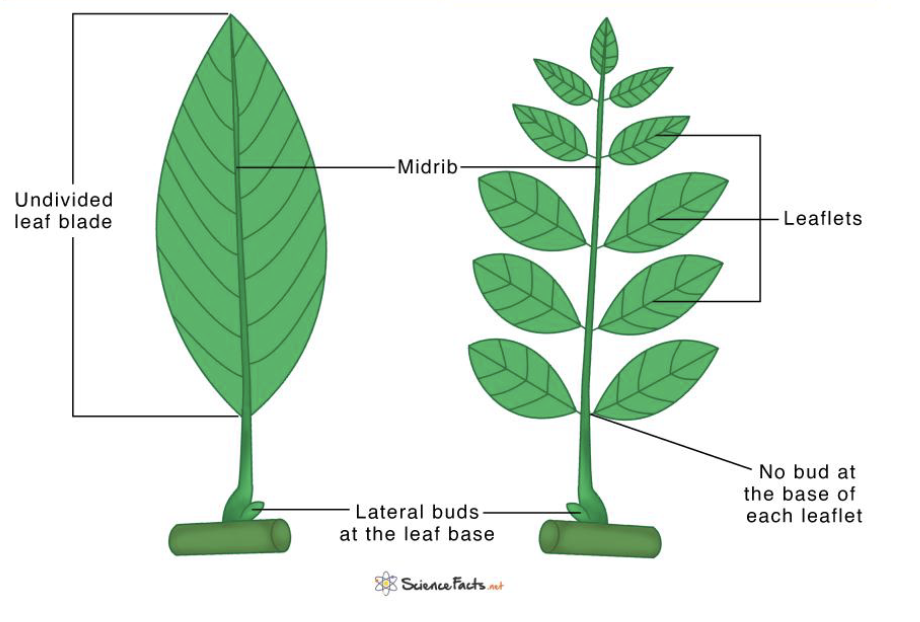
Compound leaf
leaves which are divided into leaflets
Vessel summary
● Shorter cells with large perforations (holes) on their end walls, allowing for direct water flow between stacked cells.
● Connect end-to-end, forming long, continuous tubes for efficient water transport.
● The primary water conducting cells in flowering plants, enabling faster water transport compared to tracheids.