Psych Chap 5 but im speedrunning this so i can finish watching my c-drama
0.0(0)
Studied by 13 people Call Kai
 Learn
Learn Practice Test
 Spaced Repetition
 Match
Match Flashcards
 Knowt Play
Card Sorting
1/39

Earn XP
Description and Tags
Last updated 5:21 PM on 10/18/22
Name | Mastery | Learn | Test | Matching | Spaced | Call with Kai | Chat |
|---|
No analytics yet
Send a link to your students to track their progress
40 Terms
1
New cards
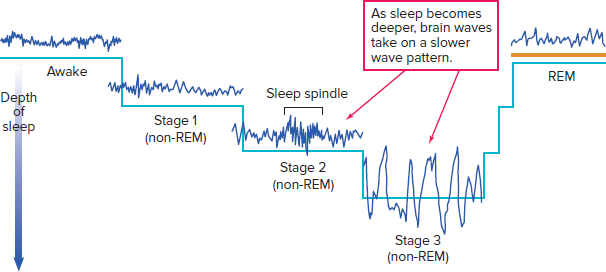
Stages of sleep
2
New cards
REM Sleep (Rapid Eye Movement)
Quick back and forth eye movements wherein the major muscles of the body appear to be paralyzed and it's in this stage in which dreaming occurs. Occupies 20% of adults' total sleeping time.
3
New cards
Unconscious wish fulfillment theory (Freud)
Psychoanalytical explanation where dreams represent unconscious wishes that the dreamer wants to fulfil.
4
New cards
Dreams for survival theory
Evolutionary explanation in which information relevant to daily survival is reconsidered and reprocessed. Dreams provide clues for living.
5
New cards
Activation synthesis theory
Neuroscience explanation in which dreams are the result of random activation of various memories tied together in a logical story line.
6
New cards
Hypnosis
Trancelike states of heightened susceptibility to the suggestions of others.
7
New cards
Meditation
A learned technique for refocusing attention that brings about an altered state of consciousness.
8
New cards
Consciousness
The awareness of the sensations, thoughts, and feelings we are experience at a given moment.
9
New cards
Altered states of consciousness
All other states of consciousness when we're not awake like sleeping.
10
New cards
Depressants
Impedes the nervous system by causing neurons to fire more slowly.
11
New cards
Alcohol
The most frequently used depressant. Both heredity and environmental stressors can lead to alcoholism.
12
New cards
Stage 1 sleep (non-REM)
The transition between wakefulness and sleep. Low-amplitude, rapid brain waves.
13
New cards
Stage 2 sleep (non-REM)
Characterized by a slower, more regular wave pattern. Momentary interruptions of sharply pointed, spiky waves called sleep spindles.
14
New cards
Stage 3 sleep (non-REM)
Deepest stage, brain waves become slower, with higher peaks and lower valleys. Least responsive to outside stimulation.
15
New cards
Rebound effect
If a REM-deprived sleeper are able to rest undisturbed, they will spend more time in REM sleep than usual.
16
New cards
Activation Information Modulation (AIM theory)
dreams are initiated in the brain's pons, which sends random signals to the cortex
17
New cards
Insomnia
Affects 1/3 of all people. Women and older adults, and people who are unusually thin or depressed are more likely to suffer from this.
18
New cards
Sleep Apena
A condition where a person has difficulty breathing while sleeping. Significant loss of REM sleep, they are constantly reawakened when the lack of oxygen is great enough to trigger a waking response.
19
New cards
Night terrors
Sudden awakenings from non-REM sleep accompanied by extreme fear, panic, and strong physiological arousal.
20
New cards
Narcolepsy
Uncontrollable sleeping that occurs for short periods while a person is awake.
21
New cards
Sleepwalking/Sleeptalking
Occur in stage 3 sleep, most common in children. People with this condition have a vague consciousness of the world around them.
22
New cards
Class attendance was lower the day after the test because of
Schedules of reinforcement
23
New cards
Francine Shapiro
Developed a technique where people would experience REM sleep as a form of psychotherapy (EMDR)
24
New cards
If addiction runs in your family, you're only more susceptible if
you engage in the addictive substance
25
New cards
Suprachiasmatic Nucleus (SCN)
Controls our circadian rhythms (bio processes that occur regularly on a 24 hour cycle)
26
New cards
Ernest Hilgard's view on hypnosis
Hypnosis is a state of divided consciousness and dissociation where one stream involves obeying the hypnotist and the other is the hypnotized obeying those commands, whilst aware of what is happening to them.
27
New cards
Addictive drugs
produce a biological or psychological dependence on a drug in the user.
28
New cards
biological drug dependence
the body becomes so accustomed to functioning in the presence of a drug that it cannot function without it.
29
New cards
psychological drug dependence
people believe that they need the drug to respond to the stresses of daily living
30
New cards
Stimulants
drugs whose effect on the central nervous sytem cause a rise in heart rate, blood pressure, and muscular tension
31
New cards
Examples of stimulants
Caffeine, nicotine, cocaine, and amphetamines
32
New cards
Cocaine
Rapidly absorbed, takes effect almost immediately. Produces a high by flooding the brain with dopamine.
33
New cards
Amphetamine
Popularly known as speed, they stimulate the central nervous system. Includes: meth, Adderall, and bath salts.
34
New cards
Barbiturates
A form of central nervous system depressant. Induces sleep or reduces stress. Psychologically and biologically addictive.
35
New cards
Rohypnol
Called the date rape drug because when mixed with alcohol, can prevent victims from resisting sexual assault.
36
New cards
What did researches learn in the Rat Park experiment
The cure to addiction was connection
37
New cards
Narcotics
Drugs that increase relaxation and relieve pain and anxiety. The two most powerful narcotics are morphine and heroin.
38
New cards
Opiates
Includes heroin, they are narcotics that are derived from natural substances.
39
New cards
Hallucinogens
Drugs that alter perceptions, thoughts, and feelings. They can even produce hallucinations.
40
New cards
MDMA (Ectasy/Molly) and LSD
Hallucinogens that affect the operation of serotonin in the brain