Environmental Systems Exam 1
 Call Kai
 Learn
Learn Practice Test
 Spaced Repetition
 Match
Match Flashcards
 Knowt Play
1/53

There's no tags or description
Looks like no tags are added yet.
Name | Mastery | Learn | Test | Matching | Spaced | Call with Kai | Chat |
|---|
No analytics yet
Send a link to your students to track their progress
54 Terms
Biogeochemical Cycles
pathways through which essential elements and nutrients move between living organisms and the nonliving part of the Earth
Gaia Hypothesis
Earth’s living organisms and non-living surroundings interact as a single self-regulating system that maintains the climates and chemical conditions necessary for life
revolutionized the way we think about biotic-abiotic interactions on Earth
presence of life results in a series of balancing feedback loops that maintain conditions on Earth in a state of dynamic equilibrium
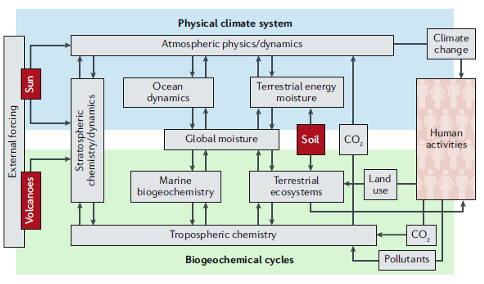
NASA Bretherton Diagram
launched the field of Earth system science
Planetary Boundaries Concept
represent a rapid evolution in scientific understanding of the human impact on the Earth system
Features of a Complex Adaptive System
Feedbacks loops and non-linear behavior
Reinforcing - positive feedback
Balancing - negative feedback
Distributed functionality
Nested system - smaller systems completely contained within larger ones
Scalable structure
Self-organization
Adaptive behavior
Criticality
Thresholds - once passed → changed in state
Emergent properties
unpredictable, emerging properties
International Geosphere Biosphere Programme
important international collaboration that greatly enhanced our understanding of global biogeochemical cycles
Four Central Ingredients of the Gaia Hypothesis
thermodynamic equilibrium - disequilibrium states need to be maintained to sustain the Earth system through time
interactions - effects of life on the Earth’s environment and how that shapes the conditions to make a living
optimality - associated with improving condition to the extent possible
balancing feedback - needed for homeostasis to arise
Daisy World Model
conceptual computer simulation created to demonstrate how living organisms can unconsciously regulate a planet’s climate
daisy population would response to changing solar radiation to maintain constant temperature
Human Domination of Earths Ecosystems
publication that used a systems approach to begin quantifying the human alteration of the Earth system, including the biogeochemical cycles of carbon, nitrogen, and water
Keeling Curve
shows human impact on the climate system by tracking the rising concentration of carbon dioxide in Earth’s atmosphere
longest continuous measurement of atmospheric CO2 in the world
NASA Earth Observing System
NASA operating satellites for ongoing EOS missions
Large Computational Models
General Circulation Models - very large-scale models used to simulate and predict the behavior of Earth’s atmosphere, oceans, and climate system
Integrated Assessment Models - integrates a variety of models that already exist and allows us to play out various scenarios
Global Cascades
occurs when changes in the Earth system triggers a domino effect of connected ecological, climatic, or systemic disruptions across a planet
Tipping Points
critical threshold that cause a typically massive and often irreversible shift in a system’s state outside of Holocene conditions
when crossed = new Earth system state may not be habitable for human society
driven by reinforcing feedback loops that rapidly push the Earth system out of Holocene conditions
Anthropocene
a rupture or a fundamental shift in how the entire Earth system functions
destabilization of the Earth system
began in 1950
post-WW2 expansion and industrial social metabolism based on the combustion of fossil fuels lead to rapid production and consumption
most important markers of the beginning of the Anthropocene - presence of radionuclides produced by thermal weapon testing
Planetary Health
exploring human-driven global environmental changes is reshaping human health
Human health depends on Earth’s life-support systems - disruptions to these systems drive current and future health burdens
Symbiocene
an era of mutualism and “fulfillment of potential” (life in harmony)
Psychological and Social Markers of new era
teaching empathy, cultural competence, emotional intelligence, and commitment to optimism, tolerance, and fulfillment of human potential
Cultural competence - ability to understand and interact with people from diverse backgrounds
Mutualism - bringing out best in one another
Anti-materialism - stuff doesn’t bring happiness
Microbiome Science
a literal and metaphorical model for global cooperation
Five Categories of Health Impacts for each Planetary Boundary
non-communicable disease
food and nutrition
infectious disease
reproductive; maternal and child health
mental health
Upstream Drivers of Anthropocene
root causes and systemic factors that create the problem
Examples
Neoliberalism - market determines everything (concentrated power and wealth)
Socioeconomic equality
Poor nutrition
Downstream Symptoms of Anthropocene
resulting effects and outcomes
Examples
Non-communicable disease - life-style driven diseases
Dysbiosis - stress, mental health decline
Loneliness
Depression
Mars Can Wait Reallocation
argues that the 19.5 billion NASA budget is a form of “intellectual escapism” while Earthly problems like veteran suicide and homelessness goes underfunded
Military Can Wait Reallocation
the military gets a lot more funding than the Mars initiative and global health don’t need the military (brings pain and conflict)
Microbiome Metaphor
we are all parts of a single organism and a healthy microbiome demonstrates mutualism
Control Variable
refers to measurable indicators used to check whether an Earth system process is staying within its safe operating zone (planetary boundary)
ex. CO2 = for climate change
Planetary Boundaries
refers to the thresholds that keep life on Earth within safe operating zone; identify the nine Earth processes essential for maintaining global stability, resilience, and life-supporting function
land system change
freshwater change
biogeochemical flows
ocean acidification
atmospheric aerosol loading
stratospheric ozone depletion
climate change
biosphere integrity
novel entities
Climate Change
earth’s climate is in the danger zone (greenhouse gas concentration has reached record levels, accelerating global warming and conditions continue to worsen)
Key Drivers: fossil fuel burning, processes leading to non-CO2 greenhouse gas emission, land system change, change in biosphere integrity, increase in atmospheric aerosol loading
Biosphere Integrity
nature’s safety net is unraveling (extinctions and loss of natural productivity are far above safe levels, with no sight of improvement)
Key Drivers: biomass harvesting, intro of invasive species, land system change, climate change, freshwater change, biogeochemical flow modification, intro of novel entities, ocean acidification
Land System Change
earth’s forests are shrinking, and most are already below safe levels, with the overall trend still negative - although the pace of forest loss has slowed)
Key Drivers: cropland and livestock grazing expansion, expansion of settlements and infrastructure, climate change, freshwater change, biosphere integrity
Freshwater Change
human impact of rivers and soil moisture is growing, pushing water system further from stability and heightening drought and flood risk
Key Drivers: irrigation and agriculture, industrial water use, household water use, climate change, increase in atmospheric aerosol loading, land system change
Biogeochemical Flow
fertilizer overuse continues to overload land and water with nitrogen and phosphorus, causing pollution and dead zones with no improvement in sight
Key Drivers: application of mined mineral phosphorus to field as fertilizers, application of industrially fixed nitrogen to fields as fertilizers, cultivation of nitrogen-fixing crops
Ocean Acidification
the ocean is turning more acidic, threatening marine life as we cross into unsafe conditions with a worsening trend
Key Drivers: fossil fuel burning
Atmospheric Aerosol Loading
air pollution differences between hemispheres are decreasing (positive sign as air quality slowly improves)
Key Drivers: fossil fuel burning, biomass burning, industrial activities
Stratospheric Ozone Depletion
the ozone layer remains stable and is showing signs of slow recovery maintaining protection against harmful UV radiation
Key Drivers: production/emission of ozone-depleting substances such as synthetic Chloroflurocarbons and Nitrous Oxides
Introduction of Novel Entities
human made chemicals, plastics, and other novel entities continue to increase without sufficient testing or control with environmental risk continuing to grow
Key Drivers: industrial production of artificial chemical compounds for industry agriculture, and consumer goods
Fanning and Raworth
doughnut model linking social and planetary boundaries
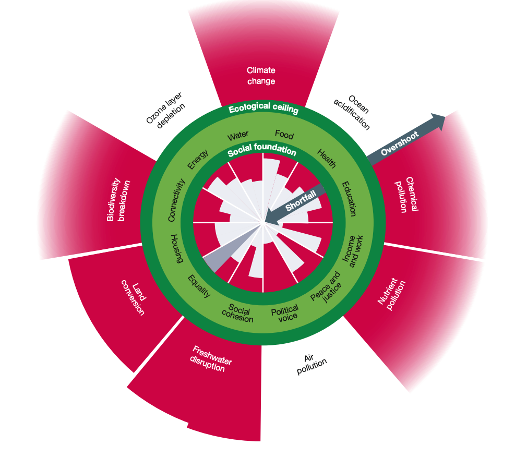
Global Change in Social Shortfall and Ecological Overshoot
Major conclusions: doubling of GDP leads to modest reductions in social shortfalls but serious overshoot of multiple planetary boundaries (overshoot increase significantly faster than reductions in social shortfalls)

Social Shortfall and Ecological Overshoot of Country Cluster by Wealth Status
Poorest vs Richest Countries: richest countries meet the social foundations but are exceeding the planetary boundaries while poorest countries have not met the social foundations and have not exceeded the planetary boundaries

Pleistocene
end of last glacial period; wild swings in climate change over time (glacial and non-glacial periods)
extreme temperature variability
Holocene
very stable climatic period in which it evolved and adapted its technologies and cultures
by transgressing several planetary boundaries → this period has ended and we are entering a new and dangerous terrain in which a still-growing world population must safeguard human wellbeing
Assessing Planetary Boundaries
planetary boundary control variables are measured in complex and multifaceted ways often requiring diverse array of observational methods and technology across various scientific disciplines
satellites orbiting Earth, sensors buried in ground, high performance computer simulation models
methods depend on various factors
each assessment method faces challenges, such as technological limitations, environmental conditions, and data interpretation complexities
The Great Acceleration
the rapid post-1950 rise in human pressures and Earth system changes
generally exponentially growth
some grew exponentially and then flatten out at high levels
Why? can’t grow any higher
human activities are causing the earth system response trends
Resilence
the capacity of the biogeochemical Earth system to absorb human pressures such that the system remains in or returns to a Holocene-like state
only this state can provide the essential structures and functions that are the foundation for sustainable development of human societies
Balancing Feedback Loops
maintain steady state (equilibrium) by preventing change
Reinforcing Feedback Loops
amplify change causing expansional increases and acceleration
Precautionary Principle
used to set planetary boundaries in very conservative positions
important because the location of tipping points for planetary boundaries in uncertain
Feedback Loop Examples
sea ice - arctic warming leads to melting sea ice, which leads to further warming because water has lower albedo (reflectance) than ice
wildfire - rising temperatures leads to increasing fire frequency or severity causing increasing CO2 emissions, loss of sequestration, and changes in albedo which causes more warming
permafrost - increasing temperature leads to more permafrost thawing, which produces CO2 and methane emissions, which in turn leads to further increasing temperatures
Plate Boundaries
represent processes of integrated Earth system functioning
processes are not separate, but connected to each other
planetary boundaries are therefore connected to one another via feedback loops
The Ocean
Largest mass of water'
Largest stock of carbon
Largest stock of heat
Very important
Absorbs roughly 89-93% of Earth’s energy imbalance
Stores and redistributes heat
Plays a major role in carbon uptake
Supports about half of global primary production through marine phytoplankton
Contributes to Earth systems resilience, habitability, and climate regulation

Extreme Events
extreme events are not isolated “climate disasters,” but outcomes of interacting planetary boundary transgressions
Hazard
inherent potential to cause harm
Exposure
actual contract or proximity between the hazard and a person or environment (ex. being in flood line)
Vulnerability
the conditions and characteristics that make people or assets susceptible to harm or weaken their ability to cope with or recover form a hazard
Extreme Event as Planetary Boundary Interactions
